Explore jobs
Find specific jobs
Explore careers
Explore professions
Best companies
Explore companies
Job outlook for reimbursement analysts in the United States
Reimbursement analyst job growth summary. After extensive research, interviews, and analysis, Zippia's data science team found that:
The projected reimbursement analyst job growth rate is 11% from 2018-2028.
About 23,100 new jobs for reimbursement analysts are projected over the next decade.
Reimbursement analyst salaries have increased 8% for reimbursement analysts in the last 5 years.
There are over 8,061 reimbursement analysts currently employed in the United States.
There are 10,216 active reimbursement analyst job openings in the US.
The average reimbursement analyst salary is $65,489.
Are reimbursement analyst jobs in demand?
Reimbursement analyst job and salary trends over time
Reimbursement analyst jobs over time
Reimbursement analyst job growth rate over time
| Year | # of jobs | % of population |
|---|---|---|
| 2021 | 8,061 | 0.00% |
| 2020 | 21,502 | 0.01% |
| 2019 | 14,620 | 0.00% |
| 2018 | 9,314 | 0.00% |
| 2017 | 9,116 | 0.00% |
Average reimbursement analyst salary over time
Reimbursement analyst salary by year
| Year | Avg. salary | Hourly rate | % Change |
|---|---|---|---|
| 2026 | $65,489 | $31.48 | +2.8% |
| 2025 | $63,709 | $30.63 | --0.7% |
| 2024 | $64,168 | $30.85 | +3.0% |
| 2023 | $62,307 | $29.96 | +3.0% |
| 2022 | $60,494 | $29.08 | +2.5% |
Reimbursement analyst jobs by state
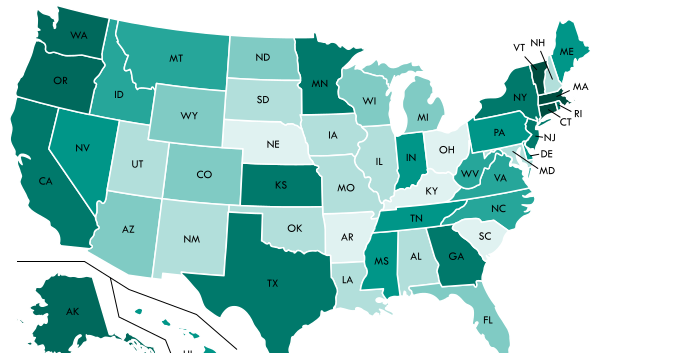
Most common states for reimbursement analysts
| Rank | State | Population | # of jobs | Employment/ 1000ppl |
|---|---|---|---|---|
| 1 | District of Columbia | 693,972 | 93 | 13% |
| 2 | Virginia | 8,470,020 | 352 | 4% |
| 3 | Maryland | 6,052,177 | 233 | 4% |
| 4 | Massachusetts | 6,859,819 | 200 | 3% |
| 5 | Colorado | 5,607,154 | 166 | 3% |
| 6 | Delaware | 961,939 | 27 | 3% |
| 7 | North Dakota | 755,393 | 26 | 3% |
| 8 | Alaska | 739,795 | 23 | 3% |
| 9 | New York | 19,849,399 | 345 | 2% |
| 10 | Georgia | 10,429,379 | 188 | 2% |
| 11 | New Jersey | 9,005,644 | 143 | 2% |
| 12 | Indiana | 6,666,818 | 113 | 2% |
| 13 | Minnesota | 5,576,606 | 99 | 2% |
| 14 | Connecticut | 3,588,184 | 68 | 2% |
| 15 | Oregon | 4,142,776 | 66 | 2% |
| 16 | Kansas | 2,913,123 | 54 | 2% |
| 17 | Nevada | 2,998,039 | 53 | 2% |
| 18 | Montana | 1,050,493 | 23 | 2% |
| 19 | Rhode Island | 1,059,639 | 20 | 2% |
| 20 | Vermont | 623,657 | 11 | 2% |
Most common cities for reimbursement analysts
| Rank | City | # of jobs | Employment/ 1000ppl | Avg. salary |
|---|---|---|---|---|
| 1 | Woburn | 2 | 5% | $86,834 |
| 2 | Englewood | 1 | 3% | $68,284 |
| 3 | Council Bluffs | 1 | 2% | $65,071 |
| 4 | Gardena | 1 | 2% | $74,475 |
| 5 | Boston | 4 | 1% | $86,984 |
| 6 | Clearwater | 1 | 1% | $67,896 |
| 7 | Lynwood | 1 | 1% | $74,439 |
| 8 | Indianapolis | 3 | 0% | $72,873 |
| 9 | Oakland | 2 | 0% | $81,720 |
| 10 | Baltimore | 1 | 0% | $65,678 |
| 11 | Detroit | 1 | 0% | $67,625 |
| 12 | Houston | 1 | 0% | $77,829 |
| 13 | Los Angeles | 1 | 0% | $74,572 |
| 14 | New Orleans | 1 | 0% | $62,367 |
Reimbursement Analyst job outlook: Expert opinions
Our panel of reimbursement analyst experts

UMass Lowell
University of Washington
University of Southern Maine
Western Kentucky University
John Jay College of Criminal Justice of the City University of New York
University of California, Santa Cruz
Ottawa University at Overland Park
University of Minnesota - Twin Cities
Drexel University
New Jersey Institute of Technology
Wake Forest University
Christopher Newport University
Michael Ciuchta Ph.D.
Associate Professor, Program Coordinator, Masters of Science in EntrepreneurshipUMass Lowell
Department of Marketing, Entrepreneurship & Innovation
What Reimbursement Analyst skills would you recommend for someone trying to advance their career?
Michael Ciuchta Ph.D.: Obviously we are seeing a tremendous increase in AI and other digital technologies. These will become a more crucial skill set for many careers going forward. But I wouldn't downplay the role of what are traditionally seen as soft skills like empathy, communications, and judgment. Not only can these distinguish you from robots but from your human competitors as well.
What will help Reimbursement Analysts increase their earning potential?
Michael Ciuchta Ph.D.: If all you want is the highest potential starting salary, then you should aim for careers that offer them. But that is a shortsighted way to view things. For example, many careers that have tournament-like pay structures (think entertainment) often have very low starting salaries but the so-called winners enjoy outsized financial gains. If you are thinking about a more traditional career, I think it's important to make sure you are more valuable to your employer than they are to you. This means you have to market yourself, both to your current employer as well as to potential ones. Of course, this approach may not be for everyone and maximizing your salary potential is only one thing you should be considering when assessing job and career opportunities.
What will help Reimbursement Analysts increase their earning potential?
Victor Menaldo: Develop oral communication skills that allow you to speak in an articulate manner and organize your thoughts to signal your competence, knowledge, work ethic, and willingness to keep learning and improving.
Tove Rasmussen
LecturerUniversity of Southern Maine
Specialized Sales, Merchandising And Marketing Operations
What general advice would you give to a Reimbursement Analyst?
Tove Rasmussen: Tove Rasmussen advises graduates beginning their career in the field to...
What Reimbursement Analyst skills would you recommend for someone trying to advance their career?
Tove Rasmussen: Tove Rasmussen believes that the skills that will become more important and prevalent in the field in the next 3-5 years are...
What Reimbursement Analyst skills would you recommend for someone trying to advance their career?
Timothy Rich PhD: Think about the types of jobs that interest you and the skills necessary for those jobs early. So many students start thinking about post-graduation life spring their senior year, when it should be an incremental process much earlier. Another pieces of advice would be to talk to faculty and alum about your interests, find internship or research opportunities when possible, and try to figure out early your strengths and weaknesses. It's easy for students, especially high performing ones, to not fully consider what their weaknesses are. I encourage students to jot down what they see as their skills too and to share them with others. It helps them to identify what's a common skill versus something that might make them stick out.
Professor Shonna Trinch Ph.D.
ProfessorJohn Jay College of Criminal Justice of the City University of New York
Ethnic, Cultural Minority, Gender, And Group Studies
What general advice would you give to a Reimbursement Analyst?
Professor Shonna Trinch Ph.D.: Being able to negotiate a salary is also a skill that students need to learn and one that is rarely taught in college. Students need to be able to ask for more than they are offered, but also take jobs at entry levels, prove themselves and then ask for an increase in pay six months into the job after they have shown that they are doing the work and achieving their goals.
What Reimbursement Analyst skills would you recommend for someone trying to advance their career?
Professor Shonna Trinch Ph.D.: Analysis and critical thinking, writing and making strong arguments are indispensable job market skills. Concepts such as 'ethnicity,' 'gender' and 'minority' are constructed in social and historical spaces and times, and students with college degrees can help de-naturalize these categories to make others understand how policy, programming and marketing might not be achieving their stated goals.
What Reimbursement Analyst skills would you recommend for someone trying to advance their career?
Stephanie Lain Ph.D.: I would advise graduates to be open to considering jobs in lots of different fields. The skills acquired through their major- such as problem-solving, critical thinking, and writing- are ones that transfer well to a variety of situations.
What general advice would you give to a Reimbursement Analyst?
Russ McCullough PhD: Business Economics is a degree that can open many doors for careers. You can feel confident applying to positions that are open to many business degrees because economics gives you a quantitative edge over many other degrees. Therefore, I recommend that you create a vision of the type of job you see yourself at in 10 years and apply to positions now that help you build the skill set to get there. For example, if you are a good communicator, look for some more sales oriented positions. If you are more of a number cruncher, then look for more analyst oriented positions. Smaller companies will likely have more cross-training experiences available while large corporations will likely focus your skills in on a particular area.
What general advice would you give to a Reimbursement Analyst?
Dr. Paige Novak P.E. (Minnesota), BCEE: Ask questions, stay curious and open minded, take opportunities to learn and develop new skills.
What Reimbursement Analyst skills would you recommend for someone trying to advance their career?
Mark Stehr PhD: At the start of your career, it's very important to land a role where you learn a lot and find good mentors. The additional skills will pay dividends as your career progresses.
What Reimbursement Analyst skills would you recommend for someone trying to advance their career?
Michael Smullen: Putting this in context, higher education is about to experience a massive change called the 'enrollment cliff' during which we anticipate a significant drop off in new student enrollment. Within the next five years, it's likely that the employment marketplace will look quite different: - Greater focus on certifications and 'mini-degree' programs to obtain new positions or to advance; - Dramatic increase in the use of artificial intelligence, similar to how email, web, Slack, and most recently Zoom/Teams supplanted former methods of communication; - Increased awareness of prioritizing mental and physical health in the workplace; - Continuous skill improvement: Certifications and 'mini-degree' will be supported by a constant flow of information updates; - Greater need for professional independence: New graduates would be wise to consider how they maintain and own their personal intellectual property to carry it through multiple employers.
What general advice would you give to a Reimbursement Analyst?
Dr. Mark Evans: Add value beyond what you are asked to do. Take ownership of your work. Volunteer for the most difficult jobs and clients.
What Reimbursement Analyst skills would you recommend for someone trying to advance their career?
Dr. Mark Evans: Don't stop learning. Treat your first job like more graduate school. Learn everything you can.
What general advice would you give to a Reimbursement Analyst?
William Donaldson Ph.D.: First, attend to the basics - show up on time, be respectful, responsible, reliable, and resourceful. Learn and respect the culture and norms of the company. Next learn your job, the expectations, deliverables, and traditions. Next excel at those and start looking for other opportunities and responsibilities. Finally, use your young eyes and familiarity with generational changes to add value. If you have a particular skill-set or affinity that is needed, step up and provide it and mentor others. In short, first be a great follower and look to grow into a leader.
What will help Reimbursement Analysts increase their earning potential?
William Donaldson Ph.D.: It depends on the field, but certainly artificial intelligence, machine learning and data analysis are emerging trends. Additionally, there are some very important emerging trends - synthetic biology, the circular economy, waste remediation, recovery and reuse, etc. that new employees should look to be in the lead on