Explore jobs
Find specific jobs
Explore careers
Explore professions
Best companies
Explore companies
Job outlook for research technician leads in the United States
Are research technician lead jobs in demand?
Research technician lead job and salary trends over time
Research technician lead jobs over time
Research technician lead job growth rate over time
| Year | # of jobs | % of population |
|---|---|---|
| 2021 | 364 | 0.00% |
| 2020 | 385 | 0.00% |
| 2019 | 380 | 0.00% |
| 2018 | 370 | 0.00% |
| 2017 | 358 | 0.00% |
Average research technician lead salary over time
Research technician lead salary by year
| Year | Avg. salary | Hourly rate | % Change |
|---|---|---|---|
| 2026 | $63,864 | $30.70 | +1.0% |
| 2025 | $63,203 | $30.39 | +3.1% |
| 2024 | $61,329 | $29.48 | +1.6% |
| 2023 | $60,364 | $29.02 | +3.0% |
| 2022 | $58,600 | $28.17 | +2.1% |
Research technician lead jobs by state
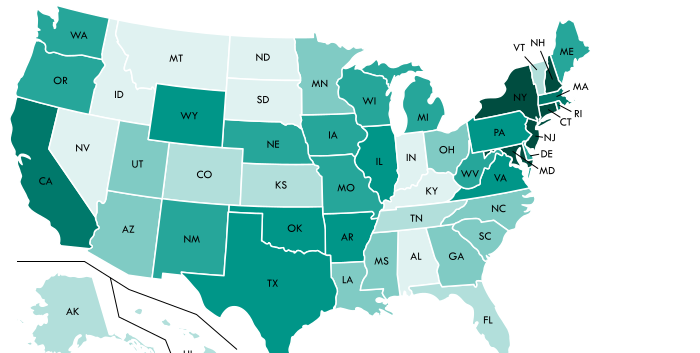
Most common states for research technician leads
| Rank | State | Population | # of jobs | Employment/ 1000ppl |
|---|---|---|---|---|
| 1 | Montana | 1,050,493 | 248 | 24% |
| 2 | Nebraska | 1,920,076 | 445 | 23% |
| 3 | South Dakota | 869,666 | 197 | 23% |
| 4 | Idaho | 1,716,943 | 357 | 21% |
| 5 | Alaska | 739,795 | 155 | 21% |
| 6 | Massachusetts | 6,859,819 | 1,347 | 20% |
| 7 | New Mexico | 2,088,070 | 412 | 20% |
| 8 | Vermont | 623,657 | 126 | 20% |
| 9 | Kansas | 2,913,123 | 556 | 19% |
| 10 | Delaware | 961,939 | 160 | 17% |
| 11 | Rhode Island | 1,059,639 | 166 | 16% |
| 12 | District of Columbia | 693,972 | 112 | 16% |
| 13 | Minnesota | 5,576,606 | 850 | 15% |
| 14 | Oklahoma | 3,930,864 | 588 | 15% |
| 15 | Arkansas | 3,004,279 | 446 | 15% |
| 16 | Nevada | 2,998,039 | 439 | 15% |
| 17 | New Hampshire | 1,342,795 | 207 | 15% |
| 18 | Maine | 1,335,907 | 206 | 15% |
| 19 | Oregon | 4,142,776 | 584 | 14% |
| 20 | Colorado | 5,607,154 | 721 | 13% |
Most common cities for research technician leads
| Rank | City | # of jobs | Employment/ 1000ppl | Avg. salary |
|---|---|---|---|---|
| 1 | Danvers | 1 | 4% | $70,832 |
| 2 | Frankfort | 1 | 4% | $46,929 |
| 3 | Annapolis | 1 | 3% | $77,703 |
| 4 | Dover | 1 | 3% | $62,828 |
| 5 | Juneau | 1 | 3% | $54,652 |
| 6 | Boston | 5 | 1% | $71,163 |
| 7 | Cambridge | 1 | 1% | $71,119 |
| 8 | Fort Lauderdale | 1 | 1% | $53,166 |
| 9 | Framingham | 1 | 1% | $71,212 |
| 10 | Hartford | 1 | 1% | $81,599 |
| 11 | Lansing | 1 | 1% | $58,735 |
| 12 | Little Rock | 1 | 1% | $65,059 |
| 13 | Atlanta | 1 | 0% | $55,264 |
| 14 | Baton Rouge | 1 | 0% | $56,547 |
| 15 | Denver | 1 | 0% | $52,403 |
| 16 | Des Moines | 1 | 0% | $61,317 |
| 17 | Indianapolis | 1 | 0% | $48,821 |
Research Technician Lead job outlook: Expert opinions
Our panel of research technician lead experts
Earlham College
SUNY Stony Brook
Pepperdine University
University of Hawaii at Manoa
University of San Diego
Northwestern University
New Mexico State University
Georgetown University
Southern Illinois University Carbondale
Jackson State University
San Jose State University
Washington State University
Purdue University
What general advice would you give to a Research Technician Lead?
Christopher Vitek Ph.D.: My research focuses on disease vectors, mostly mosquitoes, so I explore factors that influence how quickly they develop, where they spread, what time of year they are found, etc. I also do research in effective control methods, and even a little bit in disease transmission. Depending on your research area, you may be involved in looking at mathematical models, life history tables, species interactions, and more.
What Research Technician Lead skills would you recommend for someone trying to advance their career?
Christopher Vitek Ph.D.: Population biology, especially biology that focuses on disease vectors, is a great field to pursue. People will always want to get rid of mosquitoes, so there is always a demand for learning when, where, and how to control them, as well as helping to identify risks for disease transmission. Newly available molecular tools help us understand more about the biological underpinnings that control characteristics like population growth and distribution.
What general advice would you give to a Research Technician Lead?
Dr. Taufika Williams PhD: Finding a job at with an undergraduate degree may be quite doable but upward mobility in your career often requires a terminal degree (i.e. PhD). Stay in school for as long as you can! Some students will work in biotechnology for a few years after their undergraduate studies are over and then return to school for graduate education. The work experience can tremendously benefit graduate research.
What Research Technician Lead skills would you recommend for someone trying to advance their career?
Dr. Taufika Williams PhD: Wet-laboratory skills will always be important, however, data interrogation is a key space of growth, as biotechnology research is being driven by big data. Seek education in scientific writing, computer programming, delivering scientific presentations, statistics and the analysis of large datasets.
Camellia Okpodu
What will help Research Technician Leads increase their earning potential?
Camellia Okpodu: When starting your career, maximizing your salary potential involves strategic planning and effective negotiation. Here are some of the best practices I have learned through mg own experience. I often tell graduates I didn’t know these things when I graduated. Here are tips to consider: 1. Research Industry Standards: Understand the average salary range for the position you’re pursuing. Use the La or statistics to look at national data for the position you are applying for. 2. Know Your Value: Highlight your unique skills, experience, and qualifications. Present a well-articulated case during negotiations. Make sure you include an opportunity to grow. Ask about professional organization and fees. See if that can’t be included in your salary or compensation 3. Ask About Salary Range: If asked about your salary expectations, inquire about the employer’s range first. 4. Consider Total Rewards: Look beyond the base salary. Make an evaluation about other benefits - work flexibly, professional development and employee benefits. Negotiations sets the stage for your financial well-being and long-term career progression. These are the recommendations and best practices I used when I was the director of a Center of Academic Excellence for the Intelligence Community. I received two accommodations from the Obama administration’s ODNI for putting students in jobs in the Intelligence community.
Mr. Brian Zimmerman III
Assistant Vice President of Strategic CommunicationsEarlham College
Drama/Theatre Arts And Stagecraft
What general advice would you give to a Research Technician Lead?
Mr. Brian Zimmerman III: Apply, interview, and negotiate! The landscape of science is a competitive one - both for biologists and their employers. Many graduates, particularly ones who hold identities that have been historically excluded from science, tend to apply for job opportunities only if they perfectly fit the advert description. This is actually not a great strategy! Having been on the academic job market recently, I learned that job adverts tend to describe the absolute perfect candidate; employers know that person does not exist and are shooting for the moon with their adverts. If you have any of the skills, qualifications, or experiences that are mentioned or are related to a particular job advert, then apply for it! When interviewing, it's also important to take ownership of the identity you want to have; visualize yourself as, for example, a lab manager looking for their institution rather than a recent undergraduate looking for their first job. The transformation into a professional scientist begins with your mindset, as this will influence your behavior. Plus, it's easier to advocate and negotiate for yourself if you view your interviews and application through the lens of discerning if this employer has what you need to be successful, rather than the framing of hoping you're "good enough" to work there. This is all to say that once you land the interview and you've decided the employer has what you need to be successful, do not be afraid to negotiate creatively! Do some research on the cost of living of the town and the average wages for the position in that area or in an area where the cost of living is similar. When you negotiate, you can ask for more than salary - inquire about benefits, childcare, immigration/visa support, retirement contributions and matching, career development opportunities or stipends, remote work, etc. Even if you're unable to negotiate a higher salary, there are other benefits that you can leverage to make that money go farther or prepare you for a promotion earlier in your career. Additionally, if you are able, do not be afraid to apply for other jobs and share your better offers with your current employer to see if they can match or beat the competing offer. As you grow in your career, you may outgrow your current employer - and that's okay; it's an opportunity to find a new place that recognizes your increased value! At the end of the day, chances are that you are worth more than what you're currently being paid, so do not be afraid to ask questions to position yourself for success!
What will help Research Technician Leads increase their earning potential?
Mr. Brian Zimmerman III: In my specific subdiscipline of molecular biology and biochemistry, new graduates tend to pursue jobs in the "wet" or "bench" laboratory. Every lab, whether in a government setting, industry setting, or academic setting, will be outfitted with its own equipment, protocols, and standard operating procedures. Typically, new members of the lab are trained in these lab-specific procedures by a more experienced member. It can be strange to have someone explain concepts to you that you may already know, or demo equipment that you've already used; it can feel like the lab doesn't trust you or believe you're capable. In reality, this is not the case at all! Usually, this training is an intentional opportunity for you to get to know the workflow in the lab and the specific logistics of the space. However, new lab members often will be shy and not ask questions out of fear of seeming insufficiently knowledgeable. New lab members may even experience a phenomenon called "imposter syndrome," which is the feeling that one does not belong in the space but rather is an "imposter" who obtained their role not by their own merit. Imposter syndrome is particularly likely when an individual begins working in a new space where there is a substantial amount of training and on-boarding that needs to occur, which reinforces that false sense that the lab doesn't trust you. I'll be the first, but not the last, to tell a new lab member that they deserve to be there! Undergraduate programs in Biology are designed to prepare graduates to be successful in their careers and to equip them with the skills to apply what they know to novel situations and to be self-sufficient in learning new things. Don't let being in a new space shake your confidence and let self-doubt take hold!! One way to combat the "shyness" or imposter syndrome of being in a new lab is to ask questions and to build a community of support. So, my advice to a graduate beginning their laboratory career is to (1) ask questions - you will only become a better biologist by seeking the knowledge of your peers and colleagues, and you will grow by learning new techniques and protocols, and (2) to lean on your friends and colleagues to remind you of your own excellence and ability to grow. You are so not alone - we've all had to start somewhere, so seek the advice of your community!
What will help Research Technician Leads increase their earning potential?
Ross Weatherman Ph.D.: The jobs that our graduates in biochemistry and molecular biology are taking are really diverse in terms of the types of companies and in the types of job requirements. They are not all big jobs in pharmaceutical and biotech companies. Many start working for smaller diagnostic labs or support labs for manufacturing or food processing. Also, I tell our students to expect to change jobs or employers in a few years. For our students, the job market seems to be pretty dynamic for them in the first 5-10 years either because they choose to change jobs or their companies go through some sort of change.
What Research Technician Lead skills would you recommend for someone trying to advance their career?
Dr. Vitaly Citovsky: Advanced degrees, bioinformatics, hi-tech research (synthetic biology), but classical molecular biology and genetics and biochemistry skills will remain critical
What Research Technician Lead skills would you recommend for someone trying to advance their career?
Rachel Tan Ph.D.: The scientific method: to be able to find, read, interpret, understand, and implement research. Not only would this enhance personal skills and critical thinking, it could contribute to techniques and methods that could be performed; it could foster questions that would be important in advancing the field; and could set apart an individual.
What general advice would you give to a Research Technician Lead?
Qing Li: Develop your specialty and be good at one thing; jobs will be after you rather than you after jobs.
What Research Technician Lead skills would you recommend for someone trying to advance their career?
Nicole Danos PhD: In the next 3-5 years techniques in Biotech will constantly improve. Which will mean three things:
a) there will be much more data to sort through! It will be important to let the questions being asked direct data analyses.
b) workers will need to be nimble to improve their lab skills. The same principles of good practices will apply!
c) AI tools will be in the workplace. Workers will need to understand these tools and know whether or not they are appropriate for what they are trying to use, and not trust them blindly.
What general advice would you give to a Research Technician Lead?
Nathaniel Stern: To answer this question we need to be clear what field the graduate intends to continue in. If they want to continue in Physics as a “field”, then they will most likely need to go to graduate school in Physics, Astronomy, or a related field. There are many opportunities for graduates with majors in Physics, but many of these are in different fields. Physics majors excel in these other opportunities, but in order to do “physics”, meaning studying the science of matter and energy, one generally goes to graduate school. If this is the graduate’s plan, then the advice is to be passionate about the research topic that you choose. One does not need to know ahead of time that a particular direction of research is the best possible direction for them, but they should have interest in it. Research often involves small academic questions, and if one doesn’t find these interesting then it can be a bit of a slog. More generally, advice matches other career paths, however: do something that you love, and also choose impactful problems. Even if your own work is a small part of the whole, if you can see the impact of the field it can be exciting all the time. If the graduate is not going to graduate school in Physics or a related subject, then they are likely entering a technical career such as engineering, finance, education, data science, or consulting. Physics is a great basic training for whatever direction someone takes since it trains you to think and problem solve, especially in reducing a problem to its core questions (as opposed to building encyclopedic knowledge of relevant facts). But, whatever specific career path a graduate takes will likely bring more specialized methods, knowledge, and applications. Physics is a great starting point, but future endeavors will broaden thinking to new challenges outside of the rigid rules of physical laws. So, graduates should be willing to, and excited to, adapt to new cultures.
What Research Technician Lead skills would you recommend for someone trying to advance their career?
Michael Marks: This will largely depend on where you work, but if your work is fundable, landing grants and bringing in money will make you more valuable, for one. So tout your potential for securing funding. Apply for early career awards as well. If you have unused startup funds, you can also ask to use it for summer funding in some institutions. With startup funds, use it or lose it; don't let that money go to waste.
Luz Garcini PhD, MPH
Assistant ProfessorWhat general advice would you give to a Research Technician Lead?
Luz Garcini PhD, MPH: Find a purpose and a meaning in their work and be open to learning from interdisciplinary fields.
What will help Research Technician Leads increase their earning potential?
Luz Garcini PhD, MPH: Build a unique niche and new skills (another language), disseminate your work via high impact networks/avenues, get mentoring in negotiation.
What Research Technician Lead skills would you recommend for someone trying to advance their career?
Ivica Labuda PhD: Certainly everyone in the biotech field would benefit from having knowledge of biotechnology techniques and skills in concert with understanding the regulatory framework. That provides a good foundation so that one can interact confidently in every aspect of the biotech world. With AI progress, the next step is to add the basic understanding of the speed at which we can evolve new techniques and materials. Not everybody needs to code, but everyone needs to think about how to maximize its benefits for biotechnology.
What Research Technician Lead skills would you recommend for someone trying to advance their career?
Kristopher Koudelka Ph.D.: I could not in good faith give an answer to question 3, as I am not in a major hiring position. But hopefully the first two answers may be useful.
What general advice would you give to a Research Technician Lead?
Jason Ferrell: By showing up, working hard, and being helpful. Companies invest in people, more than skills, and if you demonstrate your value to an organization, the financial rewards will follow.
What Research Technician Lead skills would you recommend for someone trying to advance their career?
Jason Ferrell: College has given you the tools to be a life-long learner. Very rarely will you enter a career and have all the skills necessary to succeed. You will need to use the critical thinking, networking, and scientific background you have been taught to grow yourself into this new role. I can be intimidating, but trust me, you have all the skills and now you just need to put them into motion.
What general advice would you give to a Research Technician Lead?
Jacob Nordman: Salary potential in my field of neuroscience almost always involves publications, awards, and technical acumen. Therefore, as I mentioned, it is important to start early looking for opportunities that can strengthen these areas. Another important aspect of getting high-profile, and thus high-paying, positions, is being able to tell a story with your research and career. Employers want to see that you have thought deeply and strategically about your career and where it’s going. This will allow them to believe you are a safe bet and worthy of their investment.
What Research Technician Lead skills would you recommend for someone trying to advance their career?
Jacob Nordman: The very first thing to do, probably before you even apply for a PhD program, is ask yourself, “What do I want to do with my PhD?” In my field of neuroscience, that usually means one of 3 things: academia, industry, or policy. All three have different requirements and so involve different priorities. If the answer is academia, the most important requirement is publications, awards, and grants. These are what will make you appealing to labs and departments. If the answer is industry, having hands on experience with state-of-the-art techniques relevant to your field, along with the requisite high-profile papers, will make you appealing to employers. Either way, knowing what you will want to do will help you craft a graduate school experience that best equips you to compete in an extraordinarily competitive job marker.
What will help Research Technician Leads increase their earning potential?
Jacob Nordman: In the field of neuroscience, the field is increasingly concerned with cellular and pathway specificity – what are the cell types and pathway that control ever-specific physiological functions. Some tools necessary to probe these questions include the powerful single-cell RNA sequencing method, genetic tools like optogenetics and chemogenetics that allow for neural pathway-specific manipulations, and increasingly sophisticated computer models that incorporate machine learning and artificial intelligence. These techniques will only become more precise and integral, so familiarity with them now will set you up to learn the newer versions later.
What Research Technician Lead skills would you recommend for someone trying to advance their career?
Hung-Chung Huang: Cloud computing, AI (e.g., ChatGPT) computing, machine learning, HMM, neural network, and natural language processing.
Dr. Harit Agroia
Adjunct Professor of Public HealthSan Jose State University
Health Services/Allied Health/Health Sciences
What Research Technician Lead skills would you recommend for someone trying to advance their career?
Dr. Harit Agroia: The Health Science Researcher provides an exciting opportunity for individuals to explore areas of health that they are curious about; this role will be very well-enjoyed by someone who is curious, analytical and detail-oriented. One challenge about the role is that there may be times when research data may have to be re-collected or analyzed with evolving changes to research design and methodologies; being able to manage this effectively requires flexibility and adaptation in order to be thorough and successful in achieving set research goals.
What Research Technician Lead skills would you recommend for someone trying to advance their career?
Lindsey du Toit: Enquire about salary ranges for the types of position for which you’re applying, and opportunities for promotions/salary ranges. Pay attention to the value of the benefits package associated with positions you are seeking. These benefits may not translate to direct salary payments, but can be worth a very significant amount over the duration of your career.
What will help Research Technician Leads increase their earning potential?
Lindsey du Toit: Take every opportunity you can to learn, network, and build an effective team of people that bring a greater breadth and depth of skills and expertise to the work on which you will be focusing. Cultivate a life-long sense of intellectual curiosity and learning. Don’t be afraid to ask questions. Treat ignorance as an opportunity to learn. Questions demonstrate you want to understand the situation/problem effectively and that you are paying attention. Always demonstrate integrity in your work. It is one of the most valuable traits you can bring to your career. Be kind and supportive of your colleagues.
Yan Cong
Purdue University
Romance Languages, Literatures, And Linguistics
What Research Technician Lead skills would you recommend for someone trying to advance their career?
Yan Cong: AI singularity, Artificial General Intelligence (AGI), et cetera are topics that trigger a lot of debate nowadays and they will be prevalent in the near future. Perspectives from humanities and linguistics would contribute to the ongoing debate and provide new opportunities for future innovative technologies that are linked to languages, linguistics and humanities.