Explore jobs
Find specific jobs
Explore careers
Explore professions
Best companies
Explore companies
Job outlook for resource specialist teachers in the United States
Resource specialist teacher job growth summary. After extensive research, interviews, and analysis, Zippia's data science team found that:
The projected resource specialist teacher job growth rate is 4% from 2018-2028.
About 55,400 new jobs for resource specialist teachers are projected over the next decade.
Resource specialist teacher salaries have increased 14% for resource specialist teachers in the last 5 years.
There are over 7,294 resource specialist teachers currently employed in the United States.
There are 76,368 active resource specialist teacher job openings in the US.
The average resource specialist teacher salary is $52,552.
Are resource specialist teacher jobs in demand?
Resource specialist teacher job and salary trends over time
Resource specialist teacher jobs over time
Resource specialist teacher job growth rate over time
| Year | # of jobs | % of population |
|---|---|---|
| 2021 | 7,294 | 0.00% |
| 2020 | 7,535 | 0.00% |
| 2019 | 7,900 | 0.00% |
| 2018 | 7,704 | 0.00% |
| 2017 | 7,673 | 0.00% |
Average resource specialist teacher salary over time
Resource specialist teacher salary by year
| Year | Avg. salary | Hourly rate | % Change |
|---|---|---|---|
| 2026 | $52,552 | $25.27 | +3.5% |
| 2025 | $50,753 | $24.40 | +3.4% |
| 2024 | $49,074 | $23.59 | +2.7% |
| 2023 | $47,782 | $22.97 | +3.3% |
| 2022 | $46,235 | $22.23 | +2.0% |
Resource specialist teacher jobs by state
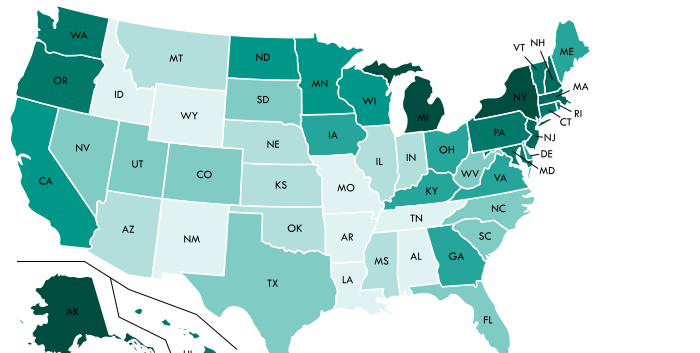
Most common states for resource specialist teachers
| Rank | State | Population | # of jobs | Employment/ 1000ppl |
|---|---|---|---|---|
| 1 | District of Columbia | 693,972 | 282 | 41% |
| 2 | New Hampshire | 1,342,795 | 264 | 20% |
| 3 | Montana | 1,050,493 | 198 | 19% |
| 4 | Maryland | 6,052,177 | 1,076 | 18% |
| 5 | Nebraska | 1,920,076 | 337 | 18% |
| 6 | Delaware | 961,939 | 173 | 18% |
| 7 | Massachusetts | 6,859,819 | 1,134 | 17% |
| 8 | Colorado | 5,607,154 | 938 | 17% |
| 9 | New Mexico | 2,088,070 | 349 | 17% |
| 10 | Minnesota | 5,576,606 | 897 | 16% |
| 11 | Iowa | 3,145,711 | 488 | 16% |
| 12 | Vermont | 623,657 | 100 | 16% |
| 13 | Illinois | 12,802,023 | 1,907 | 15% |
| 14 | New Jersey | 9,005,644 | 1,361 | 15% |
| 15 | Nevada | 2,998,039 | 438 | 15% |
| 16 | Wyoming | 579,315 | 88 | 15% |
| 17 | Virginia | 8,470,020 | 1,149 | 14% |
| 18 | Kansas | 2,913,123 | 414 | 14% |
| 19 | Connecticut | 3,588,184 | 450 | 13% |
| 20 | Alaska | 739,795 | 95 | 13% |
Most common cities for resource specialist teachers
| Rank | City | # of jobs | Employment/ 1000ppl | Avg. salary |
|---|---|---|---|---|
| 1 | East Lansing | 18 | 37% | $60,084 |
| 2 | Grand Junction | 2 | 3% | $50,066 |
| 3 | Clifton Park | 1 | 3% | $61,925 |
| 4 | Huntington Beach | 1 | 0% | $53,028 |
Resource Specialist Teacher job outlook: Expert opinions
Our panel of resource specialist teacher experts
University of Maine
University of Hawaii at Manoa
University of California - San Diego
University of Utah
Georgia College and State University
Auburn University Main Campus

Saginaw Valley State University
The University of Vermont

University of Guam
Washington University in St. Louis
Arizona State University

Michigan State University
The University of Texas at Dallas
College of Education and Human Development
Clemson University

University of Pittsburgh
What Resource Specialist Teacher skills would you recommend for someone trying to advance their career?
Sally Shelton: If you have the opportunity prior to or just after graduation, take some time to become familiar with a museum beyond just visiting, whether that's through volunteering, doing a museum-based project as part of a class, or leading a program. Learning how museums work, and how much goes on behind the scenes, will help you decide what aspects of museum work you'd like to explore. What you see in exhibits and public programs is just the tip of the iceberg. You may discover that you want to work with collections and research, or that you have a talent for teaching and public outreach, or that you have the vision to design meaningful exhibits. Look at museums in your field of interest, but don't limit yourself to that. People working in museums come from many different backgrounds, fields of expertise, skills, and talents. Knowing something about how museums work and what they do can help you decide what further education and training you may want to pursue as part of getting into this field. One of the most important things to do at the beginning is to proactively build networks in the field. Joining professional associations gives you access to meetings, webinars, workshops, and other positive experiences that can help you keep up with evolving standards and best practices in the field. You also meet people at all ages and stages of life and experience, and there is much to share and learn on both sides. The size of the institution you work in does not matter nearly as much as the professionalism of it.
Dr. William Nichols Ph.D.
Professor, Literacy, Language and CultureUniversity of Maine
Education
What general advice would you give to a Resource Specialist Teacher?
Dr. William Nichols Ph.D.: As these new graduates begin to feel included in the culture of the school, as they become more comfortable with the curriculum, as they gain a better understanding of their learners' strengths and weaknesses, as they develop a management plan that works for them, and as they get better at their pacing and time management, they will transition into a master teacher and an excellent professional in the field of education.
What will help Resource Specialist Teachers increase their earning potential?
Dr. William Nichols Ph.D.: Future graduating education majors can expect to immediately enter the 'survival phase of teaching.' Up to this point, they have had university faculty, university mentors, collaborating teacher mentors, and their peer candidates all supporting their development into excellent professionals in the field of education. However, upon the first minute of the first day of teaching, they will enter the survival phase and, in many cases, they will fight for personal and professional existence.
What general advice would you give to a Resource Specialist Teacher?
Dr. Marija Čolić: People love being SPED teachers because of the profound impact they can have on students' lives. Watching students make progress, achieve their goals, and seeing the joy this brings to their families is incredibly rewarding. The profession offers a sense of purpose and the opportunity to make a meaningful difference every day.
What general advice would you give to a Resource Specialist Teacher?
Chris Halter: Like any field, education is changing and adapting to the needs of today. Anyone in education must have strong digital literacy and be able to fluidly integrate the use of technology into their work. Along with that we need data literacy. The ability to understand data and to make decisions based on the data will help guide our decisions. Cultural literacy and competency is also crucial in any social, community-based field. To truly serve others, we must understand the strengths that come from each community.
What will help Resource Specialist Teachers increase their earning potential?
Breda O’Keeffe Ph.D.: Before even starting your career in special education, look for programs and scholarships that provide financial support for your education and teaching license/credential. Because special education teachers are in high demand, many states, districts, and institutes of higher education provide financial incentives and supports for preservice teachers. Another option is to look for programs that provide loan forgiveness for working in high need areas (e.g., special education), schools (e.g., Title I schools), or districts. Graduating with low or no debt can help maximize your take-home pay as a teacher. Also, be aware that each state has its own teacher licensing/credentialing systems and that licenses/credentials do not always transfer directly when going from one state to another. If you know what state you will be teaching in, make sure your license/credential will be easily recognized in that state (or you may face additional educational requirements and costs). In addition, be aware that teacher salaries vary widely across states, across cities within states, and across different settings (e.g., private, public, preschool, K-12, etc.). In seeking preparation to become a special education teacher, you have many options that will ultimately affect your salary potential. Alternative routes to licensure which do not include the typical supports of a traditional teacher education program may be tempting, because they tend to be shorter and less expensive. Unfortunately, special education teachers prepared through these routes leave the field sooner and at higher rates than teachers provided with higher quality training at an institute of higher education (e.g., colleges and universities). Look for accredited programs that provide hands-on instruction and multiple supervised field experiences in the settings you will be teaching in, with high quality supervision and feedback (e.g., from a faculty member with teaching experience in your area), support for preparing for licensing/credentialing requirements, and instruction in evidence-based practices in academics, classroom management, intensive behavior supports, assessment, and special education law and policy. You will be more competitive when you start and more likely to persist, which will make the costs of your education worthwhile! When you are seeking a job, district salary schedules are posted on their respective websites. If salary is of utmost interest to you, start looking for high paying districts. Typically, charter and private schools do not have posted salary schedules, but if you are applying to those institutions, you should feel comfortable asking them to match the neighboring district pay. Some districts also offer additional compensation through incentive programs, “buying out” preparation periods, or other school-related duties. Don’t jump into committees and “extra duties” right away. Look for incentive programs specifically for high needs areas, such as special education. For example, in Utah, special education teachers can access the Teacher Salary Supplement Program (TSSP). This fund serves to reward and retain qualified educators in positions that have been identified as having staffing shortages. The state has also provided additional paid workdays outside of contract days to special education teachers to help prepare files and paperwork at the start or end of the school year. In addition, you can increase your pay by seeking further education such as a master’s degree or endorsements.
What Resource Specialist Teacher skills would you recommend for someone trying to advance their career?
Bailey McAlister PhD: I would advise anyone starting a new career in academia to stay humble. Gain comprehensive awareness of the systems and structures around you. Notice opportunities for professional development. Think of things as experiences rather than tasks. Ask questions. Learn people’s stories. Really listen. Practice rhetorical listening.
Andrew Pendola Ph.D.
Associate Professor | Program CoordinatorAuburn University Main Campus
Education
What will help Resource Specialist Teachers increase their earning potential?
Andrew Pendola Ph.D.: Thanks! We've found we get better responses over email than the phone because it gives you some time to think about it. We were hoping you could answer the following questions:
Dr. Deborah Smith
Professor of Teacher EducationSaginaw Valley State University
Department of Teacher Education - Middle/Secondary Education
What soft skills should all Resource Specialist Teachers possess?
Dr. Deborah Smith: The characteristics of effective teachers include organizational skills, clarity, content knowledge, and 'dynamic presence' according to a 2014 study by Standford. Of these, I think all but 'content knowledge' qualifies as a soft skill. When we talk about this in class, students add compassion/empathy and a sense of humor quite often, but we agree that the research has it right. Soft skills are crucial for building a classroom community where teachers and students support each other and feel a sense of belonging, thus allowing for students to take risks necessary to learn. The MDE recently released new professional standards that emphasize social-emotional learning, making it clear that soft skills are valued in education.
Ellen Baker
Director of Educator Licensure ProgramsThe University of Vermont
Education Department
What soft skills should all Resource Specialist Teachers possess?
Ellen Baker: There are many soft skills that we encourage and measure through our Professional Attributes and Dispositions assessment. These are skills like communication (ability to articulate their teaching philosophy and experiences), initiative, collaborative skills, and independence. They also look for candidates who truly enjoy working with ALL students and have a growth mindset and a strengths-based perspective. They believe that all students can learn if the instruction is appropriate to the needs of the students. These often come through in interviews.
Matthew Limtiaco
Assistant Professor of Elementary EducationUniversity of Guam
School of Education
What skills stand out on Resource Specialist Teacher resumes?
Matthew Limtiaco: An appreciation for the diversity in any given classroom is critical, along with the skills and commitment toward meeting the needs of students who come from a myriad of family backgrounds, social settings, belief systems, economic statuses', and histories of access and familiarity with our education system.
Each student brings with them a completely different set of skills, interests, fears, and struggles. Our capacity for empathy, honesty, and resourcefulness directly translates to student and classroom experience. Teachers reach students when they have the tools to connect with each student, show them that they are caring adults, and help each student realize their potential through measurable development in content areas as well as soft skills.
This is true online or in face-to-face settings. Online classrooms teachers are maximizing the reduced window of interaction with students by streamlining the delivery and assessment of content. No doubt, this priority is influenced by a culture of results-oriented teaching based on narrow measures. This compromise is made with a cost. Efforts toward social-emotional support should be increased in online classes, while content expectations should be relaxed during perhaps the most stressful time our young ones and their families have faced in their lives. Any absence of empathy and soft skill development in online settings is a product of decades-old priorities placed on high-stakes tests based on national standards.
Teachers entering the field should have a strong understanding of the need for social-emotional support and an ability to meet the needs of diverse students.
Andrew Sobel Ph.D.
Director and Professor of Global StudiesWashington University in St. Louis
Global Studies
What skills will help Resource Specialist Teachers earn the most?
Andrew Sobel Ph.D.: Specific hard skills such as data analysis and computer science will initially produce the largest jump in incomes. Over time, the analytical and intercultural skills often provide our students with the greatest ability to adapt, be flexible, and respond to changing circumstances.
What soft skills should all Resource Specialist Teachers possess?
Beverly Johnson: Communication, teamwork, enthusiasm & creativity. Be thoughtful about how to incorporate these into a resume. Again, listing them in a skills section is less impactful than demonstrating them in the experiences.
Jason Merrill Ph.D.
Professor of RussianMichigan State University
Department of Linguistics and Germanic, Slavic, Asian and African Languages
Will there be an increase or decrease in demand for Resource Specialist Teachers in the next 5 years?
Jason Merrill Ph.D.: Increases in demand for graduates with Russian knowledge have been forecast for a while, making sense. Russia is the largest country globally and has a massive presence in world affairs, becoming increasingly active.
Dr. Kimberly Hill Ph.D.
Assistant ProfessorThe University of Texas at Dallas
School of Arts and Humanities
What technology do you think will become more important and prevalent for Resource Specialist Teachers in the next 3-5 years?
Dr. Kimberly Hill Ph.D.: We can expect that virtual meetings and work-from-home options will remain in demand in the next 3 to 5 years. Familiarity with the different platforms facilitating online work and e-shopping will be valuable for graduates in various fields. There is growing recognition of the need for strategies that support students and teachers without reliable high-speed internet access within education. The demand for expanded internet options will increase, but we can also expect a continuing market for remote educational technology that does not require high-speed internet.
Dr. Belinda Flores Ph.D.
Associate Dean of Professional Preparation & Partnerships, Professor, Department of Bicultural-Bilingual Studies, Principal Investigator & Founder, Academy for Teacher Excellence Research CenterCollege of Education and Human Development
Bicultural-Bilingual Studies
What experience really stands out on Resource Specialist Teacher resumes?
Dr. Belinda Flores Ph.D.: In addition to completing degree and certification requirements, employers want to see robust communication skills, digital literacy, and community engagement.
What Resource Specialist Teacher skills would you recommend for someone trying to advance their career?
Dr. Belinda Flores Ph.D.: If graduates are taking a gap year, I would recommend that they volunteer or engage in service-type activities, such as tutoring or working in another capacity with children and adolescents, assisting with community gardens, observing the world of work in business and other industries, volunteering/working in a museum, leadership development, etc. Given that we live in a global society, I also recommend that they learn a second or third language, engage in cultural activities and cultural, historical experiences. These activities will help them broaden their experiences and help them as teachers make connections to the knowledge and skills that their future students will need to acquire.
What experience really stands out on Resource Specialist Teacher resumes?
Pamela Stecker Ph.D.: Because I am not hiring teachers, I am not sure how resumes always are perceived. However, I know that our particular education majors are highly sought after, particularly in our state/region. School district personnel know that they can count on our graduates' knowledge and field-based experience in evidence-based methods.
District personnel often tell our faculty that our grads were impressive when they interviewed because they could discuss practices in academic progress monitoring, data-based decision making, explicit instructional strategies, behavior and classroom management, and functional behavior assessments. Many of our students list these practices on their resumes as part of the brief descriptions of activities they engaged in during particular field placements or student teaching.
Most of our students have been able to list various extracurricular experiences with individuals with disabilities on their resumes as well. Clemson faculty and student groups provide multiple opportunities for engagement with individuals with disabilities. For example, ClemsonLIFE is a postsecondary program for young adults with disabilities seeking a university experience. Our majors (and others) work as teachers of life-skills classes, as resident assistants in apartments, and as buddies when working out or going to movies.
A faculty member organized TOPSoccer and Challenger Baseball as sports activities for youth in the local counties. Our student chapter of the Council for Exceptional Children hosts Special Olympics games on Clemson's campus for area youth. Additionally, many of our majors volunteer at summer camps or as assistants with behavior therapy.
What technology do you think will become more important and prevalent for Resource Specialist Teachers in the next 3-5 years?
Pamela Stecker Ph.D.: Due to our reliance on technology during the COVID-19 pandemic, its use is likely to become more commonplace for various instructional practices in the future. We all have been learning to adapt to new ways of communicating, instructing, and assessing. With that said, availability and accessibility are critical roadblocks for many students with disabilities, and schools need to address these equity-related issues.
Continued development of technological tools to help teachers manage students' social and emotional well-being will be vital. Both beginning and seasoned educators, who have had to deal with these issues head-on, should have much to say to help inform research and develop new strategies for supporting students with disabilities. Regardless of the type of technological application, we should strive to establish an evidence base for its effectiveness.
Michelle Sobolak Ph.D.
Director of Teacher and Professional EducationUniversity of Pittsburgh
Department of Teaching, Learning and Leading
How do you envision technology impacting Resource Specialist Teachers in the next 5 years?
Michelle Sobolak Ph.D.: The COVID-19 pandemic has brought the use of technology in education to the forefront. Schools, teachers, students, and families have had to adjust to teaching and learning with online tools. While the impact has been great, this is an opportunity for the field of education to advance through the use of technology. It is likely that the field will retain the use of learning management systems, online tools, aspects of distance education, and technology to enrich in-person instruction. This opportunity will allow students who have to be out of the classroom to continue to learn from a distance, and schools will also be able to leverage online tools to continue instruction during inclement weather or other unplanned interruptions. In addition, in-person instruction can be enriched through the use of technology to enhance instruction, support differentiation, and advance the technological skills of learners.