Explore jobs
Find specific jobs
Explore careers
Explore professions
Best companies
Explore companies
Job outlook for rubies on rails developer in the United States
Are ruby on rails developer jobs in demand?
Ruby on rails developer job and salary trends over time
Ruby on rails developer jobs over time
Ruby on rails developer job growth rate over time
| Year | # of jobs | % of population |
|---|---|---|
| 2021 | 541 | 0.00% |
| 2020 | 534 | 0.00% |
| 2019 | 572 | 0.00% |
| 2018 | 519 | 0.00% |
| 2017 | 513 | 0.00% |
Average ruby on rails developer salary over time
Ruby on rails developer salary by year
| Year | Avg. salary | Hourly rate | % Change |
|---|---|---|---|
| 2026 | $95,617 | $45.97 | +3.4% |
| 2025 | $92,466 | $44.45 | +2.3% |
| 2024 | $90,373 | $43.45 | +2.1% |
| 2023 | $88,498 | $42.55 | +2.8% |
| 2022 | $86,077 | $41.38 | +1.8% |
Ruby on rails developer jobs by state
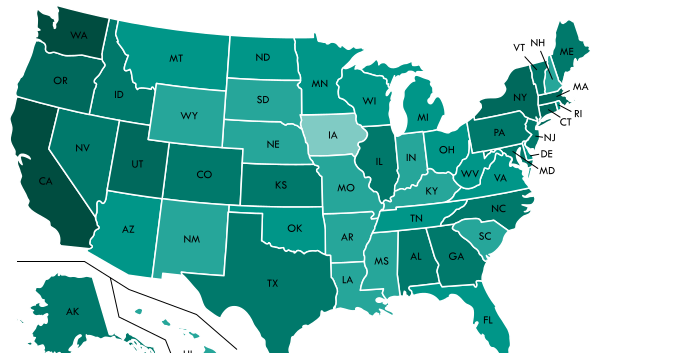
Most common states for rubies on rails developer
| Rank | State | Population | # of jobs | Employment/ 1000ppl |
|---|---|---|---|---|
| 1 | District of Columbia | 693,972 | 693 | 100% |
| 2 | Virginia | 8,470,020 | 3,378 | 40% |
| 3 | Washington | 7,405,743 | 2,964 | 40% |
| 4 | Rhode Island | 1,059,639 | 424 | 40% |
| 5 | Delaware | 961,939 | 361 | 38% |
| 6 | Vermont | 623,657 | 240 | 38% |
| 7 | Maryland | 6,052,177 | 2,216 | 37% |
| 8 | Massachusetts | 6,859,819 | 2,035 | 30% |
| 9 | Utah | 3,101,833 | 886 | 29% |
| 10 | Oregon | 4,142,776 | 1,134 | 27% |
| 11 | Wyoming | 579,315 | 157 | 27% |
| 12 | North Dakota | 755,393 | 198 | 26% |
| 13 | Nebraska | 1,920,076 | 486 | 25% |
| 14 | New Hampshire | 1,342,795 | 333 | 25% |
| 15 | Montana | 1,050,493 | 266 | 25% |
| 16 | Colorado | 5,607,154 | 1,332 | 24% |
| 17 | Minnesota | 5,576,606 | 1,328 | 24% |
| 18 | New Jersey | 9,005,644 | 2,043 | 23% |
| 19 | South Dakota | 869,666 | 187 | 22% |
| 20 | California | 39,536,653 | 8,053 | 20% |
Most common cities for rubies on rails developer
| Rank | City | # of jobs | Employment/ 1000ppl | Avg. salary |
|---|---|---|---|---|
| 1 | Cupertino | 2 | 3% | $116,055 |
| 2 | Richardson | 2 | 2% | $96,412 |
| 3 | Austin | 6 | 1% | $96,475 |
| 4 | Portland | 4 | 1% | $104,624 |
| 5 | Atlanta | 3 | 1% | $98,818 |
| 6 | Miami | 3 | 1% | $82,447 |
| 7 | Minneapolis | 3 | 1% | $88,902 |
| 8 | Irving | 2 | 1% | $96,444 |
| 9 | Salt Lake City | 2 | 1% | $103,664 |
| 10 | New York | 7 | 0% | $101,660 |
| 11 | Dallas | 6 | 0% | $96,443 |
| 12 | Los Angeles | 4 | 0% | $104,872 |
| 13 | San Francisco | 4 | 0% | $116,907 |
| 14 | Phoenix | 2 | 0% | $91,916 |
| 15 | San Antonio | 2 | 0% | $96,326 |
| 16 | San Diego | 2 | 0% | $102,144 |
| 17 | Seattle | 2 | 0% | $113,031 |
| 18 | Washington | 2 | 0% | $96,278 |
Ruby On Rails Developer job outlook: Expert opinions
Our panel of ruby on rails developer experts
Nova Southeastern University
Southern Illinois University Edwardsville
Texas A&M University San Antonio
Mount St. Joseph University

Wright State University

University of Hawaii at Hilo

Gannon University
Metropolitan State University of Denver

University of New Haven

Murray State University

University of South Alabama

University of Pittsburgh - Bradford

Montana State University
North Dakota State University

Allegheny College

Saint Xavier University

Taylor University
John Brown University
Rider University
What Ruby On Rails Developer skills would you recommend for someone trying to advance their career?
Dr. Frank Mitropoulos Ph.D.: Maximizing your salary potential as a new graduate with a Computer Applications degree involves strategic positioning, skill enhancement, and effective negotiation. Following are a few strategies to help increase your salary now and in the future: Specialize in High-Demand Areas: Identify and specialize in high-demand areas that generally offer higher salaries. Build a Strong Portfolio: Develop a portfolio that showcases your skills. A compelling portfolio can strengthen your position during salary negotiations. Develop Soft Skills: While technical skills are essential, soft skills like problem-solving, communication, and leadership hold equal significance. Enhancing these skills can give you an edge in negotiations. Do your Homework and Negotiate: Some industries and locations offer higher salaries. Decide what type of industry you want to focus on and do the background research needed to determine whether your skills will help as leverage. Use your portfolio, certifications, and skill set to strengthen your position. Be ready to articulate your value and how you can contribute to the company's success.
What will help Rubies On Rails Developer increase their earning potential?
Ahmed Imteaj PH.D.: Research Salary Trends: Before entering the job market, research salary trends for entry-level positions in your field and location. Websites like Glassdoor, PayScale, and LinkedIn Salary can provide valuable insights into typical salary ranges for different roles.
Acquire In-Demand Skills: Identify in-demand skills and technologies in your field and focus on acquiring them through coursework, certifications, internships, or personal projects. Skills such as machine learning, cloud computing, cybersecurity, and data science are highly valued and can command higher salaries.
Gain Relevant Experience: Prioritize gaining relevant experience through internships, co-op programs, part-time jobs, or freelance projects. Practical experience can significantly increase your market value and make you more attractive to employers.Customize Your Resume and Cover Letter: Tailor your resume and cover letter to highlight your relevant skills, experiences, and achievements that align with the job requirements. Highlighting your unique qualifications can increase your chances of landing interviews and negotiating a higher salary.
Prepare for Salary Negotiations: Before entering salary negotiations, research the typical salary range for the position and location, considering factors such as cost of living and industry standards. Practice articulating your value proposition and be prepared to negotiate confidently for a salary that reflects your skills, experience, and market value.
Consider Additional Benefits: In addition to salary, consider other benefits and perks offered by employers, such as health insurance, retirement plans, paid time off, flexible work arrangements, professional development opportunities, and bonuses. These benefits can add significant value to your overall compensation package.
MARLA KRAMER
Assistant Vice President of Marketing and CommunicationsWhat Ruby On Rails Developer skills would you recommend for someone trying to advance their career?
MARLA KRAMER: Computer Science, and IS in general, is a field that is constantly evolving. It is not enough to know what everybody else knows. Becoming a subject matter expert with deep knowledge is important to be successful in the long run. You have to pick your area of expertise carefully, keep yourself focused and educated in that specific area, and be prepared for a career of continuous learning.
Izzat Alsmadi
Associate ProfessorTexas A&M University San Antonio
Computer Science
What general advice would you give to a Ruby On Rails Developer?
Izzat Alsmadi: Computing fields are unique that they have a very large spectrum of possible jobs.
New graduates should be open and flexible to seek opportunities beyond a narrow focus that they may have in mind.
The degree itself is a great start but in most cases will not be enough and you have to seek own training in new software, tools, etc.
Certificates can be also important for some particular sub-disciplines (e.g. cyber security)
Rebecca Allen
Mount St. Joseph University
Special Education And Teaching
What general advice would you give to a Ruby On Rails Developer?
Rebecca Allen: AI, for sure. I have heard it said that AI might not replace humans, rather humans who know how to use AI well may replace humans who don't.
Daniel Asamoah Ph.D.
Associate Professor and Interim ChairWright State University
Information Systems and Supply Chain Management Department
What skills stand out on Ruby On Rails Developer resumes?
Daniel Asamoah Ph.D.: Web Developer: JavaScript, HTML5, CSS, PHP, Python, APIs, Web user interface design.
Travis Mandel Ph.D.
Assistant ProfessorUniversity of Hawaii at Hilo
Department of Computer Science
What soft skills should all Rubies On Rails Developer possess?
Travis Mandel Ph.D.: Although computer science seems like a highly technical field, soft skills are really what differentiates software engineers. One of the most important qualities of any software engineer is explaining their code clearly at various levels of technical depth and explaining why certain design decisions were made. You could write code that does amazing things, but if that code consists of snippets you pasted from StackOverflow without really fully understanding them, it will be a huge headache for anyone who needs to come into the codebase later and maintain or update it.
Another one is asking the right questions. Imagine you are dropped into a huge codebase and asked to add a new feature (very common!). There's no time to understand everything that is going on, but on the other hand, you need to understand enough of the code to do your task effectively, which involves asking questions. A failure to ask questions will likely result in you wasting a huge amount of time working on something that is ultimately not useful, for instance, re-implementing a complex function that already exists somewhere in the codebase.
Are there any particularly good places in the United States for Rubies On Rails Developer to find work opportunities?
Dr. Stephen Frezza Ph.D.: Computing is ubiquitous, and with more industries moving to remote work, location is becoming less critical. If the internet reaches a place reliably, computing jobs can be located there.
How do you envision technology impacting Rubies On Rails Developer in the next 5 years?
Dr. Stephen Frezza Ph.D.: Breadth and depth: Computing is becoming more like engineering; where the value of the product, its lifetime risks, costs, and benefits are more critical than just it's roll-out. So the engineering competencies that have always been a part of computing will become more central. Computing is also expanding; the role of data and the shift of once-research technologies (like machine learning) into production applications will continue to require computing graduates to broaden their base and continue as learners. This will cause shifts in what is considered 'fundamental' and the need for professionals to continue to hone and redevelop their technical skill sets.
Janos Fustos Ph.D.
ProfessorMetropolitan State University of Denver
Department of Computer Information Systems and Business Analytics
What's a good job out of college for Rubies On Rails Developer?
Janos Fustos Ph.D.: I hope students are asking that question before they enroll in the first course at a college because otherwise, they would waste lot of time and money to work on a degree or a career path that does not fulfill their goals and personal interest. In that sense any job is a good job that somebody understands, feels that he/she is a good fit and can live up to the imposed challenges, and has the knowledge/skills to work in the field. There are interesting and self-fulfilling jobs to choose from. Certainly, it starts with the definition what a "good" means to an individual, what are the attributes of that definition: is that the professional area, is the salary, is it the challenging nature, is it more about the working environment and the people they can work with, is it the promotion options, the high impact etc. There are several lists available on the internet that provide recommendations and track the different aspects of job selection options for seekers.
What's a good job out of college for Rubies On Rails Developer?
Christopher Martinez Ph.D.: The best job you can have out of college is a job you have passion for and will set you up to advance your career. If you have always wanted to work in aerospace, then you should seek out that field from the start. I hate to see students settle for a job because of pay or because they feel they can move to their dream field later.
What are the biggest trends we'll see in the Ruby On Rails Developer job market given the pandemic?
Christopher Martinez Ph.D.: I always tell students to practice for an interview by thinking about how they will answer behavior questions such as how to do your work on a team, how you lead a team, how you learn from a failure, etc. This year I would add a new question to this list, and that is how you work remotely. Students should consider how they work with classmates to find a remote work style that works for them. They should explore how to work with Slack or Microsoft Teams to communicate and organize their team. I think we will see that remote work is a trend that will remain with us for the foreseeable future so students should work to become more comfortable with this new work style.
Dr. Matthew Tennyson Ph.D.
Associate Professor of Computer ScienceMurray State University
Computer Science and Information Systems
What certifications/licenses/courses can have the biggest impact for Rubies On Rails Developer?
Dr. Matthew Tennyson Ph.D.: A bachelor's degree in computer science is extremely valuable. It has been and continues to be one of the most valuable college degrees a student can pursue. I really think all areas of computing are in demand, but web and mobile computing might be one of the strongest. Some employers do like to see extra certifications in addition to the bachelor's degree. There are literally hundreds of certifications available in the computing industry. They all vary in the required amount of time, effort, and money. I think anything that can set a candidate apart from other candidates is valuable, and that includes any certification. I would not recommend investing thousands of dollars into additional certifications after completing a bachelor's degree, but I don't think it's a bad idea for students to pursue one of the free or lower-cost certifications that are available - especially those students who might not have strong internship experience, extracurricular activities, projects, etc. to put on their resumes. I think anything DevOps related or cloud-based like Amazon's AWS or Microsoft's Azure are especially valuable right now.
Will there be an enduring impact of the coronavirus pandemic on Rubies On Rails Developer?
Bob Sweeney Ph.D.: I don't think so but I can't predict the future. The job market in this area seems to be solidifying and there are numerous local, regional, and national employers participating in our University's career fair this semester.
What technical skills for a Ruby On Rails Developer stand out to employers?
Bob Sweeney Ph.D.: Strong database skills including big data and SQL are always valued by local employers hiring our IS majors. While not technical, written and verbal communications skills are always important.
Are there any particularly good places in the United States for Rubies On Rails Developer to find work opportunities?
Dr. Y. Ken Wang: Other than San Francisco Bay, Seattle, New York, Boston, DC, we found Pittsburgh is a popular place for our students as well.
What are the biggest trends we'll see in the Ruby On Rails Developer job market given the pandemic?
Dr. Brock LaMeres Ph.D.: Businesses that do primarily computer-based work have not been impacted by COVID as much as trade-based businesses. They have figured out how to continue operations with the majority of their employees working from home. I feel like the types of jobs that people will hire into will have a significant "work-at-home" component. There will also be a surge in businesses trying to provide the resources for work-at-home employees.
Will there be an enduring impact of the coronavirus pandemic on Rubies On Rails Developer?
Dr. Simone Ludwig: So far, companies are still employing our students. As far as I have heard most of the students get employed when they finish their degree, which is good. The start is definitely different since most start working remotely usually with a couple of weeks of online training.
What experience really stands out on Ruby On Rails Developer resumes?
Dr. Simone Ludwig: Capstone experience, Internship or Co-op experience, and working on a research project will stand out on a resume.
What type of skills will young Rubies On Rails Developer need?
Dr. Simone Ludwig: The different roles our students take on once they complete our program are developer, programmer, software engineer, and development analyst positions. All of these positions involve some type of software development, be it on the front end, e.g. application development, or on the back end programming server or database applications. Besides the technical skills, the ability to communicate well and to work individually but also collaborate in a team environment are important.
Oliver Bonham-Carter Ph.D.
Assistant ProfessorAllegheny College
Department of Computer Science and Affiliated Faculty in Integrative Informatics
What are the biggest trends we'll see in the Ruby On Rails Developer job market given the pandemic?
Oliver Bonham-Carter Ph.D.: Pandemic has accelerated social connectivity trends using technology, including technology for remote work, and e-learning, and technology to make e-commerce more comfortable and faster. I foresee these accelerated technology trends to continue, even after the pandemic, and therefore job markets in these areas to continue to grow. Another big surge we have seen is in data analytics, which has been increasing over the last decade, and COVID-19 has spotlighted this field. I expect data analyst jobs to continue to be in demand and to grow. Also, the pandemic showed us the interconnectedness of technology with other areas. As the need to develop better solutions to fight various diseases heightens, for example, I expect jobs in biotech to grow.
Will there be an increase or decrease in demand for Rubies On Rails Developer in the next 5 years?
James Vanderhyde: There has been a steady increase in software and IT jobs for the last 20 years, and this is not going to slow down any time soon. In the next 5 years, demand will increase, particularly in software development and cybersecurity. The technology field changes so quickly that beyond 5 years, it is difficult to make predictions. That is why we thoroughly prepare our computer science and information systems students for technology changes and career shifts to discover the best in themselves and to be prepared to meet the demand and excel within the field.
Are there any particularly good places in the United States for Rubies On Rails Developer to find work opportunities?
James Vanderhyde: Any big city will have lots of opportunities for computing, software, and IT work. Silicon Valley and the rest of the west coast are the most famous, but innovation is happening everywhere around the country and around the world, including here in Chicago. Chicago tech companies have hired our students upon graduation, and likewise, our graduates have found success and gratification in the field.
What are the best companies to work for a Ruby On Rails Developer?
James Vanderhyde: The best companies to work for are companies that respect you as a person and not just a cog in the machine. They are inclusive, and they recognize and appreciate diversity. They have a track record of handling sick leave and family leave as needed. They will not expect you to eat dinner in your office and then go back to work after an already long day. All software companies experience crunch times around release dates, but the best companies do not experience constant crunch. That is a sign of poor management. The best companies will give you challenging problems to work on and reward innovation.
Dr. Jonathan Geisler
Associate ProfessorTaylor University
Department of Computer Science and Engineering
What are the best companies to work for a Ruby On Rails Developer?
Dr. Jonathan Geisler: The best companies to work for are the ones that are responsive to both their customers' and employees' needs. They are the ones that have tried to be proactive during the pandemic and not just survive until everything got "back to normal." They know that a damaged workforce leads to a damaged company, and so they provide good management, encouraging everyone to be healthy mentally and physically.
Will there be an increase or decrease in demand for Rubies On Rails Developer in the next 5 years?
Dr. Jonathan Geisler: There will be a continued increase in demand for computer engineering
graduates as computers become more heavily integrated into the fabric
of our lives. Things like self-driving cars, the Internet of Things, and
mobile computing will become more commonplace and increase the demand for engineering talent; the long-term trend of using smartphones and web-based applications will not slow, leading to an increase in the
demand for computing talent.
Are there any particularly good places in the United States for Rubies On Rails Developer to find work opportunities?
Dr. Ted Junseok Song: Due to COVID-19, people have more choices on location as more companies allow their employees to work remotely.
How do you envision technology impacting Rubies On Rails Developer in the next 5 years?
Dr. Ted Junseok Song: The question is not whether technology will advance or not. It is, rather, how it will advance. Professionals in the industry need to be equipped to see the customers' demand and where our society is headed. I would recommend college students to be interested in broad topics apart from topics in their major. Well-rounded people will have more opportunities to impact the future.
Dr. Howard Rees
Adjunct Assistant Professor of Information SystemsRider University
Information systems
Will there be an enduring impact of the coronavirus pandemic on Rubies On Rails Developer?
Dr. Howard Rees: We're moving into a volatile time for the economy, and planning for an uncertain future is what big companies are concerned with. In many ways, the pandemic and concerns over future pandemics that we now know can be globally devastating will be a boon for CS and IT graduates. Face to face business interactions and transactions will be dramatically reduced, both in the short term and in the long run, as there will be a need to hedge against future pandemics. Everything changes from production and operations to supply chain and risk management and diversification to the nature of "office work." And all of that must be underpinned by computer technology: communications, security, data analytics. These are trends that have been developing for the past few decades but the pandemic will accelerate them, and that's all useful, if you're a CS or IT graduate with a broad base of knowledge, which provides you the freedom to adapt.