Explore jobs
Find specific jobs
Explore careers
Explore professions
Best companies
Explore companies
Job outlook for science professors in the United States
Science professor job growth summary. After extensive research, interviews, and analysis, Zippia's data science team found that:
The projected science professor job growth rate is 12% from 2018-2028.
About 159,400 new jobs for science professors are projected over the next decade.
Science professor salaries have increased 12% for science professors in the last 5 years.
There are over 41,851 science professors currently employed in the United States.
There are 16,484 active science professor job openings in the US.
The average science professor salary is $84,942.
Are science professor jobs in demand?
Science professor job and salary trends over time
Science professor jobs over time
Science professor job growth rate over time
| Year | # of jobs | % of population |
|---|---|---|
| 2021 | 41,851 | 0.01% |
| 2020 | 43,744 | 0.01% |
| 2019 | 44,218 | 0.01% |
| 2018 | 43,645 | 0.01% |
| 2017 | 42,545 | 0.01% |
Average science professor salary over time
Science professor salary by year
| Year | Avg. salary | Hourly rate | % Change |
|---|---|---|---|
| 2026 | $84,942 | $40.84 | +2.8% |
| 2025 | $82,659 | $39.74 | +0.9% |
| 2024 | $81,915 | $39.38 | +5.5% |
| 2023 | $77,638 | $37.33 | +2.1% |
| 2022 | $76,060 | $36.57 | +1.8% |
Science professor jobs by state
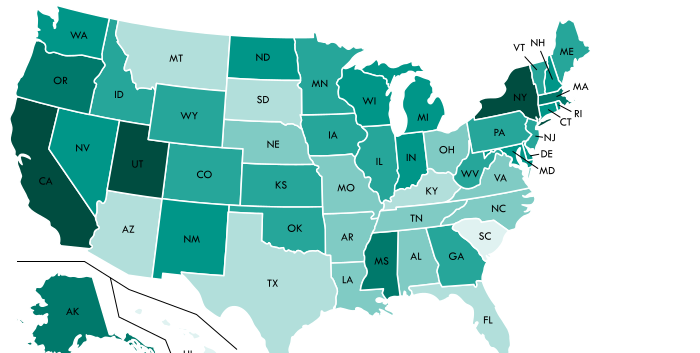
Most common states for science professors
| Rank | State | Population | # of jobs | Employment/ 1000ppl |
|---|---|---|---|---|
| 1 | District of Columbia | 693,972 | 116 | 17% |
| 2 | Vermont | 623,657 | 84 | 13% |
| 3 | South Dakota | 869,666 | 76 | 9% |
| 4 | Colorado | 5,607,154 | 395 | 7% |
| 5 | Oregon | 4,142,776 | 287 | 7% |
| 6 | West Virginia | 1,815,857 | 135 | 7% |
| 7 | Nebraska | 1,920,076 | 134 | 7% |
| 8 | Montana | 1,050,493 | 76 | 7% |
| 9 | Alaska | 739,795 | 52 | 7% |
| 10 | Virginia | 8,470,020 | 509 | 6% |
| 11 | Massachusetts | 6,859,819 | 398 | 6% |
| 12 | Utah | 3,101,833 | 190 | 6% |
| 13 | Maine | 1,335,907 | 80 | 6% |
| 14 | Rhode Island | 1,059,639 | 67 | 6% |
| 15 | Wyoming | 579,315 | 33 | 6% |
| 16 | New York | 19,849,399 | 992 | 5% |
| 17 | Mississippi | 2,984,100 | 163 | 5% |
| 18 | New Hampshire | 1,342,795 | 72 | 5% |
| 19 | Delaware | 961,939 | 49 | 5% |
| 20 | North Dakota | 755,393 | 39 | 5% |
Most common cities for science professors
| Rank | City | # of jobs | Employment/ 1000ppl | Avg. salary |
|---|---|---|---|---|
| 1 | Coral Gables | 1 | 2% | $66,558 |
| 2 | Atlanta | 1 | 0% | $93,651 |
Science Professor job outlook: Expert opinions
Our panel of science professor experts
Kean University
North Carolina State University
University of Maine
Skidmore College
Ashford University
Park University
University of South Florida

Michigan State University
Appalachian State University

Arkansas State University
University of Delaware

Farmingdale State College
What general advice would you give to a Science Professor?
Alex Holte PhD: My advice for someone new to the field of academia is to learn time management skills early and learn what type of service work you find interesting and would like to contribute to. From there, learn how to say “no” to opportunities that may not align with your goals as well. I feel a lot of new professors tend to find the need to be involved in everything, which can result in burning out later in their career.
What Science Professor skills would you recommend for someone trying to advance their career?
Alex Holte PhD: I would say being able to work with AI may be something that is more important in the next 3-5 years. Right now it’s a new technology and people are just now learning how to integrate it in the workplace, but I feel it is possible the future workforce of tomorrow will necessitate some form of being able to use AI technology.
What will help Science Professors increase their earning potential?
Alex Holte PhD: When you are starting out at any career, it is important to negotiate your salary. Many candidates feel that they have to accept their first offer, but in reality, at many jobs, there is some room for negotiation. Be mindful however, to not request a salary that is much higher than what is being offered as they may feel like a compromise would not be possible and move on to the next candidate.
What general advice would you give to a Science Professor?
Mia Fiore Ph.D.: First, I would tell all students that it is VERY different from teaching k-12. Unlike K-12, you are not placed in a school with a teaching job upon graduation; teaching in higher education is one of the most competitive fields, period. The next difference is that you are expected to be an expert/ master of your field. If you're also willing to accept that you will likely have to work as an adjunct professor (for low pay) first, then go for it! Teaching in higher education is the most rewarding job, especially for people who love learning.
What Science Professor skills would you recommend for someone trying to advance their career?
Mia Fiore Ph.D.: Awareness and familiarity with technology has become more important, and it will continue to be more important in the next 3-5 years. With everything from peer-reviewed journals available online, to AI, technology is an important part of higher education.
What will help Science Professors increase their earning potential?
Mia Fiore Ph.D.: Maximize your salary potential by teaching at a state school- if you do you can join the PSLF program and after ten years, your student loans will be forgiven.
What general advice would you give to a Science Professor?
Justin Whitehill Ph.D.: Perseverance pays off. Its worth it to pursue the career you want and not settle and be unhappy.
What Science Professor skills would you recommend for someone trying to advance their career?
Justin Whitehill Ph.D.: In the area of genetics and genomics, the identification of areas of the genome that can be CRISPR’d and used to add an immediate benefit is going to be very important as every cropping system races to make genome editing a reality. AI will likely play a huge role in predicting genes/regions of the genome that will provide the biggest benefits.
What will help Science Professors increase their earning potential?
Justin Whitehill Ph.D.: I wouldn’t know, I’m a professor.
Jane Kuandre
Associate ProfessorWhat general advice would you give to a Science Professor?
Jane Kuandre: My advice for someone looking to pursue a career in academia would be to focus on building a strong publication record, developing a network of collaborators, and continuously seeking opportunities for professional development.
What Science Professor skills would you recommend for someone trying to advance their career?
Jane Kuandre: Some essential skills for success in academia include critical thinking, effective communication, time management, and the ability to work both independently and collaboratively.
What will help Science Professors increase their earning potential?
Jane Kuandre: Networking is crucial for career advancement in academia as it allows individuals to establish collaborations, gain access to resources, and stay updated on the latest research trends.
Dr. Elizabeth Neiman
Director of Women's, Gender, and Sexuality Studies ProgramUniversity of Maine
Ethnic, Cultural Minority, Gender, And Group Studies
What general advice would you give to a Science Professor?
Dr. Elizabeth Neiman: Students interested in enhancing their program of study with a WGS minor just 3 additional courses to take in WGS so as to complete a minor. Nursing students who have taken advantage of this opportunity report to me that they are excited about the perspectives that WGS studies provides them and that they feel more prepared than ever to begin a career in Nursing.
What Science Professor skills would you recommend for someone trying to advance their career?
Dr. Elizabeth Neiman: I can reflect better on how I'd guide students to think about the work they do at UMaine in Women's Gender and Sexuality Studies so as to prepare for potential careers.
What will help Science Professors increase their earning potential?
Dr. Elizabeth Neiman: Rather than answer your questions, I'll give you some background information: Since becoming Director of the Women's, Gender and Sexuality Studies program at UMaine in fall 2022, I have been doing a great deal of outreach to faculty in other departments across the university.
Aurelie Matheron
Assistant Professor of FrenchSkidmore College
Romance Languages, Literatures, And Linguistics
What general advice would you give to a Science Professor?
Aurelie Matheron: Present yourself as a professional in your cover letter and interviews. The people who interview you will look at you as a future colleague and not a student. Use the past “I” to show what the future “I” will do. Meaning: in your interviews, say “I have developed X courses/projects and I have acquired X skills useful for a collaborative project at your institution. For instance, one project I will develop is XYZ.” You show your experience/expertise and how you will be using your skills. Don’t dwell too much on the “past I” and, I’d say, don’t use the past “we” => “at my former institution, we would do X or Z.” => this shows that you still view yourself as part of that community and don’t project yourself at your new institution. Once you have the job: observe the dynamics of your new work place. Meet with colleagues who also recently got a job at your institution. They will help you navigate the first year.
What Science Professor skills would you recommend for someone trying to advance their career?
Aurelie Matheron: Leadership: you will be in positions of leading a program/department. Learn from current chairs by observing their own skills during meetings and moments of decision. Collaboration: develop interpersonal and interprofessional relationships that will allow you to build collaborative projects (interdepartmental courses, for instance).
What will help Science Professors increase their earning potential?
Aurelie Matheron: Do some research online about how much someone earns at your stage of the career. If there is a significant gap, point out (diplomatically) that, because of your extensive experience in XYZ, you would like to get a X% increase in your salary. Be reasonable: if you want a 3% increase, ask for 5% (not 10% or more). Justify your negotiation: why should they pay me more? What experience can I show them to justify my request? If you have a higher offer from another place, you can say that “I have received another generous offer and would like to know about the possibility for matching that offer.” Salary is not the only thing you can negotiate: office space, computer/laptop, sabbaticals, course release, etc. Again, be reasonable: if you think you are entitled to XYZ requests, you also have to show why.
Fabio Lanza
ProfessorAshford University
History
What general advice would you give to a Science Professor?
Fabio Lanza: I tell them not to expect that they can achieve the same, old-style academic career (like mine, for example). A tenure-track job in a research university to be clear. Those jobs exist but they are becoming rarer and rarer. I also tell them that if they forecast incurring in serious (or even non-serious) debt in order to get a PhD, they should not do it. They should not pursue that path at all. In the program, they should take all the chances they have to learn new skills, including skills that don't seem directly related to an academic career.
What Science Professor skills would you recommend for someone trying to advance their career?
Fabio Lanza: To put it bluntly, if you want to make money, this is really not the career for you.
What will help Science Professors increase their earning potential?
Fabio Lanza: Difficult to say, given how quickly things change. Digital humanities was and still is fashionable and important. Public history (museum, exhibitions, outreach). And teaching.
Professor Wen Hsin
Professor of Computer SciencePark University
Biological And Physical Sciences
What Science Professor skills would you recommend for someone trying to advance their career?
Professor Wen Hsin: The current trending topics are AI, data analytics, and cybersecurity. Also, I continue to hear from our recent graduates that cloud computing is what they are doing in their companies these days.
What skills stand out on Science Professor resumes?
Lee Braver: Colleges and universities fall into different categories which value different skills and accomplishments. The most obvious division is between schools that emphasize research and those that pride themselves on their teaching. Research institutions are looking for scholars who can publish a lot in exclusive journals and presses, thereby enhancing their reputation. They are looking for evidence of research skills: publications, awards, letters of recommendation that praise the candidate's writing and thinking. Teaching schools, on the other hand, are looking for excellent teachers. In the buyer's market we now have, they can require high research ability as well, but some will actually be scared off by too much research. They will worry that the candidate will focus on their research instead of their teaching and that they will seek to leave as soon as they can. These schools are typically looking for teaching experience, high student evaluations, and letters that single out these qualities for praise, whereas research schools typically don't care a lot about these sorts of things. Thus, the qualities one type of institution values, the other can be apathetic towards or even avoid. Teaching schools far outnumber research schools, so there are far more jobs in the former than in the latter.
What hard/technical skills are most important for Science Professors?
Lee Braver: Well, a Ph.D. is necessary, although one can sometimes be hired within striking distance of it. The ability to teach so as to bring students to the major and get high student evaluations are often requirements at teaching schools while writing well enough to publish, often in journals with single-digit acceptance rates, is crucial to research schools. Comfort with technology is becoming more and more important.
What skills will help Science Professors earn the most?
Lee Braver: Let's see-an M.B.A., the ability to pick winning lottery numbers, being repelled by the humanities so that one goes into business-those would be pretty useful for making money. No one should go into academia for the money, not just not for wealth but even for a comfortable living, which is becoming more difficult to achieve in America in general. It is nearly impossible to make a living as an adjunct professor, which is where the profession is heading. There are many good-paying jobs, but those tend to congregate at the elite schools, the ones that emphasize research the most, and these are the fewest and hardest to get. Worse-paying jobs are also hard to come by, and the competition is just getting stiffer as more Ph.D.'s get dumped into the market each year which is itself accreting all those who did not land jobs in the previous years. At many institutions, raises are minimal since jobs are so hard to come by, and there's little else that rewards a humanities Ph.D. The only way to get a substantial raise is to get a credible offer from another institution and hope that yours wants to keep you enough to overbid them; otherwise, you're stuck, especially after getting tenure, and they know it. That's why tenure is called "golden handcuffs," though I think a better name might be something like velvet handcuffs, given gold's connotation of wealth.
What soft skills should all Science Professors possess?
Lee Braver: Soft skills are most important to working once one has gotten a job rather than important to getting a job since those are quite difficult to discern from applications and brief interviews. That is one of the reasons schools can be wary of hiring with tenure; a person could look great on paper but be a nightmare to work with, and you're stuck with them.
I believe that tenacity, organizational skills and time management, and the ability to work long hours are crucial to getting tenure and succeeding in academia more broadly, in some ways more important than raw intelligence (if such a notion is coherent). Failure and rejection are endemic to the job; anyone who gets discouraged easily will do so. One must persevere in the face of sometimes harsh criticism and hostile conditions (especially now that much of the country has turned against higher education and the humanities in particular), and one must be able to juggle multiple responsibilities that make considerable time demands. In this, the tenure track resembles other early-career positions, such as medical residency or working towards partnership in a law firm. The untenured often must do the scut work that no one else wants to do, made more difficult by the fact that they are frantically trying to learn on the job with little to no guidance. It is not at all unusual for early-career professors to teach 4 classes per semester, at least some of which are new and/or large, do all the grading for them, serve on multiple committees, and write for elusive publications, all at once.
Addie Thompson Ph.D.
Assistant ProfessorMichigan State University
Plant, Soil and Microbial Sciences
What skills stand out on Science Professor resumes?
Addie Thompson Ph.D.: I will interject a disclaimer that plant sciences are a fairly large field encompassing many disciplines and skillsets. As such, there will be jobs that are more field crops oriented, some that deal with greenhouse production, others that are analytical and lab-based, some primarily computational and data science-oriented, etc. - without even getting into adjacent fields of study that need plant science expertise like technology/patent law, environmental resources management, various NGOs. So one set of skills that apply to all of those doesn't make a lot of sense. However, it is good to get real-world experience in whatever your area of interest is, beyond classwork. This includes internships, research experiences, and study abroad programs. These experiences indicate that you may be more prepared to jump into a working environment than someone who has only had coursework.
What soft skills should all Science Professors possess?
Addie Thompson Ph.D.: One of the most important skills highlighted in our roundtable earlier this week was actually... likability. It sounds simple and obvious, but your future co-workers have to want to work with you. Your technical competence isn't as important as your willingness and ability to get along well with others without leading to discord. Similarly, unimpeachable morality. There is no tolerance or excuse for poor behavior, whether workplace harassment, stealing credit for others' work, or fabricating results. Other important skills are the ability to communicate across disciplines and to audiences with a wide range of technical expertise, creativity, work ethic, critical thinking, and I might even add empathy. That last one has begun to stand out a bit more in light of the past couple of years, but it also plays into the other skills on a day-to-day basis. If you are a likable, empathetic, creative, hard-working person, you are more likely to be successful in being able to not only think critically about a complex problem but then also communicate your solutions and suggestions to a wide audience, as you can see and process from others' perspectives and understand alternative interpretations.
What hard/technical skills are most important for Science Professors?
Addie Thompson Ph.D.: Keeping in mind the caveats in answer 1 and the suggestions there, I think a strong argument could be made for statistics and data analysis. Not all plant science positions require these skills, of course. But as automation and other technologies become increasingly pervasive, data is very much the modern currency. Learning to process, manipulate, and analyze relevant data types appropriately (ranging from analytical lab data to yield trial data to the image or sensor-based data) will almost certainly pay off. This is something you can even teach yourself through practice and/or with online course modules.
What skills will help Science Professors earn the most?
Addie Thompson Ph.D.: In addition to the suggestions in #3 above, I will re-emphasize communication, creativity, and confidence. This enables you to think of new ideas or solutions, convey them clearly to others, and have the courage and self-assurance to believe in the quality of your work.
How do you envision technology impacting Science Professors in the next 5 years?
Dr. Catherine C. Reese: Technology, in the form of data analytics, will be starting to drive governmental decision-making within the next five years. Where important decisions used to be ad hoc, they will be driven by data analysis in the future. Will data-based decisions remove the politics from the administration? That remains to be seen.
What general advice would you give to a Science Professor?
Estella Atekwana Ph.D.: There's no question entering the job market this year has been challenging. The effects of the pandemic have been felt in every industry, and some of the fields in which geoscientists make a living, like the energy market, are subject to uncertainty for both economic and political reasons. But in one sense, geoscientists are in a better position than many because of the relevance of the geosciences to society. The education we provide students -a knowledge of geoscience across disciplinary boundaries-and the development of soft skills such as team work, working collaboratively, problem solving, critical thinking, communication and more-are what industry employers are seeking, and they help students navigate the rapidly changing job landscape.
Jonathan Lehrer Ph.D.
Associate Professor and ChairFarmingdale State College
Department of Urban Horticulture and Design
Will there be an enduring impact of the coronavirus pandemic on Science Professors?
Jonathan Lehrer Ph.D.: The horticulture industry has been deemed essential from the beginning (NY) of the COVID-19 crisis, and most businesses have remained open, conducted business, and hired necessary staff. But horticulture and landscape design are service industries whose success remains inextricably linked to the greater economic situation. So, as the national economy slows, the demand for horticultural supplies and services (such as commercial landscape design, installation, and maintenance) may subside, which will have an enduring impact on job opportunities for Horticulture Department graduates.
Are there any particularly good places in the United States for Science Professors to find work opportunities?
Jonathan Lehrer Ph.D.: The Horticulture and Landscape Design industry are driven by urban and suburban development. For example, before COVID-19, urban horticulture was booming in places like Brooklyn and Manhattan. Now, we hear predictions that many residents will flee these urban centers for "safer" areas. Should this happen, growth in this sector may slow, or be reversed. Conversely, areas of the United States that are witnessing population growth due to relocation, retirement, and other social forces will see the expansion of the horticulture and allied services industry. Examples might include parts of the Middle Atlantic and South (Virginia, the Carolinas, Florida) and the Southwest (Arizona, Nevada).
How do you envision technology impacting Science Professors in the next 5 years?
Jonathan Lehrer Ph.D.: Horticulture and allied industries must evolve to meet societal concerns for increased sustainability. For example, many local municipalities are passing ordinances banning the use of gas-powered, landscape maintenance equipment. Companies and residential users will be forced to embrace a legion of new, eco-friendly options powered by efficient rechargeable batteries. These products have improved drastically in the last few years and are much quieter with highly reduced emissions. Interior horticulture is booming, partially driven by emerging technologies, such as efficient LED lighting fixtures and aquaponic growth products. In addition to beautiful tropical foliage plants that improve our well-being, other products, such as vegetables, herbs, and cannabis can now be grown indoors by almost anybody.