Explore jobs
Find specific jobs
Explore careers
Explore professions
Best companies
Explore companies
Job outlook for scientific programmers in the United States
Are scientific programmer jobs in demand?
Scientific programmer job and salary trends over time
Scientific programmer jobs over time
Scientific programmer job growth rate over time
| Year | # of jobs | % of population |
|---|---|---|
| 2021 | 143 | 0.00% |
| 2020 | 293 | 0.00% |
| 2019 | 283 | 0.00% |
| 2018 | 823 | 0.00% |
| 2017 | 884 | 0.00% |
Average scientific programmer salary over time
Scientific programmer salary by year
| Year | Avg. salary | Hourly rate | % Change |
|---|---|---|---|
| 2026 | $83,969 | $40.37 | +3.4% |
| 2025 | $81,202 | $39.04 | +2.3% |
| 2024 | $79,364 | $38.16 | +2.5% |
| 2023 | $77,443 | $37.23 | +3.0% |
| 2022 | $75,183 | $36.15 | +0.4% |
Scientific programmer jobs by state
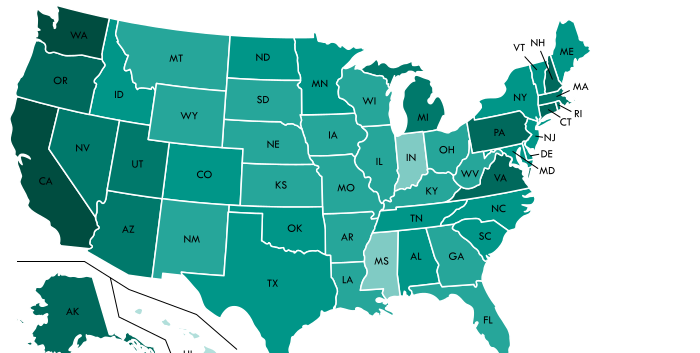
Most common states for scientific programmers
| Rank | State | Population | # of jobs | Employment/ 1000ppl |
|---|---|---|---|---|
| 1 | District of Columbia | 693,972 | 674 | 97% |
| 2 | Delaware | 961,939 | 345 | 36% |
| 3 | Rhode Island | 1,059,639 | 372 | 35% |
| 4 | Virginia | 8,470,020 | 2,857 | 34% |
| 5 | Vermont | 623,657 | 209 | 34% |
| 6 | Maryland | 6,052,177 | 2,018 | 33% |
| 7 | Washington | 7,405,743 | 2,134 | 29% |
| 8 | Massachusetts | 6,859,819 | 1,963 | 29% |
| 9 | Oregon | 4,142,776 | 1,093 | 26% |
| 10 | Utah | 3,101,833 | 760 | 25% |
| 11 | Montana | 1,050,493 | 265 | 25% |
| 12 | New Hampshire | 1,342,795 | 317 | 24% |
| 13 | Nebraska | 1,920,076 | 418 | 22% |
| 14 | Wyoming | 579,315 | 125 | 22% |
| 15 | New Jersey | 9,005,644 | 1,881 | 21% |
| 16 | North Dakota | 755,393 | 157 | 21% |
| 17 | Minnesota | 5,576,606 | 1,126 | 20% |
| 18 | Idaho | 1,716,943 | 341 | 20% |
| 19 | Colorado | 5,607,154 | 1,069 | 19% |
| 20 | California | 39,536,653 | 7,214 | 18% |
Most common cities for scientific programmers
| Rank | City | # of jobs | Employment/ 1000ppl | Avg. salary |
|---|---|---|---|---|
| 1 | Bethesda | 2 | 3% | $80,415 |
| 2 | Cambridge | 2 | 2% | $89,244 |
| 3 | New Brunswick | 1 | 2% | $78,306 |
| 4 | Newark | 1 | 2% | $122,819 |
| 5 | Piscataway | 1 | 2% | $78,288 |
| 6 | Huntsville | 1 | 1% | $77,165 |
| 7 | Houston | 1 | 0% | $75,860 |
Scientific Programmer job outlook: Expert opinions
Our panel of scientific programmer experts
Portland State University
Nova Southeastern University
Kettering University
Nova Southeastern University
Mount St. Joseph University
University of Richmond
Idaho State University

University of Kentucky

Gannon University
Auburn University at Montgomery

Murray State University

Allegheny College

Saint Xavier University

Taylor University

University of California, Santa Cruz
John Brown University
Portland State University

University of Maryland
Augusta University
What Scientific Programmer skills would you recommend for someone trying to advance their career?
Sepehr Mohammadian: 1. This is a pretty broad question. CS degree graduates can engage in different tasks and responsibilities based on the nature of their profession. Examples include 1) software engineering, in which the individual's efforts are toward leading or contributing to software development projects, 2) IT management, where the individual mainly oversees technology strategies and their implementation, 3) cybersecurity, where the individual's responsibilities are associated with the protection of systems and data from cyber threats, and 4) data and AI engineering, where the individual works on machine learning applications and analyze and derive insights from large datasets.
What will help Scientific Programmers increase their earning potential?
Wu-chang Feng: I believe so. With the advent of generative AI, it is now much easier to go from idea to implementation. We can now build things closer to the limits of our imagination.
Junping Sun Ph.D.
ProfessorNova Southeastern University
Computer Software And Media Applications
What Scientific Programmer skills would you recommend for someone trying to advance their career?
Junping Sun Ph.D.: Computer Science and its applications in various fields are very dynamic and constantly evolving, and anyone in the fields needs to prepare to be adaptive by lifelong learning.
What general advice would you give to a Scientific Programmer?
Dr. Jim Huggins: Computer science is a problem-solving discipline. Computer scientists help people solve problems. Typically, those problems deal with data; someone has a large set of data and needs to answer questions about that data, or process it in some way. Computer scientists write programs that run on computers to help their clients answer those questions and perform those processing tasks. On a given day, a computer scientist might do any or all of the following tasks, working alone or in teams: - Meet with clients to understand their problems and how a computing system might help them solve their problems. - Design computing systems to meet client needs. - Build computing systems to meet design specifications. - Test computing systems in order to find errors in their construction and fix those errors. - Repair computing systems that are not functioning properly. - Instruct users how to use the computing systems the computer scientist has designed for them. - Brainstorm new ideas for computing systems that would meet the needs of new customers.
What Scientific Programmer skills would you recommend for someone trying to advance their career?
Dr. Jim Huggins: Demand for computer scientists in the marketplace is high right now. The US Bureau of Labor Statistics states that employment in computer science is projected to grow much faster than all other occupations in the next ten years and currently pays salaries twice the national average. Working conditions for computer scientists are generally good: pleasant office environments, with the potential for flexible work environments and flexible schedules. But beyond the economic reasons, choosing computer science as a career means choosing a career that helps people solve their problems. Everyone uses computers to perform hundreds of tasks per day; computer scientists design the systems that people are using to make their everyday life more fulfilling.
What will help Scientific Programmers increase their earning potential?
Dr. Jim Huggins: Computer scientists enjoy the opportunity to be creative every day. Every computing system being designed is different from the last one or the next one; creativity is required to solve new problems every day. Computer scientists enjoy the opportunity to solve problems. There is a great feeling of accomplishment when a team finishes developing a computing system or helps a client solve their problems by using a computing system they designed. Computer scientists are innovative. By definition, they create systems that never existed beforehand. People enjoy knowing that they're creating the future of our world. Each benefit of being a computer scientist can also be a challenge. Working with people, both to determine the requirements for a system that's never existed, and to build that system, can be subject to the same interpersonal conflicts of any discipline. Problem-solving can be frustrating if the solution is not immediately apparent. Building computing systems requires technical skills that can take time to learn and to master.
What will help Scientific Programmers increase their earning potential?
Dr. Frank Mitropoulos Ph.D.: As we look toward the future of careers in Computer Applications, several skills stand out for their growing importance. These skills revolve around specific technologies that are expected to continue to grow and evolve. Technologies related to Cloud Computing, Artificial Intelligence (AI), Cybersecurity, and Data Science are quickly evolving and being applied across the technology sector. Cloud Computing: Given the widespread adoption of Cloud services, Cloud computing expertise is indispensable. Understanding how to leverage platforms like Azure, AWS, and Google Cloud is crucial to developing scalable, efficient solutions that meet business needs. Artificial Intelligence: AI and Machine Learning are transforming the world. Skills in these areas to solve real-world problems will be even more critical in the future. Cybersecurity: Digital threats are becoming more sophisticated. Safeguarding data, networks, and systems will require encryption, intrusion detection, development, and regulation skills. Data Science: Skills in Data Science will be increasingly sought after as businesses embrace data-driven decision-making. Extracting meaningful insights from extensive datasets and effectively communicating these findings will be essential. Soft skills: Finally, soft skills such as teamwork, problem-solving, and effective communication cannot be overlooked. Adapting, communicating, and leading will be essential for success.
Rebecca Allen
Mount St. Joseph University
Special Education And Teaching
What general advice would you give to a Scientific Programmer?
Rebecca Allen: AI, for sure. I have heard it said that AI might not replace humans, rather humans who know how to use AI well may replace humans who don't.
Ahmed Temani
Senior InstructorUniversity of Richmond
Computer/Information Technology Administration And Management
What general advice would you give to a Scientific Programmer?
Ahmed Temani: A lot of the buzz is about using chatbots to improve coding efficiency. However, there is a great need for systems level thinking and design as software is deployed across cloud and edge computing devices. Gaining more experience in systems design provides you with additional skills that complement whatever AI-based technology gets deployed.
What Scientific Programmer skills would you recommend for someone trying to advance their career?
Nikyra Capson: Don't be afraid of being rejected. If they see a job they want, apply. Even if they don't think they'll get it, still apply. The worst thing that could happen is being told no. Not applying is an automatic no, so they might as well try.
What soft skills should all Scientific Programmers possess?
Jennifer Cramer: Every linguistics program will teach students to use critical thinking and reading skills. In many cases, because of the complex nature of the linguistic structure, linguistics students must develop a keen sense of pattern-finding. Also, research is usually the main component of a linguistics degree program. Therefore students are typically well-trained in academic writing. Yet, because language is of interest to many, it is also important for linguistics students to develop an ability to explain what this research accomplishes in lay person's terms and what real-world implications it has.
What skills will help Scientific Programmers earn the most?
Jennifer Cramer: Computational linguistics and data science are the highest-earning linguistics careers, which likely means programming skills are the most sought after.
What skills stand out on Scientific Programmer resumes?
Jennifer Cramer: Linguistics stands at the intersection of the humanities, social sciences, and natural sciences. Therefore, the skills one acquires in linguistics degree programs can include many types. What stands out for most is their ability to apply quantitative and qualitative problem-solving skills to a wide range of problems. Most students are given the opportunity to learn how to use specialized tools that have specific applications in linguistics but can also be used in various other domains (e.g., various statistical packages, programming languages, visualization tools, audio recording equipment). Yet, they also learn to critically assess data on more qualitative measures, like discourse and sentiment analysis, which also have applications beyond the field. The most impressive resume is one that showcases that a person not only understands these approaches to a problem but can carefully articulate the problem, to begin with, execute a plan to find solutions to that problem, and produce a complete project that addresses the nuances of language in clear and concise ways.
Are there any particularly good places in the United States for Scientific Programmers to find work opportunities?
Dr. Stephen Frezza Ph.D.: Computing is ubiquitous, and with more industries moving to remote work, location is becoming less critical. If the internet reaches a place reliably, computing jobs can be located there.
How do you envision technology impacting Scientific Programmers in the next 5 years?
Dr. Stephen Frezza Ph.D.: Breadth and depth: Computing is becoming more like engineering; where the value of the product, its lifetime risks, costs, and benefits are more critical than just it's roll-out. So the engineering competencies that have always been a part of computing will become more central. Computing is also expanding; the role of data and the shift of once-research technologies (like machine learning) into production applications will continue to require computing graduates to broaden their base and continue as learners. This will cause shifts in what is considered 'fundamental' and the need for professionals to continue to hone and redevelop their technical skill sets.
Will there be an enduring impact of the coronavirus pandemic on Scientific Programmers?
Dr. Semih Dinc: I personally think there may be a positive impact of this pandemic for CS graduates in medium/long term. Even if many companies have frozen or slowed down their hiring process now, I believe this is a temporary decision. There is still a big need for new CS graduates in the industry. And to me it is more clear that people realized they can work remotely for many CS related positions. This means that many companies can cut their physical office budgets and hire more remote people. One of the factors for our students is the challenges/expenses of the city they would work. Some of them do not want to move to big cities. I am assuming with more remote working opportunities graduates will have more options.
Dr. Matthew Tennyson Ph.D.
Associate Professor of Computer ScienceMurray State University
Computer Science and Information Systems
What certifications/licenses/courses can have the biggest impact for Scientific Programmers?
Dr. Matthew Tennyson Ph.D.: A bachelor's degree in computer science is extremely valuable. It has been and continues to be one of the most valuable college degrees a student can pursue. I really think all areas of computing are in demand, but web and mobile computing might be one of the strongest. Some employers do like to see extra certifications in addition to the bachelor's degree. There are literally hundreds of certifications available in the computing industry. They all vary in the required amount of time, effort, and money. I think anything that can set a candidate apart from other candidates is valuable, and that includes any certification. I would not recommend investing thousands of dollars into additional certifications after completing a bachelor's degree, but I don't think it's a bad idea for students to pursue one of the free or lower-cost certifications that are available - especially those students who might not have strong internship experience, extracurricular activities, projects, etc. to put on their resumes. I think anything DevOps related or cloud-based like Amazon's AWS or Microsoft's Azure are especially valuable right now.
Oliver Bonham-Carter Ph.D.
Assistant ProfessorAllegheny College
Department of Computer Science and Affiliated Faculty in Integrative Informatics
What are the biggest trends we'll see in the Scientific Programmer job market given the pandemic?
Oliver Bonham-Carter Ph.D.: Pandemic has accelerated social connectivity trends using technology, including technology for remote work, and e-learning, and technology to make e-commerce more comfortable and faster. I foresee these accelerated technology trends to continue, even after the pandemic, and therefore job markets in these areas to continue to grow. Another big surge we have seen is in data analytics, which has been increasing over the last decade, and COVID-19 has spotlighted this field. I expect data analyst jobs to continue to be in demand and to grow. Also, the pandemic showed us the interconnectedness of technology with other areas. As the need to develop better solutions to fight various diseases heightens, for example, I expect jobs in biotech to grow.
What are the best companies to work for a Scientific Programmer?
James Vanderhyde: The best companies to work for are companies that respect you as a person and not just a cog in the machine. They are inclusive, and they recognize and appreciate diversity. They have a track record of handling sick leave and family leave as needed. They will not expect you to eat dinner in your office and then go back to work after an already long day. All software companies experience crunch times around release dates, but the best companies do not experience constant crunch. That is a sign of poor management. The best companies will give you challenging problems to work on and reward innovation.
Will there be an increase or decrease in demand for Scientific Programmers in the next 5 years?
James Vanderhyde: There has been a steady increase in software and IT jobs for the last 20 years, and this is not going to slow down any time soon. In the next 5 years, demand will increase, particularly in software development and cybersecurity. The technology field changes so quickly that beyond 5 years, it is difficult to make predictions. That is why we thoroughly prepare our computer science and information systems students for technology changes and career shifts to discover the best in themselves and to be prepared to meet the demand and excel within the field.
Are there any particularly good places in the United States for Scientific Programmers to find work opportunities?
James Vanderhyde: Any big city will have lots of opportunities for computing, software, and IT work. Silicon Valley and the rest of the west coast are the most famous, but innovation is happening everywhere around the country and around the world, including here in Chicago. Chicago tech companies have hired our students upon graduation, and likewise, our graduates have found success and gratification in the field.
Dr. Jonathan Geisler
Associate ProfessorTaylor University
Department of Computer Science and Engineering
Will there be an increase or decrease in demand for Scientific Programmers in the next 5 years?
Dr. Jonathan Geisler: There will be a continued increase in demand for computer engineering
graduates as computers become more heavily integrated into the fabric
of our lives. Things like self-driving cars, the Internet of Things, and
mobile computing will become more commonplace and increase the demand for engineering talent; the long-term trend of using smartphones and web-based applications will not slow, leading to an increase in the
demand for computing talent.
What general advice would you give to a Scientific Programmer?
Sheldon Logan Ph.D.: Network. The more people you know and the more comprehensive your system, the more opportunities you will be exposed to, in addition to being aware of all that's happening in the field. Technology changes quickly, so you don't want to be blindsided when changes are coming because you were pigeonholed in a specific area and not aware of broader technology trends.
How do you envision technology impacting Scientific Programmers in the next 5 years?
Dr. Ted Junseok Song: The question is not whether technology will advance or not. It is, rather, how it will advance. Professionals in the industry need to be equipped to see the customers' demand and where our society is headed. I would recommend college students to be interested in broad topics apart from topics in their major. Well-rounded people will have more opportunities to impact the future.
Mark Faust
Assistant ProfessorPortland State University
Electrical and Computer Engineering Department
What type of skills will young Scientific Programmers need?
Mark Faust: Naturally, technical skills and knowledge are required, but needs for a specific programming language or microprocessor architecture or FPGA platform experience is transitory and, in any event, can be learned if someone already has experience with a different one. Instead, what our partners (whether capstone project sponsors, internship program recruiters, or our industry advisory board) repeatedly tell us is that they're looking for students/recent college grads with the ability to work on teams and who can communicate well and effectively.
These skills are in even greater demand during COVID, when many teams aren't able to meet in person. Even before COVID made it absolutely necessary, geographically dispersed teams have been the norm in many fields, and people who aren't daunted by working across timezones and cultures, are particularly in demand. We try to not only teach these skills but give students practical experience exercising them by working on team projects, as early as a sophomore year, and culminating in their "practice" and a senior capstone project. Midway through the 2019-2020 academic year, we pivoted all capstone projects that were underway to eliminate face-to-face meetings. Most teams were already using tools like Slack, and video conferencing (e.g., Google Hangout, Skype, FaceTme, Zoom) and adapted pretty well. We moved from having an in-person poster session and demonstrations, to conducting the entire event on-line with stringent time constraints, requiring students to be particularly concise and efficient communicators.
What type of skills will young Scientific Programmers need?
Aniket Bera: Yes. Although fields using AI and modern technologies (like Computer Science and Engineering degrees) will be less affected, as there is still a huge requirement for such skillset in the industry, yes, in the short term, recent graduates may find it hard to find jobs with many companies having a hiring freeze. I'm hoping this is temporary, and things will start getting better after Spring.
Are there any particularly good places in the United States for Scientific Programmers to find work opportunities?
Gagan Agrawal: Computing related field graduates have found jobs in almost all geographies. Moreover, work from home is getting very common, as are geographically dispersed project teams. So, I think job opportunities are available everywhere.