Explore jobs
Find specific jobs
Explore careers
Explore professions
Best companies
Explore companies
Job outlook for search marketing managers in the United States
Are search marketing manager jobs in demand?
Search marketing manager job and salary trends over time
Search marketing manager jobs over time
Search marketing manager job growth rate over time
| Year | # of jobs | % of population |
|---|---|---|
| 2021 | 249 | 0.00% |
| 2020 | 242 | 0.00% |
| 2019 | 236 | 0.00% |
| 2018 | 215 | 0.00% |
| 2017 | 196 | 0.00% |
Average search marketing manager salary over time
Search marketing manager salary by year
| Year | Avg. salary | Hourly rate | % Change |
|---|---|---|---|
| 2026 | $80,550 | $38.73 | +3.9% |
| 2025 | $77,536 | $37.28 | +1.9% |
| 2024 | $76,086 | $36.58 | +1.6% |
| 2023 | $74,919 | $36.02 | +0.8% |
| 2022 | $74,324 | $35.73 | +1.9% |
Search marketing manager jobs by state
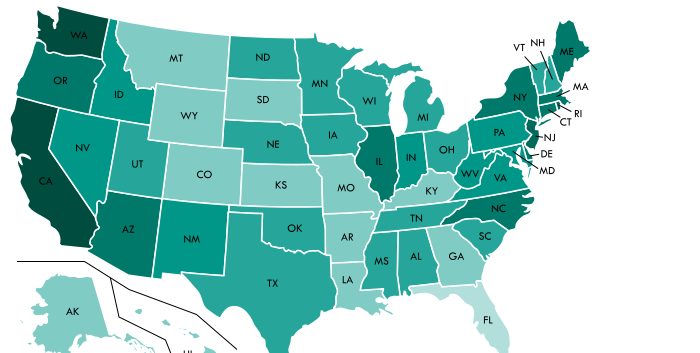
Most common states for search marketing managers
| Rank | State | Population | # of jobs | Employment/ 1000ppl |
|---|---|---|---|---|
| 1 | District of Columbia | 693,972 | 315 | 45% |
| 2 | Vermont | 623,657 | 205 | 33% |
| 3 | Rhode Island | 1,059,639 | 286 | 27% |
| 4 | Utah | 3,101,833 | 793 | 26% |
| 5 | Washington | 7,405,743 | 1,642 | 22% |
| 6 | New Hampshire | 1,342,795 | 283 | 21% |
| 7 | Montana | 1,050,493 | 220 | 21% |
| 8 | Massachusetts | 6,859,819 | 1,356 | 20% |
| 9 | Illinois | 12,802,023 | 2,290 | 18% |
| 10 | Minnesota | 5,576,606 | 1,009 | 18% |
| 11 | Connecticut | 3,588,184 | 663 | 18% |
| 12 | Wyoming | 579,315 | 102 | 18% |
| 13 | New Jersey | 9,005,644 | 1,555 | 17% |
| 14 | Virginia | 8,470,020 | 1,461 | 17% |
| 15 | Colorado | 5,607,154 | 974 | 17% |
| 16 | North Dakota | 755,393 | 131 | 17% |
| 17 | Oregon | 4,142,776 | 658 | 16% |
| 18 | South Dakota | 869,666 | 140 | 16% |
| 19 | California | 39,536,653 | 5,743 | 15% |
| 20 | Maine | 1,335,907 | 200 | 15% |
Most common cities for search marketing managers
| Rank | City | # of jobs | Employment/ 1000ppl | Avg. salary |
|---|---|---|---|---|
| 1 | Niles | 1 | 3% | $85,431 |
| 2 | Fort Collins | 1 | 1% | $65,000 |
| 3 | Pasadena | 1 | 1% | $96,177 |
| 4 | San Diego | 3 | 0% | $92,829 |
| 5 | Minneapolis | 1 | 0% | $72,676 |
Search Marketing Manager job outlook: Expert opinions
Our panel of search marketing manager experts
City University of Seattle
North Dakota State University
Siena College
Siena College

University of Scranton

University of Houston - Downtown
University of Houston - Downtown

University of West Georgia
Tusculum University
Berea College
Old Dominion University

James Madison University

Seattle University

Menlo College
Kansas State University
Metropolitan State University of Denver
University of Central Missouri

Hartwick College
What general advice would you give to a Search Marketing Manager?
Rich Johnson: Most job titles have a similar salary. Sometimes the salary is better in urban spaces where the cost of living is higher as well. Before I would assess salary, I would look at the cost of living and your monthly budget to build your personal requirements. You usually need to begin work in a starting salary position, but that doesn't mean that you need to stay there for long. When you get into a role, go all in. Master everything that is asked of you and start providing ideas to solve problems. Your value isn't just your ability to complete a task, it is your ability to provide value and creative solutions. Make sure that you retain credit for your contributions and stay positive. Building value in your role is key for job security and growth. Another part of the ladder of salary growth is self advocating for raises and knowing when you have hit the ceiling in your present position. If you do hit a plateau, the options are to pursue a new role or consider taking your skills to another business. One of the most effective growth tools that I have had in my career has been through freelance. If you have the bandwidth, consider taking on some freelance work. This will build skills and new connections that can lead to your next opportunity.
What will help Search Marketing Managers increase their earning potential?
Rich Johnson: Digital media covers a lot of mediums and requires many skill sets (print, static online, animation, interactive). The print arm is a lesser component although still valuable in the scope of marketing. Smartphones, tablets and gaming have moved a lot of digital into a customer expectation of interactive and customizable content. The present model of career specialization in a certain aspect of this spectrum of skills is changing. The age of the generalist is becoming more of a reality as design tools are becoming more accessible and A.I. is assisting in the more complex tasks. I would say that someone working in digital media will need to focus more on the big picture of design, predicting trends and developing solutions from a point of view with perspective. It will be even more important to understand the needs of a system from the top down and provide solutions that enhance that system. This might be through partnering with marketing and sales to conceptualize solutions, pitching product ideas and other functions related to creative and art direction. And be curious, all of the time. Keep up to date with everything that is happening. Take classes, watch tutorials, read articles and be obsessed with the breakneck rate of change. Digital media is constantly changing and possibilities are always expanding. It can be near impossible to be a master of all of these trajectories, but you can understand them well enough to bring in a specialist when the challenge requires it. This is where I predict that A.I. will be a major paradigm shift. There will be a time when you will ask the system to solve a problem, and you can choose what parts of the process that you want to control. So to boil it down... Develop a well rounded set of skills Further develop specialist level skills where you excel Keep on top of change and keep a thirst for learning Strengthen your connection to problem solving and creative innovation Keep an eye on the future predicting what might be around the bend
What Search Marketing Manager skills would you recommend for someone trying to advance their career?
Ajay Abraham Ph. D.: Everyone is talking about AI these days, so I will start off by joining the bandwagon, but with some nuance. It's important to know how to use artificial intelligence tools in order to be better or more effective at one's job. This doesn't mean that everyone needs to become an AI expert, but that we should be able to harness the power of AI tools to improve the quality and efficiency of our work. This requires being fluent enough with AI tools to understand, discuss, and make decisions involving AI or about AI output (even if we don't actually use those tools in a hands-on manner). This should be done while also being able to bridge the gap for those who are less fluent (perhaps those in more senior-level roles who are even less hands-on with these tools). That apart, as more of the workforce focuses more of their time on technical and similar skills, "softer" skills such as integrity, professionalism, self-awareness, and team-orientation will become even more important as differentiators.
What will help Search Marketing Managers increase their earning potential?
Jennifer D'Angelo Ph.D.: Brands across many product categories are facing an increasing level of competition. Brands may struggle with rising brand parity, where brands and their competitors are seen as similar to one another. Therefore, to stand out from competitors, it has become increasingly important for brands to have marketing managers that create value for consumers and communicate that value to consumers.
Ahmad Asady
Assistant Professor of Management Faculty Scholar, Challey Institute for Global Innovation and GrowthNorth Dakota State University
Marketing
What general advice would you give to a Search Marketing Manager?
Ahmad Asady: The role of a Marketing professional is as rewarding as it is demanding. On one hand, it offers the chance to unleash creativity, see the direct impact of your work, and enjoy a variety of experiences across different projects and industries. On the other hand, it comes with its fair share of challenges, such as the pressure to perform under tight deadlines and budgets, the constant need to stay ahead in a fast-evolving field, and the stress of quantifying the effectiveness of marketing campaigns. Despite these challenges, the role remains appealing for those drawn to a career that demands both strategic thinking and creative innovation, underscored by the powerful tool of persuasion to shape consumer behavior and drive business success.
S.Sinem Atakan
Assistant Professor of MarketingSiena College
Marketing Department
What skills will help Search Marketing Managers earn the most?
S.Sinem Atakan: The most important skills for marketing graduates, especially given the remote working conditions due to the pandemic, are self-motivation, communication, and digital marketing skills. Creativity and analytical skills are always important in marketing, but pandemic has highlighted the importance of being able to work independently and motivate yourself even when external forces are not directly present. Communication skills are crucial to work remotely and be on the same page with your team members. Digital marketing was big but getting even bigger with this breakthrough changes in consumer behavior. Hence, the rising stars of the marketing job market will be graduates who can combine all these skills seamlessly
Allison Lauenstein
Teaching Instructor of MarketingSiena College
Marketing Department
What skills will help Search Marketing Managers earn the most?
Allison Lauenstein: Leadership and collaboration will go a long way. The best ideas can come from anywhere, and it's not always about who has the best idea but who can execute the idea the best. Good marketers must understand that if you cannot successfully execute or effectively communicate a great idea, it may not be so great.
Abhijit Roy
Professor of MarketingUniversity of Scranton
School of Management
What soft skills should all Search Marketing Managers possess?
Abhijit Roy: These are very important, yet harder to quantify skills, not only for marketing professionals but for business graduates in general. They include the ability to make sound decisions under pressure, having a high emotional intelligence quotient (EQ) as embodied by having empathy towards coworkers and subordinates, delegating appropriately, mentoring, communicating, time management, maintaining positivity despite setbacks and adapting to unforeseen challenges, being flexible, being persuasive and assertive at appropriate moments, yet being collaborative, seeking feedback, and the ability to negotiate and resolve conflicts when needed, amongst others.
Soft skills are typically more instrumental in enabling candidates to fit into an organization's culture and be strong candidates for promotion. Most marketing jobs involve candidates representing their brand initiatives and building strong client relationships, so interpersonal, and other soft skills are often valued more than hard skills. The strongest case for having excellent soft skills is that they are more easily transferable across various jobs and industries.
What hard/technical skills are most important for Search Marketing Managers?
Abhijit Roy: The Marketing field has undergone a major paradigmatic shift with the growth of digitization. Hence, hard/technical skills in performing data-driven marketing, social media and data analytics, data visualization, Search Engine Optimization (SEO)/Search Engine Marketing (SEM), content creation and storytelling, and omnichannel communication are critical hard skills that are in great demand today.
Dr. Richard Conde Ph.D.
Assistant ProfessorUniversity of Houston - Downtown
Marilyn Davies College of Business
What skills stand out on Search Marketing Manager resumes?
Dr. Richard Conde Ph.D.: Showcasing the balance between people management and analytical skills. Marketing today relies on a substantial amount of data, which requires marketing managers to possess strong analytical skills. At the same time, leaders have to motivate, inspire, and guide employees. In the last 3-5 years, I have seen a greater emphasis on analytical skills.
Dr. Richard Conde Ph.D.
Assistant ProfessorUniversity of Houston - Downtown
Marilyn Davies College of Business
What soft skills should all Search Marketing Managers possess?
Dr. Richard Conde Ph.D.: The need for soft skills are consistent through time. With our societal focus on social media, texting, emojis, etc. It appears to me companies are looking for the following:
- Active listening skills
- Willingness to be self-reflective and accept feedback
- Accept different perspectives. The collision of ideas creates knowledge
- Communicate to the listener (at their level). Flex communicators
- Cultural intelligence. Demographics changes will require better understanding of team member's, boss', customer's, etc. cultural context
How have salaries changed over time for Search Marketing Managers?
Dr. Richard Conde Ph.D.: - There is a small trend in sales to minimize variable comp and increase salaries. There are a few (15 or so) Silicon Valley companies limiting commissions and focusing more on salaries
- You see a correlation between higher salaries and more complex sales processes. I see that trend continuing as more transactional sales will be automated
- Increase in pay for inside sales agents as more and more sales are being handled by inside sales agents (thanks to tech and change in buying behaviors)
What are the biggest trends we'll see in the Search Marketing Manager job market given the pandemic?
Dr. Richard Conde Ph.D.: You are already seeing these trends, which will increase in the months to come:
- More remote work away from an office. Flexibility will be key for employees with more control over their time and schedule
- The increase of video in all stages of a business. We feel more comfortable communicating via all the video communication options
- More application of AI and machine learning. Companies are finally figuring out its better to work smart
- Automated personality identification. For example, Crystal Knows can provide a person's DISC profile based on an individual's LinkedIn profile. This type of information will be used by recruiters to determine fit, plus at all other departments
- Training at all levels to accommodate virtual, technology, and cultural changes
- The need for individuals at all levels of an organization to possess (based on the level) analytical skills. Data is king and there is more and more demand for individuals who can identify, interpret, and implement decisions based on complex data analysis.
Dr. Sooho Lee
Director, Master of Public Administration (MPA) Program, Professor of Public Administration and PolicyUniversity of West Georgia
Department of Civic Engagement & Public Service
What soft skills should all Search Marketing Managers possess?
Dr. Sooho Lee: Communication, networking, and interpersonal skills.
What skills will help Search Marketing Managers earn the most?
Dr. Sooho Lee: It depends on the nature of the job. Generally speaking, analytical competence, communication, strategic planning, and leadership skills will greatly help one earn more.
What will help Search Marketing Managers increase their earning potential?
Joshua Ray Ph.D.: For several years my conversations with employers concerning graduate preparation have centered around problem-solving skills and attitude. Employers desperately need employees how can identify, define, analyze, and solve business issues in real-time and who have the demeanor to work well with people inside and outside the organization. These skills also serve entrepreneurial minded individuals. More specific skills in technology, analytics, and leadership have been, and continue to be, highly sought after.
J. Ian Norris Ph.D.
Professor of Marketing and Fellow, American Council on EducationBerea College
Economics and Business Department
What certifications/licenses/courses can have the biggest impact for Search Marketing Managers?
J. Ian Norris Ph.D.: Digital marketing skills are essential for any area of marketing. Luckily there are many online certifications available for this purpose. On the research side, Google Analytics offers a certification. It will also be valuable to know the analytics platforms on social media sites such as facebook, Instagram, and TikTok. Conversely, all of these sites also offer training on digital advertising and promotion, such as Google AdWords. Any coursework in digital marketing that provides instruction in Search Engine Marketing (SEM) will also be highly valuable. Finally, digital video and editing skills are also quite valuable, as all kinds of companies and organizations are using the short video format for storytelling and brand advertising.
What will help Search Marketing Managers increase their earning potential?
Jay Walker Ph.D.: I believe answer to number two is a good response to number three. There is an increasing importance in the ability to work with and understand data. Economics offers a framework to view the world, but through the lens of understanding data.
What will help Search Marketing Managers increase their earning potential?
Richard Tate: Sales is transitioning from a "problem solving" focus to a "teaching" focus. Great sales professionals today are able to teach their clients something that the client didn't know about their product, service, competition, market, business environment, etc. Through technology and "ask Google," most professional buyers can research and gain 60-80% of the knowledge that they need to make a buying decision.
That leaves only a 20% to 40% space for a salesperson to have an impact, and that space must be filled with new ideas and new knowledge that will assist the buyer in making an informed decision. Much of business-to-business sales today is very technical and expensive. Wrong technology decisions carry far greater risk to a company today. The wrong application can quickly turn any competitive advantage over to a competitor and with today's "sticky" technologies, you may never get that customer back.
Being an expert in your field and having the boldness to challenge your buyer's thoughts and show them a different way, is how salespeople can best increase their earning potential.
Colette Hoption Ph.D.
Associate Professor of ManagementSeattle University
Albers School of Business & Economics
How have salaries changed over time for Search Marketing Managers?
Colette Hoption Ph.D.: There is no one set path for a management student, so this question is difficult to answer. Regardless of field, I think most are wise to the negative impact the pandemic has had on business, and that has tempered most people's salary expectations, including salary increases.
As leadership is cornerstone of management education, to answer this question, one could look at the alarming rate with which CEO pay has not only increased, but also increased much more than the typical worker's salary. This is distressing because it drives greater inequalities in society. In response to the pandemic, many workers' salaries were cut and that included some CEOs' pay, but the amount of that pay cut for executives, as well as plans for how and when to restore compensation levels are increasing the volume on questions about fairness, trust in leadership and social justice.
What technical skills for a Search Marketing Manager stand out to employers?
Colette Hoption Ph.D.: Stand-out technical skills likely vary by field. For example, when working with big data, database management, and data mining and modeling would be extremely important. I also imagine that programming skills would be an asset. Thinking of my field (Management) in particular, here are some technical skills that I'd emphasize: writing skills, proficiency in using collaborative decision-making tools, project management, and familiarity with productivity trackers. Finally, in an earlier question I noted that organizations may embrace more remote work; in that situation, I can see how critical it will be for managers to show that they can effectively establish goals, rally enthusiasm, coach and mentor employees from a distance. A lesson the pandemic has taught many organizations is that forging human connections in remote work is a challenge, and those who have developed the skills to do this are invaluable.
What are the biggest trends we'll see in the Search Marketing Manager job market given the pandemic?
Stephanie Dellande: The pandemic gave rise to varied ways of consumption. Many services offered by providers, e.g., curbside pick-up, since the pandemic will continue. E-learning and e-commerce will likely remain par for the course for some time to come. The presence of digital tools (Zoom, Webinar) will allow employers and employees to stay in touch. Remote work will become a norm for companies attempting to cut operational expenses and costs associate with office space. Other trends include a construction boom as government invest in infrastructure. In addition, sexy or not, the green economy is inevitable. This will offer firms an opportunity to capitalize on a demand for renewable energy technology. Companies that are responsive to providing their products to their target market(s) in new ways will likely do well. Also, potential employees will have to update their skill set to secure a position and be successful in their newfound field of work.
What technology do you think will become more important and prevalent for Search Marketing Managers in the next 3-5 years?
Dr. Esther Swilley: Mobile technology was the trend for the last ten years, but now we need home-based technology. What is going to make "my space" a better "office space." This will also include mobile, as people set up offices in their homes, their kids/parents' homes, and in their vacation homes. Folding monitors, hot spots, of course, as well as more powerful machines that can handle each family member at the same time. It will also mean more cloud usage - both personal and professional use.
Darrin C. Duber-Smith
Senior LecturerMetropolitan State University of Denver
What skills stand out on Search Marketing Manager resumes?
Darrin C. Duber-Smith: Hiring managers are looking for specific accomplishments rather than generalized statements like "team player" or "motivated self-starter". Those self-descriptive terms have become hackneyed and have lost much of their meaning. Focus on hard skills (such as marketing planning or fluency with a particular software tool) as well as specific educational and career achievements you can identify. Degrees in the more rigorous majors are often just the beginning.
Joe Moore Ph.D.
Professor of Communication Program Coordinator, Digital Media ProductionUniversity of Central Missouri
Department of Communication
What are the biggest trends we'll see in the Search Marketing Manager job market given the pandemic?
Joe Moore Ph.D.: I think we are going to see a lot more unique content that is created through programs like Zoom. I also believe we are going to see more innovation. Digital media students and professionals are creative, and they have a hard time sitting still. I believe they'll keep telling stories, which means we could well see an uptick in blogging and podcasts. I think the storytelling will continue.
Pauline Stamp Ph.D.
Associate ProfessorHartwick College
Department of Business Administration and Accounting
How do you envision technology impacting Search Marketing Managers in the next 5 years?
Pauline Stamp Ph.D.: The student/graduate that can seamlessly transition from F2F to C2C to written communication and skillfully be productive, regardless of the modality, will be in very high demand. Students/graduates need to be constantly learning new software and technology, and learning how to use these tools, skillfully, in every situation. Communication has always been the #1 driver of success, that will never change - the way it is conducted will always change.