Explore jobs
Find specific jobs
Explore careers
Explore professions
Best companies
Explore companies
Job outlook for senior accounts payable specialists in the United States
Senior accounts payable specialist job growth summary. After extensive research, interviews, and analysis, Zippia's data science team found that:
The projected senior accounts payable specialist job growth rate is -5% from 2018-2028.
About -77,200 new jobs for senior accounts payable specialists are projected over the next decade.
Senior accounts payable specialist salaries have increased 10% for senior accounts payable specialists in the last 5 years.
There are over 65,907 senior accounts payable specialists currently employed in the United States.
There are 31,611 active senior accounts payable specialist job openings in the US.
The average senior accounts payable specialist salary is $60,557.
Are senior accounts payable specialist jobs in demand?
Senior accounts payable specialist job and salary trends over time
Senior accounts payable specialist jobs over time
Senior accounts payable specialist job growth rate over time
| Year | # of jobs | % of population |
|---|---|---|
| 2021 | 65,907 | 0.02% |
| 2020 | 63,321 | 0.02% |
| 2019 | 65,845 | 0.02% |
| 2018 | 65,635 | 0.02% |
| 2017 | 64,997 | 0.02% |
Average senior accounts payable specialist salary over time
Senior accounts payable specialist salary by year
| Year | Avg. salary | Hourly rate | % Change |
|---|---|---|---|
| 2026 | $60,557 | $29.11 | +2.9% |
| 2025 | $58,872 | $28.30 | +2.5% |
| 2024 | $57,458 | $27.62 | +2.5% |
| 2023 | $56,030 | $26.94 | +2.2% |
| 2022 | $54,817 | $26.35 | +3.1% |
Senior accounts payable specialist jobs by state
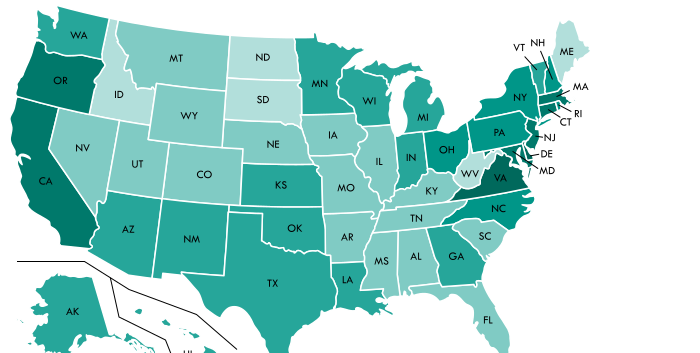
Most common states for senior accounts payable specialists
| Rank | State | Population | # of jobs | Employment/ 1000ppl |
|---|---|---|---|---|
| 1 | District of Columbia | 693,972 | 180 | 26% |
| 2 | Delaware | 961,939 | 118 | 12% |
| 3 | Massachusetts | 6,859,819 | 723 | 11% |
| 4 | Oregon | 4,142,776 | 433 | 10% |
| 5 | Iowa | 3,145,711 | 316 | 10% |
| 6 | Nebraska | 1,920,076 | 201 | 10% |
| 7 | Montana | 1,050,493 | 103 | 10% |
| 8 | Virginia | 8,470,020 | 743 | 9% |
| 9 | Maryland | 6,052,177 | 540 | 9% |
| 10 | Minnesota | 5,576,606 | 523 | 9% |
| 11 | New Hampshire | 1,342,795 | 116 | 9% |
| 12 | North Dakota | 755,393 | 66 | 9% |
| 13 | Pennsylvania | 12,805,537 | 965 | 8% |
| 14 | Colorado | 5,607,154 | 476 | 8% |
| 15 | Utah | 3,101,833 | 257 | 8% |
| 16 | Vermont | 623,657 | 50 | 8% |
| 17 | Ohio | 11,658,609 | 801 | 7% |
| 18 | North Carolina | 10,273,419 | 684 | 7% |
| 19 | New Jersey | 9,005,644 | 606 | 7% |
| 20 | Arizona | 7,016,270 | 510 | 7% |
Most common cities for senior accounts payable specialists
| Rank | City | # of jobs | Employment/ 1000ppl | Avg. salary |
|---|---|---|---|---|
| 1 | Englewood | 1 | 3% | $54,682 |
| 2 | Gurnee | 1 | 3% | $54,125 |
| 3 | Los Gatos | 1 | 3% | $75,024 |
| 4 | Aliso Viejo | 1 | 2% | $70,814 |
| 5 | Buffalo Grove | 1 | 2% | $54,072 |
| 6 | Arlington Heights | 1 | 1% | $54,054 |
| 7 | Camden | 1 | 1% | $72,785 |
| 8 | Houston | 2 | 0% | $61,101 |
| 9 | Anaheim | 1 | 0% | $71,092 |
| 10 | Atlanta | 1 | 0% | $58,226 |
| 11 | Baltimore | 1 | 0% | $70,863 |
| 12 | Chicago | 1 | 0% | $54,152 |
| 13 | Irvine | 1 | 0% | $70,918 |
| 14 | New York | 1 | 0% | $65,359 |
| 15 | San Francisco | 1 | 0% | $75,307 |
Senior Accounts Payable Specialist job outlook: Expert opinions
Our panel of senior accounts payable specialist experts
University of the Virgin Islands

Centenary University
Fairleigh Dickinson University
Florida International University
Winona State University

Bucknell University
Francisco Depusoir
Associate Professor of AccountingUniversity of the Virgin Islands
School of Business
What skills stand out on Senior Accounts Payable Specialist resumes?
Francisco Depusoir: The following skills could open the door to various opportunities for an accounting graduate on their resume.
-Excellent analytical skills
-Knowledge of Microsoft Excel
-Knowledge of Quickbooks
What skills will help Senior Accounts Payable Specialists earn the most?
Francisco Depusoir: -Accountants should be able to communicate with departments and clients.
-Written and oral communication as accountants usually have to give presentations.
-Accountants should be able to pay attention to details.
-Technological skills. Technology is constantly changing and evolving. Accountants must acquire the necessary technical skills since most of the work is done through a computer using applications.
-Data analysis: Accountants are surrounded by data, bookkeeping, tax returns, payroll reports, and tax planning which all rely on strong data analysis skills.
Frank Longo
Assistant Professor of BusinessCentenary University
Business Department
What soft skills should all Senior Accounts Payable Specialists possess?
Frank Longo: The skills listed above in question number one are soft skills. They are the skills that truly differentiate the candidate. All candidates are expected to possess hard skills such as excel proficiency. It is the soft skills that get the job done. The ability to solve problems and to lead a team are the top requirements. Recent studies conducted by the National Association of Colleges and Employers consistently arrived at this conclusion, as did a recent Centenary University survey that included New Jersey and New York employers. These skills can be demonstrated through work experience, internships, and extra-curricular activities, including clubs and sports, which can serve as examples.
What hard/technical skills are most important for Senior Accounts Payable Specialists?
Frank Longo: Proficiency with emerging technology is an attention-getter. We should note that the Certified Public Accountants Exam will contain three sections by 2024, including Data Analytics, Tax Compliance and Planning, and Information System and Controls. A basic knowledge will be required in each of these, and the CPA candidate will identify one area of the above for more detailed testing. This change in knowledge requirements reflects the skills employers see as most important to hire. Using technology in any of these areas can move a candidate to the top of the hiring list. We should emphasize that the job candidate does not need to be an expert in each area, but the ability to effectively use technology in one area is important. Employers are looking for the ability to use technology in information security, business processes, information systems, IT audits, data analytics, and tax planning but not all of them.
Keep in mind that successful firms performed audits, prepared tax returns, advised clients on data security, and much more during the pandemic, and they often did so remotely. This can be expected to continue into the future.
What technical skills for a Senior Accounts Payable Specialist stand out to employers?
Zev Fried Ph.D.: For accountants, the same skills that were always needed such as proficiency with numbers, use of different types of computer software, and problem identification and solving are still needed. Emerging from the pandemic, there are also added skills such as the ability to work remotely and collaborate and share your work that will be important to employers.
What soft skills should all Senior Accounts Payable Specialists possess?
Jose Aldrich: -Strong relationship building skills. Trusted relationships with peers, bosses and clients/customers are key.
-Analytical abilities. A lot of the work will involve interpreting data and using business analytics.
-Effective decision making. Identifying business risks and courage to take calculated risks in business.
-Leadership skills
-Ability to speak up at meetings.
-Organizational skills
Will there be an enduring impact of the coronavirus pandemic on Senior Accounts Payable Specialists?
Jodi Olson: We expect our graduates to be even more resilient to change and highly technology savvy, because of the necessary adaptations and remote workflow requirements students have had to overcome in achieving academic success and internship responsibilities during the pandemic. We see this as an enhancement to the skills they will bring to their employers, which already expect incoming graduates to be on the cutting edge of technological advancements, working toward a paperless environment, and keeping up with the many recent and continuing changes for the profession.
What are the biggest trends we'll see in the Senior Accounts Payable Specialist job market given the pandemic?
Curtis Nicholls Ph.D.: In my opinion, we are likely to see a major shift to flexible work arrangements that are actually flexible. In the past, many firms have advertised flexible work arrangements that were only flexible to a point, with historic rigidity lurking under the surface. I think the pandemic has provided evidence that employee arrangements can be more flexible (e.g. remote, alternative schedules, etc.) with employees able to maintain a high level of productivity.
From the employee's perspective, this is welcome news. However, the shift to remote work and other pandemic trends have made the line between work/life blurrier. I've discussed with several former students the challenge remote work has created as flexible schedules often mean late-night meetings or critical emails at odd hours. The advent of technology, beginning with email and accelerating through Blackberrys to iPhones, already blurred those lines, but remote work has provided additional accelerant.
What skills stand out on Senior Accounts Payable Specialist resumes?
Curtis Nicholls Ph.D.: The obvious trends are going to become more pronounced: coding and technology-related skills. I think we are going to see an elevation in the coding expectations. In the future, I expect employers to begin providing coding assessments to potential candidates. This is a common feature of engineering and finance jobs, and I think we will see it with respect to claims about coding prowess.
Data skills will also continue to become more prevalent across all business disciplines. Employers are looking for experience with large data sets, data visualization software (e.g. Tableau, PowerBI, Alteryx, etc.) and statistical analysis. Data has become a major currency, and employees' ability to utilize data for decision making will be critical to success in the employment marketplace.
Beyond the obvious, I think the pandemic has also shifted focus to skills surrounding resilience and motivation. I've heard employers during the pandemic express surprise at the disparity of responses to the pandemic: some employees made the pivot to remote work seamlessly, others required significantly more support. Skills that demonstrate resilience, such as group work, honors programs, etc. will become more important.
I would encourage job seekers to highlight skills learned during the pandemic. I would anticipate a regular interview question inquiring about how the job seeker used their extra time during the pandemic. The most common answers will likely include lots of Queen's Gambit and Tiger King, but employers will look for answers surrounding the development of new skills or acquired certifications. Imagine the employer's thoughts when you suggest that you used the extra time to pursue a lifelong dream such as learning to play the piano or guitar. If you missed the early pandemic window of opportunity, take advantage now!
This line of questions may precede a dangerous trend for employers to look for indications of mental strength. I find this possibility disheartening as we could see employers screening employees with mental health challenges at a time when the solidarity of a job could provide much needed structure.