Explore jobs
Find specific jobs
Explore careers
Explore professions
Best companies
Explore companies
Job outlook for senior application programmers in the United States
Senior application programmer job growth summary. After extensive research, interviews, and analysis, Zippia's data science team found that:
The projected senior application programmer job growth rate is -7% from 2018-2028.
About -17,900 new jobs for senior application programmers are projected over the next decade.
Senior application programmer salaries have increased 12% for senior application programmers in the last 5 years.
There are over 137,240 senior application programmers currently employed in the United States.
There are 198,092 active senior application programmer job openings in the US.
The average senior application programmer salary is $113,636.
Are senior application programmer jobs in demand?
Senior application programmer job and salary trends over time
Senior application programmer jobs over time
Senior application programmer job growth rate over time
| Year | # of jobs | % of population |
|---|---|---|
| 2021 | 137,240 | 0.04% |
| 2020 | 199,172 | 0.06% |
| 2019 | 161,156 | 0.05% |
| 2018 | 334,177 | 0.10% |
| 2017 | 335,492 | 0.10% |
Average senior application programmer salary over time
Senior application programmer salary by year
| Year | Avg. salary | Hourly rate | % Change |
|---|---|---|---|
| 2026 | $113,636 | $54.63 | +3.4% |
| 2025 | $109,892 | $52.83 | +2.3% |
| 2024 | $107,404 | $51.64 | +2.5% |
| 2023 | $104,804 | $50.39 | +3.0% |
| 2022 | $101,746 | $48.92 | +0.4% |
Senior application programmer jobs by state
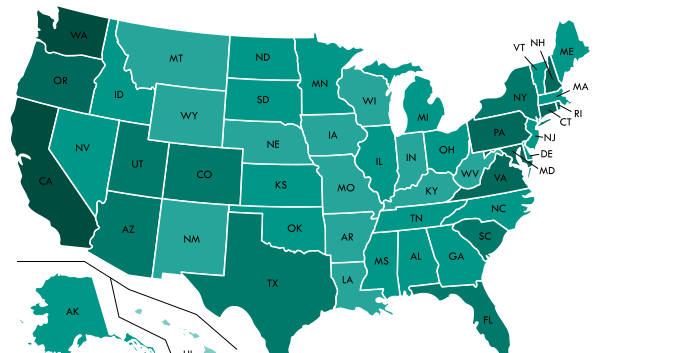
Most common states for senior application programmers
| Rank | State | Population | # of jobs | Employment/ 1000ppl |
|---|---|---|---|---|
| 1 | District of Columbia | 693,972 | 572 | 82% |
| 2 | Massachusetts | 6,859,819 | 2,332 | 34% |
| 3 | Vermont | 623,657 | 202 | 32% |
| 4 | Delaware | 961,939 | 303 | 31% |
| 5 | Washington | 7,405,743 | 2,181 | 29% |
| 6 | Rhode Island | 1,059,639 | 300 | 28% |
| 7 | Virginia | 8,470,020 | 2,245 | 27% |
| 8 | Oregon | 4,142,776 | 1,118 | 27% |
| 9 | Utah | 3,101,833 | 849 | 27% |
| 10 | Maryland | 6,052,177 | 1,543 | 25% |
| 11 | Minnesota | 5,576,606 | 1,324 | 24% |
| 12 | New Hampshire | 1,342,795 | 325 | 24% |
| 13 | Montana | 1,050,493 | 254 | 24% |
| 14 | North Dakota | 755,393 | 163 | 22% |
| 15 | California | 39,536,653 | 8,354 | 21% |
| 16 | Colorado | 5,607,154 | 1,198 | 21% |
| 17 | Wyoming | 579,315 | 120 | 21% |
| 18 | North Carolina | 10,273,419 | 2,045 | 20% |
| 19 | New Jersey | 9,005,644 | 1,790 | 20% |
| 20 | Alaska | 739,795 | 140 | 19% |
Most common cities for senior application programmers
| Rank | City | # of jobs | Employment/ 1000ppl | Avg. salary |
|---|---|---|---|---|
| 1 | Charlottesville | 1 | 2% | $120,998 |
| 2 | Downey | 1 | 1% | $128,819 |
| 3 | Rockville | 1 | 1% | $113,805 |
| 4 | Charlotte | 1 | 0% | $100,372 |
| 5 | Houston | 1 | 0% | $110,992 |
| 6 | Irvine | 1 | 0% | $127,703 |
| 7 | Jersey City | 1 | 0% | $100,301 |
| 8 | San Diego | 1 | 0% | $125,642 |
Senior Application Programmer job outlook: Expert opinions
Our panel of senior application programmer experts
Nova Southeastern University
University of Wisconsin - Eau Claire
Nova Southeastern University
Mount St. Joseph University
University of Richmond
Idaho State University
Texas Christian University

Wright State University

University of Guam

University of Hawaii at Hilo
Indiana University Southeast
University of Minnesota - Crookston

Gannon University
The University of Arizona
Rose-Hulman Institute of Technology
University of Toledo
Metropolitan State University of Denver

Eastern Washington University

Weber State University

Landmark College
Junping Sun Ph.D.
ProfessorNova Southeastern University
Computer Software And Media Applications
What Senior Application Programmer skills would you recommend for someone trying to advance their career?
Junping Sun Ph.D.: Computer Science and its applications in various fields are very dynamic and constantly evolving, and anyone in the fields needs to prepare to be adaptive by lifelong learning.
What will help Senior Application Programmers increase their earning potential?
Lyle Ford: Computer skills (programming, working effectively with AI, and the like) will be important as the world continues to automate. The ability to design, build, and repair electronic and electromechanical systems will also be important for the same reason.
What will help Senior Application Programmers increase their earning potential?
Dr. Frank Mitropoulos Ph.D.: As we look toward the future of careers in Computer Applications, several skills stand out for their growing importance. These skills revolve around specific technologies that are expected to continue to grow and evolve. Technologies related to Cloud Computing, Artificial Intelligence (AI), Cybersecurity, and Data Science are quickly evolving and being applied across the technology sector. Cloud Computing: Given the widespread adoption of Cloud services, Cloud computing expertise is indispensable. Understanding how to leverage platforms like Azure, AWS, and Google Cloud is crucial to developing scalable, efficient solutions that meet business needs. Artificial Intelligence: AI and Machine Learning are transforming the world. Skills in these areas to solve real-world problems will be even more critical in the future. Cybersecurity: Digital threats are becoming more sophisticated. Safeguarding data, networks, and systems will require encryption, intrusion detection, development, and regulation skills. Data Science: Skills in Data Science will be increasingly sought after as businesses embrace data-driven decision-making. Extracting meaningful insights from extensive datasets and effectively communicating these findings will be essential. Soft skills: Finally, soft skills such as teamwork, problem-solving, and effective communication cannot be overlooked. Adapting, communicating, and leading will be essential for success.
Rebecca Allen
Mount St. Joseph University
Special Education And Teaching
What general advice would you give to a Senior Application Programmer?
Rebecca Allen: AI, for sure. I have heard it said that AI might not replace humans, rather humans who know how to use AI well may replace humans who don't.
Ahmed Temani
Senior InstructorUniversity of Richmond
Computer/Information Technology Administration And Management
What general advice would you give to a Senior Application Programmer?
Ahmed Temani: A lot of the buzz is about using chatbots to improve coding efficiency. However, there is a great need for systems level thinking and design as software is deployed across cloud and edge computing devices. Gaining more experience in systems design provides you with additional skills that complement whatever AI-based technology gets deployed.
What Senior Application Programmer skills would you recommend for someone trying to advance their career?
Ahmed Temani: This one I'm not sure how to answer as it is too broad. I would say work hard and do quality work, but that seems obvious.
What Senior Application Programmer skills would you recommend for someone trying to advance their career?
Nikyra Capson: Don't be afraid of being rejected. If they see a job they want, apply. Even if they don't think they'll get it, still apply. The worst thing that could happen is being told no. Not applying is an automatic no, so they might as well try.
Dr. Brandon Chicotsky
Assistant Professor of Professional Practice in Marketing at the TCU Neeley School of BusinessTexas Christian University
Specialized Sales, Merchandising And Marketing Operations
What general advice would you give to a Senior Application Programmer?
Dr. Brandon Chicotsky: Continually upskill, and each week (or more often), demo software that helps create efficiencies and accelerations in your workflow. Do this in collaboration with a senior colleague to strengthen your discernments and implementation potential. Be an 'all in' professional beyond any one particular strategy at work. Embody the industry, attend conferences, and internalize the insights and language of your categories' thought leaders.
Daniel Asamoah Ph.D.
Associate Professor and Interim ChairWright State University
Information Systems and Supply Chain Management Department
What skills stand out on Senior Application Programmer resumes?
Daniel Asamoah Ph.D.: Web Developer: JavaScript, HTML5, CSS, PHP, Python, APIs, Web user interface design.
What skills will help Senior Application Programmers earn the most?
Daniel Asamoah Ph.D.: Particularly for a web developer, HTML/CSS skills, scripting langue competency, communication skills.
James Sellmann Ph.D.
Dean, Professor of Philosophy and Micronesian StudiesUniversity of Guam
College of Liberal Arts & Social Sciences
What general advice would you give to a Senior Application Programmer?
James Sellmann Ph.D.: General advice is to keep in mind that you must leverage your skills, especially your soft skills of being able to work with people, to communicate effectively and to be able to solve problems. Be real. Don't try to pretend to be someone else to impress others. Be your authentic self. And show up on time.
What Senior Application Programmer skills would you recommend for someone trying to advance their career?
James Sellmann Ph.D.: General advice is to keep in mind that you must leverage your skills, especially your soft skills of being able to work with people, to communicate effectively and to be able to solve problems. Be real. Don't try to pretend to be someone else to impress others. Be your authentic self. And show up on time.
Travis Mandel Ph.D.
Assistant ProfessorUniversity of Hawaii at Hilo
Department of Computer Science
What soft skills should all Senior Application Programmers possess?
Travis Mandel Ph.D.: Although computer science seems like a highly technical field, soft skills are really what differentiates software engineers. One of the most important qualities of any software engineer is explaining their code clearly at various levels of technical depth and explaining why certain design decisions were made. You could write code that does amazing things, but if that code consists of snippets you pasted from StackOverflow without really fully understanding them, it will be a huge headache for anyone who needs to come into the codebase later and maintain or update it.
Another one is asking the right questions. Imagine you are dropped into a huge codebase and asked to add a new feature (very common!). There's no time to understand everything that is going on, but on the other hand, you need to understand enough of the code to do your task effectively, which involves asking questions. A failure to ask questions will likely result in you wasting a huge amount of time working on something that is ultimately not useful, for instance, re-implementing a complex function that already exists somewhere in the codebase.
Chris Sexton
Visiting Lecturer of Computer ScienceIndiana University Southeast
Computer Science Department
What hard/technical skills are most important for Senior Application Programmers?
Chris Sexton: As with soft skills, technical skills in teamwork matter, a candidate must have the ability to work with revision control, be it git or some similar system. In addition, it is vital that fundamental computing skills such as operating the shell of a Linux machine are good signs that a candidate will be able to adapt to new systems.
What soft skills should all Senior Application Programmers possess?
Chris Sexton: Teamwork is the obvious soft skill that is vital. It encompasses more than just being willing to work together but also includes strong documentation skills, textual communication skills, and precision in language. For an example of precision, which of the following is a task that can be completed:
"The login system will require strong passwords."
or
"The login system will require passwords of no less than 16 characters including at least two numbers and two non-alpha numeric characters."
It is easy for an engineer to be lax and use informal language that subtly confuses development efforts, but the valuable candidate will have strong technical communication skills.
Christine Bakke
LecturerUniversity of Minnesota - Crookston
Math, Science & Technology Department
What are the biggest trends we'll see in the Senior Application Programmer job market given the pandemic?
Christine Bakke: For many years remote tech support has been a growing field, but it was not the norm. Today, remote tech support and IT management have become crucial for daily operations. Remote work requires a solid IT infrastructure, cybersecurity, capable equipment, and quality software. The need for educated and experienced MIS / ITM / CIS will continue to increase.
Trends toward remote offices will become more acceptable and common; while some companies will return to the office en masse, others will allow more flexibility or become hybrid, and some will truly embrace the remote office. Use of remote tools such as Zoom will stay strong, as they provide global access at a huge cost benefit.
What certifications/licenses/courses can have the biggest impact for Senior Application Programmers?
Christine Bakke: MIS is a technical business degree which is offered with slightly different emphasis depending on the school's home department. For example, if a business department houses the degree it is often referred to as MIS; however, when Information Technology or Computer Science departments house this degree, the program would be called Information Technology Management (ITM) or Computer Information Systems (CIS). Each university has the autonomy to offer variations based on their specializations. Even though the programs can differ slightly, in general students receiving any of these three degrees receive an education in three areas: technical, management/business, and soft skills. Note that the US Bureau of Labor Statistics directs queries for all three fields (ITM, MIS and CIS) to the same data page (see answer to question 3).
How have salaries changed over time for Senior Application Programmers?
Christine Bakke: In previous questions, I have used my own wording; however, the US Bureau of Labor Statistics is the most accurate source for an answer to this question:
The median pay for ITM, MIS, & CIS (all listed together at the US Bureau of Labor Statistics):
$146,360 per year
$70.37 per hour
"Employment in computer and information technology occupations is projected to grow 11 percent from 2019 to 2029, much faster than the average for all occupations. These occupations are projected to add about 531,200 new jobs. Demand for these workers will stem from greater emphasis on cloud computing, the collection and storage of big data, and information security. "
Are there any particularly good places in the United States for Senior Application Programmers to find work opportunities?
Dr. Stephen Frezza Ph.D.: Computing is ubiquitous, and with more industries moving to remote work, location is becoming less critical. If the internet reaches a place reliably, computing jobs can be located there.
How do you envision technology impacting Senior Application Programmers in the next 5 years?
Dr. Stephen Frezza Ph.D.: Breadth and depth: Computing is becoming more like engineering; where the value of the product, its lifetime risks, costs, and benefits are more critical than just it's roll-out. So the engineering competencies that have always been a part of computing will become more central. Computing is also expanding; the role of data and the shift of once-research technologies (like machine learning) into production applications will continue to require computing graduates to broaden their base and continue as learners. This will cause shifts in what is considered 'fundamental' and the need for professionals to continue to hone and redevelop their technical skill sets.
Tyler Conklin
LecturerThe University of Arizona
Computer science Department
What are the biggest trends we'll see in the Senior Application Programmer job market given the pandemic?
Tyler Conklin: The impact of the pandemic on the job market is limited in computer science. We are lucky to be in a field where remote work was routine long before the pandemic. This isn't true of all software engineering jobs, but many can be done with only a computer and internet access. The biggest changes come in the interviewing process and how the actual work will occur. It may be a long time before new hires ever meet their coworkers face to face.
What certifications/licenses/courses can have the biggest impact for Senior Application Programmers?
Tyler Conklin: A bachelor's degree in computer science will always help job prospects. I would consider it a great investment. However, some companies have made it clear that they are willing and happy to hire graduates of computer science boot camps. These are shorter courses aimed at teaching the student one specific technology or a very specific set of skills so that student can acquire a job in a certain subfield of software engineering. This is a much cheaper alternative than a traditional four-year degree. The tradeoff is less breadth of knowledge and more limited job options, and of course missing out on everything else that comes with a four-year degree. An even more efficient way to increase job prospects is to work on personal projects. Few things impress an interviewer more than a candidate showing off an application that he or she built on their own. What can show an interviewer that you can do the job better than a project demonstrating the required skills and knowledge?
How have salaries changed over time for Senior Application Programmers?
Tyler Conklin: Computer scientists and software engineers have been fortunate in seeing salaries continually increase in the field. Computer science student enrollment has continued to skyrocket, leading to a larger workforce, but it appears that demand continues to grow even faster.
Will there be an enduring impact of the coronavirus pandemic on Senior Application Programmers?
J.P. Mellor: I'm sure the pandemic will have an enduring impact on all of us. Our students are certainly experiencing new challenges as they strive to learn during the pandemic. They are aquiring skills and competencies associated with working remotely and engaging while doing so. These are skills that students in past years did not attain.
What's a day at work look like for a Senior Application Programmer?
J.P. Mellor: I'm not sure that what our graduates do has changed at all. How they do it has changed somewhat. All of us are learning to connect and engage remotely. Whether they're a recent grad or a not so recent grad they all are learning new skills as a result of the impact of the pandemic.
What will help Senior Application Programmers increase their earning potential?
J.P. Mellor: Our graduates are particularly good at making positive progress even when the way forward is not clear, they don't know how to do what needs to be accomplished, and/or they've never done it before. This is a skill set requires a solid technical foundation and makes our graduates especially valuable.that is part
What certifications/licenses/courses can have the biggest impact for Senior Application Programmers?
Jared Onyango Oluoch Ph.D.: In databases - various Oracle database certifications; in networking - Cisco CCNA; in cybersecurity CompTIA security. Engineering and engineering technology graduates will boost their earning potentially by getting the Professional Engineer (PE) license.
What are the biggest trends we'll see in the Senior Application Programmer job market given the pandemic?
Jared Onyango Oluoch Ph.D.: We are already seeing a lot of professionals working remotely. This trend will likely continue especially in domains such as software engineering. With this may also occur lack of social connections and team building that we have seen over the years with people working in offices or facilities.
How have salaries changed over time for Senior Application Programmers?
Jared Onyango Oluoch Ph.D.: I think salaries in academia especially in Computer Science and Engineering Technology are rising and are expected to given the demand of graduates in these areas.
Janos Fustos Ph.D.
ProfessorMetropolitan State University of Denver
Department of Computer Information Systems and Business Analytics
Will there be an enduring impact of the coronavirus pandemic on Senior Application Programmers?
Janos Fustos Ph.D.: I think the impact will not be that much on the graduates but on the environment where they start their professional career and how they have completed their studies.
This pandemic has changed many aspects of our lives - among others how we work (or stat to work) and how we learn. Being in higher education I can definitely see both. The home office became the standard working environment with all the advantages and several disadvantages. You do not have to go/travel to your corporate office, you may be available even at odd hours to work, some find the home environment more relaxing, there are less formalities, some might communicate easier in writing or from behind a turned-off camera, they could take advantage of personal schedule and individual peek times, more control over their schedules etc.
But even as you work at home you may experience more disruption, you are more available for personal/family affairs, you may not have that much opportunity to interact with colleagues and miss opportunities for meaningful discussions for extending your knowledge base, networking, you have to deal with technical issues on your own or less support etc.
Some similar issues can be mentioned when it comes to changes in the way we participate in education. Most of the class meetings are online with limited individual interaction and/or access to teachers, less direct interaction with classmates, technical challenges, home office setup challenges etc. All these together impact students/graduates differently: some take these as an advantage while some others are impacted more by the disadvantages. But whichever we look at that I think there is a definite impact of the pandemic on all of us and while we have already spent about 10-12 month in this "splendid isolation" and survived more or less so far, we do not know if it may have more enduring or serious impact on our lives - that needs to be seen from a much longer perspective.
What's a good job out of college for Senior Application Programmers?
Janos Fustos Ph.D.: I hope students are asking that question before they enroll in the first course at a college because otherwise, they would waste lot of time and money to work on a degree or a career path that does not fulfill their goals and personal interest. In that sense any job is a good job that somebody understands, feels that he/she is a good fit and can live up to the imposed challenges, and has the knowledge/skills to work in the field. There are interesting and self-fulfilling jobs to choose from. Certainly, it starts with the definition what a "good" means to an individual, what are the attributes of that definition: is that the professional area, is the salary, is it the challenging nature, is it more about the working environment and the people they can work with, is it the promotion options, the high impact etc. There are several lists available on the internet that provide recommendations and track the different aspects of job selection options for seekers.
What technical skills for a Senior Application Programmer stand out to employers?
Janos Fustos Ph.D.: These days - since we went to the home office - everybody is looking for solutions that gives more and better support to remote workers. Organizations are looking for options where they can connect back to the organizations'' networks to complete their work. But that means much more work for the IT folks to make that happen and do that safely and securely. That means they are looking for individuals with technical skills that are in or closely related fields: security engineers and analysts, business analysts, data administrators, cloud service operators, network specialists etc.
Also, employers are looking for more experienced professional who can hit the ground running because their needs are more pressing and immediate, so they do not have too much time for training and education. But they are also looking for trainers to better educate users about their working environments and the changing working conditions. Users have to rely a bit more on these trainings because they cannot enjoy the immediate and direct IT support in their homes. In addition to that (or to extend that) helpdesk people are also in high demand who have the technical and also the people's skills to troubleshoot the problems that occur in highly uncertain and diverse environments.
Christian Hansen Ph.D.
Professor and Department ChairEastern Washington University
Department of Mathematics
What are the biggest trends we'll see in the Senior Application Programmer job market given the pandemic?
Christian Hansen Ph.D.: Within the short-term, the biggest trend in the job market is currently an increased demand for workforce in the healthcare and technology disciplines. In the long-term, healthcare will remain in demand, but I predict the highest future increase will be in the areas of data science, software and computer engineering.
What soft skills should all Senior Application Programmers possess?
Christian Hansen Ph.D.: The soft skills that all graduates should possess include strong communication and teamwork skills regardless of the discipline. Analytical skills will be in high demand, as well as the ability to adapt and learn new technology. Data will continue to play a bigger role in almost any type of business; therefore, the ability to analyze and interpret data for decision making will be increasingly critical. Many jobs in the future are jobs that do not yet exist and as a result, new graduates must have the ability to adapt.
What's a day at work look like for a Senior Application Programmer?
Christian Hansen Ph.D.: In the post-pandemic era, a typical workday for a recent graduate will likely involve some form of remote work. I predict that many businesses will benefit from the reduced cost of remote infrastructure compared to the cost of maintaining brick and mortar office space. Many new graduates will continue to spend their day on a computer while collaborating in teams via Zoom and other teleconference tools. People working in disciplines that have traditionally been "on the ground" will move towards more hybrid modes of work, reducing the need for travel and participating in face-to-face meetings and training.
What certifications/licenses/courses can have the biggest impact for Senior Application Programmers?
Dr. Kyle Feuz Ph.D.: Any time you have a certification, license or degree it's going to give you a leg up compared to your peers with similar skill sets but no certification. Often the certification or degree will help your resume make it through an initial screening process but then it's up to you to demonstrate that you have the knowledge and skills the certification is supposed to represent. It's also important to know what career you want to pursue. Certifications are usually targeted to a very limited skill set. If that skill set is a critical part of the job description then the certification will be a strong mark in your favor. Some fields even require certification before you will be considered for the position. However, if the skill set is only tangentially related to the job description then there is little benefit in having the certification.
What soft skills should all Senior Application Programmers possess?
Dr. Kyle Feuz Ph.D.: The top three things I hear from employers when talking about soft-skills are communication, collaboration, and ethics. They need employees who know how to communicate professionally in both written communications and oral communications. They also need employees who can work with others. You may be working internally with colleagues or externally with customers, clients and business partners but there are very few positions where collaborating with others is not a large part of the job. Finally, employers are looking for trustworthy employees. Many technical positions involve working with sensitive data, and no amount of technical controls can compensate for unethical or untrustworthy employees. All three of these soft skills are only going to increase in importance with the rise in remote work. Remote work cannot function successfully without good communication, collaboration and ethical behavior.
John Russo
Associate Professor and Program Coordinator of Computer ScienceLandmark College
STEM Department
Will there be an enduring impact of the coronavirus pandemic on Senior Application Programmers?
John Russo: My sense is that the coronavirus pandemic has had an enduring impact on all of society. Our graduates this year will have missed out on the opportunity to present their senior project to a group and to participate in a poster fair. The pandemic will impact the way that graduates work, in the sense that they will have had to learnt to adapt to a new learning modality fairly quickly. This can be difficult for students who struggle with executive functioning. On the positive side, students have learned to adapt to change quickly. This is a very good skill to have, since working in a technical field often involves managing and dealing with change. Over the span of one's career, there will be much change in programming languages used, technologies, etc. Learning to adapt is something that often takes some time to learn in the workplace. Our graduates this year will have acquired this skill before being employed.
What's a day at work look like for a Senior Application Programmer?
John Russo: Many companies will continue to have employees work remotely. This means that one has to be a self-starter, able to focus and stay on task. Some jobs, such as a network administrator, might not look much different than pre-pandemic. Others, such as software engineer, will be different. Much of the collaboration will take place virtually. One piece that will be missing from the workday for recent graduates is socializing and building a team outside of the boundaries of work.
What technical skills for a Senior Application Programmer stand out to employers?
John Russo: As I mentioned above, the ability to adapt to change. My favorite course is database management systems. I tell my students that the software that we use today likely will not be around for the entire span of their careers. They really need to learn how to quickly work with new technologies, languages and systems. In the span of my career much has changed. I have always found new technologies exciting and refreshing. Employers want to hire graduates who have a set of technical skills in programming languages, database management systems and techniques (such as data mining) but also can learn on the job and be excited to learn new things.