Explore jobs
Find specific jobs
Explore careers
Explore professions
Best companies
Explore companies
Job outlook for senior application system analysts in the United States
Senior application system analyst job growth summary. After extensive research, interviews, and analysis, Zippia's data science team found that:
The projected senior application system analyst job growth rate is 9% from 2018-2028.
About 56,000 new jobs for senior application system analysts are projected over the next decade.
Senior application system analyst salaries have increased 8% for senior application system analysts in the last 5 years.
There are over 102,191 senior application system analysts currently employed in the United States.
There are 124,167 active senior application system analyst job openings in the US.
The average senior application system analyst salary is $95,364.
Are senior application system analyst jobs in demand?
Senior application system analyst job and salary trends over time
Senior application system analyst jobs over time
Senior application system analyst job growth rate over time
| Year | # of jobs | % of population |
|---|---|---|
| 2021 | 102,191 | 0.03% |
| 2020 | 136,744 | 0.04% |
| 2019 | 77,578 | 0.02% |
| 2018 | 128,436 | 0.04% |
| 2017 | 127,117 | 0.04% |
Average senior application system analyst salary over time
Senior application system analyst salary by year
| Year | Avg. salary | Hourly rate | % Change |
|---|---|---|---|
| 2025 | $95,364 | $45.85 | +3.4% |
| 2024 | $92,222 | $44.34 | +2.3% |
| 2023 | $90,134 | $43.33 | +0.5% |
| 2022 | $89,656 | $43.10 | +1.2% |
| 2021 | $88,590 | $42.59 | +1.7% |
Senior application system analyst jobs by state
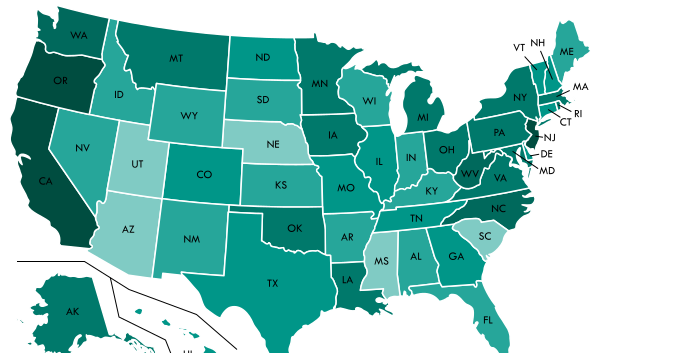
Most common states for senior application system analysts
| Rank | State | Population | # of jobs | Employment/ 1000ppl |
|---|---|---|---|---|
| 1 | Virginia | 8,470,020 | 1,850 | 22% |
| 2 | Massachusetts | 6,859,819 | 1,491 | 22% |
| 3 | Maryland | 6,052,177 | 1,330 | 22% |
| 4 | Minnesota | 5,576,606 | 977 | 18% |
| 5 | New Hampshire | 1,342,795 | 230 | 17% |
| 6 | Colorado | 5,607,154 | 892 | 16% |
| 7 | Oregon | 4,142,776 | 660 | 16% |
| 8 | Rhode Island | 1,059,639 | 169 | 16% |
| 9 | Vermont | 623,657 | 99 | 16% |
| 10 | Montana | 1,050,493 | 154 | 15% |
| 11 | North Dakota | 755,393 | 115 | 15% |
| 12 | North Carolina | 10,273,419 | 1,489 | 14% |
| 13 | New Jersey | 9,005,644 | 1,255 | 14% |
| 14 | Arizona | 7,016,270 | 990 | 14% |
| 15 | Utah | 3,101,833 | 427 | 14% |
| 16 | Nebraska | 1,920,076 | 269 | 14% |
| 17 | California | 39,536,653 | 4,972 | 13% |
| 18 | Washington | 7,405,743 | 948 | 13% |
| 19 | Connecticut | 3,588,184 | 476 | 13% |
| 20 | Missouri | 6,113,532 | 719 | 12% |
Most common cities for senior application system analysts
| Rank | City | # of jobs | Employment/ 1000ppl | Avg. salary |
|---|---|---|---|---|
| 1 | Morrisville | 3 | 12% | $104,138 |
| 2 | Livonia | 1 | 1% | $93,039 |
| 3 | Rochester Hills | 1 | 1% | $93,208 |
| 4 | Chicago | 3 | 0% | $89,505 |
| 5 | San Francisco | 1 | 0% | $125,263 |
| 6 | Washington | 1 | 0% | $106,986 |
Senior Application System Analyst job outlook: Expert opinions
Our panel of senior application system analyst experts
University of Washington
Kent State University
University of Southern Maine
University of Wisconsin - Green Bay
Western Kentucky University
SUNY College at Geneseo
Siena College
University of Maine
University of Maryland - College Park
Virginia Polytechnic Institute and State University
Cleveland State University
Indiana University - Purdue University Indianapolis
Coastal Carolina University
Drexel University
Carleton College
Mount Saint Mary's University
Washington and Lee University
What Senior Application System Analyst skills would you recommend for someone trying to advance their career?
Adam Roth: I recommend that students start by identifying a specific skill in demand within your field, such as data analysis or social media marketing, and focus on developing expertise in that area. Research salary ranges and living costs in particular areas where you’re interested in working to ensure your compensation aligns with the local market. Always negotiate a salary and consider other aspects of the offer, such as funds for continuing education, technology and more. Continuing to network and establish demand for your services is essential; attend industry events, join professional associations, and engage with professionals in your field. Never miss an opportunity to reach out to and check in with your professional contacts. Pursue additional learning opportunities and education, such as certifications or advanced degrees, to provide a competitive advantage and increase your earning potential over time.
What will help Senior Application System Analysts increase their earning potential?
Bradley Andrew Ph.D.: Once you have your first job, ask about or determine the 20% of your supervisor’s job that they hate and start doing that for them. They will love you for it and it will quickly get you recognition. You’ll also be well on your way to learning your boss’s job. Continue doing this as you progress in your career (Kudos to Theo Epstein, former GM for the Red Sox, for this recommendation)
No matter the task you’re given, do it to the absolute best of your abilities. In the professional world, you may often be given menial tasks or tasks that you don’t believe are part of your job description. Doing those tasks to the absolute best of your ability leads to increased trust, recognition and responsibility and will put you “above class.” If asked, the coffee you bring should be the best your boss has ever had. You never know who’s watching.
Don’t expect credit and don’t ask for credit when things go right; give the credit to others.
What will help Senior Application System Analysts increase their earning potential?
Victor Menaldo: Develop oral communication skills that allow you to speak in an articulate manner and organize your thoughts to signal your competence, knowledge, work ethic, and willingness to keep learning and improving.
What Senior Application System Analyst skills would you recommend for someone trying to advance their career?
Dr. Vaneet Kaur: There are two sets of skills I will highly encourage graduates to proactively start building. Firstly, business graduates need to develop higher-order skills and capabilities like knowledge-based dynamic capabilities. These will help them to (a) constantly collect knowledge about emerging opportunities (and threats) in the industry, (b) mobilize themselves and their resources to bring identified opportunities into fruition, and (c) constantly renew their skills to effectively respond to the changes in the environment. Developing such knowledge-based dynamic capabilities will automatically prepare them for the different waves of skill set requirements that will keep arising in the job market. Secondly, it is no secret that we are living in the times of artificial intelligence and automation. So, in this day and age, it is extremely important that graduates learn to ride the wave of automation rather than being discouraged by it. Business graduates are set to contribute to the world with their business acumen and expertise, what they can do to complement it is to develop low-code, no-code skills. Such skills will help graduates to automate routine processes so that their time and energies can be strategically channelized towards those activities and processes that can add significant value to their organizations.
Tove Rasmussen
LecturerUniversity of Southern Maine
Specialized Sales, Merchandising And Marketing Operations
What Senior Application System Analyst skills would you recommend for someone trying to advance their career?
Tove Rasmussen: Tove Rasmussen believes that the skills that will become more important and prevalent in the field in the next 3-5 years are...
What will help Senior Application System Analysts increase their earning potential?
Praneet Tiwari: Continue to be a learner! Business degrees give students the foundation they need to begin their careers but to continue to do well in their careers, they need to keep learning. Find opportunities to learn more to keep evolving whether it’s the use of free resources when available or if your organization funds additional degrees then use those opportunities too. The business world is constantly evolving so it’s important to stay current. Another important thing to focus on is networking. Often after we get our first jobs, we get complacent when it comes to networking but building a network is crucial. Connect with other professionals through LinkedIn, your university’s alumni associations, and events specific to your industry.
What Senior Application System Analyst skills would you recommend for someone trying to advance their career?
Timothy Rich PhD: Think about the types of jobs that interest you and the skills necessary for those jobs early. So many students start thinking about post-graduation life spring their senior year, when it should be an incremental process much earlier. Another pieces of advice would be to talk to faculty and alum about your interests, find internship or research opportunities when possible, and try to figure out early your strengths and weaknesses. It's easy for students, especially high performing ones, to not fully consider what their weaknesses are. I encourage students to jot down what they see as their skills too and to share them with others. It helps them to identify what's a common skill versus something that might make them stick out.
Jasmine Tang
SUNY College at Geneseo
Bilingual, Multilingual, And Multicultural Education
What general advice would you give to a Senior Application System Analyst?
Jasmine Tang: You need to set a goal first then go for it. Also, your first job is not your permanent job. Try to have a break from the school or work before your new job, new school term after the graduation. Be healthy & happy!
What Senior Application System Analyst skills would you recommend for someone trying to advance their career?
Jasmine Tang: Be confident of their major/minor or the subject they like and do best of the field they like for themselves not for money or please their parents or fulfill the dream of others.
What Senior Application System Analyst skills would you recommend for someone trying to advance their career?
Sunita Goel PhD: Great. Will send you the responses soon. Please let me know the latest deadline by which you need them.
What will help Senior Application System Analysts increase their earning potential?
Sunita Goel PhD: Great. Will send you the responses soon. Please let me know the latest deadline by which you need them.
What general advice would you give to a Senior Application System Analyst?
Dr. Ryan LaRochelle Ph.D.: Be flexible. Today's job market is not the same as the one that your parents or grandparents entered into. It's unlikely that you'll be with the same company for your entire working career, so look at every experience as a potential opportunity to learn and explore. Also, the work environment you're joining is more important than the job title and position description. Do some research about what it's like to work at the place that is looking to hire you, and don't be afraid to reach out to current employees to get some candid feedback. Your job title and job description is much easier to change or renegotiate over time, but it's really hard to completely transform a toxic organizational culture and environment.
What Senior Application System Analyst skills would you recommend for someone trying to advance their career?
Dr. Rellie Derfler-Rozin: Though those skills have always been crucial for managers’ success, I think people’s skills will become even more important. Some more content-related areas/skills might be easier to navigate using technology, AI etc, but there will always be a need to manage people, and given the advanced technology there will be even more of a need to be sensitive to how people react to new technology, to make sure people use the technology in both effective and ethical manner. A lot of this will come from role modeling and showing ethical strong leadership.
Dr. Rajesh Bagchi
Department Head and ProfessorVirginia Polytechnic Institute and State University
Business/Commerce
What will help Senior Application System Analysts increase their earning potential?
Dr. Rajesh Bagchi: The only constant in the workplace is change. The current pace at which everything is changing is unprecedented. My recommendation is to embrace this and change with the times. Being curious and willing to learn and adapt will be key. Also, with opportunities, there will be challenges. If you can work through the difficult times, you will be much more successful when things are going well. I cannot emphasize enough about the importance of mental health and well-being. This is not a sprint but a marathon, so it is important that you prioritize your health and well-being.
Roger Klee
Associate College Lecturer: FinanceCleveland State University
Finance And Financial Management Services
What Senior Application System Analyst skills would you recommend for someone trying to advance their career?
Roger Klee: Here is a file that contains my answers to those questions. Let me know if you have any questions.
What general advice would you give to a Senior Application System Analyst?
Oliver Keys Jr: The power of mentorships and networking early in your career will be beneficial in the long run. Also, understanding that professional skills can be half the battle. Showing up on time, dressing appropriately, and communicating effectively can be challenging for some students. Internships and externships are great for students to get technical and professional experience.
What general advice would you give to a Senior Application System Analyst?
David Olawale PhD, PMP: - Work for a company with a good leadership development program that will expose you to different areas including engineering and business sides of the operations so that you can develop your capacity and be relevant to that organization and other organizations. Your priority is to build your capacity. Work on different projects and document the value you are adding to your team and organization. These are what you need to be able to command a higher salary in that organization or any other organization when you move.
What Senior Application System Analyst skills would you recommend for someone trying to advance their career?
David Olawale PhD, PMP: - Get one or two mentors within and outside the organization you would be working at. Be willing to seek and take on new projects and learn new things that will help you to grow and develop your capacity and leadership abilities.
Mark Chandler
Director of Government Relations and Professor of PracticeCoastal Carolina University
Intelligence, Command Control And Information Operations
What Senior Application System Analyst skills would you recommend for someone trying to advance their career?
Mark Chandler: First, focus on being good at your job. Focus on learning your specific assigned area. Get the basics down – analytic skills, communication skills. Build a strong work ethic and professional foundation. If you can find a good mentor, link up with them. Be willing to go the “extra mile” in being a team player and doing things to help others on the team, and put in the hours. In intelligence, you will not always like what policy makers do or say. It’s not our job to agree or disagree with the policy, our job is to study the situation, present the facts and then present a fact-based analytic assessment. Keep opinion, bias, and politics out of our work. This will be a challenge, but it’s one you have to recognize in order to not succumb to it.
What Senior Application System Analyst skills would you recommend for someone trying to advance their career?
Mark Stehr PhD: At the start of your career, it's very important to land a role where you learn a lot and find good mentors. The additional skills will pay dividends as your career progresses.
What general advice would you give to a Senior Application System Analyst?
Professor Michael Hemesath President Emeritus: COMMIT: Even if you do not get that perfect first job, commit fully to the job you take. Expect that you will be in the job for at least a year and maybe two before you seek a second job or go to grad school. Work hard, learn everything you can, be a model employee committed to the organization. If you appear to be constantly looking for other opportunities or if you act like you are doing the organization a favor by being there, these attitudes will harm your ability to move to a future job as your references will note these traits. The professional world can be small and reviews of your performance can be shared in ways you might never imagine. FLEXIBILITY: Lots has been written about different generational attitudes toward work. You may well find that your boss or colleagues have different attitudes or values than you do. In an entry-level job in a buyer's market, you will not singlehandedly change the work culture of your organization. Be a thoughtful observer and reflect on the attitudes and values of those around you. Note that you should compromise on those things that are important to you, but you should respectfully try to understand what others value too, and you may well come to appreciate the worldview of your older colleagues and managers. This attitude will also help you understand and commit to your own professional and career values. LEARN: This advice may seem obvious to a college grad, but remember that education occurs in lots of ways and from lots of people. You will likely be asked to do things that you would prefer not to, but view each task as an opportunity to learn something about your organization and yourself. Also remember that every person in your organization has something to teach you. Ask questions about colleagues' career paths, hopes, and goals. Ask them what they wish they had known at the start of their careers. Not everything you hear will be valuable to you, but thoughtful and empathetic listening will result in a surprising amount of wisdom and may well find you a mentor or two.
Dr. Michelle Holloway
Professor and Doheny Program DirectorMount Saint Mary's University
International Business
What will help Senior Application System Analysts increase their earning potential?
Dr. Michelle Holloway: Figure out what you are good at, then consider what you would enjoy doing professionally. Your strengths will tell you what job function to do (e.g., sales, accounting, procurement). Your interests will tell you what industry to work in (e.g., tech, entertainment, retail).
What Senior Application System Analyst skills would you recommend for someone trying to advance their career?
Michelle Cowan Ph.D.: I’m not sure about this question since I haven’t really discussed this with any business analysts. I’ll pass this question on and see if I get a response. Otherwise, ask me about content strategy, UX, writing, and communication jobs, and I can speak more freely, since that’s what I did for 15 years before moving into academia.