Explore jobs
Find specific jobs
Explore careers
Explore professions
Best companies
Explore companies
Job outlook for senior architectural designers in the United States
Senior architectural designer job growth summary. After extensive research, interviews, and analysis, Zippia's data science team found that:
The projected senior architectural designer job growth rate is -3% from 2018-2028.
About -6,700 new jobs for senior architectural designers are projected over the next decade.
Senior architectural designer salaries have increased 11% for senior architectural designers in the last 5 years.
There are over 9,136 senior architectural designers currently employed in the United States.
There are 53,724 active senior architectural designer job openings in the US.
The average senior architectural designer salary is $74,891.
Are senior architectural designer jobs in demand?
Senior architectural designer job and salary trends over time
Senior architectural designer jobs over time
Senior architectural designer job growth rate over time
| Year | # of jobs | % of population |
|---|---|---|
| 2021 | 9,136 | 0.00% |
| 2020 | 8,944 | 0.00% |
| 2019 | 8,910 | 0.00% |
| 2018 | 8,803 | 0.00% |
| 2017 | 8,654 | 0.00% |
Average senior architectural designer salary over time
Senior architectural designer salary by year
| Year | Avg. salary | Hourly rate | % Change |
|---|---|---|---|
| 2026 | $74,891 | $36.01 | +2.1% |
| 2025 | $73,380 | $35.28 | +2.6% |
| 2024 | $71,530 | $34.39 | +3.9% |
| 2023 | $68,860 | $33.11 | +2.4% |
| 2022 | $67,258 | $32.34 | +1.8% |
Senior architectural designer jobs by state
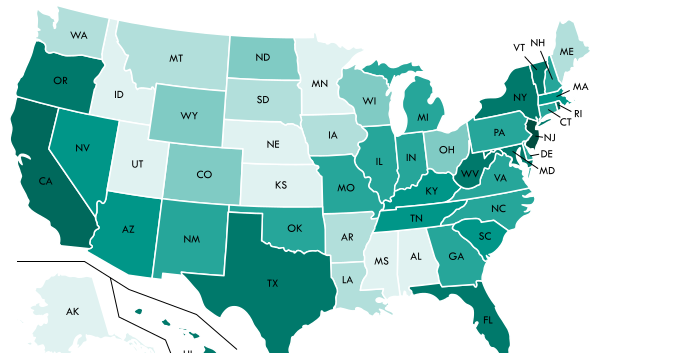
Most common states for senior architectural designers
| Rank | State | Population | # of jobs | Employment/ 1000ppl |
|---|---|---|---|---|
| 1 | District of Columbia | 693,972 | 299 | 43% |
| 2 | Washington | 7,405,743 | 961 | 13% |
| 3 | Oregon | 4,142,776 | 532 | 13% |
| 4 | Massachusetts | 6,859,819 | 797 | 12% |
| 5 | Virginia | 8,470,020 | 953 | 11% |
| 6 | California | 39,536,653 | 3,574 | 9% |
| 7 | Georgia | 10,429,379 | 964 | 9% |
| 8 | Minnesota | 5,576,606 | 507 | 9% |
| 9 | Utah | 3,101,833 | 269 | 9% |
| 10 | Rhode Island | 1,059,639 | 93 | 9% |
| 11 | Maryland | 6,052,177 | 470 | 8% |
| 12 | Colorado | 5,607,154 | 450 | 8% |
| 13 | New Hampshire | 1,342,795 | 103 | 8% |
| 14 | New York | 19,849,399 | 1,418 | 7% |
| 15 | Illinois | 12,802,023 | 904 | 7% |
| 16 | North Carolina | 10,273,419 | 689 | 7% |
| 17 | Wisconsin | 5,795,483 | 404 | 7% |
| 18 | North Dakota | 755,393 | 52 | 7% |
| 19 | Texas | 28,304,596 | 1,634 | 6% |
| 20 | New Jersey | 9,005,644 | 516 | 6% |
Most common cities for senior architectural designers
| Rank | City | # of jobs | Employment/ 1000ppl | Avg. salary |
|---|---|---|---|---|
| 1 | Frankfort | 1 | 4% | $72,714 |
| 2 | Annapolis | 1 | 3% | $76,221 |
| 3 | Dover | 1 | 3% | $68,261 |
| 4 | Juneau | 1 | 3% | $55,762 |
| 5 | Brea | 1 | 2% | $78,332 |
| 6 | Cypress | 1 | 2% | $78,355 |
| 7 | Hartford | 1 | 1% | $69,891 |
| 8 | Lansing | 1 | 1% | $68,497 |
| 9 | San Francisco | 3 | 0% | $83,429 |
| 10 | Los Angeles | 2 | 0% | $78,702 |
| 11 | Washington | 2 | 0% | $76,680 |
| 12 | Atlanta | 1 | 0% | $67,068 |
| 13 | Austin | 1 | 0% | $76,062 |
| 14 | Baton Rouge | 1 | 0% | $59,837 |
| 15 | Boston | 1 | 0% | $70,553 |
| 16 | Denver | 1 | 0% | $64,874 |
| 17 | Des Moines | 1 | 0% | $59,763 |
| 18 | Indianapolis | 1 | 0% | $69,990 |
Senior Architectural Designer job outlook: Expert opinions
Our panel of senior architectural designer experts
Worcester Polytechnic Institute
Missouri University of Science and Technology
Massachusetts Institute of Technology
University of Florida
University of Nevada - Las Vegas
SUNY at Buffalo
University of North Carolina at Greensboro
University of Nevada - Las Vegas
University of Oregon

University Of Nevada, Las Vegas

Kansas State University

University of North Texas

Florida International University

University of New Mexico
Arizona State University

Dunwoody College of Technology

Syracuse University
Dr. Steven Van Dessel Ph.D. Assoc. AIA
Associate Professor, Director Architectural Engineering ProgramWorcester Polytechnic Institute
Architectural Engineering
What general advice would you give to a Senior Architectural Designer?
Dr. Steven Van Dessel Ph.D. Assoc. AIA: Employers always stress the importance of students knowing the fundamentals of engineering and the integration of engineering fundamentals with architectural design. Our program is quite unique in this respect as we are the only degree program in the country where students can earn an architectural engineering degree that is ABET accredited (they can get their PE) - and then also can gain their NAAB accredited architecture degree with one additional year (allowing them to also become architects). Knowledge of building information modeling is required, and I would think that AI at some point will also play a role when combined with advanced surveying technologies.
What Senior Architectural Designer skills would you recommend for someone trying to advance their career?
Dr. Steven Van Dessel Ph.D. Assoc. AIA: We typically advise our student to pursue internship as soon as the summer after sophomore year so they can get experience in different sub-areas of architectural engineering that would allow them to get a better understanding of the careers they could pursue with their degree. This typically results in an offer for full employment early in senior year – at least for our students
What will help Senior Architectural Designers increase their earning potential?
Dr. Steven Van Dessel Ph.D. Assoc. AIA: Starting salary is something they can/should consider – but it is often better for recent graduates to understand the growth potential with a particular employer/firm and understand what other benefits exist. We tell them to ask questions about the typical promotion steps within an organization, for example. Students that have taken the FE exam should highlight that – and ask questions in the interview about what mentoring there is within a firm to take the PE exam – it shows a positive level of professional attitude. Our students work for architects, engineering consultancy, contractors, etc. I think Bankrate listed AE as the most rewarding degree a few years ago – and one of the items listed was the diversity of office and fieldwork that makes employment enjoyable (i.e. not stuck in their office all week)
What general advice would you give to a Senior Architectural Designer?
Rebecca Dolgas: 2. The ability to implement VR, AR, and AI capabilities. Clients are coming to expect photorealistic renderings and to be able to walk through their space virtually. Having the skill set to implement these tools will be crucial in keeping clients informed and pleased with your work.
Heath Pickerill PhD
Assistant Teaching ProfessorMissouri University of Science and Technology
Architectural Engineering
What will help Senior Architectural Designers increase their earning potential?
Heath Pickerill PhD: By boosting your resume through participation in professional organizations and design teams within the field, as well as diverse work experience with on-the-job training through internships and co-ops.
What Senior Architectural Designer skills would you recommend for someone trying to advance their career?
Paul Pettigrew AIA, NCARB, MIT M.Arch ʼ88: Adaptability, the ability and desire to constantly learn new tools, techniques, business practices, and construction technologies/methodologies. The architecture profession has changed dramatically since the introduction of computers into practice, and all indications are that architectural practice will continue to change as computers, fabrication machines that talk to and work with computers, and technologies related to issues of sustainability, continue to adapt to the economics, business, practice, and significance of the architecture profession.
What general advice would you give to a Senior Architectural Designer?
Martin Gold FAIA: The most widespread complaint from people in the field is that it consumes ones attention, requires long hours, and relative to other professions, such as medicine, law, accounting, or engineering, the pay is lower on a per hour basis. On the other hand, architecture is more of an art than other professions and offers opportunities for creative people to have prosperous careers. The famous French architect Le Corbusier would say, architecture is a way of life.
What general advice would you give to a Senior Architectural Designer?
Georges Fares: In the coming years, several skills will become increasingly important in interior design. First, sustainability and eco-friendly design will gain significant emphasis. Designers will need to be well-versed in sustainable materials, energy-efficient systems, and green certifications such as LEED and WELL. Knowledge of how to incorporate renewable resources and environmentally responsible practices into projects will be essential. Technology integration will also be highly valued. Proficiency in advanced design software, 3D modeling, and the use of virtual reality (VR) and augmented reality (AR) will become integral to the design process. These tools will enhance visualization, presentation, and client collaboration, allowing for more immersive and interactive experiences. An awareness of global design trends and cultural sensitivity will be increasingly important as the world becomes more interconnected. Designers will often work on international projects, requiring an understanding of diverse cultural aesthetics, traditions, and preferences. This global perspective will help create spaces that resonate with varied client bases. Adaptability will be crucial in responding to evolving client needs, technological advancements, and market trends. The ability to pivot and innovate in response to new challenges will distinguish successful designers. Moreover, collaboration with diverse teams, including architects, engineers, and contractors, will be essential for seamless project execution. Effective communication and teamwork will ensure that all aspects of a project align and integrate smoothly. Finally, understanding clients' emotional needs and how design can address these will become a key aspect of creating meaningful and impactful spaces. Interior designers will need to consider psychological and emotional factors, designing environments that promote well-being, productivity, and comfort. This client-centered approach will lead to more personalized and effective design solutions.
What Senior Architectural Designer skills would you recommend for someone trying to advance their career?
Georges Fares: Maximizing salary potential in interior design involves a combination of strategic actions and ongoing professional development. To start, focusing on niche areas within interior design that are currently in high demand, such as sustainable design, healthcare design, or incorporating advanced technology, can significantly enhance your market value. These specialized skills set you apart from competitors and allow you to command higher fees for your expertise. Pursuing additional certifications and advanced degrees can further improve your qualifications and deepen your knowledge in these specialized areas. For example, obtaining LEED certification for sustainable design or a master's degree in healthcare design can make you more attractive to employers looking for specific skill sets. Networking is another critical component of maximizing salary potential. Establishing connections with industry professionals, mentors, and potential employers can lead to job opportunities with competitive salaries. Attending industry conferences, participating in professional organizations, and engaging in online communities are effective ways to build and maintain a robust professional network. A well-organized portfolio is essential in showcasing your best work, demonstrating your problem-solving skills, creativity, and ability to meet clients' needs, and including case studies that highlight improvements in functionality, sustainability, or user experience. Developing soft skills such as strong communication, negotiation, and leadership is also crucial, as they help articulate your design vision, secure better project terms and salaries, and position you for higher-compensation managerial roles. Overall, these strategies can help new graduates navigate the early stages of their careers and position themselves for financial and professional growth in the interior design field. By continuously improving your skills, expanding your network, and showcasing your work effectively, you can enhance your professional reputation and salary prospects.
What will help Senior Architectural Designers increase their earning potential?
Georges Fares: Starting a career in interior design can be both exciting and challenging. My advice is to stay curious and keep learning because the field of interior design is ever-evolving. Staying updated with the latest trends, materials, and technologies is crucial. Networking actively is also essential. Attend industry events, join professional organizations, and connect with peers and mentors, as these connections can open doors to opportunities and collaborations. Seek diverse experiences by gaining exposure to different types of projects and environments, whether residential, commercial, or hospitality. This will make you a more versatile designer. Lastly, stay resilient. The design field can be competitive and demanding, but by continuously honing your skills and maintaining a positive attitude, you can navigate through challenges successfully.
What Senior Architectural Designer skills would you recommend for someone trying to advance their career?
Grant Mosey Ph.D.: I would advise architecture students to be as flexible as possible. While NAAB accredited schools award 6,000 to 7,000 professional degrees per year, NCARB states that fewer than 3,500 architects reach licensure each year. This suggests that many of those educated as architects are actually finding work in allied subjects. I know of many graduates who are set to become architects who end up becoming real estate professionals, construction professionals, policy-makers, academics, and more. Even for those dead set on architectural practice, these opportunities in adjacent fields can open doors to more design-focused practice.
What will help Senior Architectural Designers increase their earning potential?
Elaine Chow AIA, RA, NCARB: Continue being a student throughout your career since learning never stops, especially in architecture where the knowledge is vast and first-hand experience is valuable. There are many facets to the architecture profession, when first graduating try to explore different roles to see what interests you and challenges you best.
What Senior Architectural Designer skills would you recommend for someone trying to advance their career?
Cameron John M.F.A.: Interior Architecture and Design offers an opportunity to help clients - real people - realize their vision. Whether it is a single-family home, a corporate office, or a hospital - the spaces designed are real. These spaces have tangible effect on the well-being, health, and happiness of others. The challenges of any field of design - architecture or otherwise - are that it is often a pursuit of passion. Design work often involves late nights and long hours to reach submittal deadlines and manage the complexities of any project. The volume of information you need to coordinate and manage requires a high level of organization and focus. Attention to detail is incredibly important. Design work is not as highly compensated as other professional pursuits for the amount of expertise and work that goes into realizing a project.
What will help Senior Architectural Designers increase their earning potential?
Cameron John M.F.A.: People spend 90% of their time inside. Interior Architecture and Design is a growing profession as more and more people take interest in the design of their spaces. The COVID-19 pandemic accelerated this impact as people were forced to occupy their spaces and physically recognize how their space impacts their health - both mentally and physically. Additionally, current economic pressures have made it more appealing for companies to renovate their current space rather than build an entirely new structure.
What general advice would you give to a Senior Architectural Designer?
Alfredo Fernandez-Gonzalez: It is important for recent graduates to recognize that Architecture is no longer limited to the physical realm, as transformative technologies are providing interesting career opportunities in the digital realm as well. This rapidly evolving context offers many opportunities and new directions for the discipline and remaining (or becoming!) current in new developments in computing power, digital visuals, manufacturing technologies, and robotics, are ways in which a recent graduate can secure a good paying job.
What Senior Architectural Designer skills would you recommend for someone trying to advance their career?
Alfredo Fernandez-Gonzalez: Globally, there is significant demand for architects who are facile in the use of transformative technologies that support designers to generate and evaluate innovative ideas to provide solutions in a rapidly changing environment. Needless to say, being extremely competent in the many applications of Building Information Modeling (BIM), Extended Reality (XR), Generative Design, and Sustainability, will make new graduates effective at a time in which the profession and the world are rapidly transforming.
What general advice would you give to a Senior Architectural Designer?
Dr. Alison Kwok PhD, RA, FAIA, LEED BD+C, CPHC: Diversify your experiences (and expectations); gain knowledge in a variety of different areas and certifications. Curate your portfolio to show a range of the kinds of work that you're able to offer. Get out of the comfort zone of doing only what you know "how to do" and challenge with incremental bits of knowledge.
Dak Kopec Ph.D.
Associate Professor, Coordinator, BA Interior Architecture and Design and Master of Design ProgramUniversity Of Nevada, Las Vegas
School of Architecture
What experience really stands out on Senior Architectural Designer resumes?
Dak Kopec Ph.D.: Experience in the areas where one intends to practice. If someone wants to work in hospitality design, an employer will see what kind of experience they have. This is why selecting one's internship location is so important.
Many employers are also looking to see how well the Interior Designer can think outside the box and develop innovative design ideas.
An area of specialized knowledge that will complement the existing design team. Most firms are looking for future leaders.
What Senior Architectural Designer skills would you recommend for someone trying to advance their career?
Dak Kopec Ph.D.: Design thinking. This can be done by looking for certificates or attending a series of seminars. The COVID-19 virus has opened up numerous opportunities to shape an Interior Designer's scope. Using Design Thinking as a means to solve problems will enhance a person's marketability.
Additionally, I would recommend learning about disease transmission and pathology. With a stronger foundation in these areas, the interior designer will be better equipped to address the infection control expectations that will likely be required of future Interior Designers.
Vibhavari Jani
Associate ProfessorKansas State University
Interior Architecture and Industrial Design
What soft skills should all Senior Architectural Designers possess?
Vibhavari Jani: Critical thinking, interpersonal communication, collaboration, and ability to lead.
What hard/technical skills are most important for Senior Architectural Designers?
Vibhavari Jani: Ability to master various software: Revit, Rhyno, Sketchup, 3D rendering software (Enscape and Lunion), BIM.
Bill Morgan
Coordinator, Undergraduate Program — Interior Design, Lecturer, Interior DesignUniversity of North Texas
Department of Design
What hard/technical skills are most important for Senior Architectural Designers?
Bill Morgan: -Drawing Proficiency (drawing of all types, includes 3D visualization)
-Technical Proficiency (detailing)
-Project Management
What are the biggest trends we'll see in the Senior Architectural Designer job market given the pandemic?
Katie Rothfield: The post-COVID-19 job market for interior architecture/design majors largely mirrors what we are seeing in each respective industry: while some trades, such as hospitality and cruise ship, are seeing a downturn or outright freeze in work, other sectors, such as law, were unaffected by the pandemic and are still operating and hiring at normal speed. Likewise, just as there is a great demand for healthcare workers, demand is also high for interior designers with strong problem-solving skills and knowledge of innovative sustainable design practices, building systems, technology, and psychology/theory who can address issues related to indoor air quality, viral transmission on surfaces, and social distancing.
In addition, corporations will need interior designers to study and respond to new remote and in-person work patterns and rethink the future design of the office, and with so many people spending countless hours at home, there is increased interest and demand in the residential design market.
What skills stand out on Senior Architectural Designer resumes?
Katie Rothfield: Now, more than ever, it is important for interior architecture/design graduates to diversify their skill sets and credentials:
Internship experience will always set a candidate apart from the crowd. Given the pandemic's negative impact on the number of full-time interior design positions, a recent graduate could secure paid internship opportunities while looking for full-time employment. This would help boost their resume and could get their foot in the door at a company that may hire full-time positions as the vaccine becomes more widely available.
Most companies expect recent interior architecture/design graduates to be proficient in a variety of computer programs, such as AutoCAD, Revit, and SketchUp. Alumni can stay current and add software programs to their resumes by watching online tutorials and improving their projects for their portfolios.
Professional exams demonstrate leadership and help candidates rise to the top of the resume stack. Leadership in Energy and Environmental Design (LEED) and WELL accreditation demonstrate knowledge of sustainable design practices and a commitment to designing interiors that positively affect human health and wellbeing. In addition, passing the Interior Design Fundamentals Exam (IDFX - the first section of the National Council for Interior Design Qualification (NCIDQ) Exam) confirms acquisition of interior design knowledge that is essential to the profession. Interior architecture/design majors can take all three of these exams prior to graduation.
How have salaries changed over time for Senior Architectural Designers?
Tamarah Begay: Salaries have changed a lot over the time I have spent in the Architectural Field. Minority women are now getting the recognition that they deserve in a field that has predominantly been ruled by non-minority males, and although it still is not equal, we have gained admission to higher compensation than we used to receive.
What are the biggest trends we'll see in the Senior Architectural Designer job market given the pandemic?
Tamarah Begay: One of the largest trends in the job market given the pandemic is the usage of different online and virtual platforms for interviews and meetings. Not only are these platforms being used to communicate ideas and design but to connect and link professionals to job seekers. This has allowed the industry to have shifted to predominantly working remotely. There has also been a rise and increase in anti-microbial materials, space planning, and incorporating a cleaner HVAC and air quality system into buildings. This can include using hard surface floors and furniture without fabrics to allow for ease of cleaning and to help reduce the spread of germs and incorporating specialty air filters or lights. The industry has also seen an increase in wanting to incorporate outdoor spaces within designs.
What certifications/licenses/courses can have the biggest impact for Senior Architectural Designers?
Tamarah Begay: Certifications and licenses that can be locally, nationally, and universally applicable are most impactful for a future job prospect to have. Being a licensed Architect and having or being LEED certified is of great impact for job prospects on all levels. Staying up to date on continuing education courses and staying knowledgeable about new products or methods should be a habitual update to one's personal knowledge bank. Bringing versatility and diversity to the work place in any form, whether it is through licenses or courses, is beneficial and can have a great impact.
How have salaries changed over time for Senior Architectural Designers?
Marc Neveu Ph.D.: I was first hired into an architecture office over 25 years ago, so I can say with some confidence, that salaries have gone up! Many offices, however, are very different than when I graduated. Not all, but many are much more integrated with other disciplines. There is an incredible group of firms in the valley, like Construction Zone, who do both design and construction. Others, like Ryan Companies, are integrated from Development through Facilities Management. By owning more of the entire process, rather than just the design, firms are able to generate more revenue. As a student graduating today, I would be better position to have an architecture degree plus an additional credential - in construction management, real estate development, or even sustainability. In this way, you can leverage your position in an office to be more valuable.
What are the biggest trends we'll see in the Senior Architectural Designer job market given the pandemic?
Marc Neveu Ph.D.: The pandemic has had an interesting effect. At first, everyone froze and thought all work was going to stop. We are a year in and many firms are as busy as they were a year ago. Still, it is different for different markets, and there is some caution about projects scheduled a year from now. That said, money is relatively cheap at the moment and that is good for construction.
What technical skills for a Senior Architectural Designer stand out to employers?
Marc Neveu Ph.D.: Here is a baseline of technical skills, usually related to the software used in the office, but software changes. I was in a conversation recently with Christiana Moss, who is a partner at Studio Ma, and she had a great quote. She needed recent graduates "who could be useful." This meant being able to think on their own, to ask questions, and to be able to take on a project without the need to be told how to do everything. We don't expect graduates to know everything they need to know to build a building, but they should be aware of what they don't know and be able to ask good questions, work collaboratively, and also independently.
Anonymous Professor
What are the biggest trends we'll see in the Senior Architectural Designer job market given the pandemic?
Anonymous Professor : With regards to trends during the pandamic ... I think that there are huge opportunities to be had, if the graduates have their acts together. I network with my former students who are now partners or upper managers in companies. The era of Monday morning meetings in conference rooms is over. In the future, networking with colleagues and clients will be done via some distance system. So the Zoom classes taken today will prepare students for the boardroom tomorrow. Quit whinning and see the opportinities waiting the be catured ... they are there ... the challenges with distance learning will separate the 'wheat from the chaf' ... those who can adapt to a new way of thinking will survive ... those who cannot will be quickly sent to the scrap heap. But, graduates cannot act like young spoiled people. They need to have skills and abilities ... AND ... people skills ... big time ...
What certifications/licenses/courses can have the biggest impact for Senior Architectural Designers?
Anonymous Professor : With regard to student graduates with the license issue and their potential, it's all about and their ability to think ... my contacts tell me that they want people who can look outside the box ... and be flexible to change ... and make no mistake about it ... the future is all about a willingness to change and be flexible to change. Professional license requirements is a think of the past ... it's all about what you can do now.
How have salaries changed over time for Senior Architectural Designers?
Anonymous Professor : With regard to money and employment compensation ... those who can be willing to try new things and move with the flow will do well ... very well. Those who cannot, it's McDonald's and minimum wage ...
A footnote: ... the people I contact do not care about who you are, what you are, or how you are. So things like pronouns, and victimization, and excuses, and hanging on to reasons for failure will not cut it in the workplace of the future ... learn ... grow ... and you will have success ...
Will there be an enduring impact of the coronavirus pandemic on Senior Architectural Designers?
Paul Strother: We are hopeful that we will not see any long-term impact on our graduates due to the pandemic. That being said, we know that some students have struggled with the added stress of COVID-19, and others with managing online education, leading them to withdraw from school. And we know that students who choose not to finish their degree carry the long-term effects of a disrupted education.
What type of skills will young Senior Architectural Designers need?
Paul Strother: For students earning their A.A.S. in Architectural Drafting & Design, the skills they are currently learning will be critical to their future success. Not only should students master Revit, but they also need the ability to quickly learn other software. They need an understanding of the principles of construction and building systems, and they need to know the role of the architect and its companion players, such as contractors, consultants and owners. Understanding regulatory elements will also continue to be key skill sets. At the core, when they leave Dunwoody, they must be ready to continue learning new systems, software and regulations, and possess the fundamental skill of good communication. This past year has also taught students to be flexible, and exposed them to new ways of communicating and doing business, which are critical skills as they enter today's workforce.
What experience really stands out on Senior Architectural Designer resumes?
Paul Strother: Dunwoody focuses on ensuring our students are learning the skills employers need. Because of that, students are ready for a part-time office job even before they graduate. Dunwoody structures the program and its class schedule in a way that allows for part-time positions, and provides students with the right software and a grasp of the building systems they're working with. We know that a recent graduate with the right skills, along with some experience on their resume, will be hired first after graduation.
Will there be an enduring impact of the coronavirus pandemic on Senior Architectural Designers?
Kristen DeWolf: The class of 2021 will be in a highly competitive hiring situation. Not only will they have their peers to compete against for jobs, but also those who were laid-off or furloughed as a result of the coronavirus pandemic. It will be imperative for the graduates to prove they are the 'right' candidate. At the same time, this class has had to jump into flexibility mode to be successful as classes, club meetings, and even internships went virtual. They have already proven they are quick to adapt to the changing nature of work.
What's a good job out of college for Senior Architectural Designers?
Kristen DeWolf: We are encouraging students to keep their options open. Any position that will add soft and/or hard skills to your resume is a great job to consider after college. Showing the value they provide will only help them as they continue to build their careers.
What technical skills for a Senior Architectural Designer stand out to employers?
Kristen DeWolf: This is certainly highly dependent upon the industry the employer is in/type of work being done; however, MSExcel is one of the key skills that I hear over and over again from employers across many industries. Researching the employer/industry and understanding the technologies most used (and learning those programs if you don't already) is a great way for a candidate to stand out. There are plenty of opportunities to learn technical skills on sites such as LinkedIn Learning. When a candidate can show they're paying attention and have learned the skills to hit the ground running, the more valuable they will be as a candidate.