Explore jobs
Find specific jobs
Explore careers
Explore professions
Best companies
Explore companies
Job outlook for senior computer scientists in the United States
Are senior computer scientist jobs in demand?
Senior computer scientist job and salary trends over time
Senior computer scientist jobs over time
Senior computer scientist job growth rate over time
| Year | # of jobs | % of population |
|---|---|---|
| 2021 | 708 | 0.00% |
| 2020 | 1,447 | 0.00% |
| 2019 | 963 | 0.00% |
| 2018 | 1,282 | 0.00% |
| 2017 | 1,191 | 0.00% |
Average senior computer scientist salary over time
Senior computer scientist salary by year
| Year | Avg. salary | Hourly rate | % Change |
|---|---|---|---|
| 2026 | $139,644 | $67.14 | +3.4% |
| 2025 | $135,043 | $64.92 | +2.3% |
| 2024 | $131,985 | $63.45 | +3.4% |
| 2023 | $127,692 | $61.39 | +2.4% |
| 2022 | $124,704 | $59.95 | +1.1% |
Senior computer scientist jobs by state
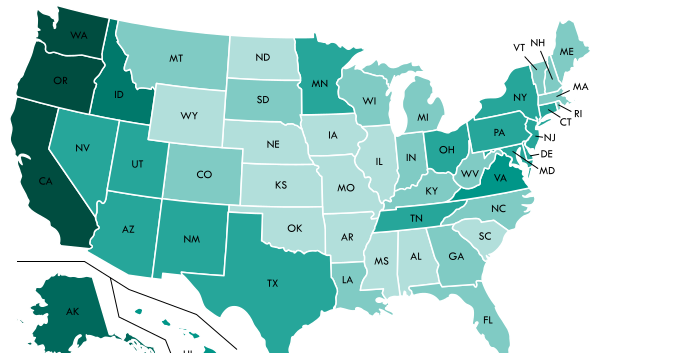
Most common states for senior computer scientists
| Rank | State | Population | # of jobs | Employment/ 1000ppl |
|---|---|---|---|---|
| 1 | District of Columbia | 693,972 | 279 | 40% |
| 2 | Delaware | 961,939 | 182 | 19% |
| 3 | Maryland | 6,052,177 | 1,091 | 18% |
| 4 | Virginia | 8,470,020 | 1,326 | 16% |
| 5 | New Hampshire | 1,342,795 | 189 | 14% |
| 6 | South Dakota | 869,666 | 124 | 14% |
| 7 | Vermont | 623,657 | 87 | 14% |
| 8 | Wyoming | 579,315 | 80 | 14% |
| 9 | Alaska | 739,795 | 99 | 13% |
| 10 | North Dakota | 755,393 | 96 | 13% |
| 11 | Washington | 7,405,743 | 872 | 12% |
| 12 | Massachusetts | 6,859,819 | 846 | 12% |
| 13 | Colorado | 5,607,154 | 593 | 11% |
| 14 | Connecticut | 3,588,184 | 392 | 11% |
| 15 | Montana | 1,050,493 | 118 | 11% |
| 16 | Rhode Island | 1,059,639 | 117 | 11% |
| 17 | New Jersey | 9,005,644 | 927 | 10% |
| 18 | Oregon | 4,142,776 | 402 | 10% |
| 19 | Utah | 3,101,833 | 297 | 10% |
| 20 | New Mexico | 2,088,070 | 218 | 10% |
Most common cities for senior computer scientists
| Rank | City | # of jobs | Employment/ 1000ppl | Avg. salary |
|---|---|---|---|---|
| 1 | Cambridge | 1 | 1% | $117,088 |
| 2 | Dayton | 1 | 1% | $120,616 |
| 3 | San Antonio | 7 | 0% | $124,901 |
| 4 | Boston | 1 | 0% | $117,097 |
Senior Computer Scientist job outlook: Expert opinions
Our panel of senior computer scientist experts
Portland State University
Ohio State University
Kennesaw State University
Cumberland University
Texas A&M University
Robert Morris University
Medical College of Wisconsin
Louisiana State University and A&M College
Pacific University
Kettering University
North Carolina State University
Nazareth College of Rochester
Arkansas State University
Michigan State University
What general advice would you give to a Senior Computer Scientist?
Dr. Partha Sengupta: Data processing and data science have a rapid growth in job market about 35% which is faster in growth than any other streams of Computer Science. Data is the new petroleum of the modern age. Data storage and management in cloud-based infrastructure, understanding data storage in relational and non-relational databases and secure catching configuration, global accessibility and collaboration of data, data privacy and security, preprocessing and using advanced algorithms to analyze data is the current and future requirement. You are going to take center stage in all other end software applications which will need a robust and secure data workflow for successful implementation of the process.
What Senior Computer Scientist skills would you recommend for someone trying to advance their career?
Dr. Partha Sengupta: Skills of data privacy like anonymization, aggregation, user-centric privacy control, homomorphic encryption, and federated learning algorithms. Database security that protects the confidentiality, integrity, and availability of an organization. Using adaptive security systems in this field is very important for automation of data storage and accessibility. Understanding data privacy laws like General Data Protection Regulation (GDPR) used in Europe, USA laws like California Consumer Privacy Act (CCPA) etc. and more cybersecurity laws and ethics to evolve in the future for dynamic nature of data workflow, such that the students understand compliance with myriads of data protection regulations as per individual country, continents, and global data protection and privacy laws. Students should also be aware of quantum computing mechanisms and post-quantum encryption process. Another important aspect is edge computing which involves data processing at the edge, real-time decision-making, optimized data transmission, distributed architecture, and scalability and flexibility. Understanding A.I. models used in multimodal learning process like audio, video, images, 3D maps, natural language processing (NLP) and deep learning algorithms, generative transformer models which correlated relation between words in a sentence using a technique called self-attention, local training of data using A.I models in a distributive network called Federated learning.
What will help Senior Computer Scientists increase their earning potential?
Dr. Partha Sengupta: Fit to jobs like Data Controllers and Data Processors understanding both USA and International data privacy and protection laws, implementing data protection into system and processes, auditing, authentication, and access control. Creators of robust and secured databases and recommender systems using collaborative, content, hybrid and contextual filtering. One such example is Deep Learning Recommendation Learning (DLRM). Data storage, processability and usage in edge computing in IoT devices including personalized chatbots. Running A.I. (AIoT), analytics, and other business capabilities on IoT devices, consolidate edge data at scale and eliminate data silos, deploy manage and help secure edge workloads remotely, optimize the costs of running edge solutions, and enable devices to react faster to local changes. Handling data related to medical instruments, medical chatbots, and usage of A.I for data analytics in application of telemedicine, diagnosis accuracy, and medical laboratories. Medical data analytics of A.I application in mental health disorders (MHD) and medical image classification. Another important aspect of genetic data and the application of A.I on it. Language Model architectures using human language data, deep learning algorithms, and application of generative transformers
What will help Senior Computer Scientists increase their earning potential?
Dr. Devin Rafferty PhD: Read anything and everything, especially history. There is an enormous value that someone can gain simply from understanding how different disciplines fit together, because the real-world is not segmented into sociology, politics, economics, etc.; rather it is all one dynamic system. For example, when students ask me what they should really focus on reading to prepare for their careers, I usually respond by asking what *exactly* will be their careers in fifteen years--which is frequently met with indecision. The point is that one should not tailor their knowledge and skill sets to an expected career; rather, just the opposite, one should learn *everything* that the brain can absorb and then the skill sets needed for the career will already be there--and obtaining promotions will be fairly straightforward.
Cornelius Nelan Prof.
Professor of MathematicsWhat general advice would you give to a Senior Computer Scientist?
Cornelius Nelan Prof.: I would say that it is a good idea to visit the career placement center in your school to get help writing a resume. When you apply, write a cover letter that is specifically tailored to the job description and explain how you would uniquely be qualified for the position. Do some research into the company and explain why you are interested in the job.
What Senior Computer Scientist skills would you recommend for someone trying to advance their career?
Cornelius Nelan Prof.: Advanced topics are gravy, you should be grounded in the basics: Precalculus skills (especially trigonometry and algebra), Calculus, and Linear Algebra. It is also good to have a background in statistics, and computer science (Learn a computer language, such as Java.) Given the job market today, you should be somewhat familiar with Data Science and AI. If you have time take some business (especially Finance) classes. It is also important to be able to work in group settings. An important skill is your ability to communicate (orally and in writing) to mathematicians but also to non-mathematicians. If you can find a professor who is willing to supervise (and give credit for) some independent research project, do so. It is important to demonstrate that you can work independently (do literature searches, work problems out for yourself). Include this in your resume. It would also be good to get some experience tutoring mathematics (to non-majors or majors). Again, this demonstrates your ability to communicate.
What will help Senior Computer Scientists increase their earning potential?
Cornelius Nelan Prof.: Emphasize your ability to learn mathematics independently, and work with groups. In your cover letter emphasize your ability to grow and adapt to the job you are applying for. Even after you find a job, keep looking; something better may come up.
What general advice would you give to a Senior Computer Scientist?
Dr. Ali Fridley Ph.D.: Networking skills and the ability to build relationships are paramount. Be a lifelong student. Learn from those around you, especially those you admire. Know your strengths and use them. On the other hand, understand your weaknesses and surround yourself with people who are skilled in those areas.
What general advice would you give to a Senior Computer Scientist?
Wu-chang Feng: It's hard to generalize across an entire discipline, but I'd say the vast majority of time, we are constantly learning what is being done, constantly building on top of that, and constantly solving any problems along the way.
What Senior Computer Scientist skills would you recommend for someone trying to advance their career?
Wu-chang Feng: This is subjective, but I think people enjoy the creative act of thinking about a problem, figuring out how to solve it, then building software to do so. What they disliked before was the inability to quickly go from thought to working implementation. This gap is now much narrower.
What will help Senior Computer Scientists increase their earning potential?
Wu-chang Feng: I believe so. With the advent of generative AI, it is now much easier to go from idea to implementation. We can now build things closer to the limits of our imagination.
Professor Todd Thompson
Astronomy Chair (potentially)Ohio State University
Astronomy And Astrophysics
What will help Senior Computer Scientists increase their earning potential?
Professor Todd Thompson: Work hard. Be curious. Develop microskills associated with your science projects, but also the macroskills needed to develop and lead projects: question-asking, conceptualization, data interrogation, reading and writing.
What will help Senior Computer Scientists increase their earning potential?
Dr. Pengcheng Xiao: Maximizing salary potential when starting a career in mathematics involves pursuing advanced degrees or certifications, gaining practical experience through internships and research opportunities, acquiring in-demand skills such as programming and data analysis, negotiating effectively for competitive compensation packages, and staying updated with market trends to identify opportunities for career advancement and higher salaries.
What will help Senior Computer Scientists increase their earning potential?
Dr. Noa Stroop: 1. Always look to upskill. Technology changes so rapidly (Moore's Law) that one's expertise can become outdated in a remarkably short amount of time. Stay current on emerging technologies and seek out certifications to prove your adaptability and aptitude.
What Senior Computer Scientist skills would you recommend for someone trying to advance their career?
Nitesh Saxena: The key would be to focus on continuous experiential learning and dynamically adjusting to the changing landscape of this beautiful field.
What Senior Computer Scientist skills would you recommend for someone trying to advance their career?
Steve Mancini D.B.A.: While we all understand the importance of technology, concepts that were mere theory or in their infancy just a few decades ago, such as Artificial Intelligence, have become mainstays in our daily lives. As such, being aware of new technology and being on the front edge of what was once theoretical is always a good skill to have. In this case, fields like AI, machine learning, data analytics, data analysis. etc. can now be expanded into every aspect of our lives thus resulting in even greater advances in the future. So, stay engaged in the learning process, don't get stale, things are always changing!
Prof. Kirsten Beyer
Director of PhD Program in Public and Community HealthMedical College of Wisconsin
Public Health
What will help Senior Computer Scientists increase their earning potential?
Prof. Kirsten Beyer: Gaining experience and publishing; pursuing multiple positions to give you leverage; being confident and recognizing your own worth.
Jill Trepanier
Associate ProfessorLouisiana State University and A&M College
Atmospheric Sciences And Meteorology
What will help Senior Computer Scientists increase their earning potential?
Jill Trepanier: Learn communication skills - including writing, speaking, and ways to create and communicate visualizations.
What general advice would you give to a Senior Computer Scientist?
Dr. John Wilson PhD, MBA: AI-based tools, immersive technologies, and no code development tools (just to name a few), are in their infancy, but for the first time are accessible to all kinds of users, not just those who have deep technical knowledge. Those who learn to apply technologies like these in novel ways to develop innovative solutions addressing complex logistical, economic, geopolitical, and social problems, will be in high demand.
What will help Senior Computer Scientists increase their earning potential?
Dr. John Wilson PhD, MBA: Many of the jobs that will be in demand in the next few years don’t even exist yet, so be prepared for rapid changes in the way work gets done. This means that the ability to be flexible and adaptable is as important, or more so, than your field of study. Look for people who are experts in their field yet are challenging assumptions and pressing the frontier in terms of technology and innovation – learn from them, ask questions, volunteer to get involved rather than sitting on the sidelines waiting to see what happens.
What Senior Computer Scientist skills would you recommend for someone trying to advance their career?
John Mayberry PhD: Combining your mathematical knowledge with computing skills is critical in today’s landscape. Learning to code in Python, R, Matlab, or C++ will strengthen your toolkit for tackling complex problems and increase your marketability in the field. In addition, the ability to analyze data using rigorous statistical methods and data visualization techniques will continue to be important in coming years. Storytelling, whether through words or visualizations, is often overlooked as an important skill, but mathematicians learn a great deal about putting together stories out of numbers and that is a highly competitive skill.
What general advice would you give to a Senior Computer Scientist?
Dr. Jim Huggins: Computer science is a problem-solving discipline. Computer scientists help people solve problems. Typically, those problems deal with data; someone has a large set of data and needs to answer questions about that data, or process it in some way. Computer scientists write programs that run on computers to help their clients answer those questions and perform those processing tasks. On a given day, a computer scientist might do any or all of the following tasks, working alone or in teams: - Meet with clients to understand their problems and how a computing system might help them solve their problems. - Design computing systems to meet client needs. - Build computing systems to meet design specifications. - Test computing systems in order to find errors in their construction and fix those errors. - Repair computing systems that are not functioning properly. - Instruct users how to use the computing systems the computer scientist has designed for them. - Brainstorm new ideas for computing systems that would meet the needs of new customers.
What Senior Computer Scientist skills would you recommend for someone trying to advance their career?
Dr. Jim Huggins: Demand for computer scientists in the marketplace is high right now. The US Bureau of Labor Statistics states that employment in computer science is projected to grow much faster than all other occupations in the next ten years and currently pays salaries twice the national average. Working conditions for computer scientists are generally good: pleasant office environments, with the potential for flexible work environments and flexible schedules. But beyond the economic reasons, choosing computer science as a career means choosing a career that helps people solve their problems. Everyone uses computers to perform hundreds of tasks per day; computer scientists design the systems that people are using to make their everyday life more fulfilling.
What will help Senior Computer Scientists increase their earning potential?
Dr. Jim Huggins: Computer scientists enjoy the opportunity to be creative every day. Every computing system being designed is different from the last one or the next one; creativity is required to solve new problems every day. Computer scientists enjoy the opportunity to solve problems. There is a great feeling of accomplishment when a team finishes developing a computing system or helps a client solve their problems by using a computing system they designed. Computer scientists are innovative. By definition, they create systems that never existed beforehand. People enjoy knowing that they're creating the future of our world. Each benefit of being a computer scientist can also be a challenge. Working with people, both to determine the requirements for a system that's never existed, and to build that system, can be subject to the same interpersonal conflicts of any discipline. Problem-solving can be frustrating if the solution is not immediately apparent. Building computing systems requires technical skills that can take time to learn and to master.
What Senior Computer Scientist skills would you recommend for someone trying to advance their career?
Joseph Brazel: Have options and leverage to leave your firm if need be. Stay connected with your former classmates so that you are aware of when another firm may need your expertise and be willing to pay a higher salary than your current employer. But also be sure to not jump around from job to job on the basis of salary bumps - that leads to a resume that suggests you do not invest in your employer.
What will help Senior Computer Scientists increase their earning potential?
Joseph Brazel: The use of data analytics and eventually AI.
What Senior Computer Scientist skills would you recommend for someone trying to advance their career?
Jeffrey Allan: Over the next few years, I see a big need for solid technical skills in AI, data management, and data analysis as businesses increasingly implement AI and also rely on data to drive decisions. Understanding the ethical and social implications of technology will be equally important. This means being able to both manage and analyze data in addition to ensure that it’s used responsibly. Effective communication and the ability to work well in diverse teams will also be a key advantage. These soft skills help to translate complex technical details into actionable business insights, which is something that is surprisingly difficult to do.
What will help Senior Computer Scientists increase their earning potential?
Jeffrey Allan: Specializing in fast-growing tech areas like AI or cybersecurity can make you a very attractive candidate to potential employers and can be a great way to increase your earning potential. Leadership abilities and project management skills can also result in higher-paying roles. These skills involve both technical expertise and also the capacity to lead teams and manage resources.
What Senior Computer Scientist skills would you recommend for someone trying to advance their career?
Dr. Hrishikesh Desai CA, CFA, EA: Data Analytics and Data Literacy, Skills in AI / Automation Platforms and Tools, Complex problem-solving, Emotional Intelligence, Entrepreneurial Mindset
What general advice would you give to a Senior Computer Scientist?
Hanne Hoffmann PhD: Remember that life is a journey, and your interests, skills and job opportunities will continue to change. Thus, developing a long-term career plan, identifying what skill you would like to gain, and how you can best apply the skills you have, will help to identify jobs where you will excel, and provide you with additional training to reach your next goal. Sometimes students are fixed on getting to work on a very specific skill, or topic, limiting their capacity to find a job. It is important to remember that skills are transferable, and having jobs after graduating that will put you in a position to get to that dream job is part of the journey.
What Senior Computer Scientist skills would you recommend for someone trying to advance their career?
Hanne Hoffmann PhD: When you interview, think about what the employer will gain from hiring you, and clearly explain to them how you will make them be successful. This will place you in a stronger position to negotiate your entry salary. After assuring a job, salary can also be negotiated during yearly evaluations, as well as when you have made major accomplishments in your position.
What will help Senior Computer Scientists increase their earning potential?
Hanne Hoffmann PhD: Being able to code will be a required skill for many jobs in the future. More and more research is based on large datasets, and knowing how to manage large amounts of data and data analysis will be an important skill. I also think that being able to use AI, and understand its limits and strengths, will be a skill that will be sought after. Critical thinking and data interpretation is an old timer, which is a skill gained in graduate school, which is key for success in most jobs requiring a graduate degree. Jobs that require technical skills will look for individuals who can trouble shoot and further improve current techniques to meet changing demands of the field.
What general advice would you give to a Senior Computer Scientist?
Dr. John Halarewicz: Career opportunities in data science include data analyst, data scientist, data engineer, machine learning engineer, business intelligence analyst, and more.
What will help Senior Computer Scientists increase their earning potential?
Dr. John Halarewicz: Essential skills for a successful career in computer science include programming languages, problem-solving abilities, analytical thinking, communication skills, and continuous learning.