Explore jobs
Find specific jobs
Explore careers
Explore professions
Best companies
Explore companies
Job outlook for senior database engineers in the United States
Senior database engineer job growth summary. After extensive research, interviews, and analysis, Zippia's data science team found that:
The projected senior database engineer job growth rate is 9% from 2018-2028.
About 10,500 new jobs for senior database engineers are projected over the next decade.
Senior database engineer salaries have increased 12% for senior database engineers in the last 5 years.
There are over 127,906 senior database engineers currently employed in the United States.
There are 110,265 active senior database engineer job openings in the US.
The average senior database engineer salary is $123,540.
Are senior database engineer jobs in demand?
Senior database engineer job and salary trends over time
Senior database engineer jobs over time
Senior database engineer job growth rate over time
| Year | # of jobs | % of population |
|---|---|---|
| 2021 | 127,906 | 0.04% |
| 2020 | 45,180 | 0.01% |
| 2019 | 41,856 | 0.01% |
| 2018 | 44,463 | 0.01% |
| 2017 | 45,776 | 0.01% |
Average senior database engineer salary over time
Senior database engineer salary by year
| Year | Avg. salary | Hourly rate | % Change |
|---|---|---|---|
| 2026 | $123,540 | $59.39 | +3.4% |
| 2025 | $119,469 | $57.44 | +2.3% |
| 2024 | $116,764 | $56.14 | +3.5% |
| 2023 | $112,810 | $54.24 | +2.4% |
| 2022 | $110,127 | $52.95 | +4.0% |
Senior database engineer jobs by state
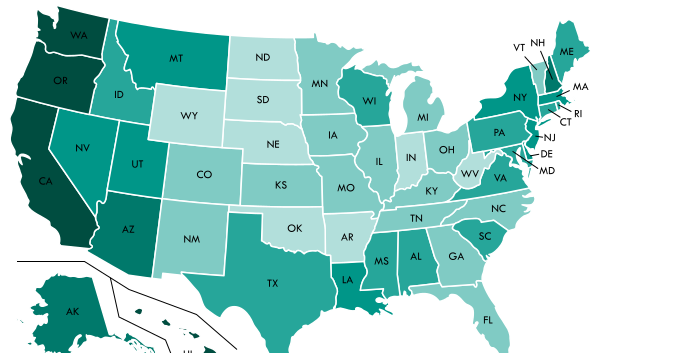
Most common states for senior database engineers
| Rank | State | Population | # of jobs | Employment/ 1000ppl |
|---|---|---|---|---|
| 1 | District of Columbia | 693,972 | 647 | 93% |
| 2 | Virginia | 8,470,020 | 2,664 | 31% |
| 3 | Maryland | 6,052,177 | 1,687 | 28% |
| 4 | Washington | 7,405,743 | 2,036 | 27% |
| 5 | Massachusetts | 6,859,819 | 1,832 | 27% |
| 6 | Vermont | 623,657 | 168 | 27% |
| 7 | Oregon | 4,142,776 | 1,071 | 26% |
| 8 | Rhode Island | 1,059,639 | 264 | 25% |
| 9 | Utah | 3,101,833 | 755 | 24% |
| 10 | New Hampshire | 1,342,795 | 301 | 22% |
| 11 | Delaware | 961,939 | 198 | 21% |
| 12 | Colorado | 5,607,154 | 1,130 | 20% |
| 13 | California | 39,536,653 | 7,609 | 19% |
| 14 | Minnesota | 5,576,606 | 1,057 | 19% |
| 15 | Montana | 1,050,493 | 199 | 19% |
| 16 | North Carolina | 10,273,419 | 1,511 | 15% |
| 17 | Nebraska | 1,920,076 | 283 | 15% |
| 18 | Georgia | 10,429,379 | 1,437 | 14% |
| 19 | New Jersey | 9,005,644 | 1,241 | 14% |
| 20 | Arizona | 7,016,270 | 979 | 14% |
Most common cities for senior database engineers
| Rank | City | # of jobs | Employment/ 1000ppl | Avg. salary |
|---|---|---|---|---|
| 1 | Annapolis | 9 | 23% | $109,787 |
| 2 | Frankfort | 3 | 11% | $107,320 |
| 3 | Lansing | 3 | 3% | $106,570 |
| 4 | Atlanta | 8 | 2% | $107,278 |
| 5 | Washington | 8 | 1% | $114,906 |
| 6 | Boston | 4 | 1% | $118,954 |
| 7 | Baton Rouge | 3 | 1% | $120,399 |
| 8 | Chandler | 3 | 1% | $124,228 |
| 9 | Urban Honolulu | 3 | 1% | $139,925 |
| 10 | Des Moines | 2 | 1% | $102,266 |
| 11 | New York | 4 | 0% | $120,257 |
| 12 | San Diego | 4 | 0% | $139,856 |
| 13 | Austin | 3 | 0% | $114,470 |
| 14 | San Francisco | 3 | 0% | $153,809 |
| 15 | Chicago | 2 | 0% | $108,020 |
Senior Database Engineer job outlook: Expert opinions
Our panel of senior database engineer experts
University of Minnesota - Crookston
The University of Arizona

Rose-Hulman Institute of Technology

University of Toledo
Metropolitan State University of Denver

Eastern Washington University

Landmark College
Christine Bakke
LecturerUniversity of Minnesota - Crookston
Math, Science & Technology Department
How have salaries changed over time for Senior Database Engineers?
Christine Bakke: In previous questions, I have used my own wording; however, the US Bureau of Labor Statistics is the most accurate source for an answer to this question:
The median pay for ITM, MIS, & CIS (all listed together at the US Bureau of Labor Statistics):
$146,360 per year
$70.37 per hour
"Employment in computer and information technology occupations is projected to grow 11 percent from 2019 to 2029, much faster than the average for all occupations. These occupations are projected to add about 531,200 new jobs. Demand for these workers will stem from greater emphasis on cloud computing, the collection and storage of big data, and information security. "
What are the biggest trends we'll see in the Senior Database Engineer job market given the pandemic?
Christine Bakke: For many years remote tech support has been a growing field, but it was not the norm. Today, remote tech support and IT management have become crucial for daily operations. Remote work requires a solid IT infrastructure, cybersecurity, capable equipment, and quality software. The need for educated and experienced MIS / ITM / CIS will continue to increase.
Trends toward remote offices will become more acceptable and common; while some companies will return to the office en masse, others will allow more flexibility or become hybrid, and some will truly embrace the remote office. Use of remote tools such as Zoom will stay strong, as they provide global access at a huge cost benefit.
What certifications/licenses/courses can have the biggest impact for Senior Database Engineers?
Christine Bakke: MIS is a technical business degree which is offered with slightly different emphasis depending on the school's home department. For example, if a business department houses the degree it is often referred to as MIS; however, when Information Technology or Computer Science departments house this degree, the program would be called Information Technology Management (ITM) or Computer Information Systems (CIS). Each university has the autonomy to offer variations based on their specializations. Even though the programs can differ slightly, in general students receiving any of these three degrees receive an education in three areas: technical, management/business, and soft skills. Note that the US Bureau of Labor Statistics directs queries for all three fields (ITM, MIS and CIS) to the same data page (see answer to question 3).
Tyler Conklin
LecturerThe University of Arizona
Computer science Department
What are the biggest trends we'll see in the Senior Database Engineer job market given the pandemic?
Tyler Conklin: The impact of the pandemic on the job market is limited in computer science. We are lucky to be in a field where remote work was routine long before the pandemic. This isn't true of all software engineering jobs, but many can be done with only a computer and internet access. The biggest changes come in the interviewing process and how the actual work will occur. It may be a long time before new hires ever meet their coworkers face to face.
What will help Senior Database Engineers increase their earning potential?
J.P. Mellor: Our graduates are particularly good at making positive progress even when the way forward is not clear, they don't know how to do what needs to be accomplished, and/or they've never done it before. This is a skill set requires a solid technical foundation and makes our graduates especially valuable.that is part
How have salaries changed over time for Senior Database Engineers?
Jared Onyango Oluoch Ph.D.: I think salaries in academia especially in Computer Science and Engineering Technology are rising and are expected to given the demand of graduates in these areas.
Janos Fustos Ph.D.
ProfessorMetropolitan State University of Denver
Department of Computer Information Systems and Business Analytics
What's a good job out of college for Senior Database Engineers?
Janos Fustos Ph.D.: I hope students are asking that question before they enroll in the first course at a college because otherwise, they would waste lot of time and money to work on a degree or a career path that does not fulfill their goals and personal interest. In that sense any job is a good job that somebody understands, feels that he/she is a good fit and can live up to the imposed challenges, and has the knowledge/skills to work in the field. There are interesting and self-fulfilling jobs to choose from. Certainly, it starts with the definition what a "good" means to an individual, what are the attributes of that definition: is that the professional area, is the salary, is it the challenging nature, is it more about the working environment and the people they can work with, is it the promotion options, the high impact etc. There are several lists available on the internet that provide recommendations and track the different aspects of job selection options for seekers.
Christian Hansen Ph.D.
Professor and Department ChairEastern Washington University
Department of Mathematics
What are the biggest trends we'll see in the Senior Database Engineer job market given the pandemic?
Christian Hansen Ph.D.: Within the short-term, the biggest trend in the job market is currently an increased demand for workforce in the healthcare and technology disciplines. In the long-term, healthcare will remain in demand, but I predict the highest future increase will be in the areas of data science, software and computer engineering.
What soft skills should all Senior Database Engineers possess?
Christian Hansen Ph.D.: The soft skills that all graduates should possess include strong communication and teamwork skills regardless of the discipline. Analytical skills will be in high demand, as well as the ability to adapt and learn new technology. Data will continue to play a bigger role in almost any type of business; therefore, the ability to analyze and interpret data for decision making will be increasingly critical. Many jobs in the future are jobs that do not yet exist and as a result, new graduates must have the ability to adapt.
What's a day at work look like for a Senior Database Engineer?
Christian Hansen Ph.D.: In the post-pandemic era, a typical workday for a recent graduate will likely involve some form of remote work. I predict that many businesses will benefit from the reduced cost of remote infrastructure compared to the cost of maintaining brick and mortar office space. Many new graduates will continue to spend their day on a computer while collaborating in teams via Zoom and other teleconference tools. People working in disciplines that have traditionally been "on the ground" will move towards more hybrid modes of work, reducing the need for travel and participating in face-to-face meetings and training.
John Russo
Associate Professor and Program Coordinator of Computer ScienceLandmark College
STEM Department
What technical skills for a Senior Database Engineer stand out to employers?
John Russo: As I mentioned above, the ability to adapt to change. My favorite course is database management systems. I tell my students that the software that we use today likely will not be around for the entire span of their careers. They really need to learn how to quickly work with new technologies, languages and systems. In the span of my career much has changed. I have always found new technologies exciting and refreshing. Employers want to hire graduates who have a set of technical skills in programming languages, database management systems and techniques (such as data mining) but also can learn on the job and be excited to learn new things.