Explore jobs
Find specific jobs
Explore careers
Explore professions
Best companies
Explore companies
Job outlook for senior embedded software engineers in the United States
Senior embedded software engineer job growth summary. After extensive research, interviews, and analysis, Zippia's data science team found that:
The projected senior embedded software engineer job growth rate is 21% from 2018-2028.
About 284,100 new jobs for senior embedded software engineers are projected over the next decade.
Senior embedded software engineer salaries have increased 9% for senior embedded software engineers in the last 5 years.
There are over 4,535 senior embedded software engineers currently employed in the United States.
There are 207,872 active senior embedded software engineer job openings in the US.
The average senior embedded software engineer salary is $113,699.
Are senior embedded software engineer jobs in demand?
Senior embedded software engineer job and salary trends over time
Senior embedded software engineer jobs over time
Senior embedded software engineer job growth rate over time
| Year | # of jobs | % of population |
|---|---|---|
| 2021 | 4,535 | 0.00% |
| 2020 | 35,070 | 0.01% |
| 2019 | 5,438 | 0.00% |
| 2018 | 35,644 | 0.01% |
| 2017 | 34,598 | 0.01% |
Average senior embedded software engineer salary over time
Senior embedded software engineer salary by year
| Year | Avg. salary | Hourly rate | % Change |
|---|---|---|---|
| 2026 | $113,699 | $54.66 | +3.4% |
| 2025 | $109,952 | $52.86 | +2.3% |
| 2024 | $107,463 | $51.66 | +2.2% |
| 2023 | $105,118 | $50.54 | +0.7% |
| 2022 | $104,395 | $50.19 | +1.2% |
Senior embedded software engineer jobs by state
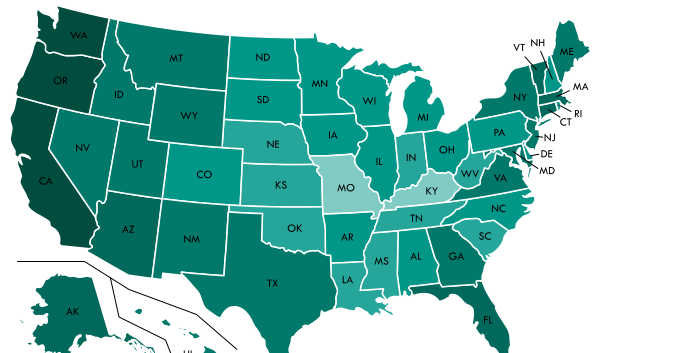
Most common states for senior embedded software engineers
| Rank | State | Population | # of jobs | Employment/ 1000ppl |
|---|---|---|---|---|
| 1 | District of Columbia | 693,972 | 798 | 115% |
| 2 | Washington | 7,405,743 | 3,925 | 53% |
| 3 | Massachusetts | 6,859,819 | 3,168 | 46% |
| 4 | Maryland | 6,052,177 | 2,481 | 41% |
| 5 | Delaware | 961,939 | 379 | 39% |
| 6 | Colorado | 5,607,154 | 2,108 | 38% |
| 7 | Virginia | 8,470,020 | 3,158 | 37% |
| 8 | Oregon | 4,142,776 | 1,416 | 34% |
| 9 | California | 39,536,653 | 13,148 | 33% |
| 10 | Utah | 3,101,833 | 1,032 | 33% |
| 11 | Vermont | 623,657 | 193 | 31% |
| 12 | New Hampshire | 1,342,795 | 401 | 30% |
| 13 | Minnesota | 5,576,606 | 1,518 | 27% |
| 14 | Rhode Island | 1,059,639 | 291 | 27% |
| 15 | Wyoming | 579,315 | 150 | 26% |
| 16 | North Dakota | 755,393 | 171 | 23% |
| 17 | New Mexico | 2,088,070 | 464 | 22% |
| 18 | Montana | 1,050,493 | 236 | 22% |
| 19 | South Dakota | 869,666 | 192 | 22% |
| 20 | Nebraska | 1,920,076 | 394 | 21% |
Most common cities for senior embedded software engineers
| Rank | City | # of jobs | Employment/ 1000ppl | Avg. salary |
|---|---|---|---|---|
| 1 | Severn | 7 | 16% | $105,622 |
| 2 | Niles | 4 | 14% | $98,123 |
| 3 | Columbia | 5 | 5% | $105,513 |
| 4 | Clifton | 4 | 5% | $106,755 |
| 5 | Santa Clara | 5 | 4% | $137,713 |
| 6 | Alameda | 3 | 4% | $138,082 |
| 7 | Mountain View | 3 | 4% | $137,825 |
| 8 | Boulder | 3 | 3% | $102,526 |
| 9 | Orlando | 6 | 2% | $112,609 |
| 10 | Huntsville | 3 | 2% | $100,240 |
| 11 | San Diego | 11 | 1% | $121,106 |
| 12 | Boston | 4 | 1% | $115,050 |
| 13 | Fort Wayne | 3 | 1% | $87,006 |
| 14 | Mesa | 3 | 1% | $112,993 |
| 15 | San Jose | 5 | 0% | $137,545 |
| 16 | Los Angeles | 4 | 0% | $126,635 |
| 17 | San Francisco | 4 | 0% | $138,257 |
Senior Embedded Software Engineer job outlook: Expert opinions
Our panel of senior embedded software engineer experts
Nova Southeastern University

University of Hawaii at Hilo
University of Minnesota - Crookston

Gannon University

Rose-Hulman Institute of Technology

University of Toledo
Metropolitan State University of Denver

Eastern Washington University

Landmark College
Auburn University at Montgomery

Allegheny College

Saint Xavier University

Taylor University
John Brown University
Rider University

Union University
Defiance College

Seminole State College of Florida
Carthage College

Harding University
Junping Sun Ph.D.
ProfessorNova Southeastern University
Computer Software And Media Applications
What Senior Embedded Software Engineer skills would you recommend for someone trying to advance their career?
Junping Sun Ph.D.: Computer Science and its applications in various fields are very dynamic and constantly evolving, and anyone in the fields needs to prepare to be adaptive by lifelong learning.
Travis Mandel Ph.D.
Assistant ProfessorUniversity of Hawaii at Hilo
Department of Computer Science
What skills stand out on Senior Embedded Software Engineer resumes?
Travis Mandel Ph.D.: The number one thing that employers typically look for is a project that demonstrates your ability to program something new and useful. The best projects are ones that someone undertakes independently or with a small group of others - if it is the latter, you need to clarify what you contributed. It's even better if you include a link to public code on Github so that employers can look around your Github page and get a sense of your coding style. A working demo is also very impressive. Ideally, this wouldn't be something you were forced to do for a class but rather something you took the independent initiative to do.
College GPA doesn't matter as much as people think it does - most companies care much more about what you can do than how well you did in class. Unless it is extremely low, it shouldn't be a problem. Listing courses can be useful, but even better would be listing skills you learned in classes. For instance, the class "Artificial Intelligence" means completely different things at institutions. So employers may not necessarily understand what skills you learned in that class unless you highlight them.
What soft skills should all Senior Embedded Software Engineers possess?
Travis Mandel Ph.D.: Although computer science seems like a highly technical field, soft skills are really what differentiates software engineers. One of the most important qualities of any software engineer is explaining their code clearly at various levels of technical depth and explaining why certain design decisions were made. You could write code that does amazing things, but if that code consists of snippets you pasted from StackOverflow without really fully understanding them, it will be a huge headache for anyone who needs to come into the codebase later and maintain or update it.
Another one is asking the right questions. Imagine you are dropped into a huge codebase and asked to add a new feature (very common!). There's no time to understand everything that is going on, but on the other hand, you need to understand enough of the code to do your task effectively, which involves asking questions. A failure to ask questions will likely result in you wasting a huge amount of time working on something that is ultimately not useful, for instance, re-implementing a complex function that already exists somewhere in the codebase.
Christine Bakke
LecturerUniversity of Minnesota - Crookston
Math, Science & Technology Department
What are the biggest trends we'll see in the Senior Embedded Software Engineer job market given the pandemic?
Christine Bakke: For many years remote tech support has been a growing field, but it was not the norm. Today, remote tech support and IT management have become crucial for daily operations. Remote work requires a solid IT infrastructure, cybersecurity, capable equipment, and quality software. The need for educated and experienced MIS / ITM / CIS will continue to increase.
Trends toward remote offices will become more acceptable and common; while some companies will return to the office en masse, others will allow more flexibility or become hybrid, and some will truly embrace the remote office. Use of remote tools such as Zoom will stay strong, as they provide global access at a huge cost benefit.
What certifications/licenses/courses can have the biggest impact for Senior Embedded Software Engineers?
Christine Bakke: MIS is a technical business degree which is offered with slightly different emphasis depending on the school's home department. For example, if a business department houses the degree it is often referred to as MIS; however, when Information Technology or Computer Science departments house this degree, the program would be called Information Technology Management (ITM) or Computer Information Systems (CIS). Each university has the autonomy to offer variations based on their specializations. Even though the programs can differ slightly, in general students receiving any of these three degrees receive an education in three areas: technical, management/business, and soft skills. Note that the US Bureau of Labor Statistics directs queries for all three fields (ITM, MIS and CIS) to the same data page (see answer to question 3).
How have salaries changed over time for Senior Embedded Software Engineers?
Christine Bakke: In previous questions, I have used my own wording; however, the US Bureau of Labor Statistics is the most accurate source for an answer to this question:
The median pay for ITM, MIS, & CIS (all listed together at the US Bureau of Labor Statistics):
$146,360 per year
$70.37 per hour
"Employment in computer and information technology occupations is projected to grow 11 percent from 2019 to 2029, much faster than the average for all occupations. These occupations are projected to add about 531,200 new jobs. Demand for these workers will stem from greater emphasis on cloud computing, the collection and storage of big data, and information security. "
Are there any particularly good places in the United States for Senior Embedded Software Engineers to find work opportunities?
Dr. Stephen Frezza Ph.D.: Computing is ubiquitous, and with more industries moving to remote work, location is becoming less critical. If the internet reaches a place reliably, computing jobs can be located there.
How do you envision technology impacting Senior Embedded Software Engineers in the next 5 years?
Dr. Stephen Frezza Ph.D.: Breadth and depth: Computing is becoming more like engineering; where the value of the product, its lifetime risks, costs, and benefits are more critical than just it's roll-out. So the engineering competencies that have always been a part of computing will become more central. Computing is also expanding; the role of data and the shift of once-research technologies (like machine learning) into production applications will continue to require computing graduates to broaden their base and continue as learners. This will cause shifts in what is considered 'fundamental' and the need for professionals to continue to hone and redevelop their technical skill sets.
Will there be an enduring impact of the coronavirus pandemic on Senior Embedded Software Engineers?
J.P. Mellor: I'm sure the pandemic will have an enduring impact on all of us. Our students are certainly experiencing new challenges as they strive to learn during the pandemic. They are aquiring skills and competencies associated with working remotely and engaging while doing so. These are skills that students in past years did not attain.
What will help Senior Embedded Software Engineers increase their earning potential?
J.P. Mellor: Our graduates are particularly good at making positive progress even when the way forward is not clear, they don't know how to do what needs to be accomplished, and/or they've never done it before. This is a skill set requires a solid technical foundation and makes our graduates especially valuable.that is part
What are the biggest trends we'll see in the Senior Embedded Software Engineer job market given the pandemic?
Jared Onyango Oluoch Ph.D.: We are already seeing a lot of professionals working remotely. This trend will likely continue especially in domains such as software engineering. With this may also occur lack of social connections and team building that we have seen over the years with people working in offices or facilities.
How have salaries changed over time for Senior Embedded Software Engineers?
Jared Onyango Oluoch Ph.D.: I think salaries in academia especially in Computer Science and Engineering Technology are rising and are expected to given the demand of graduates in these areas.
Janos Fustos Ph.D.
ProfessorMetropolitan State University of Denver
Department of Computer Information Systems and Business Analytics
What's a good job out of college for Senior Embedded Software Engineers?
Janos Fustos Ph.D.: I hope students are asking that question before they enroll in the first course at a college because otherwise, they would waste lot of time and money to work on a degree or a career path that does not fulfill their goals and personal interest. In that sense any job is a good job that somebody understands, feels that he/she is a good fit and can live up to the imposed challenges, and has the knowledge/skills to work in the field. There are interesting and self-fulfilling jobs to choose from. Certainly, it starts with the definition what a "good" means to an individual, what are the attributes of that definition: is that the professional area, is the salary, is it the challenging nature, is it more about the working environment and the people they can work with, is it the promotion options, the high impact etc. There are several lists available on the internet that provide recommendations and track the different aspects of job selection options for seekers.
Christian Hansen Ph.D.
Professor and Department ChairEastern Washington University
Department of Mathematics
What soft skills should all Senior Embedded Software Engineers possess?
Christian Hansen Ph.D.: The soft skills that all graduates should possess include strong communication and teamwork skills regardless of the discipline. Analytical skills will be in high demand, as well as the ability to adapt and learn new technology. Data will continue to play a bigger role in almost any type of business; therefore, the ability to analyze and interpret data for decision making will be increasingly critical. Many jobs in the future are jobs that do not yet exist and as a result, new graduates must have the ability to adapt.
What's a day at work look like for a Senior Embedded Software Engineer?
Christian Hansen Ph.D.: In the post-pandemic era, a typical workday for a recent graduate will likely involve some form of remote work. I predict that many businesses will benefit from the reduced cost of remote infrastructure compared to the cost of maintaining brick and mortar office space. Many new graduates will continue to spend their day on a computer while collaborating in teams via Zoom and other teleconference tools. People working in disciplines that have traditionally been "on the ground" will move towards more hybrid modes of work, reducing the need for travel and participating in face-to-face meetings and training.
John Russo
Associate Professor and Program Coordinator of Computer ScienceLandmark College
STEM Department
What technical skills for a Senior Embedded Software Engineer stand out to employers?
John Russo: As I mentioned above, the ability to adapt to change. My favorite course is database management systems. I tell my students that the software that we use today likely will not be around for the entire span of their careers. They really need to learn how to quickly work with new technologies, languages and systems. In the span of my career much has changed. I have always found new technologies exciting and refreshing. Employers want to hire graduates who have a set of technical skills in programming languages, database management systems and techniques (such as data mining) but also can learn on the job and be excited to learn new things.
Will there be an enduring impact of the coronavirus pandemic on Senior Embedded Software Engineers?
Dr. Semih Dinc: I personally think there may be a positive impact of this pandemic for CS graduates in medium/long term. Even if many companies have frozen or slowed down their hiring process now, I believe this is a temporary decision. There is still a big need for new CS graduates in the industry. And to me it is more clear that people realized they can work remotely for many CS related positions. This means that many companies can cut their physical office budgets and hire more remote people. One of the factors for our students is the challenges/expenses of the city they would work. Some of them do not want to move to big cities. I am assuming with more remote working opportunities graduates will have more options.
What type of skills will young Senior Embedded Software Engineers need?
Dr. Semih Dinc: I may be little biased on this question maybe because of my research field. But I notice a significant demand on machine learning experts in the industry. Today I think a CS graduate should have skills such as machine learning, computer vision, and programming for mobile environments.
What experience really stands out on Senior Embedded Software Engineer resumes?
Dr. Semih Dinc: According to my experience, most companies are not looking for "straight A" students. Instead, they look for someone with real world experience in their field. A recent graduate will most likely stand out if he/she has somehow contributed real projects. This can be achieved through internships. For many students, who do not have this option, they can still stand out by sharing their "good" school projects to platforms like GitHub. This way they can show companies that they are aware of these tools, and they will be ready to adopt the new company environment.
Oliver Bonham-Carter Ph.D.
Assistant ProfessorAllegheny College
Department of Computer Science and Affiliated Faculty in Integrative Informatics
What are the biggest trends we'll see in the Senior Embedded Software Engineer job market given the pandemic?
Oliver Bonham-Carter Ph.D.: Pandemic has accelerated social connectivity trends using technology, including technology for remote work, and e-learning, and technology to make e-commerce more comfortable and faster. I foresee these accelerated technology trends to continue, even after the pandemic, and therefore job markets in these areas to continue to grow. Another big surge we have seen is in data analytics, which has been increasing over the last decade, and COVID-19 has spotlighted this field. I expect data analyst jobs to continue to be in demand and to grow. Also, the pandemic showed us the interconnectedness of technology with other areas. As the need to develop better solutions to fight various diseases heightens, for example, I expect jobs in biotech to grow.
Will there be an increase or decrease in demand for Senior Embedded Software Engineers in the next 5 years?
Oliver Bonham-Carter Ph.D.: More technology and expertise to use online productivity, development, and communication technologies, is now needed to build and maintain online infrastructures to bring people together in a smaller world. The increase in demand for graduates in the areas mentioned above will result from the current dependence that the pandemic has forced upon Internet-based technologies for communications and productivity. For instance, more will likely be done online after the pandemic since companies have grown used to the convenience of organizing online meetings, working in the cloud, and completing development and scheduling tasks, using freshly-minted, online productivity technologies from GitHub, Zoom, Google Meet, and similar organizations.
In academia, conferences used to be in-person only, and so if you wanted to meet colleagues in your research area, you had to attend in person. Due to the lessons learned from conducting meetings during the pandemic, participants are encouraged to attend conferences virtually, give presentations, develop collaborations, and become involved in new and exciting projects without leaving their living rooms.
These events have grown used to this freedom to organize events, without physical boundaries, when getting people together to meet, think, and work. It is logical to perform more online work now, to be done so conveniently to include more people and more productivity, with less travel and hotels to worry about. It would seem that those who design technological innovations, permitting better communication, development, and productivity for online users will be the creators of the collaboration spaces of tomorrow.
What technology do you think will become more important and prevalent for Senior Embedded Software Engineers in the next 3-5 years?
Oliver Bonham-Carter Ph.D.: In the next few years, technologies related to artificial intelligence, data analytics, cloud computing, container-orchestration systems, and cybersecurity will continue to become more important and prominent. These technologies have the foundation to improve the quality of life in terms of health, education, fighting misinformation, creating better connections, fighting climate change, etc. IoT with smart devices connected online will continue to rise, thus producing more data, which will necessitate AI, data analytics, and security solutions. Additionally, I foresee 5G technology to play an essential role in the next few years, as e-commerce expands into autonomous delivery services. In the software engineering field, to enable fast, secure, and connected software development, technologies allowing to automate a part of that process, such as version control, containerization, and Kubernetes, will also become increasingly important.
Will there be an increase or decrease in demand for Senior Embedded Software Engineers in the next 5 years?
James Vanderhyde: There has been a steady increase in software and IT jobs for the last 20 years, and this is not going to slow down any time soon. In the next 5 years, demand will increase, particularly in software development and cybersecurity. The technology field changes so quickly that beyond 5 years, it is difficult to make predictions. That is why we thoroughly prepare our computer science and information systems students for technology changes and career shifts to discover the best in themselves and to be prepared to meet the demand and excel within the field.
Are there any particularly good places in the United States for Senior Embedded Software Engineers to find work opportunities?
James Vanderhyde: Any big city will have lots of opportunities for computing, software, and IT work. Silicon Valley and the rest of the west coast are the most famous, but innovation is happening everywhere around the country and around the world, including here in Chicago. Chicago tech companies have hired our students upon graduation, and likewise, our graduates have found success and gratification in the field.
What are the best companies to work for a Senior Embedded Software Engineer?
James Vanderhyde: The best companies to work for are companies that respect you as a person and not just a cog in the machine. They are inclusive, and they recognize and appreciate diversity. They have a track record of handling sick leave and family leave as needed. They will not expect you to eat dinner in your office and then go back to work after an already long day. All software companies experience crunch times around release dates, but the best companies do not experience constant crunch. That is a sign of poor management. The best companies will give you challenging problems to work on and reward innovation.
Dr. Jonathan Geisler
Associate ProfessorTaylor University
Department of Computer Science and Engineering
What are the best companies to work for a Senior Embedded Software Engineer?
Dr. Jonathan Geisler: The best companies to work for are the ones that are responsive to both their customers' and employees' needs. They are the ones that have tried to be proactive during the pandemic and not just survive until everything got "back to normal." They know that a damaged workforce leads to a damaged company, and so they provide good management, encouraging everyone to be healthy mentally and physically.
Will there be an increase or decrease in demand for Senior Embedded Software Engineers in the next 5 years?
Dr. Jonathan Geisler: There will be a continued increase in demand for computer engineering
graduates as computers become more heavily integrated into the fabric
of our lives. Things like self-driving cars, the Internet of Things, and
mobile computing will become more commonplace and increase the demand for engineering talent; the long-term trend of using smartphones and web-based applications will not slow, leading to an increase in the
demand for computing talent.
How do you envision technology impacting Senior Embedded Software Engineers in the next 5 years?
Dr. Ted Junseok Song: The question is not whether technology will advance or not. It is, rather, how it will advance. Professionals in the industry need to be equipped to see the customers' demand and where our society is headed. I would recommend college students to be interested in broad topics apart from topics in their major. Well-rounded people will have more opportunities to impact the future.
Dr. Howard Rees
Adjunct Assistant Professor of Information SystemsRider University
Information systems
What technology do you think will become more important and prevalent for Senior Embedded Software Engineers in the next 3-5 years?
Dr. Howard Rees: Hmm, what technology? That's a question with many different levels of context. For some undergraduates in CS and IT, I would look at systems programming in massively parallel environments, application programming with particular focus on security and privacy, and data science and analytics. For other undergraduates, they might look at artificial intelligence and machine learning, for business applications especially. AI is becoming ubiquitous throughout the business, but it's often used as a "black box."
Meaning that the applications (and those "operating" them) do not understand what's happening inside. AI systems are often "designed, trained, and tested" by the provider and certified as generating the output most desired by the customer but only in a statistical sense. There is no "proof" that the AI black box is, with certainty, doing what the business customer (or the provider for that matter) thinks it is doing - it just does a good job when tested on data. There will be a significant need for tech-savvy people to design, train, monitor, and apply them so that they do not deviate from the desired goals. Such deviations can result in socially destructive business practices. As you can't properly manage what you don't understand, there is a risk in using AI too blindly. CS and IT graduates will need to help out.
Will there be an enduring impact of the coronavirus pandemic on Senior Embedded Software Engineers?
Dr. Howard Rees: We're moving into a volatile time for the economy, and planning for an uncertain future is what big companies are concerned with. In many ways, the pandemic and concerns over future pandemics that we now know can be globally devastating will be a boon for CS and IT graduates. Face to face business interactions and transactions will be dramatically reduced, both in the short term and in the long run, as there will be a need to hedge against future pandemics. Everything changes from production and operations to supply chain and risk management and diversification to the nature of "office work." And all of that must be underpinned by computer technology: communications, security, data analytics. These are trends that have been developing for the past few decades but the pandemic will accelerate them, and that's all useful, if you're a CS or IT graduate with a broad base of knowledge, which provides you the freedom to adapt.
What technology do you think will become more important and prevalent for Senior Embedded Software Engineers in the next 3-5 years?
Brian Glas: [Something]-as-code will continue to grow in prevalence as we strive to automate more processes and technologies. More jobs will need, at least, the essential ability to understand and write in some scripting language or similar. We should also see an increase in collaboration tooling to support communication and collaboration with more of the workforce spread globally.
What general advice would you give to a Senior Embedded Software Engineer?
Brian Glas: Build relationships: Different technologies will interest and challenge you, but throughout your career, you'll find that it's the relationships that are the most important. This is harder to grasp earlier in your career, but much easier to understand after 15-20 years.
Gain different perspectives: Spend time with people in other roles that your job interacts with, and gain a solid understanding of how they view things; this is most valuable for career progression and understanding of how your work fits into the big picture.
Will there be an enduring impact of the coronavirus pandemic on Senior Embedded Software Engineers?
Aaron Napierala: I think the pandemic's lasting impact on graduates will be decisive in preparing them for careers in technology. A recent graduate of mine just completed training for a new position with a company, completely remote. It was the first time the company had ever done anything like this before. It was a success, and the graduate raves at the entire process. The pandemic is forcing companies to scrutinize how they operate, to ensure the best possible outcome, for whatever it is they are doing. Once they see the success of being able to accomplish something more efficiently, or they are more cost-effective, they may continue on this path. Why would a company post their ad locally and interview a handful of candidates, when they can open up access globally and draw from a much larger pool? So for graduates just now entering the workforce, they have a distinct advantage: having access to technology for the majority of their lives and just coming out of situations that were forced on them to communicate remotely.
Craig Tidwell Ph.D.
Professor/Program ManagerSeminole State College of Florida
Center for Information Technology
What technology do you think will become more important and prevalent for Senior Embedded Software Engineers in the next 3-5 years?
Craig Tidwell Ph.D.: Understanding cloud technologies such as Amazon Web Services, Microsoft Azure, and Google are needed. Since many organizations have a hybrid structure, where they have internal and external cloud technologies, learning how to integrate them with existing technologies is critical.
Will there be an enduring impact of the coronavirus pandemic on Senior Embedded Software Engineers?
Craig Tidwell Ph.D.: Many I.T. employees already have the option to work remotely (telecommute), but this will become even more important with the Coronavirus challenges. Employees must be able to work remotely and be organized and self-directed. Employers are looking for teleworkers that can work on a task from anywhere.
What general advice would you give to a Senior Embedded Software Engineer?
Craig Tidwell Ph.D.: Students who are graduating with a degree in computer and information systems should focus on being lifelong learners. The most challenging, and sometimes frustrating, aspect of a career in information technology is that it is always changing. Employers are also looking for employees that can work well with others, especially in teams. Having a good understanding of the development and design process, and project management (DevOps) is a plus. Currently, there is a high demand for graduates with cloud and information security knowledge and skills.
Will there be an enduring impact of the coronavirus pandemic on Senior Embedded Software Engineers?
Perry Kivolowitz: Companies will see that work-at-a-distance has value. More companies will compare fixed physical space costs versus, in many cases, productivity increases when allowing people to work remotely. I believe, those in the office real estate business should be concerned as companies downsize their physical space, opting for more flexible practices such as remote workers and hotelling, or time-sharing of reduced physical space.
What technology do you think will become more important and prevalent for Senior Embedded Software Engineers in the next 3-5 years?
Frank McCown Ph.D.: Software continues to move to mobile devices and the web and away from desktop applications. The pandemic has encouraged growth in applications that make in-person transactions go away, and that trend will likely continue. Obviously AI-enabled or assisted applications will continue to grow.
What general advice would you give to a Senior Embedded Software Engineer?
Frank McCown Ph.D.: The market is stable for software developers, despite the economic challenges created by the pandemic. Before accepting a job offer, talk to the company's employees through online meetings or email, and see what they think of the company. Do they enjoy their work? Are there opportunities to learn new technologies? How does the company treat their employees? There's a good chance you will be working remotely in your first job, so you will need to exercise a lot of self-discipline, be punctual for online meetings, do the work you've been assigned, and know when to ask questions when you get stuck. Expect a steeper-than-normal learning curve if you are working remotely instead of in an office.
Will there be an enduring impact of the coronavirus pandemic on Senior Embedded Software Engineers?
Frank McCown Ph.D.: Many companies have changed their hiring practices. It's not unusual for a new graduate to jump straight into remote work. I predict the move from in-person work to remote work is only going to accelerate as we get more comfortable with it. Once the pandemic dies down, and economic uncertainties start to go away, companies that had been on hiring freezes will likely jump back in, creating a strong market for graduates.