Explore jobs
Find specific jobs
Explore careers
Explore professions
Best companies
Explore companies
Job outlook for senior hardware engineers in the United States
Senior hardware engineer job growth summary. After extensive research, interviews, and analysis, Zippia's data science team found that:
The projected senior hardware engineer job growth rate is 5% from 2018-2028.
About 3,700 new jobs for senior hardware engineers are projected over the next decade.
Senior hardware engineer salaries have increased 4% for senior hardware engineers in the last 5 years.
There are over 46,656 senior hardware engineers currently employed in the United States.
There are 55,261 active senior hardware engineer job openings in the US.
The average senior hardware engineer salary is $116,383.
Are senior hardware engineer jobs in demand?
Senior hardware engineer job and salary trends over time
Senior hardware engineer jobs over time
Senior hardware engineer job growth rate over time
| Year | # of jobs | % of population |
|---|---|---|
| 2021 | 46,656 | 0.01% |
| 2020 | 41,759 | 0.01% |
| 2019 | 43,819 | 0.01% |
| 2018 | 39,763 | 0.01% |
| 2017 | 43,342 | 0.01% |
Average senior hardware engineer salary over time
Senior hardware engineer salary by year
| Year | Avg. salary | Hourly rate | % Change |
|---|---|---|---|
| 2026 | $116,383 | $55.95 | +2.0% |
| 2025 | $114,105 | $54.86 | +2.3% |
| 2024 | $111,555 | $53.63 | --0.5% |
| 2023 | $112,061 | $53.88 | +0.0% |
| 2022 | $112,022 | $53.86 | +3.0% |
Senior hardware engineer jobs by state
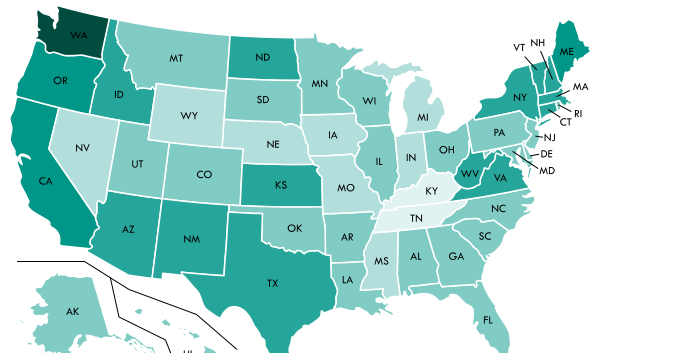
Most common states for senior hardware engineers
| Rank | State | Population | # of jobs | Employment/ 1000ppl |
|---|---|---|---|---|
| 1 | District of Columbia | 693,972 | 268 | 39% |
| 2 | Massachusetts | 6,859,819 | 1,112 | 16% |
| 3 | Virginia | 8,470,020 | 1,203 | 14% |
| 4 | Washington | 7,405,743 | 1,038 | 14% |
| 5 | Maryland | 6,052,177 | 841 | 14% |
| 6 | Delaware | 961,939 | 130 | 14% |
| 7 | California | 39,536,653 | 5,289 | 13% |
| 8 | Colorado | 5,607,154 | 735 | 13% |
| 9 | Oregon | 4,142,776 | 519 | 13% |
| 10 | Utah | 3,101,833 | 333 | 11% |
| 11 | New Hampshire | 1,342,795 | 142 | 11% |
| 12 | Arizona | 7,016,270 | 683 | 10% |
| 13 | Vermont | 623,657 | 62 | 10% |
| 14 | Minnesota | 5,576,606 | 501 | 9% |
| 15 | Wyoming | 579,315 | 50 | 9% |
| 16 | Rhode Island | 1,059,639 | 87 | 8% |
| 17 | Alabama | 4,874,747 | 364 | 7% |
| 18 | Alaska | 739,795 | 51 | 7% |
| 19 | Connecticut | 3,588,184 | 226 | 6% |
| 20 | Idaho | 1,716,943 | 100 | 6% |
Most common cities for senior hardware engineers
| Rank | City | # of jobs | Employment/ 1000ppl | Avg. salary |
|---|---|---|---|---|
| 1 | Andover | 2 | 6% | $119,674 |
| 2 | Derry | 2 | 6% | $118,205 |
| 3 | Annapolis | 2 | 5% | $109,939 |
| 4 | Bartlesville | 2 | 5% | $99,996 |
| 5 | Bethesda | 2 | 3% | $109,702 |
| 6 | Santa Clara | 3 | 2% | $143,711 |
| 7 | Boulder | 2 | 2% | $109,677 |
| 8 | Washington | 4 | 1% | $101,776 |
| 9 | Cleveland | 2 | 1% | $98,543 |
| 10 | Fort Wayne | 2 | 1% | $95,464 |
| 11 | Fremont | 2 | 1% | $143,778 |
| 12 | Henderson | 2 | 1% | $89,536 |
| 13 | Huntsville | 2 | 1% | $106,358 |
| 14 | San Jose | 5 | 0% | $143,512 |
| 15 | Indianapolis | 3 | 0% | $94,574 |
| 16 | Phoenix | 3 | 0% | $114,455 |
| 17 | San Diego | 3 | 0% | $127,266 |
| 18 | Boston | 2 | 0% | $119,898 |
Senior Hardware Engineer job outlook: Expert opinions
Our panel of senior hardware engineer experts
Gonzaga University
Stevens Institute of Technology
California State University - Fresno
University of Michigan - Ann Arbor
University of Alabama at Birmingham
San Diego State University
Jackson State University
University of Utah

East Tennessee State University

Old Dominion University

University of Central Florida

Rose-Hulman Institute of Technology
Northern Michigan University

University of Mississippi
Elon University
Merrimack College
Marietta College
University of California Merced
What general advice would you give to a Senior Hardware Engineer?
Craig Johnson Ph.D., P.E.: To begin your career in our field, please know that there are some shared values, some behavior constraints, and some awesome possible career paths for you to explore! Our program is accredited through ABET, which means that you can acquire your Professional Engineering licensure. Along with licensure are ethics compliance and legal behavior. You must put safety as a first constraint in all work. Create great technical solutions to real problems that may affect us all. Politics and company policies evolve, and we must evolve with them. New finance realities dictate that you will be more active in both seeking new jobs and changing jobs to promote your careers. You are at the center of many crossroads of technical activity that present options for your path forward.
What Senior Hardware Engineer skills would you recommend for someone trying to advance their career?
Steven Schennum Ph.D. P.E.: The most important skill is the ability to learn new things, and especially to unlearn things you “know” after evidence demonstrates that these things are not true. Learn how to analyze information. Your intuition, simulations, and results should all be in alignment. If they are not, then dig deeper. Learn the terminology and jargon specific to your company and your projects. Spend time reading. Don’t be afraid to ask questions. Don’t be intimidated by new software.
What will help Senior Hardware Engineers increase their earning potential?
Steven Schennum Ph.D. P.E.: Put a good resume together and follow suggestions of people who are experts at preparing resumes. Before you have an interview, practice interviewing. Participate in a mock interview and listen to feedback. Maximize salary potential by documenting your accomplishments, your work, and your results. Keep a journal. If you have good documentation, you can more easily make a case for promotion when the time comes.
What Senior Hardware Engineer skills would you recommend for someone trying to advance their career?
Min Song: Communication skills and innovative thinking skills. As emerging technologies continue to be complex and multidisciplinary, it’s important to be able to communicate with professionals in diverse disciplines. Taking robotics, for example, the electrical engineer must be able to work with mechanical and biomechanical engineers, computer engineers, software engineers, artificial intelligence experts, cognitive scientists, system engineers, etc. A person will be able to generate innovative ideas only if the person has a complete and comprehensive understanding of the entire system and can work well with other individuals with a range of expertise.
What general advice would you give to a Senior Hardware Engineer?
Aaron Stillmaker Ph.D.: I highly encourage students starting to look for jobs to get their resume polished both by talking with a trusted professor and taking advantage of career centers at their university. I always suggest that students highlight fascinating projects on their resumes that highlight their knowledge base without having to list skills, and they need to be ready to talk intelligibly about those projects. I would make sure to prepare for interviews by brushing up on design course material that are taught in the courses most closely pertaining to the specialty they are interviewing for. I also suggest they contact professors they have a good relationship with to ask them to reach out to their contacts in the field, as many professors have connections in the industry and are happy to help their good students attain good jobs.
What general advice would you give to a Senior Hardware Engineer?
Todd Allen: - take jobs where you can build new skills while proving your professional competence. This philosophy, throughout your career, will lead to further growth opportunities
What will help Senior Hardware Engineers increase their earning potential?
Todd Allen: -work hard to develop professional networks
- get the details right
- the way you present is as important as your technical knowledge
What general advice would you give to a Senior Hardware Engineer?
Arie Nakhmani: Electrical Engineering combines a dozen sub-fields such as power systems, telecommunications, embedded systems, machine learning/AI, hardware design, signal analysis, IoT, etc., and jobs in these different subfields could look completely different. Some involve office work with the computer designing algorithms or optimizing processes, others might involve inspecting power transmission lines with drones in the middle of the forest. Some jobs include testing airplane engines and others designing microchips and working in clean rooms.
What Senior Hardware Engineer skills would you recommend for someone trying to advance their career?
Arie Nakhmani: Electrical Engineering has always (from its inception) been a good profession to enter, but now it is better than ever. Now everything is becoming Electrical Engineering, and the world cannot survive without it even for a few days. Electrical Engineering is the most necessary profession for the survival of modern society.
What will help Senior Hardware Engineers increase their earning potential?
Arie Nakhmani: People who have EE degrees like being able to choose from a variety of EE sub-fields and being able to enter new areas because they learn science fundamentals and math, critical thinking, and the ability to solve difficult problems that are very helpful in life regardless of the job they pick. People dislike that solving difficult problems is difficult and requires a lot of effort. Not all are ready to put their effort in.
What general advice would you give to a Senior Hardware Engineer?
Asad Salem Ph.D: To optimize your engineering salary potential, meticulously delve into industry salary benchmarks. Beyond excelling in your academic pursuits, acquire hands-on experience through research, internships, or co-op opportunities. Exhibit relevant skills and project accomplishments, consider pursuing advanced areas of expertise or certifications, and approach job offers with confidence during negotiations. Moreover, augment this strategy by actively engaging in networking, staying attuned to market inclinations, and showcasing a willingness to take on demanding projects. By emphasizing your dedication and proactively contributing, you can fortify your commitment and bolster your long-term earnings prospects in the dynamic field of engineering.
What will help Senior Hardware Engineers increase their earning potential?
Asad Salem Ph.D: Cultivate a well-rounded skill set, encompassing interpersonal, communication, teamwork, work ethics, and self-learning capabilities, to propel your career forward. Foster a curious mindset, actively seek feedback, and confront challenges with confidence. In a dynamic professional landscape, prioritize adaptability and continuous learning. Strike a harmonious balance between a solid technical foundation and crucial soft skills, such as effective communication and teamwork. Stay abreast of industry developments, take a proactive stance, and seek mentorship for effective career navigation. Develop a robust technical base while valuing soft skills, staying informed about industry trends, taking initiative, and securing mentors to guide you through your career journey.
What Senior Hardware Engineer skills would you recommend for someone trying to advance their career?
Dr. Arif Engin: Electrical engineering graduates are sought by a wide range of employers in government and industry for many different types of work. The top occupations in electrical engineering fields are projected to grow and sometimes require an advanced degree.
What will help Senior Hardware Engineers increase their earning potential?
Dr. Arif Engin: Electrical engineers solve problems by skillfully applying mathematics and science. Electrical engineering classes are challenging at college, and electrical engineers must embrace lifelong learning to remain at the top of their skills. In the end, seeing the results of their work in a finished product is a rewarding experience.
Mahmoud Manzoul
Professor of Electrical and Computer Engineering at Jackson State UniversityJackson State University
Electrical, Electronics, And Communications Engineering
What Senior Hardware Engineer skills would you recommend for someone trying to advance their career?
Mahmoud Manzoul: In addition to honing strong technical abilities, cultivating soft skills is paramount. Unfortunately, as professors, we often overlook the significance of these skills, which are indispensable for thriving in one's career. Soft skills encompass effective communication across diverse audiences and the ability to collaborate harmoniously within a team.
Florian Solzbacher
Department Chair, Professor, Elect & Computer EngineeringUniversity of Utah
Electrical and Computer Engineering Department
What skills stand out on Senior Hardware Engineer resumes?
Florian Solzbacher: Examples of having applied the knowledge gained in their studies to practical examples of solving engineering problems that require the combination of skills and at least some understanding of system engineering aspects are important signals that graduating engineers are ready to be productive in a real-world setting are always important. Obviously, participating in projects that address current "hot topic" problems, e.g., in robotics, AI/machine learning, power systems, biomedical applications, or that resonate with specific problems an employer is currently working on, will raise a student's profile.
Supplemental skills, such as Entrepreneurial or business training, can enhance and differentiate a student's resume. This shows that an engineer is not solely focused on the core technical engineering skills but does have an understanding of the driving forces and their interaction in a real-world business setting, that are not only part of the design requirements for a product (e.g., design to cost), but also often drive the selection of technical solution paths, after all, every development and product has to make business sense. Imagine two young engineers proposing a solution to their manager for a new product: one maybe even over-exceeds the technical requirements, but the development and/or manufacturing and servicing effort and cost is significantly higher than a colleagues solution that may only just about reach the requirements, or maybe even compromise on some specifications, but that is far cheaper to develop, make and service and that may allow entering a far larger market- chances are very high that the business may decide to go for the "inferior" solution from a technical point of view, that is, however, the better product. This supplemental skill set is a significant competitive advantage to have as an engineer.
Jared Wilson
Assistant Professor and Faculty CoordinatorEast Tennessee State University
Surveying and Mapping
Are there any particularly good places in the United States for Senior Hardware Engineers to find work opportunities?
Jared Wilson: Within the field of land surveying and related employment opportunities, work is available. However, in my experience, work may not be in the exact location a person wishes to live. So, a move may be necessary, or potentially traveling to where the work is located. Should a graduate, or person for that matter, want to work, work is available.
Will there be an enduring impact of the coronavirus pandemic on Senior Hardware Engineers?
Michel Audette Ph.D.: My take on this is what I've seen with my wife's work in industry, which suggests that the industrial landscape is going to be increasingly equipped for, and open to, remote work. I think that the implication for graduates is that they may need to be flexible about working within a geographically distributed team. If company deciders feel that someone is worth employing because of a unique skill set, then they would typically be more willing to hire that person even if unable to make it to work regularly, if that is feasible given the nature of the work; some work, such as hardware testing or industrial production, may not lend itself to remote contributions.
Nonetheless, for those areas that accommodate geographically distributed activity, such as software development, graduates can expect to interact with team members all over the US, possibly all over the world, if someone is deemed unique enough to hire despite living abroad. This places a high premium on the ability and willingness to work in a heterogeneous team, where not only will members look different, but also have myriad accents in their English, which will also impose a certain adaptability and tolerance to team members.
A related impact could also be that global hiring will make it easier for multi-national companies to hire a portion of their talent in countries where wages are lower and motivate US-based engineers to seek out graduate degrees in order to increase their competitiveness and employability at US salaries.
Maria Jacob
ProfessorUniversity of Central Florida
Department of ECE
Will there be an enduring impact of the coronavirus pandemic on Senior Hardware Engineers?
Maria Jacob: Well, this is a somewhat difficult question, since it's hard to predict what is going to happen.
Given the current research, everything seems to indicate that even with the vaccine, we won't be able to come back to what we were used to for a long time.
This will mean, work and classes from home for some time. Although I see and enjoy some of the advantages of staying at home (that go from clothing to saving money on gas), I feel we are losing some of the human contact we were used to. Of course, we have software like Zoom or Meet that helps us to communicate with others, but this virtuality is just simply different. For example, some students do just fine, and others can't deal with the fact that they have to write their questions over a chat. More than that, some students have family making everything more difficult.
There are other aspects that also impact the knowledge the new graduates have at the time of start working. For example, we as professors also have to take into account that we are living special circumstances and that some students may find this new system more difficult. Then, sometimes is easy to overcompensate and be more lenient with some things. If we are not careful this could lead to students graduating having less knowledge in some topics, where students pass a class not knowing certain topics that they should.
Dr. Galen Duree
Head of the Department of Physics and Optical Engineering and ProfessorRose-Hulman Institute of Technology
Department of Physics and Optical Engineering
What Senior Hardware Engineer skills would you recommend for someone trying to advance their career?
Dr. Galen Duree: It again depends on what the graduate sees as their next step - graduate school or a job with a company or lab. If the next step is graduate school, the graduate should investigate what they are interested in pursuing and then where the best school is to get the experience that the graduate thinks he or she wants.
General reading about technologies or reading available articles about subjects the graduate is interested in will help generate questions they can ask potential graduate schools. This time would also be a chance to improve areas where the graduate may feel weak while an undergraduate. Many online resources can help them brush up on week background topics. Do not worry about transfer credits because that is usually not helpful in graduate school, but improve knowledge and experience in areas where the graduate feels weak. If the graduate has identified a graduate school and program to study in, the graduate school might have some recommendations about what to review. All of this will help improve success in graduate school.
If the next step is a job with a company or lab, taking courses to improve communication will help. Many technically competent or even technically brilliant people struggle with effective communication. Techniques about writing reports, making oral presentations, or communicating technical information will help improve success. The gap year also provides time to investigate technologies that the graduate wants to be involved in and the companies or labs in those areas.
Once the graduate has identified areas of interest and companies or labs that the graduate might want to work for, they can be contacted to either answer questions or point the graduate in a direction for further investigation.
In either case, a gap year can provide a chance to refine the graduate's choice for the next steps and help them prepare other skills overlooked during the undergraduate years.
What technology do you think will become more important and prevalent for Senior Hardware Engineers in the next 3-5 years?
Dr. Galen Duree: People with knowledge, even introductory experience, in quantum effects, quantum computing, optics in general (communication, measurements, imaging, illumination, detection), material science and engineering, biotechnology, and nanotechnology, will be in high demand.
What technology do you think will become more important and prevalent for Senior Hardware Engineers in the next 3-5 years?
Michael Rudisill: Impossible to pick a technology - but in general, renewable energies, electric cars; in that area, will undoubtedly continue to grow. And even with some public resistance, I think we will continue to see more expert systems, artificial intelligence systems, etc.; everywhere from self-driving cars to security systems.
How would you rate the starting salaries for Senior Hardware Engineers, as well as the prospects for salary advancement?
Michael Rudisill: From what we've seen, salaries haven't been reduced, even though demand is down. I would expect wages and salary progression to remain strong as the need for engineering will only continue to grow.
How do you envision technology impacting Senior Hardware Engineers in the next 5 years?
Dr. John Daigle Ph.D.: Starting with automatic speech recognition and leading to biometrics in identifications/verifications of people and self-driving autonomous vehicles in the near future, artificial intelligence/machine learning continues to play a big role in the development of our society and our thinking with respect to ethics and safety. Additionally, wireless access to information and entertainment and connectivity for data-intensive applications in IoT and industrial IoT would skyrocket with emerging 5G and future technologies. Tomorrow's electrical engineers would work in interdisciplinary teams that would increasingly involve mechanical and biomedical engineers and computer scientists.
What type of skills will young Senior Hardware Engineers need?
John Ring: While our universities consistently educate engineering students with hard skills and strong engineering fundamentals, tomorrow's engineers need to be strong communicators, collaborators, and critical thinkers. Our professional environments are filled with data and information, and the constraint is typically how much time individuals can dedicate to solving a problem. At Elon University, we educate tomorrow's engineers to have the hard skills necessary to analyze the information and situations, apply critical thinking techniques to determine ways to solve the issue, and then concisely and efficiently communicate with colleagues as solutions are being set in motion.
Rickey Caldwell Ph.D.
Assistant Professor of Mechanical EngineeringMerrimack College
Departmet of Mechanical Engineering
Will there be an enduring impact of the coronavirus pandemic on Senior Hardware Engineers?
Rickey Caldwell Ph.D.: In terms of job opportunities, no. It may take longer to secure that first job, and it may be an employer's job market for the next several years. This means starting salaries may not be as high as a year ago, and yearly raises may be near zero up to 3% (depending on career fields and markets). Additionally, some benefits, such as tuition reimbursement, may not be available at some companies.
However, I strongly suspect that things will get better (as a wild guess) in 3 - 5 years as the economy rebounds. For the immediate future, the full economic effects of the pandemic have not been fully realized. As companies restructure to deal with their impact on their bottom lines and workers are laid-off, more experienced employees are entering the job marking and seeking jobs. This is very similar to the financial system crash around 2008, so that could be referenced for a similar environment, especially its effect on the Midwest. Job seekers must be persistent.
For enduring changes, the pandemic has presented a great opportunity to change the nature of where we do work. This experiment has been tried before at places like Yahoo, for example. Pre-pandemic, some companies allowed workers to work from home several times per month under flexible scheduling. I believe the coronavirus pandemic will make these types of work options a larger part of the business workplace culture. Additionally, many companies are actively working to enhance their diversity, equity, and inclusion in the workplace. With this renewed attention, there may be more opportunities for workers that are women, BIPOC, LBGQT+, and others to rewrite and form new workplace norms to have new working environments. I strongly encourage people to take their seats at this table and create the world you wish to work in.
How do you envision technology impacting Senior Hardware Engineers in the next 5 years?
Rickey Caldwell Ph.D.: Technology is always evolving. Machine learning, IOT, and cyber-physical systems are having and will continue to have an impact on areas such as nondestructive evaluation. As 5G comes online, these technologies will be more ubiquitous and impactful. Imagine an accelerometer on your refrigerator, sending you a text message that the compressor has an 80% chance of failing in the next 30 days. Or flying robots using optical measurement techniques, Bayesian statistics, and modal analysis to inspect bridges and then reporting their findings to local newspapers and government agencies. Or meta-materials created human-made materials with designer properties. Or energy harvesting to enhance battery charging technology. Much research and development is occurring in this and other needs and uses areas of engineering physics.
Will there be an enduring impact of the coronavirus pandemic on Senior Hardware Engineers?
Ben Ebenhack: I believe that the impact of the pandemic on the US economy is still unfolding and that we won't be able to see any kind of robust turnaround until vaccines are widely available and seen, in practice, to be effective. Until that time, I suspect that we'll continue to see a lot of volatility as investors speculate about recovery, reopening, etc., but the trends will probably vacillate.
Once the pandemic is clearly seen to be reasonably well-controlled, I think that there will be a good deal of pent-up demand for energy and its services. I expect to see a modest recovery in energy prices, but that may not translate to jobs for a few years. Ultimately, the world's need for energy will drive prices up, and there will probably be another boom. Everyone should remember that half of humanity (~3.5 billion people) lack access to modern energy, on which development depends. With global economic recovery, I would expect that to apply considerable upward pressure on energy (and related resource) demands for the next several decades. Alternative energy will continue to grow, but I don't think it can grow as fast as some optimists expect.
Ashlie Martini
Professor of Mechanical EngineeringUniversity of California Merced
Sustainability Research & Engineering
Will there be an enduring impact of the coronavirus pandemic on Senior Hardware Engineers?
Ashlie Martini: The pandemic is and will continue to have a severe adverse effect on job opportunities for new graduates. Most companies have slowed or stopped hiring, and, even when positions are available, new graduates are competing with experienced engineers who are now in the job market. I have no way of predicting how long this will be the case, but it is certainly going to be a significant issue for the next year or two.
Are there any particularly good places in the United States for Senior Hardware Engineers to find work opportunities?
Ashlie Martini: I am assuming you are asking about the physical location in this question. If so, then I don't think there is some specific geographical location that is best for finding work opportunities. If anything, the pandemic has shown companies that remote work is a viable alternative to traditional in-person work. So, it is likely that location is now less important than it was before, at least for functions that can be carried out remotely.