Explore jobs
Find specific jobs
Explore careers
Explore professions
Best companies
Explore companies
Job outlook for senior information assurance analysts in the United States
Senior information assurance analyst job growth summary. After extensive research, interviews, and analysis, Zippia's data science team found that:
The projected senior information assurance analyst job growth rate is 32% from 2018-2028.
About 35,500 new jobs for senior information assurance analysts are projected over the next decade.
Senior information assurance analyst salaries have increased 12% for senior information assurance analysts in the last 5 years.
There are over 6,120 senior information assurance analysts currently employed in the United States.
There are 86,212 active senior information assurance analyst job openings in the US.
The average senior information assurance analyst salary is $97,479.
Are senior information assurance analyst jobs in demand?
Senior information assurance analyst job and salary trends over time
Senior information assurance analyst jobs over time
Senior information assurance analyst job growth rate over time
| Year | # of jobs | % of population |
|---|---|---|
| 2021 | 6,120 | 0.00% |
| 2020 | 4,476 | 0.00% |
| 2019 | 4,658 | 0.00% |
| 2018 | 8,801 | 0.00% |
| 2017 | 8,572 | 0.00% |
Average senior information assurance analyst salary over time
Senior information assurance analyst salary by year
| Year | Avg. salary | Hourly rate | % Change |
|---|---|---|---|
| 2025 | $97,479 | $46.86 | +3.4% |
| 2024 | $94,267 | $45.32 | +2.3% |
| 2023 | $92,133 | $44.29 | +3.0% |
| 2022 | $89,472 | $43.02 | +3.1% |
| 2021 | $86,746 | $41.70 | +2.8% |
Senior information assurance analyst jobs by state
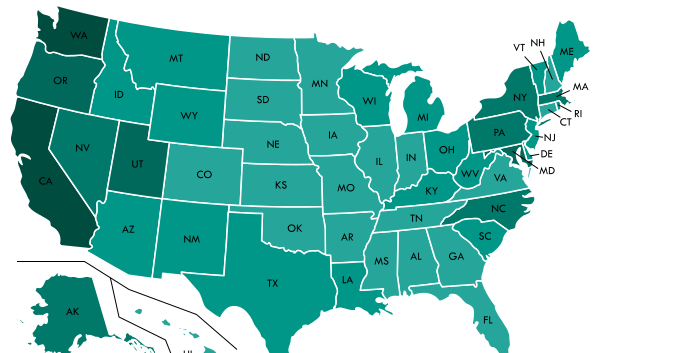
Most common states for senior information assurance analysts
| Rank | State | Population | # of jobs | Employment/ 1000ppl |
|---|---|---|---|---|
| 1 | District of Columbia | 693,972 | 329 | 47% |
| 2 | Massachusetts | 6,859,819 | 1,655 | 24% |
| 3 | North Dakota | 755,393 | 159 | 21% |
| 4 | Vermont | 623,657 | 129 | 21% |
| 5 | Utah | 3,101,833 | 616 | 20% |
| 6 | New Hampshire | 1,342,795 | 266 | 20% |
| 7 | Rhode Island | 1,059,639 | 217 | 20% |
| 8 | Delaware | 961,939 | 181 | 19% |
| 9 | Alaska | 739,795 | 139 | 19% |
| 10 | Washington | 7,405,743 | 1,240 | 17% |
| 11 | Nebraska | 1,920,076 | 319 | 17% |
| 12 | Montana | 1,050,493 | 176 | 17% |
| 13 | South Dakota | 869,666 | 144 | 17% |
| 14 | Virginia | 8,470,020 | 1,375 | 16% |
| 15 | Colorado | 5,607,154 | 925 | 16% |
| 16 | Minnesota | 5,576,606 | 866 | 16% |
| 17 | Oregon | 4,142,776 | 670 | 16% |
| 18 | Wyoming | 579,315 | 95 | 16% |
| 19 | North Carolina | 10,273,419 | 1,557 | 15% |
| 20 | Maryland | 6,052,177 | 885 | 15% |
Most common cities for senior information assurance analysts
| Rank | City | # of jobs | Employment/ 1000ppl | Avg. salary |
|---|---|---|---|---|
| 1 | Annapolis | 1 | 3% | $107,696 |
| 2 | Manhattan Beach | 1 | 3% | $113,873 |
| 3 | Miami Lakes | 1 | 3% | $85,010 |
| 4 | Springfield | 2 | 2% | $84,605 |
| 5 | Tallahassee | 2 | 1% | $87,180 |
| 6 | Lansing | 1 | 1% | $87,878 |
| 7 | Boston | 3 | 0% | $98,600 |
| 8 | Atlanta | 2 | 0% | $84,772 |
| 9 | Sacramento | 2 | 0% | $130,750 |
| 10 | Urban Honolulu | 1 | 0% | $80,823 |
Senior Information Assurance Analyst job outlook: Expert opinions
Our panel of senior information assurance analyst experts

University of California, Irvine

Coastal Carolina University

Ohio State University
Orfalea College of Business
Carthage College
David Feldman Ph.D.
Professor of Urban Planning and Public Policy and Political Science, Director, Water UCI, Director, MPP ProgramUniversity of California, Irvine
Urban Planning and Public Policy
What skills stand out on Senior Information Assurance Analyst resumes?
David Feldman Ph.D.: Succinct writing, critical thinking, strong quantitative analytical skills.
Sourav Batabyal Ph.D.
Assistant Professor, Finance and EconomicsCoastal Carolina University
Finance and Economics Department
Will there be an enduring impact of the coronavirus pandemic on Senior Information Assurance Analysts?
Sourav Batabyal Ph.D.: In the U.S., the first confirmed COVID-19 case was reported on January 22, 2020. Since then, this pandemic has forced us to shut down many businesses and paused many economic activities. Social distancing requirements imposed to fight the epidemic have crushed many industries including airlines, leisure & hospitality, bars & restaurants, Broadway & entertainment, etc. Unemployment peaked at 14.7% in April and then eventually fell to 7.9% in September. The colleges and universities across the country have canceled in-person classes and switched to online instruction to control coronavirus spread. On June 8, NBER announced that the U.S. economy was in recession since February. This recession is different than any other recent economic downturn. It's pegged to the global health crisis caused by the coronavirus pandemic.
The Coronavirus Aid, Relief, and Economic Security (CARES) Act was passed by Congress with bipartisan support and signed into law by President Trump on March 27, 2020. It was an over $2 trillion economic relief package that provided direct financial assistance to American workers, families, and small businesses, and preserved jobs for American industries. The Federal Reserve lowered the target range for the federal funds rate from 0 to 1/4 percent. Interest rates near zero will likely stay in place for years, as the Federal Reserve seeks to restructure the economy characterized by low inflation and a lockdown-affected labor market. The major economies are experiencing sharp economic contractions, as evidenced by falling real GDP, real income, employment, industrial production, and wholesale, retail sales.
In Fall 2020, many colleges and universities announced their plans for a phased return to face-to-face (F2F) instruction. At Coastal Carolina University (CCU), we are in Phase 1 of the Coastal Comeback plan. Every one of us needs to follow the standards and guidelines for the soft comeback to F2F instruction. These standards are: wearing masks, physical and social distancing, avoid public gathering, sanitation and disinfection, personal protective equipment, health screening and monitoring, and COVID-19 testing and infection containment.
Recent graduates may find it more challenging than standard times to find their first job in a recession-hit economy. Those students who already finished an internship or have prior job experience may find it easier to be absorbed in this labor market. If they don't find the suitable jobs they are looking for, we can see a rise in graduate school enrollments in the coming semesters. The recovery process will be slower if Congress and the White House delay the second round of fiscal stimulus. It will take a long time for output to go back to the full employment level, but hiring will take momentum, once we have the vaccine and therapeutics available for everyone. The coronavirus pandemic will remain in our memories and represent not just a global health crisis, but also a cautionary tale of how society is ready to overcome such adversity in the future. Students need to be resilient, stay informed, keep faith in what they are doing; then a whole new world of opportunities will open up for them, once the pandemic is over.
Trey Billing Ph.D.
Post-Doctoral Research FellowOhio State University
Mershon Center for International Security Studies
What experience really stands out on Senior Information Assurance Analyst resumes?
Trey Billing Ph.D.: An experience beyond the classroom is significant, though the relevant experience varies widely, depending on the position. For example, for a job related to human security, an internship abroad within a conflict-affected state would stand out.
What technology do you think will become more important and prevalent for Senior Information Assurance Analysts in the next 3-5 years?
Eduardo Zambrano: Machine learning, without a doubt. Machine learning is a compelling set of tools for classification and prediction. That does not describe the future - it represents the present. What the future will bring is integration between statistical learning and econometrics. This integration will vastly improve the ability of organizations to use their data to make the right decisions. Technology companies like Amazon, Microsoft, and Uber have already started profiting from this integration. In the next 3-5 years, we will see the inclusion of these methods become more known throughout the rest of the economy.
Will there be an enduring impact of the coronavirus pandemic on Senior Information Assurance Analysts?
Erik Johnson Ph.D.: Graduating in a recession stinks! It is harder to find a job, but if you do find a job, it will likely pay you less than the same position if the economy weren't in a recession. This will not be a temporary problem; it will probably last a long time. There is economic research that shows that you can "catch up" with your peers who graduated during good times after about a decade. However, for the catch up, you will need to be flexible with your jobs. Most of the catch up in wages will come from switching jobs. Few employers will give you sufficient wage increases to make up for the fact they were able to hire you relatively cheaply during a recession. Instead, you will need to look for new jobs every few years to get the raises that will put you on track to earn as much as if you hadn't graduated in a recession. It's hard work, but it will pay off.