Explore jobs
Find specific jobs
Explore careers
Explore professions
Best companies
Explore companies
Job outlook for senior information technology administrators in the United States
Senior information technology administrator job growth summary. After extensive research, interviews, and analysis, Zippia's data science team found that:
The projected senior information technology administrator job growth rate is 5% from 2018-2028.
About 18,200 new jobs for senior information technology administrators are projected over the next decade.
Senior information technology administrator salaries have increased 9% for senior information technology administrators in the last 5 years.
There are over 203,707 senior information technology administrators currently employed in the United States.
There are 156,682 active senior information technology administrator job openings in the US.
The average senior information technology administrator salary is $105,357.
Are senior information technology administrator jobs in demand?
Senior information technology administrator job and salary trends over time
Senior information technology administrator jobs over time
Senior information technology administrator job growth rate over time
| Year | # of jobs | % of population |
|---|---|---|
| 2021 | 203,707 | 0.06% |
| 2020 | 226,220 | 0.07% |
| 2019 | 174,469 | 0.05% |
| 2018 | 80,845 | 0.02% |
| 2017 | 82,311 | 0.02% |
Average senior information technology administrator salary over time
Senior information technology administrator salary by year
| Year | Avg. salary | Hourly rate | % Change |
|---|---|---|---|
| 2025 | $105,357 | $50.65 | +3.4% |
| 2024 | $101,886 | $48.98 | +2.3% |
| 2023 | $99,579 | $47.87 | +1.2% |
| 2022 | $98,426 | $47.32 | +1.8% |
| 2021 | $96,727 | $46.50 | +2.4% |
Senior information technology administrator jobs by state
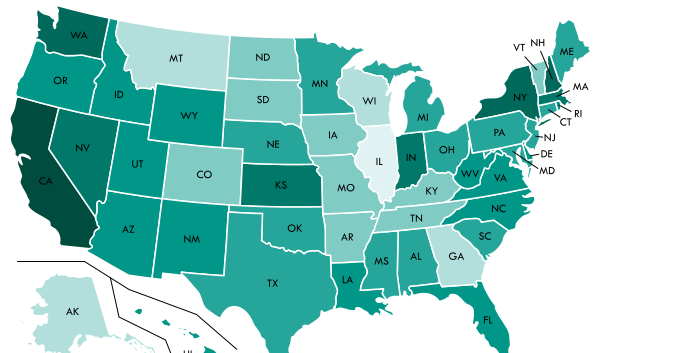
Most common states for senior information technology administrators
| Rank | State | Population | # of jobs | Employment/ 1000ppl |
|---|---|---|---|---|
| 1 | District of Columbia | 693,972 | 442 | 64% |
| 2 | North Dakota | 755,393 | 259 | 34% |
| 3 | Massachusetts | 6,859,819 | 2,115 | 31% |
| 4 | Virginia | 8,470,020 | 2,481 | 29% |
| 5 | Maryland | 6,052,177 | 1,772 | 29% |
| 6 | Alaska | 739,795 | 211 | 29% |
| 7 | Vermont | 623,657 | 178 | 29% |
| 8 | New Hampshire | 1,342,795 | 370 | 28% |
| 9 | Utah | 3,101,833 | 841 | 27% |
| 10 | Colorado | 5,607,154 | 1,449 | 26% |
| 11 | Washington | 7,405,743 | 1,794 | 24% |
| 12 | Minnesota | 5,576,606 | 1,328 | 24% |
| 13 | Oregon | 4,142,776 | 986 | 24% |
| 14 | Rhode Island | 1,059,639 | 258 | 24% |
| 15 | Delaware | 961,939 | 228 | 24% |
| 16 | South Dakota | 869,666 | 209 | 24% |
| 17 | Wyoming | 579,315 | 138 | 24% |
| 18 | Nebraska | 1,920,076 | 428 | 22% |
| 19 | Montana | 1,050,493 | 234 | 22% |
| 20 | Arizona | 7,016,270 | 1,476 | 21% |
Most common cities for senior information technology administrators
| Rank | City | # of jobs | Employment/ 1000ppl | Avg. salary |
|---|---|---|---|---|
| 1 | Deer Park | 1 | 3% | $100,206 |
| 2 | Erie | 2 | 2% | $93,057 |
| 3 | Alpharetta | 1 | 2% | $85,866 |
| 4 | Diamond Bar | 1 | 2% | $120,631 |
| 5 | Irving | 2 | 1% | $99,326 |
| 6 | Orlando | 2 | 1% | $106,608 |
| 7 | Los Angeles | 2 | 0% | $121,337 |
| 8 | Bakersfield | 1 | 0% | $126,512 |
| 9 | Boston | 1 | 0% | $108,383 |
| 10 | Dallas | 1 | 0% | $99,340 |
| 11 | Houston | 1 | 0% | $100,229 |
| 12 | Jacksonville | 1 | 0% | $106,235 |
| 13 | Mesa | 1 | 0% | $103,860 |
| 14 | Miami | 1 | 0% | $104,092 |
Senior Information Technology Administrator job outlook: Expert opinions
Our panel of senior information technology administrator experts
University of South Alabama
Stevens Institute of Technology
Massachusetts Maritime Academy
University of New Haven

University of Florida

University of Florida
Indiana University
University of Missouri

University of Illinois at Chicago

University of Illinois at Chicago
NCWIT
Loyola University Chicago
Fairfield University

New York Institute of Technology

University of Illinois

Iowa State University
What Senior Information Technology Administrator skills would you recommend for someone trying to advance their career?
Sean Walker: To maximize your salary, it is really essential to learn the tools and methods associated with Systems Engineering while also maintaining a sense of creativity. Employers are not only looking for engineers with the ability to apply specific tools but also the ability to think creatively to solve complex systems problems. I often encourage my students to maintain their creative hobbies so that they don't lose those skills. But, more immediately, gaining a graduate education in Systems Engineering can help any engineer increase their earning potential.
What general advice would you give to a Senior Information Technology Administrator?
Anthony Barrese: Pursue opportunities to broaden your experience across systems engineering, development, integration and test, field sales support and professional services positions. Generalist experience becomes invaluable with career advancement. Running a team is much more feasible for leaders who understand the process behind the work their reports deliver.
What general advice would you give to a Senior Information Technology Administrator?
Mark Whalen P.E.: A system engineer designs, develops, and manages complex technical systems across a large variety of industries. This can include defining solutions to system-level problems, plus allocating requirements, technologies and team member tasking at a project level, as well as communicating complex ideas and systems to key stakeholders.
An entry-level system engineer will typically apply advanced mathematical techniques to solve system-level technical problems, as well as installing, testing, and troubleshooting complex operating systems
What Senior Information Technology Administrator skills would you recommend for someone trying to advance their career?
Mark Whalen P.E.: Many system engineers enjoy working across all technologies at a higher organizational level, and interacting with all types of technologists to manage and implement complex technical systems.
Many system engineers can feel challenged by their lack of depth of understanding of particular technologies compared to technical specialists.
Laura Kier
Network Design and Administration InstructorWhat general advice would you give to a Senior Information Technology Administrator?
Laura Kier: Students graduating from the Computer Network Design and Administration program will enter the job market with a solid foundation in networking technologies. Above that they should also be able to develop and demonstrate excellent communication and interpersonal skills. Networking has a strong emphasis on teamwork and being able to communicate well with customers, co-workers and teammates is vital. Attaining certifications in Cisco, Linux, Windows, and security will also help the student stand out within the industry (classes in the program help to learn the knowledge needed to attain certifications). Students should participate in any local or online communities and groups to enhance skills and knowledge and find networking opportunities.
What Senior Information Technology Administrator skills would you recommend for someone trying to advance their career?
Laura Kier: Computer Networking is a dynamic field with a wide variety of opportunities in many different industries. Some skills that will be more important in general are skills in software defined networking and automation. Skills in the DevOps field will be necessary, as well as skills leveraging AI tools. Cybersecurity is always important and using AI tools to enhance security and monitoring is necessary.
What will help Senior Information Technology Administrators increase their earning potential?
Laura Kier: Learn to present your skills well from the interview and into your career. Those communication skills count! Industry certifications like CCNA matter. They help you demonstrate a willingness to grow and learn beyond what was required for your degree. Be willing to take on new challenges with your new job and keep learning new skills. It is really important for graduates to understand that talented IT professionals can move up quickly in a company, but they often must start at the bottom to showcase their technical and soft skills. Because of that, they should not shy away from entry level jobs if there is potential for growth.
Adrian Rusu
Professor, Alice E. and Michael J. Fisher Teaching Chair in Computer ScienceUniversity of New Haven
Computer Science
What general advice would you give to a Senior Information Technology Administrator?
Adrian Rusu: By getting involved in internships, co-ops, or other potential real-world experiences in their field of interest, so they can obtain real-world experience beyond classroom during their studies. Generally, employers value graduates who already have relevant real-world experience and who therefore can easier adapt to job requirements.
What will help Senior Information Technology Administrators increase their earning potential?
Adrian Rusu: Since an Information Systems degree covers a variety of different types of jobs, a graduate beginning their career has a variety of opportunities. My advice is to follow their interests and pursue jobs in their area of interest.
Peter Dobbins Ph.D.
LecturerUniversity of Florida
Computer & Information Science & Engineering Department
What are the biggest trends we'll see in the Senior Information Technology Administrator job market given the pandemic?
Peter Dobbins Ph.D.: I have heard points toward the "working remotely" model. As Computer Scientists, this is something we have known and in certain cases actually have been doing for a number of years. Industry shifts adapting to COVID have brought the fields surrounding CS into the remote work model... and are finding it works! As one of the first fields to embrace the model (a simple transition given how natural the fit), CS majors will only continue to find remote work opportunities.
What skills stand out on Senior Information Technology Administrator resumes?
Peter Dobbins Ph.D.: Skills would be the things allowing a student/employee to display their ability to work remotely: initiative, teamwork, independence, self-starter, some of the same things we have always seen were positive attributes.
What skills stand out on Senior Information Technology Administrator resumes?
Sanethia Thomas Ph.D.: As we are in a competitve market and moreso now due to the pandemic, it is valuable for students to show work experience and how it relates to the job they are applying for. It is a plus if they can show work experience in a remote environment. Students should be able to show that they are capable in working in a team environment and the roles they filled on the team; team lead, technical lead, front end, back end, project manager ect. Students should also have a portoflio of thier work, projects ect.
I often hear employers seek out students who have expereince working in the community or doing some type of social good. Highlighting community/social good works speaks to human side of the applicant, which most employers value.
Are there any particularly good places in the United States for Senior Information Technology Administrators to find work opportunities?
Sanethia Thomas Ph.D.: San Fransico Bay remains on top with Seattle, New York, Los Angeles and Pittsburgh closley following.
What are the biggest trends we'll see in the Senior Information Technology Administrator job market given the pandemic?
Sanethia Thomas Ph.D.: When the pandemic first hit, I had students very concerned about their summer plans of having an internship, but as things worked itself out, and a lot of students maintained their internship by working remotely. In response to the declining job market, I have seen students redirect their efforts in the direction of graduate school. Many have expereinced difficulties finding job opportunities and "landing" the interview. Therefore more students are considering graduate school as we ride the wave of the pandemic.
What are the biggest trends we'll see in the Senior Information Technology Administrator job market given the pandemic?
Bipin Prabhakar: Technology will become a strategic enabler for most businesses. There will be increasing demand for graduates who can help create this technology (Computer Science/Data Science) and for graduates who can leverage technology (information Systems) to create business value.
What skills stand out on Senior Information Technology Administrator resumes?
Bipin Prabhakar: Skills by themselves on resumes do not provide enough information for the reviewer to assess a candidate. The resume has to showcase the actual capabilities rather than just listing skills. What can you actually do with the listed skill? With that said, deep skills in software development, data science and AI or the broad set of skills required to enable digital transformation will be in demand. Digital transformation requires skills in business analysis, business process and process design, technologies such as next generation ERP systems, AI and ML, cloud architectures and platforms and business analytics.
Are there any particularly good places in the United States for Senior Information Technology Administrators to find work opportunities?
Bipin Prabhakar: There are three major sectors that hire technology graduates - the tech companies that tend to be in tech hubs and major cities, major corporations that are all over the country and consulting organizations that tend to have offices in the bigger cities with access to local clients or well-connected airports. Major employers tend to recruit nationally from the top programs across the country. The best time to find work is before graduation and the best place to find work is the campus recruitment process.
What skills stand out on Senior Information Technology Administrator resumes?
Dale Musser Ph.D.: -Working on teams and collaboration - people skills matter a lot.
-Past accomplishments in delivering results while working with others
-Technical skills in target areas for job. The hottest areas right now: machine learning, large scale apps, and autonomous systems.
What are the biggest trends we'll see in the Senior Information Technology Administrator job market given the pandemic?
Dale Musser Ph.D.: -Work at home for now. "You will have an office at the company after the pandemic."
-Transition of companies to new locations. I see some companies leaving the Bay Area for other locations. Reducing space in San Francisco by a number of companies shows that after the pandemic many employees won't be returning to the physical locations they used to work.
-Increased focus on automation and autonomous systems given the proximity issues.
Are there any particularly good places in the United States for Senior Information Technology Administrators to find work opportunities?
Dale Musser Ph.D.: -Yes, everywhere. IT, CS, and CE are in demand in every corner of the U.S. The hot spots are the tech centers, such as the Bay Area, Seattle, Austin, and Atlanta.
-I tell my students to mostly ignore the job sites and to look at the employment and careers pages on company websites. The best jobs never make it to job sites.
Will there be an enduring impact of the coronavirus pandemic on Senior Information Technology Administrators?
James R. Thompson Ph.D.: The coronavirus pandemic has made apparent the vital role the government plays in addressing society's larger problems. It will attract new people to the field of public administration and strengthen the commitment of those already in the field to their careers.
What are the biggest trends we'll see in the Senior Information Technology Administrator job market given the pandemic?
Matthew Liotine Ph.D.: Currently, much of the hiring is skewed toward online fulfillment roles, which is of no surprise given the pandemic. This includes roles in procurement, which is undergoing a transformation due to COVID. This also means working within the physical environments and operations required to support this activity. Several of our students received offers from Amazon as a result of their hiring push.
What Senior Information Technology Administrator skills would you recommend for someone trying to advance their career?
Matthew Liotine Ph.D.: If a student decides to take time off before moving on to a job or graduate school, they should use that time to develop skills in which you may not receive formal training while in college. For example, skills like leadership, problem-solving, teamwork, and communication are going to be more vital than ever in the new norm.
What general advice would you give to a Senior Information Technology Administrator?
Matthew Liotine Ph.D.: Most employers tell me that soft skills are equally, if not more important, than technical skills or domain knowledge. This translates into external/internal customer-facing skills, such as communication, team collaboration, writing, presentation, problem-solving, and being resourceful. (Many graduates overlook writing as a vital skill, but they fail to realize that in the course of their jobs, they will likely be required to write lots of memos and tons of emails.) The need to perfect these skills within the confines of a virtual world has become even more challenging and amplified with COVID. I teach in the information systems discipline, and when you view student resumes, many people look the same on paper. The soft skills will make a candidate stand out head and shoulders above the rest. That's why the candidate should pay attention to the screening interviews that they will undergo during the hiring process since employers will use these interviews to vet these skills.
Are there any particularly good places in the United States for Senior Information Technology Administrators to find work opportunities?
Adriane Bradberry: Technology increasingly permeates every aspect of society and provides the foundation for most modern innovation. Young graduates with computing skills will be able to apply to some of the most fastest-growing and highest-paying jobs over the next decade-jobs that are available in nearly every industry, including art, finance, healthcare, and entertainment. Students can establish and develop necessary skills by exploring computing programming apps, taking Computer Science or IT courses (online or at a local community college, if these classes are not offered at school), taking math classes, and joining after-school computing clubs. Graduates who develop these skills will contribute to meaningful work-developing innovative solutions that save lives, solve health problems, improve the environment, and keep us connected.
What type of skills will young Senior Information Technology Administrators need?
Peter Dordal Ph.D.: I'm leaving off software developers, and answering about our Information Technology graduates.
IT students entering the business world will need to know how to get the maximum leverage out of business systems. In many cases, this will mean writing their own specialized queries to extract the precise business intelligence needed; general-purpose "canned" queries just won't cut it. They will need a broad understanding of what software can accomplish for the enterprise and how to deploy new software effectively; this applies to software used in the office as well as to software used in manufacturing and shipping. And they will need to understand how to lease storage and computing resources from the cloud to meet not only predictable, long-term demands but also sudden short-term business projects.
Students working in database administration and management will need to be able to manage much larger volumes of data than a few years ago. They will need to be familiar with the great variety of new databases in order to pick the best tool for the job.
Students working in network management will need to be able to ensure that everyone has the bandwidth and server access they need, as those demands expand to include extensive video, low-latency real-time connectivity, and the regular transfer of huge amounts of data.
Students in cybersecurity will need to be fully acquainted with all the recommended best practices. However, they will also have to be able to anticipate and guard against potential new vulnerabilities. "By the book" protection is no longer sufficient.
Are there any particularly good places in the United States for Senior Information Technology Administrators to find work opportunities?
Peter Dordal Ph.D.: For software developers, yes, there are advantages in working in places where there is a high concentration of other developers. But for students interested in applying IT to business, there are opportunities everywhere.
How do you envision technology impacting Senior Information Technology Administrators in the next 5 years?
Peter Dordal Ph.D.: I think the biggest driver for change will be the continued explosive increase in the amount of data available. Ten years ago, it was enough to know customers' names, addresses, and past orders. Now there is a huge stream of information about what customers are looking at, what they are clicking on, what they're doing with your product, and what your customers' customers are doing. Analysis of this kind of information is becoming mainstream.
Are there any particularly good places in the United States for Senior Information Technology Administrators to find work opportunities?
Joshua Elliott Ed.D.: Although I am not sure where the best places are to work geographically, many states are adopting initiatives like Open Educational Resources (OER) and ISTE Certification for Educators, both of which are a part of the Fairfield University Educational Technology program.
What technology do you think will become more important and prevalent for Senior Information Technology Administrators in the next 3-5 years?
Babak Beheshti Ph.D.: -The enormous growth of IoT and wearables. The number of connected devices is expected to be more than 26 billion in 2020. That includes things like household appliances, controllable lighting, and much more. This trend is likely to continue as it is expected to see the industry grow to 661 billion dollars by 2021.
-We will be witnessing a more widespread commercial deployment of 5G in 2020. With the implementation of the Standalone 5G devices based on the 3gpp release 16, we should be seeing the more robust mobile broadband deployment of 5G, wider availability of 5G smartphones, and a push towards an all 5G Network in select urban areas around the world.
-Significant growth in AI-based technologies, from face recognition and voice recognition to business intelligence and market predictions. As machines and deep learning algorithms get integrated into many applications, many industries will undergo substantial changes. AI systems will continue to interact with our phones; cars will interpret and analyze their surroundings and intelligently drive themselves. Online vendors will monitor our browsing habits, and Google decides what kind of search results to give us, based on who it thinks we are.
What Senior Information Technology Administrator skills would you recommend for someone trying to advance their career?
Ranganathan Chandrasekaran: With remote-working and virtual collaborations becoming routine, more firms are increasing their investments in technology. In my opinion, irrespective of the location, many companies will seek to hire technology professionals.
Will there be an enduring impact of the coronavirus pandemic on Senior Information Technology Administrators?
Ranganathan Chandrasekaran: I expect companies, across the board, to 'go-digital' more than ever before. This pandemic has taught us that a lot can be achieved by clever use of technologies and by working remotely and virtually. The pandemic has also served as a wake-up call for several firms with outdated and inflexible technological infrastructures, weak cybersecurity, and poor business continuity plans. I see firms across many industries to digitize a lot of their processes and operations. With increased digitization, cybersecurity is going to be much more important. Tele-work, use of smart devices, and use of AI-driven operations is going to accelerate at a rapid pace. Many firms will be forced to undertake technology projects that they have been sidelining for a long time and swiftly execute them.
How do you envision technology impacting Senior Information Technology Administrators in the next 5 years?
Kevin Scheibe Ph.D.: My field is all about technology, so the impact is always high. Greater bandwidth has enabled virtual connectivity and remote work. As we continue to improve that connectivity, we create new challenges and new opportunities. Business Analytics is exploding, and graduates with the ability to tackle intricate problems, and use distributed technologies to solve them, will only be in higher demand. It is also why it is essential to develop the discipline to be self-motivated. The organizations hiring our students want strong, critical thinkers, excellent communicators, and the ability to pivot in complex and changing environments.