Explore jobs
Find specific jobs
Explore careers
Explore professions
Best companies
Explore companies
Job outlook for senior licensed practical nurses in the United States
Senior licensed practical nurse job growth summary. After extensive research, interviews, and analysis, Zippia's data science team found that:
The projected senior licensed practical nurse job growth rate is 6% from 2018-2028.
About 41,300 new jobs for senior licensed practical nurses are projected over the next decade.
Senior licensed practical nurse salaries have increased 11% for senior licensed practical nurses in the last 5 years.
There are over 608,660 senior licensed practical nurses currently employed in the United States.
There are 263,650 active senior licensed practical nurse job openings in the US.
The average senior licensed practical nurse salary is $51,806.
Are senior licensed practical nurse jobs in demand?
Senior licensed practical nurse job and salary trends over time
Senior licensed practical nurse jobs over time
Senior licensed practical nurse job growth rate over time
| Year | # of jobs | % of population |
|---|---|---|
| 2021 | 608,660 | 0.18% |
| 2020 | 642,071 | 0.19% |
| 2019 | 662,071 | 0.20% |
| 2018 | 666,038 | 0.20% |
| 2017 | 666,997 | 0.20% |
Average senior licensed practical nurse salary over time
Senior licensed practical nurse salary by year
| Year | Avg. salary | Hourly rate | % Change |
|---|---|---|---|
| 2026 | $51,806 | $24.91 | +2.8% |
| 2025 | $50,384 | $24.22 | +2.7% |
| 2024 | $49,068 | $23.59 | +2.7% |
| 2023 | $47,784 | $22.97 | +2.1% |
| 2022 | $46,787 | $22.49 | +2.1% |
Senior licensed practical nurse jobs by state
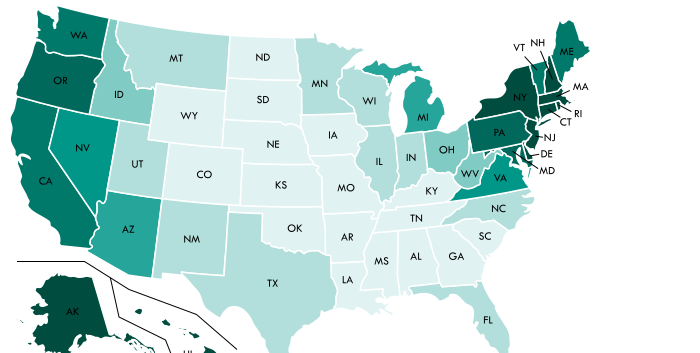
Most common states for senior licensed practical nurses
| Rank | State | Population | # of jobs | Employment/ 1000ppl |
|---|---|---|---|---|
| 1 | New Hampshire | 1,342,795 | 1,450 | 108% |
| 2 | North Dakota | 755,393 | 767 | 102% |
| 3 | Massachusetts | 6,859,819 | 6,820 | 99% |
| 4 | South Dakota | 869,666 | 864 | 99% |
| 5 | Vermont | 623,657 | 571 | 92% |
| 6 | Maine | 1,335,907 | 1,179 | 88% |
| 7 | Delaware | 961,939 | 826 | 86% |
| 8 | Montana | 1,050,493 | 880 | 84% |
| 9 | Indiana | 6,666,818 | 5,225 | 78% |
| 10 | Alaska | 739,795 | 555 | 75% |
| 11 | Iowa | 3,145,711 | 2,342 | 74% |
| 12 | Florida | 20,984,400 | 15,192 | 72% |
| 13 | Pennsylvania | 12,805,537 | 9,154 | 71% |
| 14 | West Virginia | 1,815,857 | 1,273 | 70% |
| 15 | Nebraska | 1,920,076 | 1,329 | 69% |
| 16 | District of Columbia | 693,972 | 471 | 68% |
| 17 | Kansas | 2,913,123 | 1,918 | 66% |
| 18 | New Mexico | 2,088,070 | 1,384 | 66% |
| 19 | Maryland | 6,052,177 | 3,920 | 65% |
| 20 | Wyoming | 579,315 | 372 | 64% |
Most common cities for senior licensed practical nurses
| Rank | City | # of jobs | Employment/ 1000ppl | Avg. salary |
|---|---|---|---|---|
| 1 | Gloucester | 2 | 7% | $57,425 |
| 2 | Columbia | 1 | 3% | $49,122 |
| 3 | Gainesville | 2 | 2% | $49,867 |
| 4 | Tuscaloosa | 2 | 2% | $48,980 |
| 5 | Auburn | 1 | 2% | $49,070 |
| 6 | Brentwood | 1 | 2% | $49,251 |
| 7 | Burlington | 1 | 2% | $51,325 |
| 8 | Daytona Beach | 1 | 2% | $50,000 |
| 9 | Indianapolis | 5 | 1% | $50,171 |
| 10 | Orlando | 2 | 1% | $50,275 |
| 11 | Bethlehem | 1 | 1% | $57,344 |
| 12 | Carlsbad | 1 | 1% | $54,551 |
| 13 | Jacksonville | 2 | 0% | $49,618 |
Senior Licensed Practical Nurse job outlook: Expert opinions
Our panel of senior licensed practical nurse experts
Pennsylvania State University - Harrisburg
California State University - Chico
Meharry Medical College
Molloy College
University of St. Francis
The University of Tampa
Harding University
Dr. Robert Doerfler PhD, CRNP
Associate Teaching Professor of Nursing & NLN Certified Nurse EducatorPennsylvania State University - Harrisburg
Registered Nursing, Nursing Administration, Nursing Research And Clinical Nursing
What general advice would you give to a Senior Licensed Practical Nurse?
Dr. Robert Doerfler PhD, CRNP: The earliest approach for the individual new grad is to consider several offers; don't agree to the first job offer—no matter how flattering and rosy it seems. You may end up agreeing to it in a short time, but give yourself a chance to consider other offers as well. Think about secondary gains. One offer may be a little less than another, but money isn't everything. Secondary benefits may include employer reimbursement or payment for continuing education (required by many states for re-licensure), cross-training in or certification for a clinical specialty that pays better (and thus a job you can bid on later), a promotion scheme that supplies specific benchmarks to the new grad to aim for to hit higher salary targets, and benefits plans that cover more out of pocket costs for health care, dental and vision insurance, 401k, and similar non-salary compensation. You may make more money at one job, but end up paying out of pocket for high deductibles or non-covered care, than you might at a job that has a much better benefits package, even if the pay is a little less.
What will help Senior Licensed Practical Nurses increase their earning potential?
Dr. Robert Doerfler PhD, CRNP: Facility with telehealth will become more important, as health systems develop better follow up of discharged patients in order to reduce readmissions. Recognizing clinical deterioration and knowing when to speak up about it, and to whom, will become more important as health care systems become more consolidated, and as they continue to experience shortages of RNs (especially as more states pass minimum staffing laws). Developing skills in research ("evidence-based practice"), collaboration with colleagues in councils and committees, and unit-based advocacy will become more important as a counterweight to the prerogatives of non-clinical administrators seeking to boost efficiencies, cut costs, and control risk: Advocating for patients is important, but advocating for your unit's needs also advocates for your patients as a class of people with particular needs.
What Senior Licensed Practical Nurse skills would you recommend for someone trying to advance their career?
Rich Burton DNP, RN, CMSRN: Most hospitals have set rates for nurses but if you are looking to maximize your salary, I would say location location location. Certain areas of the country pay more than others, be willing to move to maximize your earning potential. Hospitals might also pay more for certifications or a bachelor’s degree as well.
Olugbemiga Ogunkua M.D., Ph.D.
ProfessorMeharry Medical College
Health Services/Allied Health/Health Sciences
What will help Senior Licensed Practical Nurses increase their earning potential?
Olugbemiga Ogunkua M.D., Ph.D.: 1. Learn as much as you can as if you are still a student. Respect your seniors and colleagues. Show humility so that you can learn from all around you. Those not having long list of degrees can teach you a lot. Nurses, technicians working aids and ancillary staffs have seen a lot in the practice and you can tap into their experience and be a better you professionally.
Normadeane Armstrong PhD, RN, ANP-BC
ProfessorMolloy College
Registered Nursing, Nursing Administration, Nursing Research And Clinical Nursing
What Senior Licensed Practical Nurse skills would you recommend for someone trying to advance their career?
Normadeane Armstrong PhD, RN, ANP-BC: Technological Proficiency, Cultural Competence, Focus on Preventive Care and Health Promotion, Interprofessional Collaboration.
What will help Senior Licensed Practical Nurses increase their earning potential?
Normadeane Armstrong PhD, RN, ANP-BC: Specialize, Further Education, Negotiate, Explore Alternative Settings, Stay Updated.
Dr. Maria Martinez DNP RN
Interim Associate Dean for Undergraduate NursingUniversity of St. Francis
Registered Nursing, Nursing Administration, Nursing Research And Clinical Nursing
What general advice would you give to a Senior Licensed Practical Nurse?
Dr. Maria Martinez DNP RN: Bedside clinical experience is important, getting certifications, soft skills to enhance your EI quotient, develop your leadership skills, going back for your MSN.
What Senior Licensed Practical Nurse skills would you recommend for someone trying to advance their career?
Dr. Maria Martinez DNP RN: Stay resilient and gain your experience for 2-3 years as an RN. When interviewing and applying for your first RN career opportunity, look at the mission and vision of the hospital, to see if it matches your work ethic values. Inquire and seek a good preceptor/mentor who will empower you to grow in your career. Stay humble and learn from the experts.
What will help Senior Licensed Practical Nurses increase their earning potential?
Dr. Maria Martinez DNP RN: Save and invest your earrings. Consider having 401K, 403b, Roth, Traditional IRAs. Look into credit unions, bonds, stocks. Be financially savvy and save your money.
What general advice would you give to a Senior Licensed Practical Nurse?
Dr. MaryAnn D'Alesandro DNP, MSN, RN, CNOR, NI-BC, CNE: The most important to skills to have and/or learn are critical thinking, trusting, and strengthening their gut intuition, and being adaptable to unpredictable situations and changing environments. The pandemic taught us that in many ways. Common sense and critical thinking are more important than you can imagine. But the most important skill is being okay being a life-long learner and understanding that no 2 days will be the same.
Marcus Binns MSN-NE, RN
Assistant ProfessorHarding University
Registered Nursing, Nursing Administration, Nursing Research And Clinical Nursing
What will help Senior Licensed Practical Nurses increase their earning potential?
Marcus Binns MSN-NE, RN: Research before you interview on what normal pay is for your degree and type of nursing role you are wanting to be in. This varies by state and institution, but it will give you a guideline of what to expect. When they ask during the interview 'what is your expected salary?', you can then answer with a foundation in reality. If you are starting off with no experience, you can expect on the low-end of normal (around 25th percentile). Following that, look for ways to advance yourself in your role. This can include certifications, skills training, committee work at the institution, etc. Your best resources are clinical educators or your nurse manager on what additional training you can do that would benefit the environment you are in. These then stand out when you do your yearly reviews. Also, if you desire to make as much as possible, you need to also look into shift-differentials for your institution. Many hospitals will pay you extra on top of your salary if you come in to work nights, weekends, or extra shifts outside of your contracted shifts. I would caution against doing this excessively, however, because that will also increase your mental/physical fatigue from working in a draining environment. Value your downtime for your physical and mental health!