Explore jobs
Find specific jobs
Explore careers
Explore professions
Best companies
Explore companies
Job outlook for senior marketing research analysts in the United States
Are senior marketing research analyst jobs in demand?
Senior marketing research analyst job and salary trends over time
Senior marketing research analyst jobs over time
Senior marketing research analyst job growth rate over time
| Year | # of jobs | % of population |
|---|---|---|
| 2021 | 2,108 | 0.00% |
| 2020 | 1,999 | 0.00% |
| 2019 | 1,966 | 0.00% |
| 2018 | 1,849 | 0.00% |
| 2017 | 1,728 | 0.00% |
Average senior marketing research analyst salary over time
Senior marketing research analyst salary by year
| Year | Avg. salary | Hourly rate | % Change |
|---|---|---|---|
| 2026 | $60,313 | $29.00 | +3.2% |
| 2025 | $58,462 | $28.11 | +1.1% |
| 2024 | $57,848 | $27.81 | --0.2% |
| 2023 | $57,949 | $27.86 | +1.1% |
| 2022 | $57,334 | $27.56 | +0.7% |
Senior marketing research analyst jobs by state
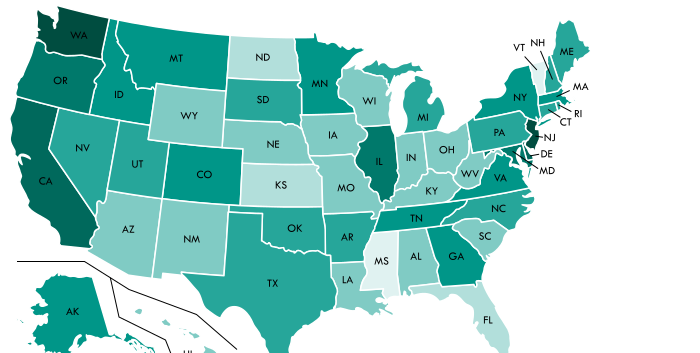
Most common states for senior marketing research analysts
| Rank | State | Population | # of jobs | Employment/ 1000ppl |
|---|---|---|---|---|
| 1 | New Hampshire | 1,342,795 | 458 | 34% |
| 2 | District of Columbia | 693,972 | 230 | 33% |
| 3 | Minnesota | 5,576,606 | 1,610 | 29% |
| 4 | Vermont | 623,657 | 182 | 29% |
| 5 | South Dakota | 869,666 | 244 | 28% |
| 6 | Rhode Island | 1,059,639 | 274 | 26% |
| 7 | North Dakota | 755,393 | 193 | 26% |
| 8 | Wyoming | 579,315 | 149 | 26% |
| 9 | Virginia | 8,470,020 | 2,131 | 25% |
| 10 | Colorado | 5,607,154 | 1,424 | 25% |
| 11 | Delaware | 961,939 | 241 | 25% |
| 12 | Nebraska | 1,920,076 | 465 | 24% |
| 13 | Maine | 1,335,907 | 304 | 23% |
| 14 | Pennsylvania | 12,805,537 | 2,843 | 22% |
| 15 | Connecticut | 3,588,184 | 799 | 22% |
| 16 | Oregon | 4,142,776 | 869 | 21% |
| 17 | North Carolina | 10,273,419 | 2,029 | 20% |
| 18 | Georgia | 10,429,379 | 1,962 | 19% |
| 19 | New Mexico | 2,088,070 | 392 | 19% |
| 20 | Montana | 1,050,493 | 188 | 18% |
Senior Marketing Research Analyst job outlook: Expert opinions
Our panel of senior marketing research analyst experts
Susquehanna University
Montana State University - Billings
University of Colorado at Colorado Springs
North Carolina State University
Oklahoma State University
Salem State University
University of South Florida
University of San Francisco
Donnelly College
North Dakota State University
California State University - Chico
University of Nebraska - Omaha
Lafayette College
University of Cincinnati
Pepperdine University
What general advice would you give to a Senior Marketing Research Analyst?
Dr. Hualu Zheng PhD: Be data-driven – be able to draw conclusions based on meaningful data analysis is key to the success of a marketing leader. Continuously honing your skills in collecting, visualizing, and analyzing marketing data will pave the way for better knowledge of your company, the competition, and the industry. Be curious and stay updated – marketing is dynamic; it demands the professionals to continue to learn the new trends, news, policy changes, and technology innovations, to keep up with the evolvements and remain competitive. Network – build and expand your connections with other professionals in the field – Stay open-minded; people from other categories can offer invaluable insights that can be inspiring. These connections not only provide fresh perspectives but also open doors to potential future opportunities.
What Senior Marketing Research Analyst skills would you recommend for someone trying to advance their career?
Dr. Hualu Zheng PhD: Given the importance of data-driven decision making in the field of marketing, mastering data analysis is critical for the success of young marketing professionals. Additionally, the ability to utilize AI tools for analyzing market trends and data is equally essential.
What will help Senior Marketing Research Analysts increase their earning potential?
Dr. Hualu Zheng PhD: Invest in Your Skills: Continuously investing in acquiring new skills and qualifications is critical. It can be especially beneficial to pursue sequential qualifications in one specialty, such as digital marketing or marketing analytics. For example, if a young professional is interested in the field of digital marketing, diving into the details of this sub-field and enhancing as many relevant skills as possible will significantly enhance the professional's competitiveness, their value to the organization, and therefore their salary potential. This might involve learning various facets like content creation, PR, digital posting, social media scheduling, graphic design, and digital analytics, etc.
What general advice would you give to a Senior Marketing Research Analyst?
Dr. Sarah Keller: Visualize your dream job, search online to find examples of organizations and positions doing what you want to do, find the individuals doing those jobs and schedule an informational interview with them. Find out how they got there, what steps they followed.
What Senior Marketing Research Analyst skills would you recommend for someone trying to advance their career?
Dr. Sarah Keller: Be curious, be eager, hard working, and be kind. Build relationships with everyone in your network, not just those who you think will be useful to you. You never know how a relationship will benefit you down the line.
What will help Senior Marketing Research Analysts increase their earning potential?
Dr. Sarah Keller: Digital strategies of persuasion; finding out what works to build engagement and action online; research evaluating social media strategies.
What Senior Marketing Research Analyst skills would you recommend for someone trying to advance their career?
Paul Yankey: I always emphasize these key points for new marketing graduates: 1. Do something you connect with at a heart level. 2. Embrace ethics and diligence. 3. Cultivate curiosity alongside focused work. 4. Harness your UCCS advantage. 5. Prioritize in-person connection.
What general advice would you give to a Senior Marketing Research Analyst?
Dr. Pieter Verhallen Ph.D.: Generally speaking, always negotiate salary and signing bonus -- there is only an upside to this. Switching jobs in times of high(er) inflation is also beneficial for salary increases. Seek certifications demonstrating proficiency in marketing analytic tools (such as Google Analytics).
What Senior Marketing Research Analyst skills would you recommend for someone trying to advance their career?
Dr. Pieter Verhallen Ph.D.: As the field is evolving rapidly, pursue internal (and external) training opportunities to stay current with the evolving technologies and tools in the (digital) marketing field (particularly, the use of AI tools and functionality).
What will help Senior Marketing Research Analysts increase their earning potential?
Dr. Pieter Verhallen Ph.D.: Less marketing design skills, more marketing strategy skills (trend analysis, evaluation of alternatives).
What general advice would you give to a Senior Marketing Research Analyst?
Dr. Héctor Lozada Ph.D.: First, define and build your personal brand. Know your strengths and weaknesses and identify opportunities to develop your strengths further and overcome or at least minimize your weaknesses. Answer the question, “What is your unique value proposition?” This means identifying what sets you apart and is based on your analysis of your strengths and weaknesses. Do your analytical skills set you apart? Is it your domain knowledge or your creativity? Make sure that your strengths are stated effectively in your resume and that you can have a conversation that supports them. Establishing a robust online presence is also helpful in solidifying your unique value proposition. Showcase your expertise, projects, and insights on platforms like LinkedIn. Did you work on class projects that demonstrate your expertise? Network with market research professionals and share your passion for market research (or your career of choice). Embrace change and stay curious about emerging trends, technologies, and methodologies. In my experience, adaptability is key.
What Senior Marketing Research Analyst skills would you recommend for someone trying to advance their career?
Dr. Héctor Lozada Ph.D.: Network. Do not be content with your current network, aim at growing it periodically with more substantive connections. Make yourself visible as an expert and constantly update your skills. Learn new skills (Upskill), and be open to what is new and how it can help you grow as a professional. And know your value!
What will help Senior Marketing Research Analysts increase their earning potential?
Dr. Héctor Lozada Ph.D.: In my opinion, advancements in technology, particularly artificial intelligence (AI), machine learning, and big data analytics, are shaping the future of market research. These technologies will allow market researchers to analyze and gather large amounts of data more efficiently, leading to more accurate and actionable insights. Also, learn another language if you have not done so already.
Karen Wallach
What Senior Marketing Research Analyst skills would you recommend for someone trying to advance their career?
Karen Wallach: Hi Alex, Just wanted to circle back on this, do you still want me to put something together?
What general advice would you give to a Senior Marketing Research Analyst?
Jerry Rackley: Your degree is the ticket that got you in the door. The real learning begins when you start your first job. Be humble, have a willingness to learn, find a mentor within the company, be an excellent team member, be responsive, go the extra mile in performing tasks, and take solutions to your manager, not just problems.
What Senior Marketing Research Analyst skills would you recommend for someone trying to advance their career?
Jerry Rackley: Maximizing earnings potential is really about performance. What employers value are results, not activities. It's easy to stay busy and look busy, but what employees are evaluated on are the results they produce. Understand what results matter to the organization and focus on achieving them. Make sure you know what is in your performance plan because that's how you'll be evaluated. Don't hesitate to periodically seek feedback from your manager by asking 'how am I doing?' 'What can I do better?' 'If my performance review was today, what would it be?'
What will help Senior Marketing Research Analysts increase their earning potential?
Jerry Rackley: For marketing, understanding how to leverage data, using an analytics process and tools to turn that data into actionable information, is a critical, in-demand set of skills. It's highly likely that marketers will need to learn SQL so they can retrieve data from various sources and join it together for analysis. Then, marketers need communications skills to convey the insights that come out of the analysis to various stakeholders. It's a blend of hard, quantitative skills and soft skills.
What general advice would you give to a Senior Marketing Research Analyst?
Jean-Paul James Ph.D.: Starting a career in marketing requires a draw from many different disciplines. Profit and Loss (P&L;) management from accounting is important. Being able to manage marketing efforts is key. I always tell my students that Marketing is part art and part science. In our modern world and moving forward, marketers will have to become more data-driven in their decisions. This requires a skill set in being able to interpret market research data but also extract insights from that data. Marketing is creative in the sense that you must eventually make fact-based informed decisions that sometimes lie in intuition. A skill set that will become more prevalent will be in the coming years will be someone who is “Artificial Intelligence (AI)-literate”. Just as people have to be computer literate to do the jobs of today, marketers will have to understand how to use AI to be more effective in their jobs and decision-making. You will forever need human intuition to optimize marketing decisions.
What Senior Marketing Research Analyst skills would you recommend for someone trying to advance their career?
Jean-Paul James Ph.D.: Experience. Having experience and your network will maximize your salary potential. Once in a position, marketing practitioners need to continue to network—not only within their company but in the industry. The hidden job market refers to jobs that employers do not advertise or publish publicly. Not publicizing these openings can help these employers save on the costs and time associated with posting and evaluating job applications or interviewing. Only through networking can entry-level marketers maximize their opportunities and, thus, their salaries.
What will help Senior Marketing Research Analysts increase their earning potential?
Jean-Paul James Ph.D.: I would recommend that while in college, students get as much experience via internships and networking. I always tell my students that getting a job ‘is about what you know as much as WHO you know. Networking can include going to industry conferences and taking advantage of networking with professors. Experience can include marketing class projects. Entry-level jobs are competitive and the marketing graduates with the most experience and the most contacts in their network—in tandem with their degree—will have the best chances of success. I would also recommend that students have an open mind when it comes to where they are starting their careers. The United States is a big country with lots of opportunities as well as global opportunities!
Jay Civitillo
University of South Florida
Business/Commerce
What Senior Marketing Research Analyst skills would you recommend for someone trying to advance their career?
Jay Civitillo: Good evening, Attached are my responses. I look forward to reviewing the draft. Have a great weekend!
What will help Senior Marketing Research Analysts increase their earning potential?
Jay Civitillo: I mentioned this to the department chair. He asked me to develop responses, which he will review with other marketing professors. I can have formal answers back to you by the end of the week. Will this work?
Esmat Sangari
University of San Francisco
Business Administration, Management And Operations
What will help Senior Marketing Research Analysts increase their earning potential?
Esmat Sangari: To maximize salary potential when starting a career in the field, it's important to negotiate effectively, demonstrate value to employers, and pursue opportunities for advancement. Developing specialized skills and obtaining relevant certifications can also help increase earning potential.
Dhuha Shareef
Donnelly College
Liberal Arts And Sciences, General Studies And Humanities
What general advice would you give to a Senior Marketing Research Analyst?
Dhuha Shareef: 1. Research Salary Expectations : Before accepting a job offer, research the typical salary range for similar positions in your area and industry. Websites like Glassdoor and PayScale can provide helpful salary data. 2. Negotiate Your Salary : Don't be afraid to negotiate your salary, especially if you have relevant experience or skills that make you a strong candidate. Practice your negotiation skills and be prepared to make a case for why you deserve a higher salary. 3. Consider Additional Education or Certifications : Obtaining advanced degrees or relevant certifications can increase your earning potential in the liberal arts field. However, weigh the cost of further education against the potential salary increase. 4. Demonstrate Value : Once you're in the job, consistently demonstrate your value to the organization through your work performance, contributions, and achievements. This can position you for salary increases and advancement opportunities in the future.
What Senior Marketing Research Analyst skills would you recommend for someone trying to advance their career?
Dhuha Shareef: 1. Digital Literacy : As technology continues to advance, proficiency in digital tools and platforms will become increasingly important in many liberal arts careers. This includes skills like data analysis, social media management, and digital marketing. 2. Cultural Competence : With globalization and increasing diversity in workplaces, the ability to work effectively with people from different backgrounds and cultures will be highly valued. 3. Creativity and Innovation: Liberal arts graduates often bring a unique perspective and creative thinking to their work. The ability to innovate and adapt to new challenges will be key in the rapidly changing job market.
What will help Senior Marketing Research Analysts increase their earning potential?
Dhuha Shareef: 1. Networking : Build relationships with professionals in your field through networking events, online platforms like LinkedIn, and informational interviews. Networking can lead to job opportunities and valuable insights. 2. Gain Practical Experience : Look for internships, volunteer opportunities, or entry-level positions that allow you to gain hands-on experience in your chosen field. This can help you develop relevant skills and make valuable connections. 3. Continuous Learning : Stay up-to-date with industry trends, developments, and new technologies through reading, attending workshops, or taking online courses. Continuous learning will keep your skills sharp and make you more competitive in the job market. 4. Develop Soft Skills : Communication, critical thinking, problem-solving, and adaptability are crucial skills in any career, but especially in the liberal arts field. Work on honing these skills to stand out to employers.
What will help Senior Marketing Research Analysts increase their earning potential?
Dr. Stefanie Boyer: To maximize your salary potential, first choose a company that offers opportunities for advancement. Understand what it takes to make more money and talk to your boss early about company priorities and how you can take on more responsibilities if you do your job well. Keep an eye on the company's long-term goals and learn skills that will help you become the perfect candidate for those key positions. Be a self-directed learner who uses a variety of resources to continue learning and developing new skills while establishing strategic relationships within the organization. But don't get too caught up in the future; you must take the necessary steps and perform your duties well. There are no shortcuts to hard work and effort, which develop your character and experience on the job.
What general advice would you give to a Senior Marketing Research Analyst?
Christina Weber PhD: There are a number of skills that will be important. Soft skills such as creativity, adaptability, collaboration, emotional intelligence, and persuasion. In addition, there is a growing need for folks who have high cultural competence, especially with understanding the experiences of diverse groups. Finally, there is a need for folks to have skills in social science research—understanding how to develop research projects, conduct surveys, focus groups, as well as experience with programs such as GIS, SPSS, and r-studio.
What Senior Marketing Research Analyst skills would you recommend for someone trying to advance their career?
Christina Weber PhD: As stated above, I think that having the skills listed above with help a lot with this. I also think that doing research on the field they are entering, so they know the typical salary can help folks with negotiating their salary.
What general advice would you give to a Senior Marketing Research Analyst?
Cassandra Faith: New skills all seem to relate to new and advancing technology. Pay attention to trends as they develop especially as it relates to AI and marketing.
What Senior Marketing Research Analyst skills would you recommend for someone trying to advance their career?
Cassandra Faith: Again, this seems to be related to the skills you develop over time. Pay attention to the opportunities that are needed but few people want to do. Public speaking and writing skills will always be valuable so stay current on those skills as well.
What will help Senior Marketing Research Analysts increase their earning potential?
Cassandra Faith: Take advantage of every opportunity to learn something new. Attend conferences, take classes, learn new skills. It all adds up.
What general advice would you give to a Senior Marketing Research Analyst?
John Lyden: Research skills (ability to find and interpret information), oral and written communication skills (ability to present information clearly), data analysis and interpretation, language interpretation and translation. Computer facility will be highly valued. Employers will include those in higher education, government, non-profits, research institutes, and museums.
What will help Senior Marketing Research Analysts increase their earning potential?
John Lyden: Convey to potential employers the range of skills you possess and the ways you have used them. If you had an internship, describe the skills you used and explain how they can apply to various jobs. Emphasize and demonstrate your communication and research skills. Give examples from the courses you took and explain the connections between them that have allowed you to utilize higher order thinking of analysis and synthesis. Your degree in Religion can also be combined with a complementary minor or double major and may lead you to graduate school in almost any field you choose to pursue.
What Senior Marketing Research Analyst skills would you recommend for someone trying to advance their career?
Brett Hendrickson PhD, MDiv (he/him): Religious Studies majors who wish to maximize their salary potential should be bold in articulating the digital research tools that they learned as part of their education. Religious Studies graduates know how to use and assess historical and cultural data from multiple online data sources. They should also emphasize their excellent interpersonal skills and that they are well-versed in interacting with diverse people on highly sensitive topics.
What will help Senior Marketing Research Analysts increase their earning potential?
Lori Bruce MA, MBE, HEC-C: Multidisciplinary partnership is critical, since bioethicists can be “gatekeepers;” their policies may influence which members of the public receive certain health services, and which do not receive them.
Knowledge, applied cautiously! It’s important to have a nuanced understanding of many bioethics principles and theories, and apply them with caution, so that the most relevant values are influencing your work.
What general advice would you give to a Senior Marketing Research Analyst?
Dr. Anna McAlister Ph.D: I have so many answers to this question! Here are a few answers:
* Be yourself and let people get to know you. If you want interesting opportunities to come your way, you need to let people know what interests you. This might be about your hobbies and interests, a sport you play, your favorite food, your pets, etc. Let's say you love animals. If you're working in an ad agency and there's a pet food brand that's a new client for the agency, maybe that's a project you want to work on. If your colleagues know you love animals, you might be more likely to be assigned to work on that project. But that won't happen if you don't present your authentic self at work.
* Finding the perfect job is all about "fit". There's more to a workplace than the work you do day to day. Every workplace has culture and some workplace politics. Some places are rigid, others are more casual. Some pay well but take a greater toll on your work/life balance. Sometimes you'll be happier in a slightly lower paying job if it offers flexibility in work hours or requires a shorter commute. Think about the things you truly value. If income is priority #1, go for the high paying job. If you can't stand a long commute and don't like public transport, maybe you're better off at a slightly lower paying job closer to home as opposed to being in the center of the city.
* Don't put yourself in a box. Your degree doesn't define you. There are (typically) several decades between your entry level job and your retirement. Continue to explore and grow and don't be afraid to step outside of the "box" you feel you belong in. As an example, I'm a marketing professor but I don't have a marketing degree. I have a doctoral degree in psychology and I was a psychology major as an undergrad. I conduct research on the effects of marketing on young children's food and beverage choices. I study food and beverage marketing because I find it interesting, but I never formally studied health and nutrition either. It's okay to explore your interests. Your first job is simply the starting point. You'll most likely end up somewhere far from where you started. Talk to people who are close to retirement. Ask them where they started and how they got to where they are now. You'll may be surprised to find that the majority of folks will describe "happy accidents" or "detours" they took along their career paths. Do not feel like you have to stick to the path you dreamed up when you were a freshman! Your career is likely to make many twists and turns. Don't resist them! You are not a failure if you start over or go back to school at some point!
What Senior Marketing Research Analyst skills would you recommend for someone trying to advance their career?
Dr. Anna McAlister Ph.D: Definitely AI! Last week I attended the American Academy of Advertising where multiple presenters predicted "prompt engineer" to be a highly sought after role in the near future. Generative AI is only as good as good as the prompts fed into it. People who master the art of creating great prompts will be in demand in the job market in the very near future. I suspect they will be highly paid too!
At Endicott College, our students are required to complete 3 internships before graduating. We survey internship supervisors and listen to their feedback. I've run some analyses on recent data from these site supervisors to understand what they're looking for in entry level employees. In addition to particular technical skills (data analytics, SEO, graphic design), soft skills are definitely still valued very highly. Sought-after skills include confidence, assertiveness, curiosity, being proactive, time management, and attention to detail. Something else that came up over and over again was the orientation to lifelong learning. Students need to know learning should not stop when they graduate college. Whether it's a graduate degree, a certificate program, badging, or workshops, employers value employees who want to continue to upskill and stay relevant. Also, employers want young people to know how to keep a calendar (literally, using a tool like Calendly is important!)
What will help Senior Marketing Research Analysts increase their earning potential?
Dr. Anna McAlister Ph.D: It’s very important to be polite but at the same time, not too humble. Showcase your talents! Even if you have not mastered a skill, if you have some level of proficiency you should let people know about it! As an example, I teach a video editing course to undergraduate students. When students leave my class, they are proficient using Camtasia. They may not be experts, but they are certainly proficient. They have a skill that many other entry level employees do not possess. I nag them to put it on their resumés. Many entry level employees looking for marketing jobs do not have experience with video editing. Show off the skill!
Also, show off any extracurricular activities you’ve engaged in. For example, students who take leadership roles in clubs and organizations on campus should put that on their resumes. The nature of the club doesn’t really matter. What matters is that the student can show they’re organized, committed, etc. For example, at Endicott College I advise Charity Craft Club. This club does crafts (knitting, painting, jewelry making) and we sell items to raise money for charity. In the past I’ve had students say to me things like “Should I really put Charity Craft Club on my resumé? It’s not a business club.” I say “absolutely!”. Showing you have a leadership role in that club is a signal that you’re a leader!
Negotiate! The time between getting the job offer and accepting the job is the prime time for negotiating. But don’t be too cocky. It’s a difficult line to walk and so it is essential to seek input from “seasoned” professionals. Talk to people in the industry who are a bit more advanced than you. Talk to internship supervisors, professors, or employees at the company if you are able to connect with them. Also review online resources (eg. Glassdoor, ZipRecruiter, Salary.com). As much as possible, try to know your worth. You don’t want to be too cocky and ask for an outrageous salary. But you also don’t want to accept a lowball offer. Sometimes the salary isn’t very flexible but other benefits or perks might be.
Finally, I would say it’s important to think about bringing solutions. What can you do for the company you hope will hire you? What problems can you solve for them? Again, this speaks to that idea of being a lifelong learner. An entry level employee can offer a fresh perspective and a willingness to explore new options. Current employees may be a little set in their ways. An entry level employee can be ready to learn and adapt and bring new knowledge to the company. Don’t worry about not knowing enough or not having enough experience. Just be ready to hit the ground running. You may be the breath of fresh air the company needs!
What general advice would you give to a Senior Marketing Research Analyst?
Dr. Jennifer Caplan PhD: Technology advances so quickly these days that staying on top of advances will be really important. Luckily, any religion major has spent a ton of time thinking about the way society advances and develops, so you're well-positioned to be an early adopter of new software and tech platforms.
What general advice would you give to a Senior Marketing Research Analyst?
Anna Penner: Other than getting a job teaching sociology, there really aren't jobs that will be advertised as looking for a sociologist. But sociology gives you tools to be able to work in nearly whatever industry you want to be in. Don't limit yourself to a "sociology" job and don't sell yourself short because you don't have a major the job may be aimed at. Because many people don't have a clear understanding of what sociology is, you will likely need to explain how your degree has positioned you to be uniquely qualified to do the job you're applying for. You have a lot of skills that employers want and need; look over job descriptions and find ways that you can meet and exceed the expectations for those jobs and make sure to call attention to them in job applications and interviews.