Explore jobs
Find specific jobs
Explore careers
Explore professions
Best companies
Explore companies
Job outlook for senior php developers in the United States
Senior php developer job growth summary. After extensive research, interviews, and analysis, Zippia's data science team found that:
The projected senior php developer job growth rate is 13% from 2018-2028.
About 20,900 new jobs for senior php developers are projected over the next decade.
Senior php developer salaries have increased 11% for senior php developers in the last 5 years.
There are over 20,681 senior php developers currently employed in the United States.
There are 166,679 active senior php developer job openings in the US.
The average senior php developer salary is $109,614.
Are senior php developer jobs in demand?
Senior php developer job and salary trends over time
Senior php developer jobs over time
Senior php developer job growth rate over time
| Year | # of jobs | % of population |
|---|---|---|
| 2021 | 20,681 | 0.01% |
| 2020 | 8,348 | 0.00% |
| 2019 | 6,314 | 0.00% |
| 2018 | 5,560 | 0.00% |
| 2017 | 5,570 | 0.00% |
Average senior php developer salary over time
Senior php developer salary by year
| Year | Avg. salary | Hourly rate | % Change |
|---|---|---|---|
| 2026 | $109,614 | $52.70 | +3.4% |
| 2025 | $106,002 | $50.96 | +2.3% |
| 2024 | $103,602 | $49.81 | +2.1% |
| 2023 | $101,453 | $48.78 | +2.8% |
| 2022 | $98,678 | $47.44 | +1.8% |
Senior php developer jobs by state
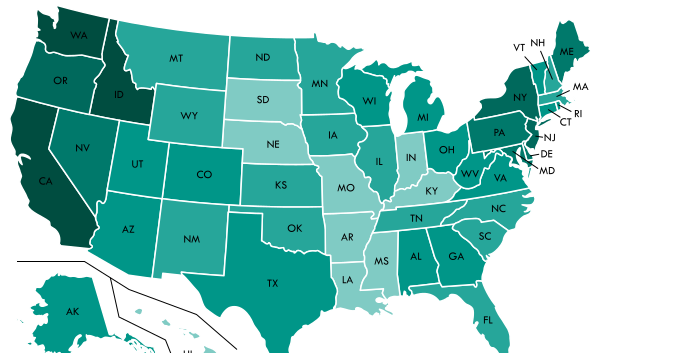
Most common states for senior php developers
| Rank | State | Population | # of jobs | Employment/ 1000ppl |
|---|---|---|---|---|
| 1 | District of Columbia | 693,972 | 730 | 105% |
| 2 | Vermont | 623,657 | 242 | 39% |
| 3 | Virginia | 8,470,020 | 3,238 | 38% |
| 4 | Rhode Island | 1,059,639 | 406 | 38% |
| 5 | Delaware | 961,939 | 322 | 33% |
| 6 | Maryland | 6,052,177 | 1,935 | 32% |
| 7 | Massachusetts | 6,859,819 | 1,918 | 28% |
| 8 | Oregon | 4,142,776 | 1,127 | 27% |
| 9 | Utah | 3,101,833 | 831 | 27% |
| 10 | North Dakota | 755,393 | 200 | 26% |
| 11 | Nebraska | 1,920,076 | 476 | 25% |
| 12 | New Hampshire | 1,342,795 | 338 | 25% |
| 13 | Montana | 1,050,493 | 263 | 25% |
| 14 | Minnesota | 5,576,606 | 1,322 | 24% |
| 15 | New Jersey | 9,005,644 | 2,038 | 23% |
| 16 | Washington | 7,405,743 | 1,701 | 23% |
| 17 | Colorado | 5,607,154 | 1,265 | 23% |
| 18 | South Dakota | 869,666 | 187 | 22% |
| 19 | Wyoming | 579,315 | 125 | 22% |
| 20 | Indiana | 6,666,818 | 1,330 | 20% |
Most common cities for senior php developers
| Rank | City | # of jobs | Employment/ 1000ppl | Avg. salary |
|---|---|---|---|---|
| 1 | Atlantic City | 2 | 5% | $121,166 |
| 2 | Coconut Creek | 1 | 2% | $94,252 |
| 3 | San Clemente | 1 | 2% | $124,447 |
| 4 | Akron | 1 | 1% | $104,100 |
| 5 | Alexandria | 1 | 1% | $107,640 |
| 6 | Boca Raton | 1 | 1% | $94,498 |
| 7 | Boynton Beach | 1 | 1% | $94,887 |
| 8 | Orange | 1 | 1% | $125,901 |
| 9 | Redlands | 1 | 1% | $126,094 |
| 10 | Santa Monica | 1 | 1% | $127,361 |
| 11 | Austin | 2 | 0% | $107,457 |
| 12 | Chicago | 2 | 0% | $98,831 |
| 13 | Dallas | 2 | 0% | $108,161 |
| 14 | New York | 2 | 0% | $120,035 |
| 15 | Washington | 2 | 0% | $113,013 |
| 16 | Atlanta | 1 | 0% | $102,380 |
| 17 | Irvine | 1 | 0% | $125,382 |
| 18 | Los Angeles | 1 | 0% | $127,265 |
Senior PHP Developer job outlook: Expert opinions
Our panel of senior php developer experts
Nova Southeastern University
University of Wisconsin - Eau Claire
Nova Southeastern University
Southern Illinois University Edwardsville
Oklahoma State University Institute of Technology - Okmulgee
Mount St. Joseph University
University of Richmond
Idaho State University

Wright State University

University of Guam

University of Hawaii at Hilo
Indiana University Southeast
Southeastern Louisiana University
University of Tulsa

Gannon University
Xavier University of Louisiana
What Senior PHP Developer skills would you recommend for someone trying to advance their career?
Sepehr Mohammadian: 1. This is a pretty broad question. CS degree graduates can engage in different tasks and responsibilities based on the nature of their profession. Examples include 1) software engineering, in which the individual's efforts are toward leading or contributing to software development projects, 2) IT management, where the individual mainly oversees technology strategies and their implementation, 3) cybersecurity, where the individual's responsibilities are associated with the protection of systems and data from cyber threats, and 4) data and AI engineering, where the individual works on machine learning applications and analyze and derive insights from large datasets.
Junping Sun Ph.D.
ProfessorNova Southeastern University
Computer Software And Media Applications
What Senior PHP Developer skills would you recommend for someone trying to advance their career?
Junping Sun Ph.D.: Computer Science and its applications in various fields are very dynamic and constantly evolving, and anyone in the fields needs to prepare to be adaptive by lifelong learning.
What will help Senior PHP Developers increase their earning potential?
Dale Dzielski MBA, CMA®, PMP®, SAFe® 4 Agilist: Gain knowledge in Statistics, Data Analytics, cybersecurity, cloud computing, artificial intelligence as well as understanding of Agile Methodology, architecture and design principles/concepts, and development tools such as Jira and GitHub. These will continue to grow in importance to your career. Also, keep watching for disruptive technologies. These will change the way we live and perform our jobs such as the impact AI has already had. I can't name them now because they haven't been innovated or named yet. In fact, you may become a part of doing so.
What general advice would you give to an Senior PHP Developer?
Lyle Ford: Having a broad base of skills, both technical and interpersonal are very valuable. Often, physics majors are hired to be problem solvers and each problem has its own set of unique conditions that may require a different set of skills to solve. The ability to be an effective team member is vital and proof of that will make you stand out. Evidence of independent work is also helpful so highlight and research or internship experiences you have had.
What Senior PHP Developer skills would you recommend for someone trying to advance their career?
Lyle Ford: Be flexible and open to new experiences. Technology changes rapidly and your skills will have to evolve to keep up. You will always need your creativity and problem solving skills, but the way in which you implement them will change with your environment which will require you to constantly update your skillset. Always look for opportunities to network. This can give you insights into developing areas and open doors for future paths you may be unaware of.
What will help Senior PHP Developers increase their earning potential?
Dr. Frank Mitropoulos Ph.D.: As we look toward the future of careers in Computer Applications, several skills stand out for their growing importance. These skills revolve around specific technologies that are expected to continue to grow and evolve. Technologies related to Cloud Computing, Artificial Intelligence (AI), Cybersecurity, and Data Science are quickly evolving and being applied across the technology sector. Cloud Computing: Given the widespread adoption of Cloud services, Cloud computing expertise is indispensable. Understanding how to leverage platforms like Azure, AWS, and Google Cloud is crucial to developing scalable, efficient solutions that meet business needs. Artificial Intelligence: AI and Machine Learning are transforming the world. Skills in these areas to solve real-world problems will be even more critical in the future. Cybersecurity: Digital threats are becoming more sophisticated. Safeguarding data, networks, and systems will require encryption, intrusion detection, development, and regulation skills. Data Science: Skills in Data Science will be increasingly sought after as businesses embrace data-driven decision-making. Extracting meaningful insights from extensive datasets and effectively communicating these findings will be essential. Soft skills: Finally, soft skills such as teamwork, problem-solving, and effective communication cannot be overlooked. Adapting, communicating, and leading will be essential for success.
What Senior PHP Developer skills would you recommend for someone trying to advance their career?
Ahmed Imteaj PH.D.: Artificial Intelligence and Machine Learning (LLMs): With the rise of Large Language Models (LLMs) like GPT-3 and BERT, skills in natural language processing (NLP), transfer learning, and fine-tuning pre-trained models will become increasingly valuable. LLMs have applications in areas such as text generation, sentiment analysis, and language translation.
Sustainable AI: As concerns about the environmental impact of AI and computing grow, skills in sustainable AI practices, energy-efficient algorithms, and green computing will be in demand. Professionals who can develop AI solutions that minimize energy consumption and carbon footprint will play a crucial role in building a more sustainable future.
Cybersecurity: With the ever-increasing threat landscape and sophisticated cyberattacks, cybersecurity skills will remain critical. In addition to traditional cybersecurity practices, such as network security and encryption, skills in areas such as threat intelligence, incident response, and penetration testing will be in high demand.
Cloud Computing: As more businesses migrate their infrastructure and services to the cloud, skills in cloud computing will continue to be in high demand. Proficiency with cloud platforms such as AWS, Azure, and Google Cloud, as well as expertise in areas like serverless computing, containerization, and hybrid cloud architectures, will be valuable for building and managing scalable and resilient cloud-based solutions.
What will help Senior PHP Developers increase their earning potential?
Ahmed Imteaj PH.D.: Research Salary Trends: Before entering the job market, research salary trends for entry-level positions in your field and location. Websites like Glassdoor, PayScale, and LinkedIn Salary can provide valuable insights into typical salary ranges for different roles.
Acquire In-Demand Skills: Identify in-demand skills and technologies in your field and focus on acquiring them through coursework, certifications, internships, or personal projects. Skills such as machine learning, cloud computing, cybersecurity, and data science are highly valued and can command higher salaries.
Gain Relevant Experience: Prioritize gaining relevant experience through internships, co-op programs, part-time jobs, or freelance projects. Practical experience can significantly increase your market value and make you more attractive to employers.Customize Your Resume and Cover Letter: Tailor your resume and cover letter to highlight your relevant skills, experiences, and achievements that align with the job requirements. Highlighting your unique qualifications can increase your chances of landing interviews and negotiating a higher salary.
Prepare for Salary Negotiations: Before entering salary negotiations, research the typical salary range for the position and location, considering factors such as cost of living and industry standards. Practice articulating your value proposition and be prepared to negotiate confidently for a salary that reflects your skills, experience, and market value.
Consider Additional Benefits: In addition to salary, consider other benefits and perks offered by employers, such as health insurance, retirement plans, paid time off, flexible work arrangements, professional development opportunities, and bonuses. These benefits can add significant value to your overall compensation package.
What will help Senior PHP Developers increase their earning potential?
Evgenia Smirni: Focus on having a strong basis of the fundamentals. The purpose of your education is to teach you asking the right questions to be able to find the right solutions. This field is changing continuously. Learning how to pivot when new, emerging trends happen, is key for success. Last but not least, do not underestimate the value of liberal arts educations - combining CS with liberal arts can offer communication skills that are of paramount importance for your career trajectory in this tech field.
Mr. Mark Pranger
Instructor, School of Creative and Information TechnologiesOklahoma State University Institute of Technology - Okmulgee
Mining And Petroleum Technologies/Technicians
What Senior PHP Developer skills would you recommend for someone trying to advance their career?
Mr. Mark Pranger: The biggest advice here is to show the organization the long haul. It costs a lot of money to advertise, find, recruit, hire, and train employees in our field. The company wants to know their return on that investment will be higher. A large technical breadth versus a deep technical understanding is the balance you have to maintain. Many companies I deal with as an internship coordinator tell me that they can train the technical niche needs that they have but the student has to be able to show that they can learn and absorb that knowledge and put it to use. Going back to the portfolio, this gives someone looking at it insight into what extent you can learn, absorb, and produce. I personally am a true believer in the depth over breadth in the computer science programming field. While syntax changes from language to language, the concepts that we use to engineer our software remain the same. So Java does one activity different than C# or Ruby, that concept though will be important and the syntax can be picked up easier if you understand the concept. To me, a deeper understanding of one language and the ability to adapt quickly to another language is more important than having a little knowledge in a wide breadth of language but no depth. I have been in this field for 30 years now and probably know about half that number of languages that I have used over those 30 years. I didn't start with all those languages, but I did start with a very deep understanding of just one or two. I could spend my time quickly learning syntax to pick up a new language for a new position because I understood the concepts so well in my root language. Learn it deep, understand it deep and show you can transfer it across laterally. Put together that portfolio. The portfolio reinforces the narrative I discussed in the earlier question also.
MARLA KRAMER
Assistant Vice President of Marketing and CommunicationsWhat Senior PHP Developer skills would you recommend for someone trying to advance their career?
MARLA KRAMER: Computer Science, and IS in general, is a field that is constantly evolving. It is not enough to know what everybody else knows. Becoming a subject matter expert with deep knowledge is important to be successful in the long run. You have to pick your area of expertise carefully, keep yourself focused and educated in that specific area, and be prepared for a career of continuous learning.
What general advice would you give to an Senior PHP Developer?
MARLA KRAMER: Do the necessary course work from a reputed institution, where you can get the necessary hands-on experience under the tutelage of an established expert. Create a portfolio of your work on GitHub so that you can share your projects with potential employees. It is more important to demonstrate your skills through code, than it is to provide a list of classes that you have taken. Certification courses are expensive, but getting an accredited certificate in Mobile Application Development or any of the rapidly growing fields is always an advantage. The internet has a lot of uncurated, self-published, and incorrect information, especially when it comes to computer science. It is important that you pick your sources wisely as you build your skills.
What will help Senior PHP Developers increase their earning potential?
MARLA KRAMER: It is unlikely that software development will be fully automated in the near future. Writing correct and efficient applications is a skill set that will only grow as we invent more ways to improve the quality of our lives. As more and more commerce and critical services migrate onto the internet, IS development will require a deeper knowledge of cybersecurity, data analytics, and cloud computing. According to the U.S. Bureau of Labor Statistics (BLS), Information Security Analysis jobs are expected to grow by 32% over the next 10 years. The BLS estimates Software Developers, Quality Assurance and Testing will grow by 25% over the next decade.
Right now, however, software development is going through a lull because of competition from abroad. Being an expert in at least two popular programming languages, having a solid theoretical foundation, and being able to innovate is pivotal. Artificial Intelligence is being deployed to solve some problems now, thanks to the powerful computers we have today. Learning to effectively use AI frameworks as part of your application development will add a lot of value to your skillset.
Rebecca Allen
Mount St. Joseph University
Special Education And Teaching
What general advice would you give to an Senior PHP Developer?
Rebecca Allen: AI, for sure. I have heard it said that AI might not replace humans, rather humans who know how to use AI well may replace humans who don't.
Ahmed Temani
Senior InstructorUniversity of Richmond
Computer/Information Technology Administration And Management
What general advice would you give to an Senior PHP Developer?
Ahmed Temani: A lot of the buzz is about using chatbots to improve coding efficiency. However, there is a great need for systems level thinking and design as software is deployed across cloud and edge computing devices. Gaining more experience in systems design provides you with additional skills that complement whatever AI-based technology gets deployed.
What Senior PHP Developer skills would you recommend for someone trying to advance their career?
Ahmed Temani: This one I'm not sure how to answer as it is too broad. I would say work hard and do quality work, but that seems obvious.
What Senior PHP Developer skills would you recommend for someone trying to advance their career?
Nikyra Capson: Don't be afraid of being rejected. If they see a job they want, apply. Even if they don't think they'll get it, still apply. The worst thing that could happen is being told no. Not applying is an automatic no, so they might as well try.
Daniel Asamoah Ph.D.
Associate Professor and Interim ChairWright State University
Information Systems and Supply Chain Management Department
What skills stand out on Senior PHP Developer resumes?
Daniel Asamoah Ph.D.: Web Developer: JavaScript, HTML5, CSS, PHP, Python, APIs, Web user interface design.
What skills will help Senior PHP Developers earn the most?
Daniel Asamoah Ph.D.: Particularly for a web developer, HTML/CSS skills, scripting langue competency, communication skills.
James Sellmann Ph.D.
Dean, Professor of Philosophy and Micronesian StudiesUniversity of Guam
College of Liberal Arts & Social Sciences
What general advice would you give to an Senior PHP Developer?
James Sellmann Ph.D.: General advice is to keep in mind that you must leverage your skills, especially your soft skills of being able to work with people, to communicate effectively and to be able to solve problems. Be real. Don't try to pretend to be someone else to impress others. Be your authentic self. And show up on time.
Travis Mandel Ph.D.
Assistant ProfessorUniversity of Hawaii at Hilo
Department of Computer Science
What skills will help Senior PHP Developers earn the most?
Travis Mandel Ph.D.: Solid foundational skills in data science, machine learning, and artificial intelligence. Even if you are not an AI researcher or machine learning engineer, with AI becoming so pervasive, chances are your code will have to interact with it at some point. Although listing many of the latest technologies (Tensorflow/Keras, Pytorch) looks great on a resume, what is even more valuable is a solid grasp of the fundamentals that transcend specific libraries. Employers will be impressed by someone who can analyze large data sets in languages like Python, communicate effectively with the machine learning teams, and identify new potential ways to integrate machine learning into the product. This is a highly in-demand skillset that can easily help unlock higher-paying positions.
Chris Sexton
Visiting Lecturer of Computer ScienceIndiana University Southeast
Computer Science Department
What hard/technical skills are most important for Senior PHP Developers?
Chris Sexton: As with soft skills, technical skills in teamwork matter, a candidate must have the ability to work with revision control, be it git or some similar system. In addition, it is vital that fundamental computing skills such as operating the shell of a Linux machine are good signs that a candidate will be able to adapt to new systems.
Dr. Ghanssan Alkadi Ph.D.
Professor of Computer ScienceSoutheastern Louisiana University
Department of Computer Science
What skills stand out on Senior PHP Developer resumes?
Dr. Ghanssan Alkadi Ph.D.: Working on Software projects that involve team communication, Agile Process, and working with either the MERN, MEAN, or .Net stacks.
What skills will help Senior PHP Developers earn the most?
Dr. Ghanssan Alkadi Ph.D.: Web and Mobile App development will help you earn the most.
Sal Aurigemma Ph.D.
Associate Professor of CIS, J. Bradley Oxley Professor of Computer Information SystemsUniversity of Tulsa
School of Accounting and CIS at the Collins College of Business
What skills will help Senior PHP Developers earn the most?
Sal Aurigemma Ph.D.: Each of the areas and skills mentioned above is important. The way to earn the most in any of the varied specialties in IT depends on having the right blend of technical and soft skills for a particular employer and, frankly, being the right person at the right time for the right employer. That sounds ambiguous, but the point is that those looking for IT work need to research which companies, locations, and specific jobs pay the most with open positions that match their skillset. And, if you find that dream job with the dream pay but you don't have the requisite skills, there are plenty of opportunities to show a potential employer that you are willing to learn the skills to succeed in that position.
Are there any particularly good places in the United States for Senior PHP Developers to find work opportunities?
Dr. Stephen Frezza Ph.D.: Computing is ubiquitous, and with more industries moving to remote work, location is becoming less critical. If the internet reaches a place reliably, computing jobs can be located there.
How do you envision technology impacting Senior PHP Developers in the next 5 years?
Dr. Stephen Frezza Ph.D.: Breadth and depth: Computing is becoming more like engineering; where the value of the product, its lifetime risks, costs, and benefits are more critical than just it's roll-out. So the engineering competencies that have always been a part of computing will become more central. Computing is also expanding; the role of data and the shift of once-research technologies (like machine learning) into production applications will continue to require computing graduates to broaden their base and continue as learners. This will cause shifts in what is considered 'fundamental' and the need for professionals to continue to hone and redevelop their technical skill sets.
Ashwith Chilvery Ph.D.
Director, Dual-Degree Engineering Program, Assistant Professor of PhysicsXavier University of Louisiana
Department of Physics and Computer Science
Will there be an enduring impact of the coronavirus pandemic on Senior PHP Developers?
Ashwith Chilvery Ph.D.: The coronavirus pandemic has made a substantial impact on every industry across latitude and longitude. It adapted us to the new normal, which some industries see as a boon and others as bane. HigherEd, which happens to be the oldest and mature industry, is no exception. The cohort of graduates who are very special because they are flexible, comprehend concepts via simulations, videos and peer mentoring. The benefits of these pedagogies are unique, thought provoking and content rich. Subsequently, our conventional methods to calibrate or gauge student's learning outcomes were fine-tuned to current circumstances. Moreover, the prominence of online learning has also enabled us to bridge the gap. So, the repercussions of pandemic on current graduates would be narrow and low-gravity.
What's a good job out of college for Senior PHP Developers?
Ashwith Chilvery Ph.D.: With increasing unemployment rates, it would be challenging for most of the graduates to find suitable and relevant jobs. More precisely, the pandemic has increased the competition by reducing the number of job vacancies. However, the students with prior internships and research experiences have an advantage to be absorbed quickly but the majority would still be on a hunt mode. In this perspective, they may want to be strategic and pursue jobs that are at a junior level but aligned with their strengths and passion. Self-employment could be other means where they could be on the learning curve and hone skills that are desired. Volunteering has always rewarded those who have embraced it. In short, graduates have to digest the current scenario and strategize their skill sets to land in their dream job.
What technical skills for an Senior PHP Developer stand out to employers?
Ashwith Chilvery Ph.D.: In any job market, employers always desire graduates with sound technical skills that complement their teams. For instance, graduates may want to be cognizant of disruptive technologies in their fields such as software programming, coding, designing, 3d printing, project management, digital marketing, technical writing, data analytics and etc. In addition, employers have special fondness for graduates with multidisciplinary capabilities and skills. Having such sound skills would enable them to evolve as an independent thinker and thrive as a team player.