Explore jobs
Find specific jobs
Explore careers
Explore professions
Best companies
Explore companies
Job outlook for senior programmer analyst leads in the United States
Senior programmer analyst lead job growth summary. After extensive research, interviews, and analysis, Zippia's data science team found that:
The projected senior programmer analyst lead job growth rate is 9% from 2018-2028.
About 56,000 new jobs for senior programmer analyst leads are projected over the next decade.
Senior programmer analyst lead salaries have increased 8% for senior programmer analyst leads in the last 5 years.
There are over 154,948 senior programmer analyst leads currently employed in the United States.
There are 69,745 active senior programmer analyst lead job openings in the US.
The average senior programmer analyst lead salary is $92,293.
Are senior programmer analyst lead jobs in demand?
Senior programmer analyst lead job and salary trends over time
Senior programmer analyst lead jobs over time
Senior programmer analyst lead job growth rate over time
| Year | # of jobs | % of population |
|---|---|---|
| 2021 | 154,948 | 0.05% |
| 2020 | 200,711 | 0.06% |
| 2019 | 145,025 | 0.04% |
| 2018 | 275,104 | 0.08% |
| 2017 | 280,820 | 0.09% |
Average senior programmer analyst lead salary over time
Senior programmer analyst lead salary by year
| Year | Avg. salary | Hourly rate | % Change |
|---|---|---|---|
| 2026 | $92,293 | $44.37 | +3.4% |
| 2025 | $89,252 | $42.91 | +2.3% |
| 2024 | $87,231 | $41.94 | +0.5% |
| 2023 | $86,769 | $41.72 | +1.2% |
| 2022 | $85,737 | $41.22 | +1.7% |
Senior programmer analyst lead jobs by state
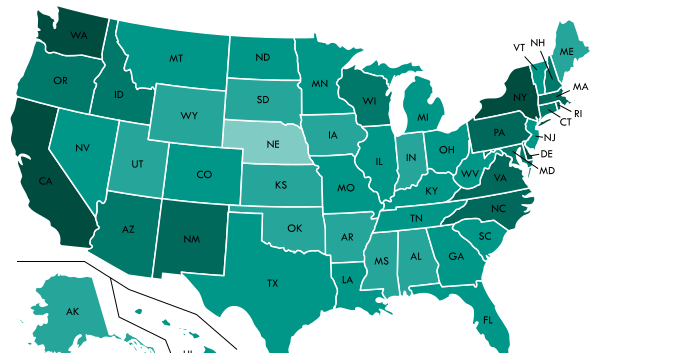
Most common states for senior programmer analyst leads
| Rank | State | Population | # of jobs | Employment/ 1000ppl |
|---|---|---|---|---|
| 1 | District of Columbia | 693,972 | 397 | 57% |
| 2 | Alaska | 739,795 | 194 | 26% |
| 3 | Montana | 1,050,493 | 248 | 24% |
| 4 | Nebraska | 1,920,076 | 414 | 22% |
| 5 | Idaho | 1,716,943 | 363 | 21% |
| 6 | South Dakota | 869,666 | 172 | 20% |
| 7 | Kansas | 2,913,123 | 555 | 19% |
| 8 | Virginia | 8,470,020 | 1,550 | 18% |
| 9 | New Mexico | 2,088,070 | 359 | 17% |
| 10 | Michigan | 9,962,311 | 1,631 | 16% |
| 11 | Massachusetts | 6,859,819 | 1,064 | 16% |
| 12 | Nevada | 2,998,039 | 479 | 16% |
| 13 | Arkansas | 3,004,279 | 448 | 15% |
| 14 | Delaware | 961,939 | 143 | 15% |
| 15 | Maryland | 6,052,177 | 823 | 14% |
| 16 | Oregon | 4,142,776 | 518 | 13% |
| 17 | Vermont | 623,657 | 80 | 13% |
| 18 | Oklahoma | 3,930,864 | 480 | 12% |
| 19 | New Hampshire | 1,342,795 | 155 | 12% |
| 20 | North Carolina | 10,273,419 | 1,130 | 11% |
Most common cities for senior programmer analyst leads
| Rank | City | # of jobs | Employment/ 1000ppl | Avg. salary |
|---|---|---|---|---|
| 1 | Denver | 1 | 0% | $82,627 |
Senior Programmer Analyst Lead job outlook: Expert opinions
Our panel of senior programmer analyst lead experts
University of North Dakota
Xavier University
University of Wisconsin - Green Bay
SUNY College at Geneseo
Siena College
University of Maine
West Virginia University
Indiana University - Purdue University Indianapolis
Mount Saint Mary's University
Washington and Lee University
Cumberland University
Brigham Young University - Idaho
What Senior Programmer Analyst Lead skills would you recommend for someone trying to advance their career?
Dr. Swagata Banerjee PhD: Digital literacy: As technology continues to evolve, proficiency in digital tools and platforms will become increasingly essential. Adaptability: The ability to quickly learn new skills and adapt to changing circumstances will be crucial in a rapidly evolving industry landscape. Data literacy: Understanding and analyzing data will become more important for making informed decisions and optimizing strategies. Interdisciplinary skills: The ability to work across different disciplines and collaborate effectively with diverse teams will be highly valued. Emotional intelligence: Soft skills such as empathy, communication, and teamwork will continue to be in demand as workplaces become more interconnected and dynamic.
Prof. Mohammad Elahee Ph.D.
Perlroth Professor of Int’l. BusinessWhat Senior Programmer Analyst Lead skills would you recommend for someone trying to advance their career?
Prof. Mohammad Elahee Ph.D.: A combination of both hard and soft skills will be needed to survive in this ‘dog eat dog world’. Hard skills that will be in high demand are familiarity with new AI- and machine-driven technologies and quantitative reasoning. Soft skills that employers will be looking for include emotional intelligence, communication and interpersonal skills and a “can do attitude”. Paradoxical though it may sound, AI would actually create more demand for people with emotional and social intelligence.
What will help Senior Programmer Analyst Leads increase their earning potential?
David Hart: This field has become more valuable ever since the supply chain interruption due to Covid. The analyst is challenged every day with supply chain issues and deployment of the right resources to their prospective areas. Every day can be a new challenge so the work is rarely mundane.
What Senior Programmer Analyst Lead skills would you recommend for someone trying to advance their career?
Adam Roth: I recommend that students start by identifying a specific skill in demand within your field, such as data analysis or social media marketing, and focus on developing expertise in that area. Research salary ranges and living costs in particular areas where you’re interested in working to ensure your compensation aligns with the local market. Always negotiate a salary and consider other aspects of the offer, such as funds for continuing education, technology and more. Continuing to network and establish demand for your services is essential; attend industry events, join professional associations, and engage with professionals in your field. Never miss an opportunity to reach out to and check in with your professional contacts. Pursue additional learning opportunities and education, such as certifications or advanced degrees, to provide a competitive advantage and increase your earning potential over time.
What general advice would you give to a Senior Programmer Analyst Lead?
Bradley Andrew Ph.D.: So-called soft skills are still in demand by employers, based on recent surveys, because a smaller percentage of graduates possess them. These include:
Showing up and on time;
Having a strong work ethic;
Critical thinking skills
Social skills, including the ability to get along well with people, motivate and encourage them, and leadership skills. Also be able to schmooze with clients over dinner or drinks, or just in your office. A personal touch and connection is something software can’t provide.
Creativity—Apple products, for example, appeal to many people because of their combination of form and function.
The ability to work AI in order to increase one’s productivity will become more important over the next 5 years.
What Senior Programmer Analyst Lead skills would you recommend for someone trying to advance their career?
Bradley Andrew Ph.D.: I’m going to change the question based on the evidence gathered by labor economists. Overall, income rises most in a person’s 20s and 30s, stagnates in one’s 40s and actually falls from age 50 on. Moreover, people who are willing to change jobs more frequently have greater salary growth. If this is your goal, then spending your twenties and thirties working hard on your skills and credentials, being willing to move from one position to another and being geographically flexible will increase your lifetime income.
What will help Senior Programmer Analyst Leads increase their earning potential?
Bradley Andrew Ph.D.: Once you have your first job, ask about or determine the 20% of your supervisor’s job that they hate and start doing that for them. They will love you for it and it will quickly get you recognition. You’ll also be well on your way to learning your boss’s job. Continue doing this as you progress in your career (Kudos to Theo Epstein, former GM for the Red Sox, for this recommendation)
No matter the task you’re given, do it to the absolute best of your abilities. In the professional world, you may often be given menial tasks or tasks that you don’t believe are part of your job description. Doing those tasks to the absolute best of your ability leads to increased trust, recognition and responsibility and will put you “above class.” If asked, the coffee you bring should be the best your boss has ever had. You never know who’s watching.
Don’t expect credit and don’t ask for credit when things go right; give the credit to others.
Yvette Koepke
Associate Dean for Academic SuccessUniversity of North Dakota
Ethnic, Cultural Minority, Gender, And Group Studies
What Senior Programmer Analyst Lead skills would you recommend for someone trying to advance their career?
Yvette Koepke: Salary: Preparation is key. Prepare by taking advantage of opportunities and experiences through projects, jobs, internships, organizations, or volunteering. Prepare by doing homework about the field and the position, and research showing the value of diversity. And prepare by practicing how best to make the case for what you can contribute.
What will help Senior Programmer Analyst Leads increase their earning potential?
Dr. DAWN TOLONEN MBA: For the near future concentrate on three areas, soft skills, critical thinking, and artificial intelligence (AI). Your technical skills helped you land the job, but it’s your soft skills that lead to promotion.
What will help Senior Programmer Analyst Leads increase their earning potential?
Praneet Tiwari: Continue to be a learner! Business degrees give students the foundation they need to begin their careers but to continue to do well in their careers, they need to keep learning. Find opportunities to learn more to keep evolving whether it’s the use of free resources when available or if your organization funds additional degrees then use those opportunities too. The business world is constantly evolving so it’s important to stay current. Another important thing to focus on is networking. Often after we get our first jobs, we get complacent when it comes to networking but building a network is crucial. Connect with other professionals through LinkedIn, your university’s alumni associations, and events specific to your industry.
Jasmine Tang
SUNY College at Geneseo
Bilingual, Multilingual, And Multicultural Education
What Senior Programmer Analyst Lead skills would you recommend for someone trying to advance their career?
Jasmine Tang: Be confident of their major/minor or the subject they like and do best of the field they like for themselves not for money or please their parents or fulfill the dream of others.
What Senior Programmer Analyst Lead skills would you recommend for someone trying to advance their career?
Sunita Goel PhD: Great. Will send you the responses soon. Please let me know the latest deadline by which you need them.
What general advice would you give to a Senior Programmer Analyst Lead?
Dr. Ryan LaRochelle Ph.D.: Be flexible. Today's job market is not the same as the one that your parents or grandparents entered into. It's unlikely that you'll be with the same company for your entire working career, so look at every experience as a potential opportunity to learn and explore. Also, the work environment you're joining is more important than the job title and position description. Do some research about what it's like to work at the place that is looking to hire you, and don't be afraid to reach out to current employees to get some candid feedback. Your job title and job description is much easier to change or renegotiate over time, but it's really hard to completely transform a toxic organizational culture and environment.
What Senior Programmer Analyst Lead skills would you recommend for someone trying to advance their career?
Robert Bentz: The obvious one is artificial intelligence. Many people are concerned that they may be replaced by AI, but nothing can be further from the truth. Those who learn to work with AI are going to be the ones that excel. There's a skill to knowing what you can and can't get from this remarkable new technology.
Robert Affe
Senior Lecturer, EmeritusWhat Senior Programmer Analyst Lead skills would you recommend for someone trying to advance their career?
Robert Affe: Realize that your first job is not a lifetime job. In fact, you probably will not have that job in a year or two, so keep a steady emotional mindset about your responsibilities. Digital/tech industries are evolving at an accelerated pace. Learn to “think like your boss”. It will demonstrate that you are observant, and can learn; and your boss will appreciate and likely reward that extra effort. Demonstrate your "commitment to the enterprise”, whether it is your specific assignment or the other goal of the company. Do what is expected of you——and then do more.
What general advice would you give to a Senior Programmer Analyst Lead?
Oliver Keys Jr: The power of mentorships and networking early in your career will be beneficial in the long run. Also, understanding that professional skills can be half the battle. Showing up on time, dressing appropriately, and communicating effectively can be challenging for some students. Internships and externships are great for students to get technical and professional experience.
What Senior Programmer Analyst Lead skills would you recommend for someone trying to advance their career?
David Olawale PhD, PMP: - Get one or two mentors within and outside the organization you would be working at. Be willing to seek and take on new projects and learn new things that will help you to grow and develop your capacity and leadership abilities.
What will help Senior Programmer Analyst Leads increase their earning potential?
David Olawale PhD, PMP: - The ability to learn fast (seek and learn new things)
- Teamwork and effective communication
- customer-centric and systems-based thinking for design and problem-solving
Dr. Michelle Holloway
Professor and Doheny Program DirectorMount Saint Mary's University
International Business
What will help Senior Programmer Analyst Leads increase their earning potential?
Dr. Michelle Holloway: Figure out what you are good at, then consider what you would enjoy doing professionally. Your strengths will tell you what job function to do (e.g., sales, accounting, procurement). Your interests will tell you what industry to work in (e.g., tech, entertainment, retail).
What Senior Programmer Analyst Lead skills would you recommend for someone trying to advance their career?
Michelle Cowan Ph.D.: I’m not sure about this question since I haven’t really discussed this with any business analysts. I’ll pass this question on and see if I get a response. Otherwise, ask me about content strategy, UX, writing, and communication jobs, and I can speak more freely, since that’s what I did for 15 years before moving into academia.
What general advice would you give to a Senior Programmer Analyst Lead?
Dr. Karah Sprouse D.B.A.: Year after year I tell my graduates that the best thing that they can do is get in the game. As a new graduate, you are not supposed to know exactly what you want to do with your degree, and even if you do know, the only way to become experienced is through it. Do your best to find a job opportunity that aligns with your values, interests, and qualifications and begin navigating your career path from there. Secondly, be patient with yourself as you are learning new things and do not be afraid to ask questions when you need help or clarity to do your job well. Companies are in desperate need of new graduates who are motivated to learn and bring value where possible.
What will help Senior Programmer Analyst Leads increase their earning potential?
Dr. Karah Sprouse D.B.A.: While salary is certainly important, it is more impactful for graduates to seek a career path that aligns with their values and interests and there is opportunity for growth. Growth may or may not look like advancement in a particular organization, but is there opportunity for you to learn and grow personally and professionally? When passion meets growth, the earning cannot help but follow.
What Senior Programmer Analyst Lead skills would you recommend for someone trying to advance their career?
Prof. Kim Jovanovich P.E.: Attached please see the responses to your interview questions. I hope this sheds some light on the questions you asked!
What will help Senior Programmer Analyst Leads increase their earning potential?
Kevin Kimball: Continue learning and make social connections within your employer’s umbrella, within your profession and within your larger community. The ones who have significant earnings upside are the ones who can sell the business and be connectors between people.