Explore jobs
Find specific jobs
Explore careers
Explore professions
Best companies
Explore companies
Job outlook for senior project control analysts in the United States
Are senior project control analyst jobs in demand?
Senior project control analyst job and salary trends over time
Senior project control analyst jobs over time
Senior project control analyst job growth rate over time
| Year | # of jobs | % of population |
|---|---|---|
| 2021 | 1,906 | 0.00% |
| 2020 | 1,821 | 0.00% |
| 2019 | 1,760 | 0.00% |
| 2018 | 1,698 | 0.00% |
| 2017 | 1,635 | 0.00% |
Average senior project control analyst salary over time
Senior project control analyst salary by year
| Year | Avg. salary | Hourly rate | % Change |
|---|---|---|---|
| 2026 | $87,448 | $42.04 | +2.8% |
| 2025 | $85,054 | $40.89 | +2.0% |
| 2024 | $83,408 | $40.10 | +1.4% |
| 2023 | $82,251 | $39.54 | +1.4% |
| 2022 | $81,133 | $39.01 | +0.0% |
Senior project control analyst jobs by state
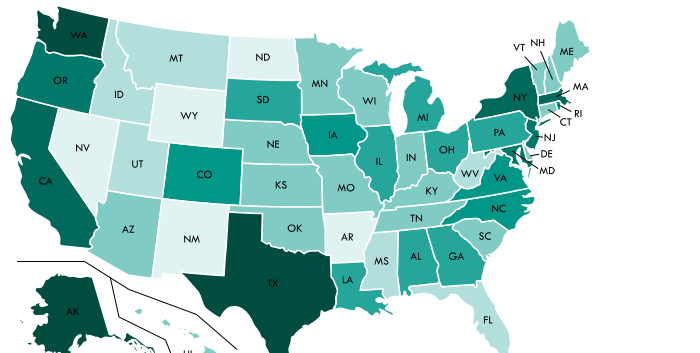
Most common states for senior project control analysts
| Rank | State | Population | # of jobs | Employment/ 1000ppl |
|---|---|---|---|---|
| 1 | District of Columbia | 693,972 | 489 | 70% |
| 2 | Delaware | 961,939 | 347 | 36% |
| 3 | New Hampshire | 1,342,795 | 423 | 32% |
| 4 | Minnesota | 5,576,606 | 1,575 | 28% |
| 5 | North Dakota | 755,393 | 193 | 26% |
| 6 | Georgia | 10,429,379 | 2,607 | 25% |
| 7 | Nebraska | 1,920,076 | 455 | 24% |
| 8 | Virginia | 8,470,020 | 1,924 | 23% |
| 9 | Wisconsin | 5,795,483 | 1,294 | 22% |
| 10 | Ohio | 11,658,609 | 2,288 | 20% |
| 11 | Missouri | 6,113,532 | 1,211 | 20% |
| 12 | Iowa | 3,145,711 | 640 | 20% |
| 13 | Kansas | 2,913,123 | 586 | 20% |
| 14 | New Mexico | 2,088,070 | 416 | 20% |
| 15 | Texas | 28,304,596 | 5,306 | 19% |
| 16 | Massachusetts | 6,859,819 | 1,310 | 19% |
| 17 | Indiana | 6,666,818 | 1,259 | 19% |
| 18 | Idaho | 1,716,943 | 329 | 19% |
| 19 | Maryland | 6,052,177 | 1,112 | 18% |
| 20 | South Dakota | 869,666 | 153 | 18% |
Most common cities for senior project control analysts
| Rank | City | # of jobs | Employment/ 1000ppl | Avg. salary |
|---|---|---|---|---|
| 1 | Rockville | 1 | 1% | $95,652 |
| 2 | San Diego | 3 | 0% | $94,144 |
| 3 | Denver | 2 | 0% | $89,196 |
Senior Project Control Analyst job outlook: Expert opinions
Our panel of senior project control analyst experts

University of California, Irvine

Adelphi University

Ohio State University

Kent State University

Saint Xavier University

Missouri State University

San Diego State University

Indiana University Northwest
Quinnipiac University
Orfalea College of Business
Carthage College
What will help Senior Project Control Analysts increase their earning potential?
Brett Zollinger Ph.D.: Fully utilize the advice and resources of your university's career services office. Build a skills and experience portfolio that is error free. Use that portfolio as your LinkedIn profile or to update and bolster your LinkedIn profile. During the job search, customize every application to the organization's mission, goals, and responsibilities listed in the job ad. Network - tell friends and relatives that you are searching for jobs. Yes, this may yield a lot of notifications for positions in which you're not interested, but it's far better to have many than few leads. If it comes down to holding out for the "perfect position" accepting offer(s) that are more tangential to your interests but are still using your academic knowledge and training, do not hold out for perfect! Sometimes it's not easy to see the many avenues for growth and for realizing your full potential to contribute to an organization before you start. Also, if it turns out that you, indeed, want to keep searching after landing the first position, go for it.
David Feldman Ph.D.
Professor of Urban Planning and Public Policy and Political Science, Director, Water UCI, Director, MPP ProgramUniversity of California, Irvine
Urban Planning and Public Policy
What skills stand out on Senior Project Control Analyst resumes?
David Feldman Ph.D.: Succinct writing, critical thinking, strong quantitative analytical skills.
Hanna Kim Ph.D.
Associate Professor, ChairAdelphi University
Anthropology, College of Arts and Sciences
What hard/technical skills are most important for Senior Project Control Analysts?
Hanna Kim Ph.D.: Hard skills: being more than monolingual! In a globally connected marketplace where young people worldwide are learning and mastering the English language, their multilingualism makes them attractive hires for multinational or international companies. Anthropology students know the non-negotiable importance of knowing a fieldwork language to understand peoples and their cultures. The same would hold for the workplace: knowing one or more languages affords an employee not just possibilities for work assignments: such an employee, i.e., an anthropology graduate who values the connection of language and culture, is ideally suited to work on projects that demand sensitivity to cultural, social, historical, and political nuances. This includes those who work in international humanitarian groups as well as those who work in global finance.
Trey Billing Ph.D.
Post-Doctoral Research FellowOhio State University
Mershon Center for International Security Studies
Will there be an enduring impact of the coronavirus pandemic on Senior Project Control Analysts?
Trey Billing Ph.D.: The Coronavirus pandemic underscores that while global problems may have technical answers, in theory, the implementation of these answers will always be subject to political and social dynamics. I imagine that this will remind those in the policy world that technical solutions' performance requires a deep understanding of political and social challenges that graduates of international relations programs might bring.
Dr. Pratim Datta Ph.D.
Professor of Information SystemsKent State University
College of Busines
What type of skills will young Senior Project Control Analysts need?
Dr. Pratim Datta Ph.D.: I am thinking and problem-solving. I find young people often shy or scared to think hard. It does not work when a person (student) wants a one-size-fits-all solution to all problems. They have to have the guts to think and take risks, and risk-taking is rare these days, as is thinking. No technical skills matter if a person cannot or will not believe it.
Next is collaboration. No one works alone (except maybe artists, writers, etc., but they have agents, so even they do not work alone. In business, everyone works in teams, so all graduates must know how to work with others. That means good communication skills, and that means being straight-forward and entirely honest with all peers. If people cannot contribute to a team, they have no future in business.
Next is self-learning. Graduates must be interested on their own, without a mentor or teacher telling them what to consider next. The rate of technological change is so fast that waiting to be told what to do next is a non-starter. No textbook can be written fast enough to relate to new trends. Successful young people learn what is being developed and master it independently with assistance from no one. No one can hide, and the business expects high-performance from everyone.
Dr. Faisal Rahman Ph.D.
Founding Dean & ProfessorSaint Xavier University
The Graham School of Management
What will help Senior Project Control Analysts increase their earning potential?
Dr. Faisal Rahman Ph.D.: There is significant variation in salaries from one field to another. Those who have prior experience (either through part-time jobs or internships) tend to get better starting salaries. Increases in salary is mostly based on performance/productivity. A future manager must be able to manage their subordinates and their boss/supervisor. They must also be able to work with others as most jobs require working with a team.
Dr. Gabriel Ondetti Ph.D.
Professor, Director, Master of Global Studies programMissouri State University
Department of Political Science
Will there be an enduring impact of the coronavirus pandemic on Senior Project Control Analysts?
Dr. Gabriel Ondetti Ph.D.: There will probably be some aftereffects, like an increase in remote work opportunities and perhaps a reduction in jobs related to conferences and other mass public events. Other than that, it's hard to say. I'm more concerned about the political situation in the United States than COVID-19. That's the disease that could hurt us in the long term.
How do you envision technology impacting Senior Project Control Analysts in the next 5 years?
Stephen Brincks Ph.D.: Technology continues to significantly impact the accounting profession while providing additional opportunities and challenges for graduates. Significant portions of the accounting process can now be automated (some estimates suggest up to 50%), which frees up employee time to focus on higher value-added activities such as data analysis or real-time data monitoring. On-site meetings and monitoring are becoming less frequent, instead of online discussions and monitoring. The combination of cloud computing and real-time sales/inventory tracking allows accountants to monitor company documents daily.
Accountants can view, edit, and analyze documents much more quickly than in the past, allowing potential problems to be detected and promptly fixed. Improved online communication tools, such as Zoom, provide opportunities for quick online meetings to clarify issues or provide feedback. Software programs increasingly create accounting documents and financial information. Since technological change shows no signs of slowing down, graduates will need to improve their technical skillsets to excel in their careers consistently.
Will there be an enduring impact of the coronavirus pandemic on Senior Project Control Analysts?
Surekha Rao: There will be an enduring impact of the present crisis, and its impact will be felt long after we are on the other side of this pandemic.
The pandemic has shown us that if you can work remotely, it is likely that you will keep your job. This has demonstrated the value of white-collar jobs. The considerable unemployment detailed analysis has shown the profound need for a graduate degree to continue to be employed.
The business and work landscape will undergo massive rethinking about the business models. There will be rethinking the infrastructure required for business and hiring full-time versus contact workers. It will also mean that that business will have a lean workforce. The lesson for graduates is to complete their degree with a focus on acquiring many skills to be more employable.
What general advice would you give to a Senior Project Control Analyst?
Surekha Rao: It is more important than ever to present yourself to be flexible and emphasize your multiple skill-set. Economics graduates tend to know some data analysis, business basics, and international business. If they have math and computer skills, it will undoubtedly make them attractive hires.
What general advice would you give to a Senior Project Control Analyst?
Christopher Ball Ph.D.: Economics is a broad, analytical, and generally more quantitative significant. Because it's a social science, that helps students understand nearly any field because they know all fundamental interactions between people in markets (supply and demand) or inside workplaces (incentives, optimal production, etc.). And because much of economics focuses on the market place (supply and demand), our majors have an understanding of the core principles involved in all business disciplines. As a result, I recommend our students aim for more quantitative jobs and those using more analysis. The specific field is less important, and I always recommend people seek employment in areas they like. When you enjoy something, you work harder, and you are more likely to succeed. Because economics forms the basis of so many things in business, from the marketing to production to the management, economics majors tend to start similarly to other majors and then change trajectories and rise faster than other majors. A few years out and they are ideal for management because they can apply economic concepts to any area and learn the basics quickly.
However, if someone is quantitatively oriented and added a technical minor to the econ major like data science or something, then those students are in super high demand, COVID crisis or not. We still see them graduating with some of the highest starting salaries and having much higher wage,s just five years out, than most other graduates. All the benefits of economics being analytical and quantitative combines well with those hardcore data skills to form a compelling combination.
Will there be an enduring impact of the coronavirus pandemic on Senior Project Control Analysts?
Christopher Ball Ph.D.: Yes. The coronavirus pandemic has further helped sever the community connection between a place of work and its employees. Some jobs will continue to be online, and others not, but the current generation of graduates already feel less connected to specific institutions and are more likely to change jobs. I believe this online experiment we all did during the coronavirus will permanently enhance that, and all our graduates should expect to change careers more often in their lifetimes. They will always have the option of picking a job where they can work from home. That was a growing possibility with the growing "gig economy" (Uber, etc.) but will be a more significant option. Simultaneously, I believe, personally, that this has also highlighted the fact that there is a premium to doing things in person. No one was happy just staying home and only working online. To get counseling, to sell or teach, to motivate colleagues, and many more things, we learned that you need to meet in person. Also, specific experiences people want in person: college generally, going to a bar, a restaurant, and so on. So it's like we all learned that the world wouldn't be all online or all in-person, but we don't know what the right mix will be. The premium, however, will be on the in-person side of things. So our graduates need to think about this. Yes, it's valuable to be able to code, and you can work from home. But if you just work from home, you compete globally against people coding in Europe, Asia, Australia, etc. So those who can understand those work-from-home skills, but combine them with interpersonal skills, will be even more valuable in the future.
What general advice would you give to a Senior Project Control Analyst?
Eduardo Zambrano: First, here is some 'technical' advice:
Every Economics graduate should feel very comfortable with coding and data management. This training can be obtained, if your school does not offer it, by attending software and data carpentry workshops online (https://carpentries.org/). A graduate with good Python and R skills, and working knowledge of SQL, will stand out in a crowded field, no matter what sub-field of economics the graduate may be interested in.
Now, here is some 'big picture' advice:
Economic data does not analyze itself, and it does not come from 'nature.' Economic data is the result of the decisions of individuals. To understand data generated by a human activity, you need to think about the incentives that lead individuals to make the decisions that are captured in this data. Therefore, knowledge of econometrics is essential, as it is knowledge of economic theory. What distinguishes Economists from other kinds of data analysts is this emphasis on the understanding that if you do not factor accurately how individuals respond to incentives in the analysis of your data, your review is likely to be flawed or, at least, incomplete. Getting good at this way of data analysis takes many years, and graduates should be prepared to continue learning how to do this well past their college years. With this advice comes a caveat, and an acknowledgment of responsibility: every data analyst must understand that decisions based on data have ethical implications, and can affect some gender or ethnic groups in different ways. These considerations must be explicitly addressed, or the analyst may provide biased and ultimately undesirable advice to the decision-makers.
What general advice would you give to a Senior Project Control Analyst?
Erik Johnson Ph.D.: Economics gives you a set of tools to analyze a variety of policy and business problems. However, determining which tools to apply in which situation requires that you learn the industry, you are working from top to bottom. When you begin a new job in a new field, be sure to do everything you can to understand how the organization and the industry work to understand the primary incentives that everyone faces. One right way to do this is to make as many connections within the company you are working for as possible, and always be on the lookout for new opportunities within the company and how they can help you learn more. Moreover, do your best to ensure that a significant portion of your job involves some creative endeavors, such as economic modeling or building tools for yourself or others to use. As computing power continues to become cheaper, and artificial intelligence becomes more advanced, relatively repetitive tasks become more comfortable and easier to automate. Therefore, you will have less job security. Creative tasks, such as modeling and tool building, are difficult to automate and are more likely to provide you with more satisfaction.
What technology do you think will become more important and prevalent for Senior Project Control Analysts in the next 3-5 years?
Erik Johnson Ph.D.: Two technologies are likely to become more critical in the next 3-5 years: First, much more videoconferencing and remote meetings are likely here to stay. Be sure you can communicate effectively through these mediums. Secondly, using large amounts of numerical and textual data will become increasingly crucial for businesses and policy analysis. Learning how to sift through these data and glean insights from them are likely essential skills to develop and will allow you to grow in your career.
Will there be an enduring impact of the coronavirus pandemic on Senior Project Control Analysts?
Erik Johnson Ph.D.: Graduating in a recession stinks! It is harder to find a job, but if you do find a job, it will likely pay you less than the same position if the economy weren't in a recession. This will not be a temporary problem; it will probably last a long time. There is economic research that shows that you can "catch up" with your peers who graduated during good times after about a decade. However, for the catch up, you will need to be flexible with your jobs. Most of the catch up in wages will come from switching jobs. Few employers will give you sufficient wage increases to make up for the fact they were able to hire you relatively cheaply during a recession. Instead, you will need to look for new jobs every few years to get the raises that will put you on track to earn as much as if you hadn't graduated in a recession. It's hard work, but it will pay off.