Explore jobs
Find specific jobs
Explore careers
Explore professions
Best companies
Explore companies
Job outlook for senior quality assurance engineers in the United States
Senior quality assurance engineer job and salary trends over time
Senior quality assurance engineer jobs over time
Senior quality assurance engineer job growth rate over time
| Year | # of jobs | % of population |
|---|---|---|
| 2021 | 237,382 | 0.07% |
| 2020 | 227,599 | 0.07% |
| 2019 | 162,302 | 0.05% |
| 2018 | 111,634 | 0.03% |
| 2017 | 92,722 | 0.03% |
Average senior quality assurance engineer salary over time
Senior quality assurance engineer salary by year
| Year | Avg. salary | Hourly rate | % Change |
|---|---|---|---|
| 2026 | $106,802 | $51.35 | +3.4% |
| 2025 | $103,283 | $49.66 | +2.3% |
| 2024 | $100,945 | $48.53 | +2.0% |
| 2023 | $98,976 | $47.58 | +2.3% |
| 2022 | $96,740 | $46.51 | +1.5% |
Senior quality assurance engineer jobs by state
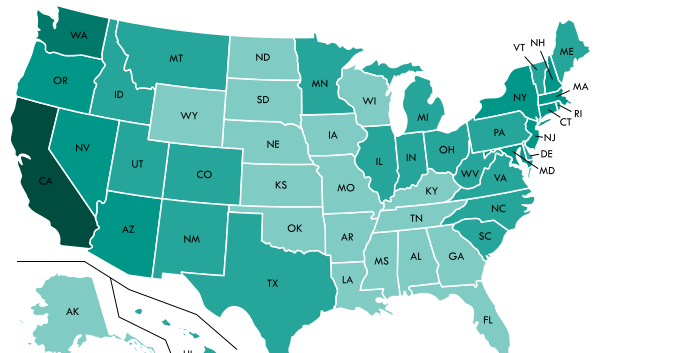
Most common states for senior quality assurance engineers
| Rank | State | Population | # of jobs | Employment/ 1000ppl |
|---|---|---|---|---|
| 1 | District of Columbia | 693,972 | 677 | 98% |
| 2 | Delaware | 961,939 | 432 | 45% |
| 3 | Washington | 7,405,743 | 3,260 | 44% |
| 4 | Vermont | 623,657 | 250 | 40% |
| 5 | New Hampshire | 1,342,795 | 492 | 37% |
| 6 | Virginia | 8,470,020 | 3,045 | 36% |
| 7 | Utah | 3,101,833 | 1,114 | 36% |
| 8 | Maryland | 6,052,177 | 2,046 | 34% |
| 9 | Colorado | 5,607,154 | 1,896 | 34% |
| 10 | Oregon | 4,142,776 | 1,418 | 34% |
| 11 | Rhode Island | 1,059,639 | 352 | 33% |
| 12 | California | 39,536,653 | 12,545 | 32% |
| 13 | Massachusetts | 6,859,819 | 2,216 | 32% |
| 14 | Wyoming | 579,315 | 176 | 30% |
| 15 | Minnesota | 5,576,606 | 1,475 | 26% |
| 16 | North Dakota | 755,393 | 198 | 26% |
| 17 | Indiana | 6,666,818 | 1,584 | 24% |
| 18 | Connecticut | 3,588,184 | 855 | 24% |
| 19 | Alaska | 739,795 | 176 | 24% |
| 20 | Arizona | 7,016,270 | 1,513 | 22% |
Most common cities for senior quality assurance engineers
| Rank | City | # of jobs | Employment/ 1000ppl | Avg. salary |
|---|---|---|---|---|
| 1 | Burlington | 10 | 41% | $95,798 |
| 2 | Cupertino | 6 | 10% | $131,961 |
| 3 | Santa Clara | 10 | 8% | $131,839 |
| 4 | Lakeland | 7 | 7% | $86,141 |
| 5 | Mountain View | 4 | 5% | $131,972 |
| 6 | Alpharetta | 3 | 5% | $86,846 |
| 7 | Lowell | 4 | 4% | $95,642 |
| 8 | Atlanta | 13 | 3% | $86,749 |
| 9 | Sunnyvale | 5 | 3% | $131,897 |
| 10 | Irvine | 5 | 2% | $119,867 |
| 11 | Boston | 10 | 1% | $95,984 |
| 12 | San Diego | 9 | 1% | $117,601 |
| 13 | Austin | 8 | 1% | $91,953 |
| 14 | Washington | 8 | 1% | $99,735 |
| 15 | Denver | 6 | 1% | $88,883 |
| 16 | San Francisco | 6 | 1% | $131,964 |
| 17 | Miami | 4 | 1% | $85,053 |
| 18 | Chicago | 8 | 0% | $89,822 |
| 19 | New York | 7 | 0% | $101,065 |
| 20 | San Jose | 5 | 0% | $131,702 |
Senior Quality Assurance Engineer job outlook: Expert opinions
Our panel of senior quality assurance engineer experts
Nova Southeastern University
University of Wisconsin - Eau Claire
Texas A&M University
Southern Illinois University Edwardsville
University of Minnesota - Crookston

Gannon University
University of Toledo
Eastern Washington University

Landmark College
Auburn University at Montgomery

Allegheny College

Saint Xavier University

Taylor University
John Brown University
Rider University

Union University
Defiance College

Seminole State College of Florida
What Senior Quality Assurance Engineer skills would you recommend for someone trying to advance their career?
Sepehr Mohammadian: 1. This is a pretty broad question. CS degree graduates can engage in different tasks and responsibilities based on the nature of their profession. Examples include 1) software engineering, in which the individual's efforts are toward leading or contributing to software development projects, 2) IT management, where the individual mainly oversees technology strategies and their implementation, 3) cybersecurity, where the individual's responsibilities are associated with the protection of systems and data from cyber threats, and 4) data and AI engineering, where the individual works on machine learning applications and analyze and derive insights from large datasets.
What Senior Quality Assurance Engineer skills would you recommend for someone trying to advance their career?
Dr. Sridhar Ramachandran: To optimize your earning potential in the field of Computer Science, it’s important to establish a solid educational foundation and master widely-used programming languages and technologies. Internships offer invaluable hands-on experience, and obtaining industrial certifications in specialized areas can significantly increase your marketability. Cultivating a robust professional network and honing your salary negotiation skills are also key. It’s important to stay updated with the latest technological advancements, salary trends, and consider focusing on a niche area in high demand. From the outset of your career conversations, it’s beneficial to communicate clear salary expectations. Conduct thorough research on the current market rates for the role you’re targeting to ensure your expectations are realistic. Understanding your worth in the market is crucial, and you should aim for a salary that not only reflects your skills and experience but also keeps you motivated and invested in your work. Remember, while salary is a significant factor, aspects like work-life balance and job satisfaction also play a vital role in your overall career satisfaction. Aim for a win-win salary negotiation where both you and your employer feel the compensation is fair and equitable.
Junping Sun Ph.D.
ProfessorNova Southeastern University
Computer Software And Media Applications
What Senior Quality Assurance Engineer skills would you recommend for someone trying to advance their career?
Junping Sun Ph.D.: Computer Science and its applications in various fields are very dynamic and constantly evolving, and anyone in the fields needs to prepare to be adaptive by lifelong learning.
What Senior Quality Assurance Engineer skills would you recommend for someone trying to advance their career?
Lyle Ford: Be flexible and open to new experiences. Technology changes rapidly and your skills will have to evolve to keep up. You will always need your creativity and problem solving skills, but the way in which you implement them will change with your environment which will require you to constantly update your skillset. Always look for opportunities to network. This can give you insights into developing areas and open doors for future paths you may be unaware of.
What general advice would you give to a Senior Quality Assurance Engineer?
Aakash Tyagi: (a) Ability to work at the intersection of AI/ML and vital fields like bioengineering, finance, environmental sciences, Cyberphysical systems, etc., (b) Continual learning and adaptability to changing technology landscape, (c) Critical thinking, problem solving in medium to large team structures.
What Senior Quality Assurance Engineer skills would you recommend for someone trying to advance their career?
Ahmed Imteaj PH.D.: Artificial Intelligence and Machine Learning (LLMs): With the rise of Large Language Models (LLMs) like GPT-3 and BERT, skills in natural language processing (NLP), transfer learning, and fine-tuning pre-trained models will become increasingly valuable. LLMs have applications in areas such as text generation, sentiment analysis, and language translation.
Sustainable AI: As concerns about the environmental impact of AI and computing grow, skills in sustainable AI practices, energy-efficient algorithms, and green computing will be in demand. Professionals who can develop AI solutions that minimize energy consumption and carbon footprint will play a crucial role in building a more sustainable future.
Cybersecurity: With the ever-increasing threat landscape and sophisticated cyberattacks, cybersecurity skills will remain critical. In addition to traditional cybersecurity practices, such as network security and encryption, skills in areas such as threat intelligence, incident response, and penetration testing will be in high demand.
Cloud Computing: As more businesses migrate their infrastructure and services to the cloud, skills in cloud computing will continue to be in high demand. Proficiency with cloud platforms such as AWS, Azure, and Google Cloud, as well as expertise in areas like serverless computing, containerization, and hybrid cloud architectures, will be valuable for building and managing scalable and resilient cloud-based solutions.
What will help Senior Quality Assurance Engineers increase their earning potential?
Ahmed Imteaj PH.D.: Research Salary Trends: Before entering the job market, research salary trends for entry-level positions in your field and location. Websites like Glassdoor, PayScale, and LinkedIn Salary can provide valuable insights into typical salary ranges for different roles.
Acquire In-Demand Skills: Identify in-demand skills and technologies in your field and focus on acquiring them through coursework, certifications, internships, or personal projects. Skills such as machine learning, cloud computing, cybersecurity, and data science are highly valued and can command higher salaries.
Gain Relevant Experience: Prioritize gaining relevant experience through internships, co-op programs, part-time jobs, or freelance projects. Practical experience can significantly increase your market value and make you more attractive to employers.Customize Your Resume and Cover Letter: Tailor your resume and cover letter to highlight your relevant skills, experiences, and achievements that align with the job requirements. Highlighting your unique qualifications can increase your chances of landing interviews and negotiating a higher salary.
Prepare for Salary Negotiations: Before entering salary negotiations, research the typical salary range for the position and location, considering factors such as cost of living and industry standards. Practice articulating your value proposition and be prepared to negotiate confidently for a salary that reflects your skills, experience, and market value.
Consider Additional Benefits: In addition to salary, consider other benefits and perks offered by employers, such as health insurance, retirement plans, paid time off, flexible work arrangements, professional development opportunities, and bonuses. These benefits can add significant value to your overall compensation package.
Christine Bakke
LecturerUniversity of Minnesota - Crookston
Math, Science & Technology Department
How have salaries changed over time for Senior Quality Assurance Engineers?
Christine Bakke: In previous questions, I have used my own wording; however, the US Bureau of Labor Statistics is the most accurate source for an answer to this question:
The median pay for ITM, MIS, & CIS (all listed together at the US Bureau of Labor Statistics):
$146,360 per year
$70.37 per hour
"Employment in computer and information technology occupations is projected to grow 11 percent from 2019 to 2029, much faster than the average for all occupations. These occupations are projected to add about 531,200 new jobs. Demand for these workers will stem from greater emphasis on cloud computing, the collection and storage of big data, and information security. "
Are there any particularly good places in the United States for Senior Quality Assurance Engineers to find work opportunities?
Dr. Stephen Frezza Ph.D.: Computing is ubiquitous, and with more industries moving to remote work, location is becoming less critical. If the internet reaches a place reliably, computing jobs can be located there.
How do you envision technology impacting Senior Quality Assurance Engineers in the next 5 years?
Dr. Stephen Frezza Ph.D.: Breadth and depth: Computing is becoming more like engineering; where the value of the product, its lifetime risks, costs, and benefits are more critical than just it's roll-out. So the engineering competencies that have always been a part of computing will become more central. Computing is also expanding; the role of data and the shift of once-research technologies (like machine learning) into production applications will continue to require computing graduates to broaden their base and continue as learners. This will cause shifts in what is considered 'fundamental' and the need for professionals to continue to hone and redevelop their technical skill sets.
How have salaries changed over time for Senior Quality Assurance Engineers?
Jared Onyango Oluoch Ph.D.: I think salaries in academia especially in Computer Science and Engineering Technology are rising and are expected to given the demand of graduates in these areas.
Christian Hansen Ph.D.
Professor and Department ChairEastern Washington University
Department of Mathematics
What soft skills should all Senior Quality Assurance Engineers possess?
Christian Hansen Ph.D.: The soft skills that all graduates should possess include strong communication and teamwork skills regardless of the discipline. Analytical skills will be in high demand, as well as the ability to adapt and learn new technology. Data will continue to play a bigger role in almost any type of business; therefore, the ability to analyze and interpret data for decision making will be increasingly critical. Many jobs in the future are jobs that do not yet exist and as a result, new graduates must have the ability to adapt.
John Russo
Associate Professor and Program Coordinator of Computer ScienceLandmark College
STEM Department
What technical skills for a Senior Quality Assurance Engineer stand out to employers?
John Russo: As I mentioned above, the ability to adapt to change. My favorite course is database management systems. I tell my students that the software that we use today likely will not be around for the entire span of their careers. They really need to learn how to quickly work with new technologies, languages and systems. In the span of my career much has changed. I have always found new technologies exciting and refreshing. Employers want to hire graduates who have a set of technical skills in programming languages, database management systems and techniques (such as data mining) but also can learn on the job and be excited to learn new things.
What type of skills will young Senior Quality Assurance Engineers need?
Dr. Semih Dinc: I may be little biased on this question maybe because of my research field. But I notice a significant demand on machine learning experts in the industry. Today I think a CS graduate should have skills such as machine learning, computer vision, and programming for mobile environments.
Will there be an enduring impact of the coronavirus pandemic on Senior Quality Assurance Engineers?
Dr. Semih Dinc: I personally think there may be a positive impact of this pandemic for CS graduates in medium/long term. Even if many companies have frozen or slowed down their hiring process now, I believe this is a temporary decision. There is still a big need for new CS graduates in the industry. And to me it is more clear that people realized they can work remotely for many CS related positions. This means that many companies can cut their physical office budgets and hire more remote people. One of the factors for our students is the challenges/expenses of the city they would work. Some of them do not want to move to big cities. I am assuming with more remote working opportunities graduates will have more options.
Oliver Bonham-Carter Ph.D.
Assistant ProfessorAllegheny College
Department of Computer Science and Affiliated Faculty in Integrative Informatics
What are the biggest trends we'll see in the Senior Quality Assurance Engineer job market given the pandemic?
Oliver Bonham-Carter Ph.D.: Pandemic has accelerated social connectivity trends using technology, including technology for remote work, and e-learning, and technology to make e-commerce more comfortable and faster. I foresee these accelerated technology trends to continue, even after the pandemic, and therefore job markets in these areas to continue to grow. Another big surge we have seen is in data analytics, which has been increasing over the last decade, and COVID-19 has spotlighted this field. I expect data analyst jobs to continue to be in demand and to grow. Also, the pandemic showed us the interconnectedness of technology with other areas. As the need to develop better solutions to fight various diseases heightens, for example, I expect jobs in biotech to grow.
What are the best companies to work for a Senior Quality Assurance Engineer?
James Vanderhyde: The best companies to work for are companies that respect you as a person and not just a cog in the machine. They are inclusive, and they recognize and appreciate diversity. They have a track record of handling sick leave and family leave as needed. They will not expect you to eat dinner in your office and then go back to work after an already long day. All software companies experience crunch times around release dates, but the best companies do not experience constant crunch. That is a sign of poor management. The best companies will give you challenging problems to work on and reward innovation.
Will there be an increase or decrease in demand for Senior Quality Assurance Engineers in the next 5 years?
James Vanderhyde: There has been a steady increase in software and IT jobs for the last 20 years, and this is not going to slow down any time soon. In the next 5 years, demand will increase, particularly in software development and cybersecurity. The technology field changes so quickly that beyond 5 years, it is difficult to make predictions. That is why we thoroughly prepare our computer science and information systems students for technology changes and career shifts to discover the best in themselves and to be prepared to meet the demand and excel within the field.
Are there any particularly good places in the United States for Senior Quality Assurance Engineers to find work opportunities?
James Vanderhyde: Any big city will have lots of opportunities for computing, software, and IT work. Silicon Valley and the rest of the west coast are the most famous, but innovation is happening everywhere around the country and around the world, including here in Chicago. Chicago tech companies have hired our students upon graduation, and likewise, our graduates have found success and gratification in the field.
Dr. Jonathan Geisler
Associate ProfessorTaylor University
Department of Computer Science and Engineering
Will there be an increase or decrease in demand for Senior Quality Assurance Engineers in the next 5 years?
Dr. Jonathan Geisler: There will be a continued increase in demand for computer engineering
graduates as computers become more heavily integrated into the fabric
of our lives. Things like self-driving cars, the Internet of Things, and
mobile computing will become more commonplace and increase the demand for engineering talent; the long-term trend of using smartphones and web-based applications will not slow, leading to an increase in the
demand for computing talent.
Are there any particularly good places in the United States for Senior Quality Assurance Engineers to find work opportunities?
Dr. Ted Junseok Song: Due to COVID-19, people have more choices on location as more companies allow their employees to work remotely.
How do you envision technology impacting Senior Quality Assurance Engineers in the next 5 years?
Dr. Ted Junseok Song: The question is not whether technology will advance or not. It is, rather, how it will advance. Professionals in the industry need to be equipped to see the customers' demand and where our society is headed. I would recommend college students to be interested in broad topics apart from topics in their major. Well-rounded people will have more opportunities to impact the future.
Dr. Howard Rees
Adjunct Assistant Professor of Information SystemsRider University
Information systems
What technology do you think will become more important and prevalent for Senior Quality Assurance Engineers in the next 3-5 years?
Dr. Howard Rees: Hmm, what technology? That's a question with many different levels of context. For some undergraduates in CS and IT, I would look at systems programming in massively parallel environments, application programming with particular focus on security and privacy, and data science and analytics. For other undergraduates, they might look at artificial intelligence and machine learning, for business applications especially. AI is becoming ubiquitous throughout the business, but it's often used as a "black box."
Meaning that the applications (and those "operating" them) do not understand what's happening inside. AI systems are often "designed, trained, and tested" by the provider and certified as generating the output most desired by the customer but only in a statistical sense. There is no "proof" that the AI black box is, with certainty, doing what the business customer (or the provider for that matter) thinks it is doing - it just does a good job when tested on data. There will be a significant need for tech-savvy people to design, train, monitor, and apply them so that they do not deviate from the desired goals. Such deviations can result in socially destructive business practices. As you can't properly manage what you don't understand, there is a risk in using AI too blindly. CS and IT graduates will need to help out.
Will there be an enduring impact of the coronavirus pandemic on Senior Quality Assurance Engineers?
Dr. Howard Rees: We're moving into a volatile time for the economy, and planning for an uncertain future is what big companies are concerned with. In many ways, the pandemic and concerns over future pandemics that we now know can be globally devastating will be a boon for CS and IT graduates. Face to face business interactions and transactions will be dramatically reduced, both in the short term and in the long run, as there will be a need to hedge against future pandemics. Everything changes from production and operations to supply chain and risk management and diversification to the nature of "office work." And all of that must be underpinned by computer technology: communications, security, data analytics. These are trends that have been developing for the past few decades but the pandemic will accelerate them, and that's all useful, if you're a CS or IT graduate with a broad base of knowledge, which provides you the freedom to adapt.
What general advice would you give to a Senior Quality Assurance Engineer?
Brian Glas: Build relationships: Different technologies will interest and challenge you, but throughout your career, you'll find that it's the relationships that are the most important. This is harder to grasp earlier in your career, but much easier to understand after 15-20 years.
Gain different perspectives: Spend time with people in other roles that your job interacts with, and gain a solid understanding of how they view things; this is most valuable for career progression and understanding of how your work fits into the big picture.
What technology do you think will become more important and prevalent for Senior Quality Assurance Engineers in the next 3-5 years?
Brian Glas: [Something]-as-code will continue to grow in prevalence as we strive to automate more processes and technologies. More jobs will need, at least, the essential ability to understand and write in some scripting language or similar. We should also see an increase in collaboration tooling to support communication and collaboration with more of the workforce spread globally.
What general advice would you give to a Senior Quality Assurance Engineer?
Aaron Napierala: The most important advice I can offer, is to let them know to work toward something they are passionate about. Many people have the impression that CS is all about programming. While programming can, and does, deal with programming, an education in CS lays the foundation for students to work with technology, whatever that might be. If students are not passionate about what they are doing, I believe students would be hard-pressed to achieve their true potential. If you have a solid foundation, but nothing to build on top of that, where are you? This is why I always recommend students explore other areas, outside of CS, that they are excited to learn more about, to complement their technical knowledge. If students can't relate to people outside of their discipline, I think they will be limited on what they can do and ultimately not satisfied.
Craig Tidwell Ph.D.
Professor/Program ManagerSeminole State College of Florida
Center for Information Technology
What technology do you think will become more important and prevalent for Senior Quality Assurance Engineers in the next 3-5 years?
Craig Tidwell Ph.D.: Understanding cloud technologies such as Amazon Web Services, Microsoft Azure, and Google are needed. Since many organizations have a hybrid structure, where they have internal and external cloud technologies, learning how to integrate them with existing technologies is critical.
Will there be an enduring impact of the coronavirus pandemic on Senior Quality Assurance Engineers?
Craig Tidwell Ph.D.: Many I.T. employees already have the option to work remotely (telecommute), but this will become even more important with the Coronavirus challenges. Employees must be able to work remotely and be organized and self-directed. Employers are looking for teleworkers that can work on a task from anywhere.