Explore jobs
Find specific jobs
Explore careers
Explore professions
Best companies
Explore companies
Job outlook for senior requirements analysts in the United States
Are senior requirements analyst jobs in demand?
Senior requirements analyst job and salary trends over time
Senior requirements analyst jobs over time
Senior requirements analyst job growth rate over time
| Year | # of jobs | % of population |
|---|---|---|
| 2021 | 1,304 | 0.00% |
| 2020 | 1,245 | 0.00% |
| 2019 | 1,204 | 0.00% |
| 2018 | 1,647 | 0.00% |
| 2017 | 1,630 | 0.00% |
Average senior requirements analyst salary over time
Senior requirements analyst salary by year
| Year | Avg. salary | Hourly rate | % Change |
|---|---|---|---|
| 2025 | $84,168 | $40.47 | +3.4% |
| 2024 | $81,395 | $39.13 | +2.3% |
| 2023 | $79,552 | $38.25 | +0.5% |
| 2022 | $79,131 | $38.04 | +1.2% |
| 2021 | $78,189 | $37.59 | +1.7% |
Senior requirements analyst jobs by state
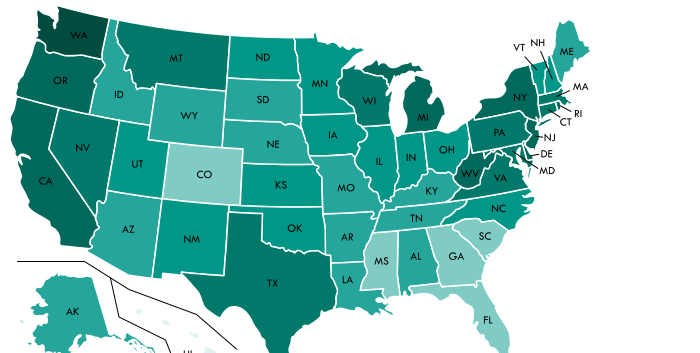
Most common states for senior requirements analysts
| Rank | State | Population | # of jobs | Employment/ 1000ppl |
|---|---|---|---|---|
| 1 | District of Columbia | 693,972 | 447 | 64% |
| 2 | Virginia | 8,470,020 | 1,437 | 17% |
| 3 | Massachusetts | 6,859,819 | 944 | 14% |
| 4 | Maryland | 6,052,177 | 757 | 13% |
| 5 | Delaware | 961,939 | 127 | 13% |
| 6 | Colorado | 5,607,154 | 602 | 11% |
| 7 | Alaska | 739,795 | 80 | 11% |
| 8 | Minnesota | 5,576,606 | 563 | 10% |
| 9 | Oregon | 4,142,776 | 405 | 10% |
| 10 | Illinois | 12,802,023 | 1,179 | 9% |
| 11 | Georgia | 10,429,379 | 923 | 9% |
| 12 | North Carolina | 10,273,419 | 903 | 9% |
| 13 | Rhode Island | 1,059,639 | 95 | 9% |
| 14 | Vermont | 623,657 | 54 | 9% |
| 15 | New Jersey | 9,005,644 | 715 | 8% |
| 16 | Washington | 7,405,743 | 624 | 8% |
| 17 | Connecticut | 3,588,184 | 290 | 8% |
| 18 | Utah | 3,101,833 | 240 | 8% |
| 19 | New Hampshire | 1,342,795 | 112 | 8% |
| 20 | North Dakota | 755,393 | 62 | 8% |
Senior Requirements Analyst job outlook: Expert opinions
Our panel of senior requirements analyst experts
Worcester Polytechnic Institute
Saint John Fisher College
Western Kentucky University
Southern Connecticut State University
Kent State University
New York University
Widener University
Xavier University
Florida Gulf Coast University
Sullivan University
University of Wisconsin - Green Bay
What will help Senior Requirements Analysts increase their earning potential?
Dr. Swagata Banerjee PhD: Network extensively: Build relationships with professionals in your field, attend industry events, and join relevant professional organizations. Continuously learn and adapt: Stay updated on industry trends, new technologies, and best practices through courses, workshops, and online resources. Seek mentorship: Find experienced professionals who can offer guidance and advice as you navigate your career path. Be proactive and resourceful: Take initiative, seek out opportunities for growth, and don't be afraid to step outside your comfort zone.
Prof. Mohammad Elahee Ph.D.
Perlroth Professor of Int’l. BusinessWhat Senior Requirements Analyst skills would you recommend for someone trying to advance their career?
Prof. Mohammad Elahee Ph.D.: A combination of both hard and soft skills will be needed to survive in this ‘dog eat dog world’. Hard skills that will be in high demand are familiarity with new AI- and machine-driven technologies and quantitative reasoning. Soft skills that employers will be looking for include emotional intelligence, communication and interpersonal skills and a “can do attitude”. Paradoxical though it may sound, AI would actually create more demand for people with emotional and social intelligence.
What general advice would you give to a Senior Requirements Analyst?
Jennifer Barr PhD: All of the skills noted in my response to Q1. However, as business professionals advance in their respective careers, they must have a keen understanding about the impact of technology on every aspect of an organization. It is also essential to stay abreast of emerging technologies and understand their implications for business practice.
Professional development should be an ongoing priority. Attend conferences and seminars, complete certificate programs, etc. Build your personal brand and value at every level.
Hone leadership skills for middle management positions including collaboration, thinking and acting systemically, resiliency and learning agility. Never forget the importance of humanity when interacting with subordinates. Lead by example always.
Recognizing the role of data capture, analytics and technology in advancing organizations, creating competitive advantage and delivering exceptional user experiences is paramount.
Hire well. Employees are considered the most valuable asset of every organization. Abilities, knowledge and experience matter but the soft skills in terms of how someone works and interacts with others should be top priorities.
What will help Senior Requirements Analysts increase their earning potential?
David Hart: This field has become more valuable ever since the supply chain interruption due to Covid. The analyst is challenged every day with supply chain issues and deployment of the right resources to their prospective areas. Every day can be a new challenge so the work is rarely mundane.
Dany Doueiri
ProfessorWhat Senior Requirements Analyst skills would you recommend for someone trying to advance their career?
Dany Doueiri: Have a team mentality, share, keep learning, and seek all professional development opportunities available to you, through your work or individually.
What Senior Requirements Analyst skills would you recommend for someone trying to advance their career?
Adam Roth: I recommend that students start by identifying a specific skill in demand within your field, such as data analysis or social media marketing, and focus on developing expertise in that area. Research salary ranges and living costs in particular areas where you’re interested in working to ensure your compensation aligns with the local market. Always negotiate a salary and consider other aspects of the offer, such as funds for continuing education, technology and more. Continuing to network and establish demand for your services is essential; attend industry events, join professional associations, and engage with professionals in your field. Never miss an opportunity to reach out to and check in with your professional contacts. Pursue additional learning opportunities and education, such as certifications or advanced degrees, to provide a competitive advantage and increase your earning potential over time.
What will help Senior Requirements Analysts increase their earning potential?
Bradley Andrew Ph.D.: Once you have your first job, ask about or determine the 20% of your supervisor’s job that they hate and start doing that for them. They will love you for it and it will quickly get you recognition. You’ll also be well on your way to learning your boss’s job. Continue doing this as you progress in your career (Kudos to Theo Epstein, former GM for the Red Sox, for this recommendation)
No matter the task you’re given, do it to the absolute best of your abilities. In the professional world, you may often be given menial tasks or tasks that you don’t believe are part of your job description. Doing those tasks to the absolute best of your ability leads to increased trust, recognition and responsibility and will put you “above class.” If asked, the coffee you bring should be the best your boss has ever had. You never know who’s watching.
Don’t expect credit and don’t ask for credit when things go right; give the credit to others.
What will help Senior Requirements Analysts increase their earning potential?
Zhu Mao: Find yourself a good platform and demonstrate your irreplaceability. New challenges always coming out from the interdisciplinary area and continuous learning will not only enhance the capability, but also demonstrate the commitment to professional growth and engagement to the field.
What will help Senior Requirements Analysts increase their earning potential?
Yi Liu Ph.D., CFP®: Having grit is more important than you may realize because facing challenges and barriers is part of the process. There will be bumps and hurdles. But what important is that you do not give up. It's okay not to have all of the answers on the first day. Be curious, ask questions, and delve deeply into learning about your profession. It can take up to 6,000 hours to completely master a field. So, allow yourself the opportunity to learn and grow. Enjoy the journey, not the destination. That's where the true learning occurs.
Xiaowen Chen Ph.D.
Assistant ProfessorWestern Kentucky University
Psychology
What Senior Requirements Analyst skills would you recommend for someone trying to advance their career?
Xiaowen Chen Ph.D.: Present your knowledge, skills, competencies, and experience by showing your research and applied projects so that employers will know what you have accomplished and the potential value you can bring to their organization.
What will help Senior Requirements Analysts increase their earning potential?
Xiaowen Chen Ph.D.: · Don’t stop learning new skills, technologies, and knowledge. Your skillsets and knowledge should continuously develop in line with the rapidly changing world. There isn't a single skill or certificate that can keep you competitive for years. · You may not be a computer scientist or data scientist, it's beneficial to understand the basics of machine learning and artificial intelligence and try to use AI-assistant tools.
What general advice would you give to a Senior Requirements Analyst?
Zheni Wang Ph.D.: Being an intrapreneur is the way to maximize your salary potential when starting your career in your field.
What Senior Requirements Analyst skills would you recommend for someone trying to advance their career?
Zheni Wang Ph.D.: I think the most important and prevalent skill in the field in the next 3-5 years is unlearning and learning continuously. We are living in an era of change now. Having a degree in business shows your ability to learn. But the best competitiveness you can reserve for yourself is to unlearn what others have done (i.e., the case studies and benchmarks you’ve been given in the classroom) and learn to create new standards and solutions when facing constant changes in the business world. By doing so, you can create values for others to remain successful.
What general advice would you give to a Senior Requirements Analyst?
Dr. Vaneet Kaur: You can maximize your salary potential by keeping yourself differentiated from your peers. You must identify, develop, and hone your unique selling proposition (USP). You want to show your prospective employer that you bring a unique value to their organization which is far superior to what other candidates can bring. You can achieve this by demonstrating to your prospective employer that you go above and beyond what is usually required and expected. More specifically, in addition to earning your degree, you should attain certifications, micro-credentialing, or badges in any niche area that you are passionate about. This will significantly add to your area specialization. Additionally, you should undertake internships or projects with faculty/business community as these will help demonstrate your working knowledge to the prospective employers. I exhort my students to continue to excel in these areas as these will not only communicate to the prospective employers that these select individuals have the drive and willingness to succeed, making them a perfect candidate to be inducted to their company, but this will also keep graduates highly relevant, marketable, and above par at all times in their career.
What will help Senior Requirements Analysts increase their earning potential?
Dr. Vaneet Kaur: For a fresh graduate, the real world can at first appear to be somewhat fuzzy. So, my advice is to step into their career with a mindset that allows them to be open to learning. It would also be extremely beneficial for young professionals to consider each encounter with their colleagues as well as early touchpoints with clients as an opportunity to enhance their repertoire of knowledge. For that matter, networking is highly important, especially at the onset of the career. So, dear graduates, please take time to network. Find a mentor, from a peer support group, and build a webwork of collaborators. Once you find or form a community of bright minds with whom you feel you belong, you will find it easier to start working smart which will help you to seize each day while making a difference every day.
What general advice would you give to a Senior Requirements Analyst?
Vasant Dhar: It isn't always the best idea to go for the highest paying job, but for one with the maximum growth potential, meaning challenging problems and the right people. I advise students to evaluate and follow the people they like to work with. Over the longer term, the relationships pay off.
Tongyang Yang Ph.D.
Assistant Professor of Economics and Business AnalyticsWidener University
Business/Commerce
What general advice would you give to a Senior Requirements Analyst?
Tongyang Yang Ph.D.: There are many reasons that people like about being a business analyst, including reasons listed as follows: 1. Analytical Skills and Data Exploration: BAs often analyze data to understand trends and identify areas for improvement. Seeing a successful implementation and its positive impact can be very rewarding. 2. Problem-solving. BAs get to identify inefficiencies and propose solutions that can improve how a business operates. 3. Continuous learning. Business analysts may work on a range of projects and the field of business analysis may be constantly evolving, which required BAs to actively cultivate skills in new businesses. For example, the coming of the AI era requires BAs to master AI fundamentals and data fluency. 4. While some thrive on the problem-solving and communication aspects of a BA role, others may find them less appealing. Carefully consider your personality and preferences to see if this aligns with your career goals.
What will help Senior Requirements Analysts increase their earning potential?
Dr. DAWN TOLONEN MBA: For the near future concentrate on three areas, soft skills, critical thinking, and artificial intelligence (AI). Your technical skills helped you land the job, but it’s your soft skills that lead to promotion.
Thomas Mathews CFA
InstructorFlorida Gulf Coast University
Finance And Financial Management Services
What general advice would you give to a Senior Requirements Analyst?
Thomas Mathews CFA: GET YOUR FOOT IN THE DOOR AT A SUITABLE POSITION, LEARN AS MUCH AS YOU CAN, FIND A MENTOR/COACH WHO IS WELL-RESPECTED IN THE ORGANIZATION, DO NOT BE AFRAID TO WORK HARD, DO NOT BE AFRAID TO RAISE YOUR HAND TO LEAD OR SUPPORT CRITICAL INITIATIVES.
What Senior Requirements Analyst skills would you recommend for someone trying to advance their career?
Thomas Smith PhD: Take every opportunity to learn something new. Work harder than everyone else, volunteer for assignments, learn your job well enough to teach someone else how to do it, so you can start learning the next job in your career path. Remember, you are there to make money for your employer. Treat that responsibility like you are making the money for yourself.
What will help Senior Requirements Analysts increase their earning potential?
Thomas Smith PhD: Soft skills (people skills) and critical thinking are both skills that will serve you well throughout your career, and unfortunately, they are areas that receive little focus in most education today. Remember the 'Golden Rule' and learn from your mistakes.
What general advice would you give to a Senior Requirements Analyst?
Praneet Tiwari: Artificial Intelligence (AI) is certainly a game-changer that everyone will have to contend with. A basic understanding of AI and automation will be important for all business professionals, as these technologies continue to transform the workplace as we know it. Business graduates with a working knowledge of AI and automation will be better prepared to understand how these technologies can be used to improve business processes and create new opportunities. Get comfortable using the versions of generative AI at our disposal now, and seek to learn more about how they are being used in your workplace. Data analysis and visualization are being used by all industries and job-levels, and is thus another important skill. The ability to collect, analyze, and interpret data will be crucial for making informed decisions in any business role. Business graduates with strong data analysis skills will be well-positioned to solve complex problems and identify new opportunities for their departments and organizations. And finally, while we may be surrounded by more and more technologies, it will be more important than ever to have strong communication and collaboration skills. These are essential for working effectively in teams and building relationships with clients and colleagues. As we use more hybrid and remote working models, it's important to be able to communicate clearly and concisely, both verbally and in writing with colleagues across the country and the world.
What Senior Requirements Analyst skills would you recommend for someone trying to advance their career?
Praneet Tiwari: Maximizing one’s salary potential is a long-term strategy, but the best way is to start out strong by searching for the best for yourself. For instance, companies in high-growth industries often offer more competitive salaries and better opportunities for promotion. If you are okay with a lower base salary but interested in more profit-sharing, then consider startups as they have equity ownership or profit-sharing models which can lead to a higher compensation package in the long run. In any situation, however, be prepared to negotiate. Before entering any salary negotiation, research the typical salary range for your position, location, and experience level. Make sure to practice your negotiation skills and have a clear idea of your desired salary range and the reasons why you deserve it. Focus on the value you bring to the company and highlight your skills. Most universities have a career center or student success center that can help you do mock interviews and negotiations. Once you land the job, make sure to deliver results, volunteer for challenging projects, and exceed expectations. This allows you to seek out raises and promotions quickly. And finally, be prepared to job-hop if needed. Strategic job-hopping may be needed if you find that the job is not a good fit, or the growth trajectory is not what you want.
What will help Senior Requirements Analysts increase their earning potential?
Praneet Tiwari: Continue to be a learner! Business degrees give students the foundation they need to begin their careers but to continue to do well in their careers, they need to keep learning. Find opportunities to learn more to keep evolving whether it’s the use of free resources when available or if your organization funds additional degrees then use those opportunities too. The business world is constantly evolving so it’s important to stay current. Another important thing to focus on is networking. Often after we get our first jobs, we get complacent when it comes to networking but building a network is crucial. Connect with other professionals through LinkedIn, your university’s alumni associations, and events specific to your industry.