Explore jobs
Find specific jobs
Explore careers
Explore professions
Best companies
Explore companies
Job outlook for senior research assistants in the United States
Senior research assistant job growth summary. After extensive research, interviews, and analysis, Zippia's data science team found that:
The projected senior research assistant job growth rate is 19% from 2018-2028.
About 150,300 new jobs for senior research assistants are projected over the next decade.
Senior research assistant salaries have increased 14% for senior research assistants in the last 5 years.
There are over 43,672 senior research assistants currently employed in the United States.
There are 49,246 active senior research assistant job openings in the US.
The average senior research assistant salary is $50,643.
Are senior research assistant jobs in demand?
Senior research assistant job and salary trends over time
Senior research assistant jobs over time
Senior research assistant job growth rate over time
| Year | # of jobs | % of population |
|---|---|---|
| 2021 | 43,672 | 0.01% |
| 2020 | 51,700 | 0.02% |
| 2019 | 51,601 | 0.02% |
| 2018 | 49,384 | 0.01% |
| 2017 | 45,363 | 0.01% |
Average senior research assistant salary over time
Senior research assistant salary by year
| Year | Avg. salary | Hourly rate | % Change |
|---|---|---|---|
| 2026 | $50,643 | $24.35 | +3.6% |
| 2025 | $48,894 | $23.51 | +1.9% |
| 2024 | $47,998 | $23.08 | +1.4% |
| 2023 | $47,340 | $22.76 | +6.5% |
| 2022 | $44,448 | $21.37 | +1.7% |
Senior research assistant jobs by state
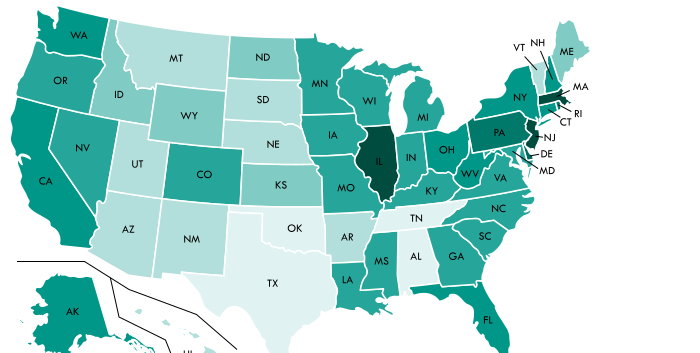
Most common states for senior research assistants
| Rank | State | Population | # of jobs | Employment/ 1000ppl |
|---|---|---|---|---|
| 1 | Massachusetts | 6,859,819 | 2,375 | 35% |
| 2 | District of Columbia | 693,972 | 220 | 32% |
| 3 | Maryland | 6,052,177 | 921 | 15% |
| 4 | Colorado | 5,607,154 | 856 | 15% |
| 5 | Vermont | 623,657 | 94 | 15% |
| 6 | Oregon | 4,142,776 | 583 | 14% |
| 7 | Rhode Island | 1,059,639 | 138 | 13% |
| 8 | Alaska | 739,795 | 97 | 13% |
| 9 | New York | 19,849,399 | 2,363 | 12% |
| 10 | Washington | 7,405,743 | 866 | 12% |
| 11 | New Hampshire | 1,342,795 | 158 | 12% |
| 12 | Delaware | 961,939 | 115 | 12% |
| 13 | New Jersey | 9,005,644 | 1,008 | 11% |
| 14 | Minnesota | 5,576,606 | 603 | 11% |
| 15 | Nebraska | 1,920,076 | 202 | 11% |
| 16 | Virginia | 8,470,020 | 812 | 10% |
| 17 | South Dakota | 869,666 | 85 | 10% |
| 18 | Pennsylvania | 12,805,537 | 1,192 | 9% |
| 19 | Connecticut | 3,588,184 | 309 | 9% |
| 20 | Wyoming | 579,315 | 50 | 9% |
Most common cities for senior research assistants
| Rank | City | # of jobs | Employment/ 1000ppl | Avg. salary |
|---|---|---|---|---|
| 1 | Dover | 1 | 3% | $62,145 |
| 2 | Idaho Falls | 1 | 2% | $42,707 |
| 3 | Baltimore | 5 | 1% | $50,471 |
| 4 | Ann Arbor | 1 | 1% | $51,113 |
| 5 | Cambridge | 1 | 1% | $68,362 |
| 6 | Boston | 2 | 0% | $68,425 |
| 7 | Washington | 2 | 0% | $61,532 |
| 8 | Houston | 1 | 0% | $37,450 |
| 9 | Indianapolis | 1 | 0% | $49,225 |
| 10 | Miami | 1 | 0% | $55,904 |
| 11 | Oakland | 1 | 0% | $61,387 |
Senior Research Assistant job outlook: Expert opinions
Our panel of senior research assistant experts
Northeastern State University
SUNY Stony Brook
Pepperdine University
University of Dallas
Northwestern University
New Mexico State University
Georgetown University
Santa Fe College
Southern Illinois University Carbondale
Washington State University
Purdue University
University of Pittsburgh
University of Nebraska - Omaha
What Senior Research Assistant skills would you recommend for someone trying to advance their career?
Christopher Vitek Ph.D.: Population biology, especially biology that focuses on disease vectors, is a great field to pursue. People will always want to get rid of mosquitoes, so there is always a demand for learning when, where, and how to control them, as well as helping to identify risks for disease transmission. Newly available molecular tools help us understand more about the biological underpinnings that control characteristics like population growth and distribution.
What will help Senior Research Assistants increase their earning potential?
Christopher Vitek Ph.D.: I love being a population biologist because it allows me to work with a lot of other people and help public health offices learn how to control vector-borne diseases. The work is interesting and has an end result that can provide some use to the public. One thing that people may not like is that population biology often uses a lot of math and mathematical modeling to help predict growth and distribution patterns. You don’t need to be an expert, but you should be comfortable with math.
What will help Senior Research Assistants increase their earning potential?
Dr. Taufika Williams PhD: Get as many graduate degrees as you are able to as it will really bump up your starting salary. An MS is great but stick around for the PhD if you can. Terminal degrees can open doors for career growth and upward mobility.
What Senior Research Assistant skills would you recommend for someone trying to advance their career?
Frank David MD, PhD: My main piece of advice is to network. Do tons of informational interviews with folks and then follow up to see if there are possible opportunities or other connections that folks can help you make. Many biotech and pharma positions go to folks with 'inside tracks' because they are recommended by current employees or already know the hiring manager. Also: be flexible about the type of role whenever possible. For example, if you’re looking at an entry-level lab-based job, don’t get hung up on the specific disease area. Or if you’re interested in regulatory science, cast a broad net and also explore roles in program management and medical writing, which involve similar activities and required skills. Finally: it’s great to look for opportunities at biotech and pharma firms, but don’t forget about contract research organizations, consultancies, and other vendors that serve drug companies. Those types of organizations are often more willing to train folks who are coming straight out of school, and those positions are great stepping stones to eventually move 'to the client side' (into drug companies) as experienced hires.
What will help Senior Research Assistants increase their earning potential?
Dulanjani Wijayasekara Ph.D.: Biology is a vast field with a lot of opportunities. The highest paying jobs in the field include health care, biostatisticians, data analysts, ecologists, genetic counselors, pharmacists, molecular biologists and research scientists/technicians in pharmaceutical companies. Depending on what area you would like to focus on, it would be a good idea to improve some basic skill sets that will give you an added advantage in the job market. If you are a fresh graduate many online certificate courses can be completed to give you these additional skills. You can improve upon IT skills such as biotechnology and computer literacy, research skills, and data analysis including biostatistics. You also can get some research experience by either volunteering in research labs or by gaining a master’s degree in molecular biology. This will open up many more job opportunities for you in the pharmaceutical area. Find out what career you love and work towards that by improving your skills and experience.
What general advice would you give to a Senior Research Assistant?
Ross Weatherman Ph.D.: Generally, broad training across a number of different types of biochemical and molecular biology methods will make you an attractive candidate to a larger number of employers and expand your potential options, but deep skills in one or two really important techniques areas, such as proteomics or bioinformatics, will make you most attractive to a single employer and improve your salary potential.
What Senior Research Assistant skills would you recommend for someone trying to advance their career?
Dr. Vitaly Citovsky: Advanced degrees, bioinformatics, hi-tech research (synthetic biology), but classical molecular biology and genetics and biochemistry skills will remain critical
What general advice would you give to a Senior Research Assistant?
Rachel Tan Ph.D.: I do not have an answer for this. My response would be to be proactive during undergraduate studies, to discern where you find joy and curiosity. Pursue that topic. I do not think that the salary should be the priority when considering careers.
What will help Senior Research Assistants increase their earning potential?
Dr. Prajay Patel Ph.D.: Think and operate one level above your position. For example, as a senior graduate student, you should operate like a postdoc. Postdocs work on independent research while learning how to write grants, so as a senior graduate student, you should consider looking for fellowships and similar funding opportunities. Learn what your supervisors/bosses are doing effectively that you can apply when you are in their position. Also, know your strengths and weaknesses. Acknowledge to yourself that you have weaknesses and try to mitigate them, but figure out where you can showcase your strengths in the projects you will get. Finally, keep your doors open to doing and learning new things. You never know what skills you learn early in your career that can pay off later.
What will help Senior Research Assistants increase their earning potential?
Nathaniel Stern: Within academic physics, your potential can be maximized by doing impactful work in graduate school that matters to other people. The next step is to communicate this impact broadly, and then figure out how to take the next step in the field. That is a lot of steps, but if one can successfully do those things in graduate school, they can build the profile, community, and intellectual leadership to demand the highest salary. Outside of academic physics, the requirements are probably not that different, but I do not have explicit knowledge of them myself. So I would fall back on the standard goals of innovation and communication, which should help one succeed in any knowledge-related career.
What will help Senior Research Assistants increase their earning potential?
Meghan McGee-Lawrence Ph.D.: Cast a wide net! A huge variety of career paths can be pursued with a degree like this, including industry, academic research, healthcare, education, and more. It is a very versatile degree, and can be a foundation for a multitude of different professions. Talk to recent graduates from your program (as many as possible!) and see what they did with their degree – the more information you can collect, the better prepared you’ll be to seek out opportunities yourself. Take the time to figure out where your interests lie – and understand that you may have to try a few different paths out before you find the right one for you. The first position you land after graduation doesn’t have to be the job you perform for the next 30 years of your life – so use each opportunity as a learning experience to figure out what you’d really like to do long-term.
What general advice would you give to a Senior Research Assistant?
Michael Marks: A few things: First, feel free to say "no" to things. As a new faculty member, more senior faculty may think they are being helpful by suggesting you take service duties, committee work, etc. But take your first year or two to get established. If you feel too many "opportunities" are coming your way, a good response might be "That sounds great, maybe that can be something I take on once I get my lab established." Second, advertise yourself. Build a website with your own domain, off of your employer's servers. This is a great way to attract graduate advisees and lab members, post your publications and data, and make yourself available to people interested in your research. I say get your own domain because employers will often change things with hosting, which can cause access issues. Finally, even if you don't post, follow some social media accounts of prominent figures in the field to keep abreast of developments, debates, and current issues.
Luz Garcini PhD, MPH
Assistant ProfessorWhat general advice would you give to a Senior Research Assistant?
Luz Garcini PhD, MPH: Find a purpose and a meaning in their work and be open to learning from interdisciplinary fields.
What Senior Research Assistant skills would you recommend for someone trying to advance their career?
Ivica Labuda PhD: Certainly everyone in the biotech field would benefit from having knowledge of biotechnology techniques and skills in concert with understanding the regulatory framework. That provides a good foundation so that one can interact confidently in every aspect of the biotech world. With AI progress, the next step is to add the basic understanding of the speed at which we can evolve new techniques and materials. Not everybody needs to code, but everyone needs to think about how to maximize its benefits for biotechnology.
What general advice would you give to a Senior Research Assistant?
Kristopher Koudelka Ph.D.: There are two skillsets, and one field I see become more important. The first skillset is application of material. You must know the language of your field; however, most content can be quickly found through simple research. People who can apply this knowledge, and formulate the new questions are more valuable employees. The second skill set is troubleshooting. Very often experiments fail or give strange results, how one can glean as much information as possible from the experiment and then plan the next course of action is a huge asset. The field I see becoming more important is computer programming. Very often these fields deal with large datasets that are so big, complex, or repetitive that computer assistance isn’t just helpful… but mandatory.
What general advice would you give to a Senior Research Assistant?
Jeff Heslep: Find a starting job that gives you a wide range of work to perform. The more experience you can gain during the first few years will help you to hone your skills, decide what areas interest you the most, and give you the opportunity to choose. Learn as much as you can about the various equipment, analytical techniques, processes, and how to troubleshoot minor problems. Take the initiative and ask to learn how to use instruments you aren't familiar with. It is unlikely someone will deny you the opportunity to broaden your knowledge. Take every chance you have to network and get to know the people within your local biotechnology industry. Networking plays a major role in employment opportunities. Work on your written and verbal communication skills. Communicating well will help you stand out. Being able to effectively convey complex scientific concepts in such a way that anyone can understand it can be a powerful skill.
What Senior Research Assistant skills would you recommend for someone trying to advance their career?
Jeff Heslep: A good entry-level starting salary is great, but it may not maximize your salary potential if the job doesn't help you grow. You might want to take learning opportunities and experience over money early on in your career. Focus on experience, learning, and growth early so your salary potential in the long run will be much higher. Be wary of companies offering a sign-on bonus for certain positions. The reason companies need to offer a sign-on bonus for specific positions is often because the job is very demanding and unpleasant, or they are positions that stagnate and offer little growth opportunities. You'll have plenty of time to advance and make a higher salary after you have a good system of self-improvement in place and ways to master your skills.
What general advice would you give to a Senior Research Assistant?
Jacob Nordman: Salary potential in my field of neuroscience almost always involves publications, awards, and technical acumen. Therefore, as I mentioned, it is important to start early looking for opportunities that can strengthen these areas. Another important aspect of getting high-profile, and thus high-paying, positions, is being able to tell a story with your research and career. Employers want to see that you have thought deeply and strategically about your career and where it’s going. This will allow them to believe you are a safe bet and worthy of their investment.
What will help Senior Research Assistants increase their earning potential?
Lindsey du Toit: Take every opportunity you can to learn, network, and build an effective team of people that bring a greater breadth and depth of skills and expertise to the work on which you will be focusing. Cultivate a life-long sense of intellectual curiosity and learning. Don’t be afraid to ask questions. Treat ignorance as an opportunity to learn. Questions demonstrate you want to understand the situation/problem effectively and that you are paying attention. Always demonstrate integrity in your work. It is one of the most valuable traits you can bring to your career. Be kind and supportive of your colleagues.
Yan Cong
Purdue University
Romance Languages, Literatures, And Linguistics
What Senior Research Assistant skills would you recommend for someone trying to advance their career?
Yan Cong: AI singularity, Artificial General Intelligence (AGI), et cetera are topics that trigger a lot of debate nowadays and they will be prevalent in the near future. Perspectives from humanities and linguistics would contribute to the ongoing debate and provide new opportunities for future innovative technologies that are linked to languages, linguistics and humanities.
What will help Senior Research Assistants increase their earning potential?
Yan Cong: Develop some in-demand skills such as programming or generating content from text models via prompt engineering, et cetera. Get experience and extra income via paid summer internships.
What will help Senior Research Assistants increase their earning potential?
Arjumand Ghazi Ph. D: Having an advanced degree such as a PhD and even a few years postdoc is a good way to start at a higher level. It often allows one to make up for the reduced earnings during the training periods while increasing long-term earnings.
Andrew Riquier Ph.D.
InstructorUniversity of Nebraska - Omaha
Neurobiology And Neurosciences
What Senior Research Assistant skills would you recommend for someone trying to advance their career?
Andrew Riquier Ph.D.: Necessary skills obviously vary from position to position and across time. Therefore, I think the ability to learn new skills as the need arises is of the utmost importance. But if I had to name something more specific, it would likely be computer skills and various data analytic skills. As AI gets further integrated into the field, understanding how to make use of it is becoming increasingly more important. Additionally, being able to analyze patterns of results across multiple fields will likely yield fruitful avenues of research.