Explore jobs
Find specific jobs
Explore careers
Explore professions
Best companies
Explore companies
Job outlook for senior scientists, product development in the United States
Are senior scientist, product development jobs in demand?
Senior scientist, product development job and salary trends over time
Senior scientist, product development jobs over time
Senior scientist, product development job growth rate over time
| Year | # of jobs | % of population |
|---|---|---|
| 2021 | 2,138 | 0.00% |
| 2020 | 2,484 | 0.00% |
| 2019 | 2,505 | 0.00% |
| 2018 | 2,370 | 0.00% |
| 2017 | 2,200 | 0.00% |
Average senior scientist, product development salary over time
Senior scientist, product development salary by year
| Year | Avg. salary | Hourly rate | % Change |
|---|---|---|---|
| 2026 | $101,127 | $48.62 | +3.1% |
| 2025 | $98,121 | $47.17 | +4.7% |
| 2024 | $93,723 | $45.06 | +3.3% |
| 2023 | $90,717 | $43.61 | +1.9% |
| 2022 | $88,993 | $42.79 | --2.1% |
Senior scientist, product development jobs by state
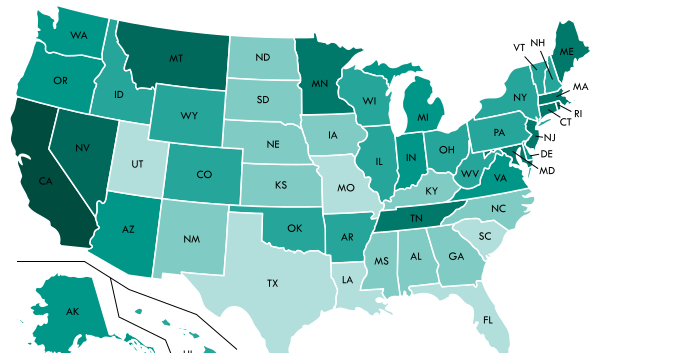
Most common states for senior scientists, product development
| Rank | State | Population | # of jobs | Employment/ 1000ppl |
|---|---|---|---|---|
| 1 | Minnesota | 5,576,606 | 2,287 | 41% |
| 2 | South Dakota | 869,666 | 328 | 38% |
| 3 | North Dakota | 755,393 | 286 | 38% |
| 4 | Wyoming | 579,315 | 218 | 38% |
| 5 | Alaska | 739,795 | 241 | 33% |
| 6 | Pennsylvania | 12,805,537 | 3,802 | 30% |
| 7 | New Mexico | 2,088,070 | 636 | 30% |
| 8 | Nebraska | 1,920,076 | 569 | 30% |
| 9 | Virginia | 8,470,020 | 2,298 | 27% |
| 10 | Massachusetts | 6,859,819 | 1,857 | 27% |
| 11 | Wisconsin | 5,795,483 | 1,566 | 27% |
| 12 | Georgia | 10,429,379 | 2,720 | 26% |
| 13 | Maryland | 6,052,177 | 1,549 | 26% |
| 14 | Kansas | 2,913,123 | 770 | 26% |
| 15 | Montana | 1,050,493 | 269 | 26% |
| 16 | Iowa | 3,145,711 | 773 | 25% |
| 17 | Arizona | 7,016,270 | 1,718 | 24% |
| 18 | Texas | 28,304,596 | 6,376 | 23% |
| 19 | Missouri | 6,113,532 | 1,401 | 23% |
| 20 | Indiana | 6,666,818 | 1,406 | 21% |
Most common cities for senior scientists, product development
| Rank | City | # of jobs | Employment/ 1000ppl | Avg. salary |
|---|---|---|---|---|
| 1 | Lexington | 1 | 3% | $102,351 |
| 2 | Madison Heights | 1 | 3% | $91,790 |
| 3 | Marlborough | 1 | 3% | $102,456 |
| 4 | Waltham | 1 | 2% | $102,396 |
| 5 | Clearwater | 1 | 1% | $70,977 |
| 6 | Oceanside | 1 | 1% | $123,717 |
| 7 | Minneapolis | 2 | 0% | $110,319 |
| 8 | San Diego | 1 | 0% | $122,580 |
Senior Scientist, Product Development job outlook: Expert opinions
Our panel of senior scientist, product development experts
SUNY Stony Brook
Georgetown University
Southern Illinois University Carbondale
Jackson State University
Washington State University
University of Kentucky
Purdue University
University of Pittsburgh
University of Nebraska - Omaha
Loyola University New Orleans
Western Washington University
Quinnipiac University
What general advice would you give to a Senior Scientist, Product Development?
Christopher Vitek Ph.D.: My research focuses on disease vectors, mostly mosquitoes, so I explore factors that influence how quickly they develop, where they spread, what time of year they are found, etc. I also do research in effective control methods, and even a little bit in disease transmission. Depending on your research area, you may be involved in looking at mathematical models, life history tables, species interactions, and more.
What Senior Scientist, Product Development skills would you recommend for someone trying to advance their career?
Christopher Vitek Ph.D.: Population biology, especially biology that focuses on disease vectors, is a great field to pursue. People will always want to get rid of mosquitoes, so there is always a demand for learning when, where, and how to control them, as well as helping to identify risks for disease transmission. Newly available molecular tools help us understand more about the biological underpinnings that control characteristics like population growth and distribution.
What general advice would you give to a Senior Scientist, Product Development?
Dr. Taufika Williams PhD: Finding a job at with an undergraduate degree may be quite doable but upward mobility in your career often requires a terminal degree (i.e. PhD). Stay in school for as long as you can! Some students will work in biotechnology for a few years after their undergraduate studies are over and then return to school for graduate education. The work experience can tremendously benefit graduate research.
What will help Senior Scientists, Product Development increase their earning potential?
Dr. Taufika Williams PhD: Get as many graduate degrees as you are able to as it will really bump up your starting salary. An MS is great but stick around for the PhD if you can. Terminal degrees can open doors for career growth and upward mobility.
What general advice would you give to a Senior Scientist, Product Development?
Frank David MD, PhD: In many biopharma industry positions, the annual cash bonus can be a sizable chunk of the compensation. So if you start out in a job like this, make sure you understand how you’ll be evaluated at the end of the year so you can make sure you knock it out of the park and get the highest possible ratings. If you go into a biopharma R&D; position straight out of undergrad, you should try to figure out relatively soon if you’ll want to go back to school for a PhD. Most science-based jobs will require a PhD to advance, but in many 'science-adjacent' jobs you’ll be able to move up without an advanced degree. Either is fine, but it would be great to figure out which direction you want to go within 2-4 years of entering the industry so you can plan accordingly.
What will help Senior Scientists, Product Development increase their earning potential?
Frank David MD, PhD: In basic research jobs, the key lab-related skills will continue to be the ones that are commonly used for discovering and developing new therapies: mammalian cell culture, in vitro assays, transfection, immunoprecipitation, Western blots, etc. It’s typically not necessary to 'check all the boxes' in terms of bench skills for a job, but having a few of these key techniques under your belt will give a company confidence that you can learn others. In general across the industry, effective written communication and project management are key skills that cut across almost all jobs and divisions within biotech and pharma. Anything you can do to build and highlight those capabilities will serve you in good stead.
Camellia Okpodu
What general advice would you give to a Senior Scientist, Product Development?
Camellia Okpodu: Adatation and fundamental knowledge of botanical terms will always be pivotal to the discipline; however new technologies and applications will move the bountiful the discipline. Bioinformatics, genomics; Machine learning, Remote Sensing and VR (both for instruction and field application) will be necessay skills. Also, Botanists will collaborate with experts from diverse fields (ecology, computer science, engineering) thus making effective communication and teamwork critical.skills of the future
What Senior Scientist, Product Development skills would you recommend for someone trying to advance their career?
Camellia Okpodu: My advise would be to continue to network by joining affiliated associations in botany and Keep learning, stay updated on research, and explore new areas.
What Senior Scientist, Product Development skills would you recommend for someone trying to advance their career?
Dr. Vitaly Citovsky: Advanced degrees, bioinformatics, hi-tech research (synthetic biology), but classical molecular biology and genetics and biochemistry skills will remain critical
What will help Senior Scientists, Product Development increase their earning potential?
Dr. Melanie Wilcox Ph.D., ABPP: This is more difficult to answer as it highly depends on the person! What matters most in career choice is whether the chosen occupation is a good fit for your interests, skills, values, and priorities. If you enjoy research, consider yourself to be a data-driven and curious person, and like to engage in work that benefits people, organizations, and/or society, Experimental Psychology could be a great fit. If you prefer to help people more directly such as through psychological services, then Clinical, Counseling, or School psychology may be a better fit; Experimental Psychology is solely a research-focused path.
Luz Garcini PhD, MPH
Assistant ProfessorWhat general advice would you give to a Senior Scientist, Product Development?
Luz Garcini PhD, MPH: Find a purpose and a meaning in their work and be open to learning from interdisciplinary fields.
What will help Senior Scientists, Product Development increase their earning potential?
Luz Garcini PhD, MPH: Build a unique niche and new skills (another language), disseminate your work via high impact networks/avenues, get mentoring in negotiation.
What Senior Scientist, Product Development skills would you recommend for someone trying to advance their career?
Ivica Labuda PhD: Certainly everyone in the biotech field would benefit from having knowledge of biotechnology techniques and skills in concert with understanding the regulatory framework. That provides a good foundation so that one can interact confidently in every aspect of the biotech world. With AI progress, the next step is to add the basic understanding of the speed at which we can evolve new techniques and materials. Not everybody needs to code, but everyone needs to think about how to maximize its benefits for biotechnology.
What will help Senior Scientists, Product Development increase their earning potential?
Ivica Labuda PhD: Everyone's career is a unique path, but a strong education gets your foot in the door and graduate programs such as Georgetown's MS in Biotechnology are accelerators for your potential. An advanced degree and the exposure to real-world internships they often provide bring you to a much higher starting point in negotiations and can help you gain confidence to start at higher positions. Salary, however, is just one measure of success -- also important to consider are satisfaction from the working environment, a great team, and potential for professional and personal growth.
What general advice would you give to a Senior Scientist, Product Development?
Kristopher Koudelka Ph.D.: There are two skillsets, and one field I see become more important. The first skillset is application of material. You must know the language of your field; however, most content can be quickly found through simple research. People who can apply this knowledge, and formulate the new questions are more valuable employees. The second skill set is troubleshooting. Very often experiments fail or give strange results, how one can glean as much information as possible from the experiment and then plan the next course of action is a huge asset. The field I see becoming more important is computer programming. Very often these fields deal with large datasets that are so big, complex, or repetitive that computer assistance isn’t just helpful… but mandatory.
What general advice would you give to a Senior Scientist, Product Development?
Jason Ferrell: By showing up, working hard, and being helpful. Companies invest in people, more than skills, and if you demonstrate your value to an organization, the financial rewards will follow.
What will help Senior Scientists, Product Development increase their earning potential?
Jason Ferrell: While technology is changing at a rapid pace and artificial intelligence will no doubt play an ever increasing role in life and science, I believe the foundations of success will not change. These include, 1. Being responsive and timely. 2. Possessing excellent written and oral communication skills. 3. Being a helpful team member. Regardless of skill set or expertise, these are three pillars of success.
What general advice would you give to a Senior Scientist, Product Development?
Jacob Nordman: Salary potential in my field of neuroscience almost always involves publications, awards, and technical acumen. Therefore, as I mentioned, it is important to start early looking for opportunities that can strengthen these areas. Another important aspect of getting high-profile, and thus high-paying, positions, is being able to tell a story with your research and career. Employers want to see that you have thought deeply and strategically about your career and where it’s going. This will allow them to believe you are a safe bet and worthy of their investment.
What Senior Scientist, Product Development skills would you recommend for someone trying to advance their career?
Jacob Nordman: The very first thing to do, probably before you even apply for a PhD program, is ask yourself, “What do I want to do with my PhD?” In my field of neuroscience, that usually means one of 3 things: academia, industry, or policy. All three have different requirements and so involve different priorities. If the answer is academia, the most important requirement is publications, awards, and grants. These are what will make you appealing to labs and departments. If the answer is industry, having hands on experience with state-of-the-art techniques relevant to your field, along with the requisite high-profile papers, will make you appealing to employers. Either way, knowing what you will want to do will help you craft a graduate school experience that best equips you to compete in an extraordinarily competitive job marker.
What will help Senior Scientists, Product Development increase their earning potential?
Hung-Chung Huang: In Industry, working for a big pharmaceutical or biotech company with several promotion potentials; in Academia, grant applications to obtain some big fundings and get promoted to a higher academic position.
What general advice would you give to a Senior Scientist, Product Development?
Lindsey du Toit: The ability to put advanced, including molecular plant pathology, skills and methods pathology in the context of fundamental principles of plant pathology is so important. There is a real danger of being trained/educated so narrowly that you lose the bigger picture and context of the work. Make an effort to learn from people with expertise in related disciplines to avoid working in an isolated ivory tower, and to benefit from the amazing cross-pollination that can happen with shared expertise.
What will help Senior Scientists, Product Development increase their earning potential?
Lindsey du Toit: Take every opportunity you can to learn, network, and build an effective team of people that bring a greater breadth and depth of skills and expertise to the work on which you will be focusing. Cultivate a life-long sense of intellectual curiosity and learning. Don’t be afraid to ask questions. Treat ignorance as an opportunity to learn. Questions demonstrate you want to understand the situation/problem effectively and that you are paying attention. Always demonstrate integrity in your work. It is one of the most valuable traits you can bring to your career. Be kind and supportive of your colleagues.
Dr. David Harmon
Professor of Animal & Food SciencesUniversity of Kentucky
Animal Sciences
What Senior Scientist, Product Development skills would you recommend for someone trying to advance their career?
Dr. David Harmon: Opportunities abound. The job opportunities outnumber current graduates. Decide what you want to be good at and then be good at it.
What will help Senior Scientists, Product Development increase their earning potential?
Dr. David Harmon: Be productive as a graduate student. Publishing is still the road to success.
Yan Cong
Purdue University
Romance Languages, Literatures, And Linguistics
What general advice would you give to a Senior Scientist, Product Development?
Yan Cong: Professionally, focus on building your resume from the first day. This process can involve publishing in your field and connecting with other researchers. Personally, balance between your graduate work and your mental wellbeing.
What Senior Scientist, Product Development skills would you recommend for someone trying to advance their career?
Yan Cong: AI singularity, Artificial General Intelligence (AGI), et cetera are topics that trigger a lot of debate nowadays and they will be prevalent in the near future. Perspectives from humanities and linguistics would contribute to the ongoing debate and provide new opportunities for future innovative technologies that are linked to languages, linguistics and humanities.
What will help Senior Scientists, Product Development increase their earning potential?
Yan Cong: Develop some in-demand skills such as programming or generating content from text models via prompt engineering, et cetera. Get experience and extra income via paid summer internships.
What general advice would you give to a Senior Scientist, Product Development?
Arjumand Ghazi Ph. D: Don’t hesitate to experiment with different career options before settling for one where you enjoy the work and make a good living.
What will help Senior Scientists, Product Development increase their earning potential?
Arjumand Ghazi Ph. D: Having an advanced degree such as a PhD and even a few years postdoc is a good way to start at a higher level. It often allows one to make up for the reduced earnings during the training periods while increasing long-term earnings.
Andrew Riquier Ph.D.
InstructorUniversity of Nebraska - Omaha
Neurobiology And Neurosciences
What general advice would you give to a Senior Scientist, Product Development?
Andrew Riquier Ph.D.: Apply for the positions you want, even if you feel underqualified. I know plenty of people who have applied for jobs they didn't quite meet the requirements for, and got hired for other reasons. In my experience, many recent graduates choose to take time to strengthen their resumes by retaking classes, working jobs they don't particularly want to get experience, etc. There is some value in that, particularly if you have been unsuccessful attaining the position you want, or if you want to see if you even enjoy that type of work. But if you are confident in what you want to do, go for it; in the worst-case scenario, you are in the same position you would be if you hadn't applied, but now you have experience applying and have potentially gained a contact in the field.
What Senior Scientist, Product Development skills would you recommend for someone trying to advance their career?
Andrew Riquier Ph.D.: Necessary skills obviously vary from position to position and across time. Therefore, I think the ability to learn new skills as the need arises is of the utmost importance. But if I had to name something more specific, it would likely be computer skills and various data analytic skills. As AI gets further integrated into the field, understanding how to make use of it is becoming increasingly more important. Additionally, being able to analyze patterns of results across multiple fields will likely yield fruitful avenues of research.
What will help Senior Scientists, Product Development increase their earning potential?
Andrew Riquier Ph.D.: Carve out a niche, and do things that make you stand out and be valuable in that space. For example, if you are inclined towards research, you can try and increase your publication count by volunteering or getting a job in a laboratory. Apply for any grants or fellowships that you can. This will increase your chances of getting hired at a higher salary in the future. If you want to teach, you can start by volunteering to guest lecture, adjunct some classes, create a new class that is all your own, present at teaching conferences, do analytics on your students to show how effective you are, etc. It is all about knowing what your field values and what makes people stand out.
Kimberlee Mix PhD
Provost Distinguished Professor of Biological SciencesLoyola University New Orleans
Biochemistry, Biophysics And Molecular Biology
What will help Senior Scientists, Product Development increase their earning potential?
Kimberlee Mix PhD: Keep an open mind in your first position - it may involve repetitive lab work focused on a single technique or protocol. Learn as much as you can about the big picture of your project and know that you have an important part in it. Take advantage of down-time during incubations to socialize with your new colleagues and learn about their career journeys. Ask lots of questions and take good notes.
What Senior Scientist, Product Development skills would you recommend for someone trying to advance their career?
Josh Kaplan Ph.D.: Demonstrating a skill set that is unique, such as experience with a rare technical research approach, or demonstrating that you can save your employer money by utilizing free resources, can be used to negotiate a higher salary.
What will help Senior Scientists, Product Development increase their earning potential?
Josh Kaplan Ph.D.: Be reliable, consistent, and focus on the details. Your neuroscience training required you to develop an attention to detail that permeated many aspects of your work. Further, you had to apply that detailed approach in a consistent manner across a potentially long experimental duration. Your future coworkers and employers will appreciate knowing that you'll be able to apply the instructions for a novel scenario reliably and consistently.
Lisa Cuchara Ph.D.
Professor of Biomedical SciencesQuinnipiac University
Microbiological Sciences And Immunology
What Senior Scientist, Product Development skills would you recommend for someone trying to advance their career?
Lisa Cuchara Ph.D.: The first and foremost would be Critical Thinking. We live in a world where facts can be easily acquired, sometimes even by asking Siri/Alexa/ChatGPT/Google/etc. But critical thinking is timeless and priceless. I can ask anyone on the street what xyz is and they can look it up, but can they provide advice or interpret.
Also being a good steward towards science and being willing and able to communicate not just with peers as we are trained, but also with the public, the politicians, the board members. John Holdren*, stated that Scientists should be tithing at least 10 percent of their time to public service ... including activism. In the ever growing science denialism that is happening in our country being able to communicate science with the public is important. As Peter Hotaz states, "Anti-science propaganda is "killing Americans in unprecedented numbers,""
*Holdren is an American scientist who served as the senior advisor to President Barack Obama on science and technology issues through his roles as assistant to the president for science and technology, director of the White House Office of Science and Technology Policy, and co-chair of the President's Council of Advisors on Science and Technology and a Research Professor in Harvard University's Kennedy School of Government