Explore jobs
Find specific jobs
Explore careers
Explore professions
Best companies
Explore companies
Job outlook for senior software test analysts in the United States
Senior software test analyst job and salary trends over time
Senior software test analyst jobs over time
Senior software test analyst job growth rate over time
| Year | # of jobs | % of population |
|---|---|---|
| 2021 | 73,633 | 0.02% |
| 2020 | 70,332 | 0.02% |
| 2019 | 57,097 | 0.02% |
| 2018 | 34,030 | 0.01% |
| 2017 | 28,181 | 0.01% |
Average senior software test analyst salary over time
Senior software test analyst salary by year
| Year | Avg. salary | Hourly rate | % Change |
|---|---|---|---|
| 2026 | $88,505 | $42.55 | +3.4% |
| 2025 | $85,589 | $41.15 | +2.3% |
| 2024 | $83,651 | $40.22 | +2.0% |
| 2023 | $82,020 | $39.43 | +2.3% |
| 2022 | $80,167 | $38.54 | +1.5% |
Senior software test analyst jobs by state
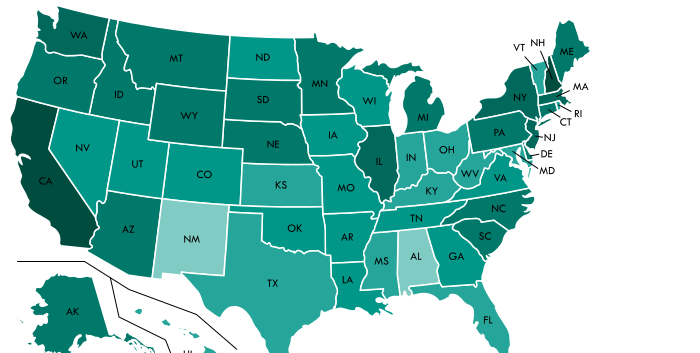
Most common states for senior software test analysts
| Rank | State | Population | # of jobs | Employment/ 1000ppl |
|---|---|---|---|---|
| 1 | District of Columbia | 693,972 | 471 | 68% |
| 2 | Virginia | 8,470,020 | 2,176 | 26% |
| 3 | Massachusetts | 6,859,819 | 1,766 | 26% |
| 4 | Washington | 7,405,743 | 1,766 | 24% |
| 5 | Maryland | 6,052,177 | 1,447 | 24% |
| 6 | South Dakota | 869,666 | 199 | 23% |
| 7 | Colorado | 5,607,154 | 1,237 | 22% |
| 8 | Utah | 3,101,833 | 697 | 22% |
| 9 | Vermont | 623,657 | 135 | 22% |
| 10 | Wisconsin | 5,795,483 | 1,169 | 20% |
| 11 | Rhode Island | 1,059,639 | 208 | 20% |
| 12 | Delaware | 961,939 | 191 | 20% |
| 13 | Missouri | 6,113,532 | 1,179 | 19% |
| 14 | New Mexico | 2,088,070 | 403 | 19% |
| 15 | New Hampshire | 1,342,795 | 249 | 19% |
| 16 | Minnesota | 5,576,606 | 979 | 18% |
| 17 | Oregon | 4,142,776 | 732 | 18% |
| 18 | California | 39,536,653 | 6,889 | 17% |
| 19 | Ohio | 11,658,609 | 1,931 | 17% |
| 20 | Nevada | 2,998,039 | 451 | 15% |
Most common cities for senior software test analysts
| Rank | City | # of jobs | Employment/ 1000ppl | Avg. salary |
|---|---|---|---|---|
| 1 | Irving | 2 | 1% | $82,775 |
| 2 | Atlanta | 1 | 0% | $85,288 |
| 3 | Colorado Springs | 1 | 0% | $87,671 |
Senior Software Test Analyst job outlook: Expert opinions
Our panel of senior software test analyst experts

Rose-Hulman Institute of Technology

University of Toledo
Metropolitan State University of Denver

Eastern Washington University

Landmark College
Will there be an enduring impact of the coronavirus pandemic on Senior Software Test Analysts?
J.P. Mellor: I'm sure the pandemic will have an enduring impact on all of us. Our students are certainly experiencing new challenges as they strive to learn during the pandemic. They are aquiring skills and competencies associated with working remotely and engaging while doing so. These are skills that students in past years did not attain.
What will help Senior Software Test Analysts increase their earning potential?
J.P. Mellor: Our graduates are particularly good at making positive progress even when the way forward is not clear, they don't know how to do what needs to be accomplished, and/or they've never done it before. This is a skill set requires a solid technical foundation and makes our graduates especially valuable.that is part
What are the biggest trends we'll see in the Senior Software Test Analyst job market given the pandemic?
Jared Onyango Oluoch Ph.D.: We are already seeing a lot of professionals working remotely. This trend will likely continue especially in domains such as software engineering. With this may also occur lack of social connections and team building that we have seen over the years with people working in offices or facilities.
How have salaries changed over time for Senior Software Test Analysts?
Jared Onyango Oluoch Ph.D.: I think salaries in academia especially in Computer Science and Engineering Technology are rising and are expected to given the demand of graduates in these areas.
Janos Fustos Ph.D.
ProfessorMetropolitan State University of Denver
Department of Computer Information Systems and Business Analytics
Will there be an enduring impact of the coronavirus pandemic on Senior Software Test Analysts?
Janos Fustos Ph.D.: I think the impact will not be that much on the graduates but on the environment where they start their professional career and how they have completed their studies.
This pandemic has changed many aspects of our lives - among others how we work (or stat to work) and how we learn. Being in higher education I can definitely see both. The home office became the standard working environment with all the advantages and several disadvantages. You do not have to go/travel to your corporate office, you may be available even at odd hours to work, some find the home environment more relaxing, there are less formalities, some might communicate easier in writing or from behind a turned-off camera, they could take advantage of personal schedule and individual peek times, more control over their schedules etc.
But even as you work at home you may experience more disruption, you are more available for personal/family affairs, you may not have that much opportunity to interact with colleagues and miss opportunities for meaningful discussions for extending your knowledge base, networking, you have to deal with technical issues on your own or less support etc.
Some similar issues can be mentioned when it comes to changes in the way we participate in education. Most of the class meetings are online with limited individual interaction and/or access to teachers, less direct interaction with classmates, technical challenges, home office setup challenges etc. All these together impact students/graduates differently: some take these as an advantage while some others are impacted more by the disadvantages. But whichever we look at that I think there is a definite impact of the pandemic on all of us and while we have already spent about 10-12 month in this "splendid isolation" and survived more or less so far, we do not know if it may have more enduring or serious impact on our lives - that needs to be seen from a much longer perspective.
What's a good job out of college for Senior Software Test Analysts?
Janos Fustos Ph.D.: I hope students are asking that question before they enroll in the first course at a college because otherwise, they would waste lot of time and money to work on a degree or a career path that does not fulfill their goals and personal interest. In that sense any job is a good job that somebody understands, feels that he/she is a good fit and can live up to the imposed challenges, and has the knowledge/skills to work in the field. There are interesting and self-fulfilling jobs to choose from. Certainly, it starts with the definition what a "good" means to an individual, what are the attributes of that definition: is that the professional area, is the salary, is it the challenging nature, is it more about the working environment and the people they can work with, is it the promotion options, the high impact etc. There are several lists available on the internet that provide recommendations and track the different aspects of job selection options for seekers.
Christian Hansen Ph.D.
Professor and Department ChairEastern Washington University
Department of Mathematics
What's a day at work look like for a Senior Software Test Analyst?
Christian Hansen Ph.D.: In the post-pandemic era, a typical workday for a recent graduate will likely involve some form of remote work. I predict that many businesses will benefit from the reduced cost of remote infrastructure compared to the cost of maintaining brick and mortar office space. Many new graduates will continue to spend their day on a computer while collaborating in teams via Zoom and other teleconference tools. People working in disciplines that have traditionally been "on the ground" will move towards more hybrid modes of work, reducing the need for travel and participating in face-to-face meetings and training.
John Russo
Associate Professor and Program Coordinator of Computer ScienceLandmark College
STEM Department
What's a day at work look like for a Senior Software Test Analyst?
John Russo: Many companies will continue to have employees work remotely. This means that one has to be a self-starter, able to focus and stay on task. Some jobs, such as a network administrator, might not look much different than pre-pandemic. Others, such as software engineer, will be different. Much of the collaboration will take place virtually. One piece that will be missing from the workday for recent graduates is socializing and building a team outside of the boundaries of work.
What technical skills for a Senior Software Test Analyst stand out to employers?
John Russo: As I mentioned above, the ability to adapt to change. My favorite course is database management systems. I tell my students that the software that we use today likely will not be around for the entire span of their careers. They really need to learn how to quickly work with new technologies, languages and systems. In the span of my career much has changed. I have always found new technologies exciting and refreshing. Employers want to hire graduates who have a set of technical skills in programming languages, database management systems and techniques (such as data mining) but also can learn on the job and be excited to learn new things.