Explore jobs
Find specific jobs
Explore careers
Explore professions
Best companies
Explore companies
Job outlook for senior systems/programmer analysts in the United States
Senior systems/programmer analyst job growth summary. After extensive research, interviews, and analysis, Zippia's data science team found that:
The projected senior systems/programmer analyst job growth rate is 9% from 2018-2028.
About 56,000 new jobs for senior systems/programmer analysts are projected over the next decade.
Senior systems/programmer analyst salaries have increased 8% for senior systems/programmer analysts in the last 5 years.
There are over 146,020 senior systems/programmer analysts currently employed in the United States.
There are 114,331 active senior systems/programmer analyst job openings in the US.
The average senior systems/programmer analyst salary is $103,413.
Are senior systems/programmer analyst jobs in demand?
Senior systems/programmer analyst job and salary trends over time
Senior systems/programmer analyst jobs over time
Senior systems/programmer analyst job growth rate over time
| Year | # of jobs | % of population |
|---|---|---|
| 2021 | 146,020 | 0.04% |
| 2020 | 176,789 | 0.05% |
| 2019 | 117,913 | 0.04% |
| 2018 | 184,413 | 0.06% |
| 2017 | 182,528 | 0.06% |
Average senior systems/programmer analyst salary over time
Senior systems/programmer analyst salary by year
| Year | Avg. salary | Hourly rate | % Change |
|---|---|---|---|
| 2026 | $103,413 | $49.72 | +3.4% |
| 2025 | $100,006 | $48.08 | +2.3% |
| 2024 | $97,742 | $46.99 | +0.5% |
| 2023 | $97,224 | $46.74 | +1.2% |
| 2022 | $96,068 | $46.19 | +1.7% |
Senior systems/programmer analyst jobs by state
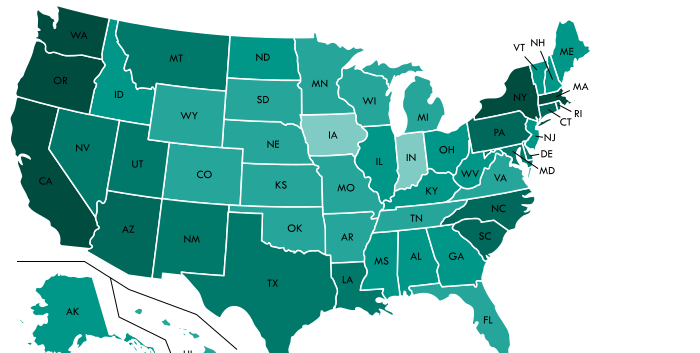
Most common states for senior systems/programmer analysts
| Rank | State | Population | # of jobs | Employment/ 1000ppl |
|---|---|---|---|---|
| 1 | District of Columbia | 693,972 | 377 | 54% |
| 2 | Alaska | 739,795 | 216 | 29% |
| 3 | Vermont | 623,657 | 151 | 24% |
| 4 | New Hampshire | 1,342,795 | 293 | 22% |
| 5 | Rhode Island | 1,059,639 | 237 | 22% |
| 6 | Delaware | 961,939 | 208 | 22% |
| 7 | North Dakota | 755,393 | 163 | 22% |
| 8 | Wyoming | 579,315 | 118 | 20% |
| 9 | Minnesota | 5,576,606 | 1,037 | 19% |
| 10 | Alabama | 4,874,747 | 916 | 19% |
| 11 | Oregon | 4,142,776 | 781 | 19% |
| 12 | South Dakota | 869,666 | 161 | 19% |
| 13 | Washington | 7,405,743 | 1,343 | 18% |
| 14 | Nebraska | 1,920,076 | 351 | 18% |
| 15 | Virginia | 8,470,020 | 1,428 | 17% |
| 16 | Arizona | 7,016,270 | 1,215 | 17% |
| 17 | New Mexico | 2,088,070 | 358 | 17% |
| 18 | Montana | 1,050,493 | 177 | 17% |
| 19 | Georgia | 10,429,379 | 1,619 | 16% |
| 20 | North Carolina | 10,273,419 | 1,577 | 15% |
Most common cities for senior systems/programmer analysts
| Rank | City | # of jobs | Employment/ 1000ppl | Avg. salary |
|---|---|---|---|---|
| 1 | Boston | 1 | 0% | $113,321 |
Senior Systems/Programmer Analyst job outlook: Expert opinions
Our panel of senior systems/programmer analyst experts
Belmont University
Mount St Mary's University

University of Guam

Indiana University Southeast
Brigham Young University - Idaho

Weber State University

Pace University
What general advice would you give to a Senior Systems/Programmer Analyst?
Dr. Tisha Brown-Gaines: Over the next five years, the expanding landscape of Big Data facilitated via Information Systems will continue to play a major role in the structure of how Smart Systems are created and maintained. As a result, having skills that will allow for effectively accessing, modifying, analyzing, storing and securing data is key. The integration of these skills are strengths that will support fields under the umbrella of computer science and data science that expand into machine learning, natural language processing and the Internet of Things (IoT) concepts.
What will help Senior Systems/Programmer Analysts increase their earning potential?
Dr. Tisha Brown-Gaines: Employers will seek candidates that have knowledge on topics such as database systems, networking, cybersecurity and artificial intelligence. Leveraging the skills acquired from your degree and extending those by acquiring external certifications in these fields will help distinguish you from other candidates. There are many online programs which offer certifications in AWS, Network+, Certified Information Systems Security Professional (CISSP) and SAP that are innovative and provide real-world case studies to prepare students to have successful careers.
What Senior Systems/Programmer Analyst skills would you recommend for someone trying to advance their career?
Sagar Raina D.Sc.: One of the recommendations would be to get an entry-level industry certification within the Information Systems field. For example, if you are interested in networking, you can go for CompTIA Network+, similarly, if you are interested in cybersecurity, you can go for CompTIA Security+. In addition to your college degree, industry certifications are well recognized by the organizations which can maximize your salary potential when starting a career in Information Systems.
What Senior Systems/Programmer Analyst skills would you recommend for someone trying to advance their career?
Kevin Jetton: The need for IT skilled employees has never faded despite the right-sizing of many organizations IT staffing components post-pandemic when there was a hiring surge to enhance systems and processes to accommodate more online-only services and offerings. The key is to have a diverse skill-set or base so as to see the bigger picture and able to not only communicate to business users and executives, but to solve problems for the enterprise and deliver them.
James Sellmann Ph.D.
Dean, Professor of Philosophy and Micronesian StudiesUniversity of Guam
College of Liberal Arts & Social Sciences
What Senior Systems/Programmer Analyst skills would you recommend for someone trying to advance their career?
James Sellmann Ph.D.: General advice is to keep in mind that you must leverage your skills, especially your soft skills of being able to work with people, to communicate effectively and to be able to solve problems. Be real. Don't try to pretend to be someone else to impress others. Be your authentic self. And show up on time.
What will help Senior Systems/Programmer Analysts increase their earning potential?
James Sellmann Ph.D.: Computer skills, especially being able to work effectively with artificial intelligence will be most important. Being able to work with actual intelligence, that is living people, will always be an important skill.
Chris Sexton
Visiting Lecturer of Computer ScienceIndiana University Southeast
Computer Science Department
What soft skills should all Senior Systems/Programmer Analysts possess?
Chris Sexton: Teamwork is the obvious soft skill that is vital. It encompasses more than just being willing to work together but also includes strong documentation skills, textual communication skills, and precision in language. For an example of precision, which of the following is a task that can be completed:
"The login system will require strong passwords."
or
"The login system will require passwords of no less than 16 characters including at least two numbers and two non-alpha numeric characters."
It is easy for an engineer to be lax and use informal language that subtly confuses development efforts, but the valuable candidate will have strong technical communication skills.
Michael McLaughlin
FacultyBrigham Young University - Idaho
Department of Computer Information Technology
What soft skills should all Senior Systems/Programmer Analysts possess?
Michael McLaughlin: The ability to work well with people.
What hard/technical skills are most important for Senior Systems/Programmer Analysts?
Michael McLaughlin: Solid understanding of the technology stack (from desktops to cloud), including at least one programming language at certification level and object-oriented design skills that include exclusivity, patterns, and data design both in relational and document databases.
Will there be an enduring impact of the coronavirus pandemic on Senior Systems/Programmer Analysts?
Dr. Kyle Feuz Ph.D.: Change is often a slow process. For years, we have been hearing about the potential benefits of having employees work remotely and many companies had even started moving in that direction prior to the pandemic. However, the pandemic forced rapid change in the workplace environment with remote work becoming a necessity if businesses wanted to stay open. As I talk with different employers I am hearing a consistent message: remote work is here to stay.
This should not be interpreted to mean that every company is suddenly committed to allowing their employees to work remotely on a full-time basis (although some are). Instead, many companies see this as an opportunity to allow increased flexibility with work schedules and remote work. I do not anticipate that these changes will be immediate. Remember, change is often a slow process. I cannot predict the ripple effect such changes will cause in the job market.
With that in mind, we can start to consider the broader effects such policies will have. This has the potential to open the job market up to a wider audience. Previously, a graduate would have to decide if they were willing to relocate before looking at an opening outside of their immediate geographic area. With full-time remote work, those geographic constraints no longer apply. Similarly, individuals with other commitments that may prevent them from working a traditional 9-5 job may find opportunities that would previously have been unavailable to them. This just barely scratches the surface of the enduring impacts the pandemic may cause but one thing is certain, the world will never be the same.
What certifications/licenses/courses can have the biggest impact for Senior Systems/Programmer Analysts?
Dr. Kyle Feuz Ph.D.: Any time you have a certification, license or degree it's going to give you a leg up compared to your peers with similar skill sets but no certification. Often the certification or degree will help your resume make it through an initial screening process but then it's up to you to demonstrate that you have the knowledge and skills the certification is supposed to represent. It's also important to know what career you want to pursue. Certifications are usually targeted to a very limited skill set. If that skill set is a critical part of the job description then the certification will be a strong mark in your favor. Some fields even require certification before you will be considered for the position. However, if the skill set is only tangentially related to the job description then there is little benefit in having the certification.
What soft skills should all Senior Systems/Programmer Analysts possess?
Dr. Kyle Feuz Ph.D.: The top three things I hear from employers when talking about soft-skills are communication, collaboration, and ethics. They need employees who know how to communicate professionally in both written communications and oral communications. They also need employees who can work with others. You may be working internally with colleagues or externally with customers, clients and business partners but there are very few positions where collaborating with others is not a large part of the job. Finally, employers are looking for trustworthy employees. Many technical positions involve working with sensitive data, and no amount of technical controls can compensate for unethical or untrustworthy employees. All three of these soft skills are only going to increase in importance with the rise in remote work. Remote work cannot function successfully without good communication, collaboration and ethical behavior.
Dr. Pauline Mosley
Full Professor and Associate Chair of Information TechnologyPace University
Seidenberg School of Computer Science and Information Systems
What are the biggest trends we'll see in the Senior Systems/Programmer Analyst job market given the pandemic?
Dr. Pauline Mosley: There are several big trends; however, in my opinion, the biggest trend we are seeing is an increase in the usage of mobile apps, cloud computing and smart technologies. The pandemic has cultivated a huge demand for these applications. The problematic effects of the pandemic such as the inability to conduct business and interact socially, has heighten the need for these technologies - hence transitioning them from emerging technologies to part of our everyday living.
What soft skills should all Senior Systems/Programmer Analysts possess?
Dr. Pauline Mosley: All graduates should possess strong communication skills, a willingness to take risks, think critically and innovatively. Lastly, they need to be flexible and willing to learn.