Explore jobs
Find specific jobs
Explore careers
Explore professions
Best companies
Explore companies
Job outlook for senior tax analysts in the United States
Senior tax analyst job growth summary. After extensive research, interviews, and analysis, Zippia's data science team found that:
The projected senior tax analyst job growth rate is 6% from 2018-2028.
About 81,800 new jobs for senior tax analysts are projected over the next decade.
Senior tax analyst salaries have increased 8% for senior tax analysts in the last 5 years.
There are over 49,745 senior tax analysts currently employed in the United States.
There are 56,996 active senior tax analyst job openings in the US.
The average senior tax analyst salary is $79,029.
Are senior tax analyst jobs in demand?
Senior tax analyst job and salary trends over time
Senior tax analyst jobs over time
Senior tax analyst job growth rate over time
| Year | # of jobs | % of population |
|---|---|---|
| 2021 | 49,745 | 0.01% |
| 2020 | 48,632 | 0.01% |
| 2019 | 48,932 | 0.01% |
| 2018 | 48,200 | 0.01% |
| 2017 | 47,879 | 0.01% |
Average senior tax analyst salary over time
Senior tax analyst salary by year
| Year | Avg. salary | Hourly rate | % Change |
|---|---|---|---|
| 2026 | $79,029 | $37.99 | +2.8% |
| 2025 | $76,869 | $36.96 | +1.5% |
| 2024 | $75,741 | $36.41 | +1.7% |
| 2023 | $74,506 | $35.82 | +1.8% |
| 2022 | $73,217 | $35.20 | +1.4% |
Senior tax analyst jobs by state
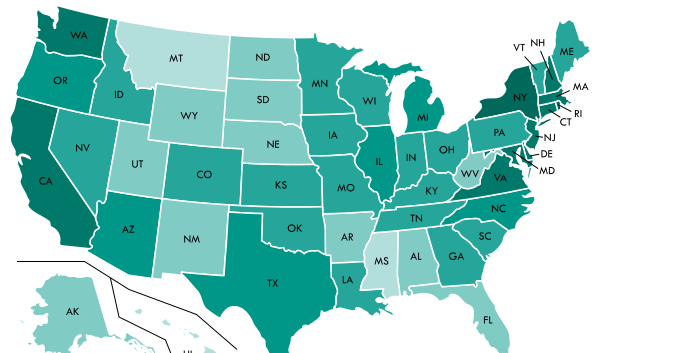
Most common states for senior tax analysts
| Rank | State | Population | # of jobs | Employment/ 1000ppl |
|---|---|---|---|---|
| 1 | District of Columbia | 693,972 | 450 | 65% |
| 2 | Massachusetts | 6,859,819 | 1,282 | 19% |
| 3 | Colorado | 5,607,154 | 945 | 17% |
| 4 | Minnesota | 5,576,606 | 932 | 17% |
| 5 | Virginia | 8,470,020 | 1,327 | 16% |
| 6 | Maryland | 6,052,177 | 977 | 16% |
| 7 | Delaware | 961,939 | 157 | 16% |
| 8 | Illinois | 12,802,023 | 1,961 | 15% |
| 9 | Connecticut | 3,588,184 | 535 | 15% |
| 10 | Rhode Island | 1,059,639 | 160 | 15% |
| 11 | Iowa | 3,145,711 | 450 | 14% |
| 12 | Washington | 7,405,743 | 975 | 13% |
| 13 | Missouri | 6,113,532 | 773 | 13% |
| 14 | New Hampshire | 1,342,795 | 177 | 13% |
| 15 | Montana | 1,050,493 | 139 | 13% |
| 16 | California | 39,536,653 | 4,767 | 12% |
| 17 | Georgia | 10,429,379 | 1,211 | 12% |
| 18 | Oregon | 4,142,776 | 503 | 12% |
| 19 | Nebraska | 1,920,076 | 221 | 12% |
| 20 | Vermont | 623,657 | 74 | 12% |
Most common cities for senior tax analysts
| Rank | City | # of jobs | Employment/ 1000ppl | Avg. salary |
|---|---|---|---|---|
| 1 | Englewood | 3 | 9% | $72,279 |
| 2 | Fountain Valley | 4 | 7% | $80,513 |
| 3 | Alpharetta | 3 | 5% | $73,155 |
| 4 | Tampa | 6 | 2% | $65,668 |
| 5 | Irvine | 5 | 2% | $80,444 |
| 6 | Irving | 4 | 2% | $73,378 |
| 7 | Hartford | 3 | 2% | $82,036 |
| 8 | Boston | 9 | 1% | $86,970 |
| 9 | Atlanta | 7 | 1% | $72,853 |
| 10 | Denver | 5 | 1% | $72,300 |
| 11 | Miami | 5 | 1% | $64,999 |
| 12 | Chicago | 12 | 0% | $74,798 |
| 13 | Los Angeles | 8 | 0% | $80,947 |
| 14 | Phoenix | 6 | 0% | $73,770 |
| 15 | Indianapolis | 4 | 0% | $68,093 |
| 16 | Dallas | 3 | 0% | $73,382 |
| 17 | New York | 3 | 0% | $91,780 |
| 18 | San Jose | 3 | 0% | $91,246 |
Senior Tax Analyst job outlook: Expert opinions
Our panel of senior tax analyst experts
Manhattan College
Gonzaga University
Ferrum College
University of Akron
The University of Texas at Arlington
University of Oregon
Stonehill College
American University
Lawrence Technological University
Pacific Lutheran University
University of Nevada - Las Vegas

Indiana University Northwest

University of California, Irvine
Keith Kerr Prof.
What Senior Tax Analyst skills would you recommend for someone trying to advance their career?
Keith Kerr Prof.: There are two basic ways that most people in the US find financial success: Either find a job that pays a high salary, or find a career that you love, regardless of the salary, and make a habit of saving and investing part of your income each month starting with your first paycheck.
If you invest only $90 a month starting at 21 and ending at retirement, you would have a bit over 1 million dollars (assuming a 10% annual gain). Wait just 5 years and start doing this at 26 and your 5 years of time will have cost you $400,000 by retirement. This is the power of compounding. Start early and even with a lower salary, you still can find financial success while pursuing careers that are meaningful to you.
What general advice would you give to a Senior Tax Analyst?
Dr. Natalia Boliari PhD: First, learn everything about the company you just started working for - its historical path, management, the way it's dealt with crises, etc. Second, learn everything about the specific industry the company belongs to and see how the company has developed relative to the development of the industry domestically and internationally. Third, always be extremely alert to notice new opportunities and be prepared to take calculated risks. That is, actively look for opportunities to complete as many and diverse tasks as possible, and volunteer to complete any type of work regardless of whether it seems relevant to your assigned job or not. Opportunities to learn, grow, and improve and thus to maximize your income, will only come up if you are exposed to diverse situations.
What Senior Tax Analyst skills would you recommend for someone trying to advance their career?
Dr. Natalia Boliari PhD: Be open minded. Finance is the broad definition of an industry which provides opportunities for careers in financial consultancy, financial analysis, stock brokerage, foreign investment, modeling, exchange rate forecasts, and many more. While most of those careers are attributed to the banking industry, you can find those and others in other sectors of the economy, such as insurance, technology, health care/medical, government, and so on. So, be open and look beyond the banking sector, examine the current and predicted trends in the economy to hunt for exciting career options.
What will help Senior Tax Analysts increase their earning potential?
Clemens Kownatzki PhD, MBA: As a beginner in any field, it pays to listen more than to talk. Be humble, pay attention, be nice to folks and probably most helpful is having a mentor who can guide you along and show you some best practices for navigating your career. You should take advantage of your education, not just to show a piece of paper that says you graduated but think of every single project, essay or paper that you write as part of a portfolio that demonstrates your skill sets. Especially in finance where we can sometimes be enamored with the beauty of a mathematical model, think about how any model should be applied in the real world. In some cases that might mean that you have to “get your hands on the wheel and learn how to drive.” I am not suggesting that you should put all your savings at risk and buy the next iteration of the latest cryptocurrency, but If you’re interested in a career in investing, put a small amount of money at risk and trade a stock, or if you must trade a few dollars’ worth of Bitcoin or Ether – as much as you would risk for a movie ticket seems reasonable. There are lots of virtual trading apps where you can trade with paper money, but there’s nothing like understanding risk when your own dollars are at stake, even if it’s just a few dollars. You should also absorb all the workshops, seminars and resources available out there. Follow Prof. Aswath Damodaran who has a YouTube Channel and hundreds of spreadsheets with financial models, all for free! Also follow some good content providers on various channels to get additional insights – in the field of finance, you need to be up-to-date on all events because those influence markets and the economy. Be ready to continue learning and update your skills and understanding while you’re working. Education doesn’t end after you finish your degree. All successful people are life-long learners.
What general advice would you give to a Senior Tax Analyst?
Andrew Brajcich: Tax technical skills will always be important. But now those are just table stakes. To be a value-adding advisor to your client or team, you need technological skills including some coding and database management skills. And it has to be more than Excel. I don’t care if it’s exposure to Python or SQL or Tableau or Alteryx or something else. You need to understand how technologies work because they will change but the fundamental concepts behind the tools remain.
What Senior Tax Analyst skills would you recommend for someone trying to advance their career?
Andrew Brajcich: Ask yourself, “What can I do to make the job of the person above me easier.” That should be your guiding light. If you approach every workday with that, you’ll soon find yourself on better clients, working with better teams, and moving up in the organization.
What Senior Tax Analyst skills would you recommend for someone trying to advance their career?
Timothy Egan M.S. Marketing: -Understanding finance and how it impacts the operations of where you work, can help you have great insight into new opportunities or see the writing on the wall in tough times. -Don't be afraid to learn new technologies, especially ones that collect data. Enhance your tech-based skills as that will increase your value to the organization where you work and the business community at large. -Learn Spanish. While globalization may have you think about learning an Asian language, the Spanish speaking market is the faster growing in the US and has been since 2010.
Dr. Karen Carpenter
Associate Professor of Health & Human PerformanceFerrum College
Health Services/Allied Health/Health Sciences
What will help Senior Tax Analysts increase their earning potential?
Dr. Karen Carpenter: This field is wide open. Decide the population you want to work with and what space you want to be in. Certifications are very valuable to get employed immediately virtually anywhere in the country. Our discipline has the power to save lives. It is an extremely rewarding profession.
What will help Senior Tax Analysts increase their earning potential?
Eric Brisker Ph.D.: Focusing on developing skills in communication, networking, social skills, analytical skills, financial knowledge, and obtaining professional certifications can help maximize salary potential in the finance industry. Developing these skills and following the advice provided can lead to opportunities for higher salaries.
What general advice would you give to a Senior Tax Analyst?
Kenton Klaus: As noted above, the best way to maximize salary potential is to quickly narrow down the areas of tax where the graduate student can separate themselves from other candidates. If the graduate student did his or her homework before finishing their graduate studies, they will be able to demonstrate to employers that they have a deeper knowledge of the technical areas in which they have an interest, along with the applicable technology.
What Senior Tax Analyst skills would you recommend for someone trying to advance their career?
Kenton Klaus: Taxation is a very broad discipline, so it's important for a new tax professional to understand all the opportunities available for them to use their graduate degree. In some cases, graduate students have already been in the workforce, and have specific plans to return to a certain area of practice. However, many students have not explored the available opportunities to see which line up best with their interests and skills. I encourage graduate students to explore the market before they graduate, reach out to alumni who work in different areas of the tax profession, and speak with the professors for the courses that most interested them.
What will help Senior Tax Analysts increase their earning potential?
Kenton Klaus: Taxation is a very broad discipline, so it's important for a new tax professional to understand all the opportunities available for them to use their graduate degree. In some cases, graduate students have already been in the workforce, and have specific plans to return to a certain area of practice. However, many students have not explored the available opportunities to see which line up best with their interests and skills. I encourage graduate students to explore the market before they graduate, reach out to alumni who work in different areas of the tax profession, and speak with the professors for the courses that most interested them.
What general advice would you give to a Senior Tax Analyst?
Dr. J. Klaus Ph.D., CPA (KY): Choosing a career in accounting today is particularly appealing due to the strong demand for skilled professionals in the field. Accounting stands out for its stability, offering a secure and reliable career path. The diversity within the profession, including areas like tax accounting and financial analysis, provides individuals with flexibility to align their work with their specific interests. With a global relevance, accountants are in high demand internationally. The current technological advancements have streamlined routine tasks, allowing professionals to focus on more strategic aspects of their roles. Pursuing well-regarded certifications, such as the CPA designation, ensures continuous learning and opens avenues for career advancement. Additionally, the flexibility for remote work and potential for entrepreneurial ventures make accounting a highly sought-after and promising choice in response to the prevalent demand for skilled professionals.
What Senior Tax Analyst skills would you recommend for someone trying to advance their career?
Dr. J. Klaus Ph.D., CPA (KY): Some individuals may find the work routine and meticulous, as attention to detail is paramount in accounting. Meeting deadlines, especially during tax season, can lead to periods of heightened stress. Additionally, the demanding nature of staying abreast of ever-changing tax laws and regulations can be seen as both a positive challenge for those who enjoy continuous learning and a potential source of stress for others. Overall, while accounting provides stability and numerous rewarding aspects, it also requires a commitment to precision and adaptability to navigate its challenges.
What will help Senior Tax Analysts increase their earning potential?
Dr. J. Klaus Ph.D., CPA (KY): Tax accountants hold a pivotal role in managing financial records, ensuring tax compliance, and offering strategic financial guidance. Their daily activities encompass preparing tax returns, conducting financial analyses, and staying abreast of dynamic tax regulations. Recent graduates embark on a fulfilling journey, starting with foundational tasks and progressing through training, collaboration with experienced professionals, and client engagement. This profession offers continuous learning opportunities, with many aspiring to attain certifications like the CPA designation. Ultimately, becoming a tax accountant is not only rewarding but also crucial in contributing to financial transparency, efficiency, and compliance for individuals and businesses alike.
Z. Jay Wang
Department Head, Associate Professor of FinanceUniversity of Oregon
Finance And Financial Management Services
What will help Senior Tax Analysts increase their earning potential?
Z. Jay Wang: Students who have a history of doing work in the field outside the classroom either through internships, industry projects, or school-sponsored clubs managing financial decisions are better poised to maximize starting salary potential. Starting early to secure internships with top companies will also position students well for higher earning potential. Most top banks and firms will post internships from April/May to August, and close by the end of September for the following summer. They are also rolling, so may fill the roles by as early as June of the sophomore year for the following summer after junior year. Finally, networking with industry and alumni professionals in the companies, firms, banks prior to applying for an internship or full-time position will have an impact. The candidate will learn more about the opportunity and company culture for their resume and potential interview, and most top companies in finance will have a referral program. If the candidate impresses the internal connection with excellent questions and strategic answers, they may get a referral that moves them up in the stacks of applicants.
What general advice would you give to a Senior Tax Analyst?
Dr. Wayne Durr: Maximizing your salary potential starts with understanding your value. What skills and
capabilities can you articulate to a prospective employer? The ability to articulate these skills
and what you bring to that company can be challenging. Think of your resume like an artist
thinks of their portfolio. What projects or analysis have you worked on? You cannot articulate
the value you will bring to that prospective company without the ability to articulate your skills
and capabilities. Do your research to determine what other employers pay people with the
same abilities. Ask employers what the salary range is and use that as your baseline. As you
get close to graduating, your classmates talk about the job offers they receive and most likely
share the salaries they are being offered. Listen and use this as a baseline. All this gives you
an idea of your value. Your first job isn't always the place where you'll be able to maximize your
earning potential. Think of your first job as where you will get the work experience to maximize
your future earning potential. Look at this as the place where you will sharpen your skills and
develop new ones. This first job will be where you fill out your resume and either have an
opportunity to maximize your earning potential there or elsewhere in the future.
Additionally, think about passive income and the "side gig". If you don't feel like you're
maximizing your earning potential at that first job, think about how you can make money on the
side. I believe we now live in a society where truly maximizing your earning potential comes
from more than your current employer. The ability to earn money from a side gig is more
prevalent than ever before. I think every student should take an entrepreneur class. Think
about your skills, which one could make you some side money. Don't dismiss jobs you did
growing up, like delivery service, landscaping, etc. There are so many apps and websites that
people and companies are looking for anything from an hour to a couple of days worth of work.
Take that first six months on the job to get settled in, and then start thinking about that side gig.
Octavian Ionici PhD
Sr. Lecturer in FinanceAmerican University
Finance And Financial Management Services
What Senior Tax Analyst skills would you recommend for someone trying to advance their career?
Octavian Ionici PhD: The finance profession is lucrative, rewarding and very competitive. Graduates should do their research about the organization they are interviewing with and be able to discuss how their skills can contribute to the business. They should also know if they would rather interact with people and clients or if they are drawn to intellectual pursuits such as analysis. Do they value power, prestige status, risk, or something else? Ultimately our core values, personal goals, interests, aptitudes, and personality will shape our career paths.
Being able to articulate what sparked their interest in the financial field and why they are interested in a chosen role will be an advantage during the hiring process. While still in college, students should join a professional association like the Financial Management Association to give them more access to that broad network, as well as access to career development resources that can set them apart from the crowd.
It's also critical to get an internship (paid or unpaid) in order to show some real-life experience. They can do this while they are still in college, during the summers, or even afterwards, to get a foot in the door.
Reading the WSJ and FT daily, and listening to Bloomberg, or other financial programs as a regular practice will help them to have fluency in the language of our profession. Because the finance sector is heavily regulated and changes occur due to changing economic and political conditions, they will need to stay updated with those changes. Financial media sources will help bring them that context to stay up to date on all of these moving parts.
What Senior Tax Analyst skills would you recommend for someone trying to advance their career?
Noah Alatza: Prior to graduation, gain as much relevant experience as possible through internships. Having multiple internships where you've proven yourself to be successful and hardworking is essential to getting the best offers for full-time roles. In the early years of your career, take note of the qualifications of your next promotion and proactively take steps to ensure that you achieve those qualifications. Finally, make sure to do your research on salary levels for similar positions and don't be afraid to ask for an increase when your work performance and data support that request.
What will help Senior Tax Analysts increase their earning potential?
Dr. Kimberly Gaither: Maximize your salary potential by asking questions and learning as quickly as possible. Be a good communicator with those above and below you as well as your peers. Be dependable. Persons who show up early and work hard will be valued and rewarded.
Matthew Cole Ph.D.
Interim Dean, College of Business and Information TechnologyLawrence Technological University
Architecture And Related Services
What Senior Tax Analyst skills would you recommend for someone trying to advance their career?
Matthew Cole Ph.D.: Maximizing Salary Potential: Specializing in high-demand areas like tax or forensic accounting, demonstrating strong technology skills, negotiating based on industry salary standards, and pursuing professional development and additional credentials will maximize salary potential.
What will help Senior Tax Analysts increase their earning potential?
Matthew Cole Ph.D.: Specializing in high-demand areas like tax or forensic accounting, demonstrating strong technology skills, negotiating based on industry salary standards, and pursuing professional development and additional credentials will maximize salary potential.
Fang Lin
Assistant Professor of FinancePacific Lutheran University
Finance And Financial Management Services
What Senior Tax Analyst skills would you recommend for someone trying to advance their career?
Fang Lin: Don't be afraid to negotiate your starting salary. Young journalists have a lot to offer newsrooms through social media skills and a willingness to adapt to new technologies such as artificial intelligence. Technology skills have value and should not be undersold. Also, young journalism students should not discount the value of their student media and internship experiences. Young journalists must use everything on their resumes to show how they bring value to their position and ask to be compensated fairly for the work they will contribute to the newsroom's success.
Dhruba Banjade
Assistant Professor in Finance & Department Chair of Business AnalysisWhat general advice would you give to a Senior Tax Analyst?
Dhruba Banjade: i. The industry technology is changing fast. Specific skills will be more critical in the finance field in the next 3-5 years. Some of these are:
ii. Data analysis/ data mining skills. Knowledge of Excel, R, Python, data visualization, Tableau, RapidMiner, machine learning, and financial modeling skills are essential in finance and business.
iii. Skills and knowledge of artificial intelligence and machine learning will give more opportunities and help career development.
iv. Network security and cybersecurity are essential to protect financial transactions and digital data.
v. Knowledge of financial regulations and risk management will be in high demand in the next 3-5 years.
vi. Soft skills such as politeness, ability to work in a diverse group, good communication, learning attitude, etc, are also necessary.
vii. Many industry and business companies today focus on sustainable development and environmental, social, and governance activities. Knowledge of sustainability and ESG measures is also helpful.
viii. Broad knowledge of global financial markets, international finance, global economy, etc., will be valuable in the next 3-5 years.
John Clark Ph.D., CFA, CFP
Chair, Dept. of FinanceUniversity of Nevada - Las Vegas
Geological And Earth Sciences/Geosciences
What general advice would you give to a Senior Tax Analyst?
John Clark Ph.D., CFA, CFP: Show you have experience. Doing an internship is a great way to increase your starting salary. I always advocate for doing applied research, this is research that you can show has implications for society - science for the sake of science is not good science! Obtaining an MS degree is also a good way to increase your salary, especially if your MS degree is relevant to your future job.
Jaclyn Barkow
Clinical Assistant Professor of AccountingIndiana University Northwest
Accounting Department
What soft skills should all Senior Tax Analysts possess?
Jaclyn Barkow: The most valuable soft skill is communication. Being able to communicate effectively with colleagues, superiors, and clients. Communication comes in the form of written and oral. Effective communication also entails knowing when to listen, when to respond, and asking questions. Young accountants will also not know everything upon entering the workplace; asking questions is important for the learning process.
What skills stand out on Senior Tax Analyst resumes?
Jaclyn Barkow: I do not do company hiring, but from my interactions with employers, major items that stand out on resumes are having an internship or completing volunteer work preparing tax returns. Successfully completing an internship shows the student what to expect during tax season and the challenges that come with it. Employers know that students understand the profession and know what they are applying for. Those who volunteer to prepare tax returns through local organizations (United Way, or AARP, for example) demonstrate the ability to pass IRS certification requirements, prepare tax returns, and in the process help the community.
What hard/technical skills are most important for Senior Tax Analysts?
Jaclyn Barkow: Understanding tax return preparation is important. This is where the internship or volunteer work stands out on resumes. Tax law changes every year, so remembering what is in a textbook becomes obsolete year after year. Research skills are important for keeping up with the ever-changing tax law.
The profession is also changing so that tax accountants must have a working understanding of information security and maintaining client information confidentially. Data security is extremely important in the profession, and identity theft is very common in tax return preparation. Having some technical information systems and information security understanding is valuable to maintaining sensitive information.
David Feldman Ph.D.
Professor of Urban Planning and Public Policy and Political Science, Director, Water UCI, Director, MPP ProgramUniversity of California, Irvine
Urban Planning and Public Policy
What skills stand out on Senior Tax Analyst resumes?
David Feldman Ph.D.: Succinct writing, critical thinking, strong quantitative analytical skills.