Explore jobs
Find specific jobs
Explore careers
Explore professions
Best companies
Explore companies
Job outlook for severe disabilities special education teachers in the United States
Are severe disabilities special education teacher jobs in demand?
Severe disabilities special education teacher job and salary trends over time
Severe disabilities special education teacher jobs over time
Severe disabilities special education teacher job growth rate over time
| Year | # of jobs | % of population |
|---|---|---|
| 2021 | 183 | 0.00% |
| 2020 | 181 | 0.00% |
| 2019 | 187 | 0.00% |
| 2018 | 2,031 | 0.00% |
| 2017 | 1,939 | 0.00% |
Average severe disabilities special education teacher salary over time
Severe disabilities special education teacher salary by year
| Year | Avg. salary | Hourly rate | % Change |
|---|---|---|---|
| 2026 | $94,545 | $45.45 | +2.3% |
| 2025 | $92,380 | $44.41 | +2.2% |
| 2024 | $90,375 | $43.45 | +0.7% |
| 2023 | $89,749 | $43.15 | +0.8% |
| 2022 | $89,033 | $42.80 | +2.1% |
Severe disabilities special education teacher jobs by state
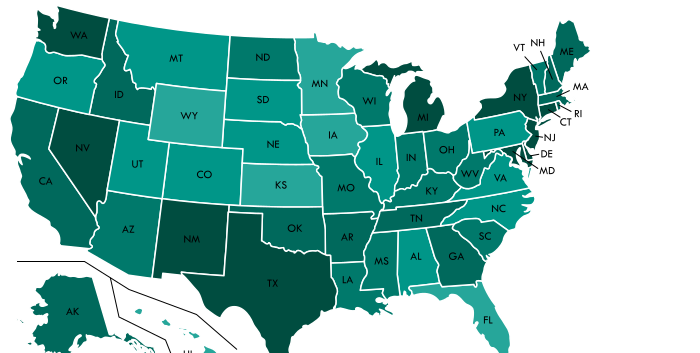
Most common states for severe disabilities special education teachers
| Rank | State | Population | # of jobs | Employment/ 1000ppl |
|---|---|---|---|---|
| 1 | District of Columbia | 693,972 | 200 | 29% |
| 2 | Nebraska | 1,920,076 | 366 | 19% |
| 3 | New Hampshire | 1,342,795 | 234 | 17% |
| 4 | Delaware | 961,939 | 167 | 17% |
| 5 | Montana | 1,050,493 | 159 | 15% |
| 6 | Illinois | 12,802,023 | 1,853 | 14% |
| 7 | Missouri | 6,113,532 | 862 | 14% |
| 8 | Maryland | 6,052,177 | 857 | 14% |
| 9 | Minnesota | 5,576,606 | 805 | 14% |
| 10 | Colorado | 5,607,154 | 766 | 14% |
| 11 | Kentucky | 4,454,189 | 619 | 14% |
| 12 | New Mexico | 2,088,070 | 288 | 14% |
| 13 | Vermont | 623,657 | 85 | 14% |
| 14 | Wyoming | 579,315 | 84 | 14% |
| 15 | Pennsylvania | 12,805,537 | 1,670 | 13% |
| 16 | New Jersey | 9,005,644 | 1,177 | 13% |
| 17 | Ohio | 11,658,609 | 1,393 | 12% |
| 18 | Massachusetts | 6,859,819 | 849 | 12% |
| 19 | Michigan | 9,962,311 | 1,048 | 11% |
| 20 | Oklahoma | 3,930,864 | 451 | 11% |
Severe Disabilities Special Education Teacher job outlook: Expert opinions
Our panel of severe disabilities special education teacher experts
University of Hawaii at Manoa
University of Utah
What Severe Disabilities Special Education Teacher skills would you recommend for someone trying to advance their career?
Dr. Natasha Griffin: Special Education is a good profession to enter now because there is a great need for it regardless of where you live. There is a global need for teachers who work with students with disabilities. Due to more assessment options, trained Special Educators can implement research-based strategies effectively, which leads to higher gains in closing achievement gaps. School districts near and far have started to offer attractive incentives to recruit Special Educators. Special Education is a field that is needed from birth to adulthood to aide in developing productive citizens.
What Severe Disabilities Special Education Teacher skills would you recommend for someone trying to advance their career?
Dr. Kimberly Coy: In the next 3-5 years, the skills that will be most important are the ability to be reflective of your practice. Teaching is an ever-evolving skill set for each person. Make sure you can look at your teaching and learn from it by being reflective and keeping your sense of wonder. Another skill will be the ability to understand that you are going to prepare students for jobs and challenges that have not been invented yet. Teach them the important skills of cultivating curiosity and adapting to change.
What general advice would you give to a Severe Disabilities Special Education Teacher?
Dr. Marija Čolić: People love being SPED teachers because of the profound impact they can have on students' lives. Watching students make progress, achieve their goals, and seeing the joy this brings to their families is incredibly rewarding. The profession offers a sense of purpose and the opportunity to make a meaningful difference every day.
What will help Severe Disabilities Special Education Teachers increase their earning potential?
Breda O’Keeffe Ph.D.: Before even starting your career in special education, look for programs and scholarships that provide financial support for your education and teaching license/credential. Because special education teachers are in high demand, many states, districts, and institutes of higher education provide financial incentives and supports for preservice teachers. Another option is to look for programs that provide loan forgiveness for working in high need areas (e.g., special education), schools (e.g., Title I schools), or districts. Graduating with low or no debt can help maximize your take-home pay as a teacher. Also, be aware that each state has its own teacher licensing/credentialing systems and that licenses/credentials do not always transfer directly when going from one state to another. If you know what state you will be teaching in, make sure your license/credential will be easily recognized in that state (or you may face additional educational requirements and costs). In addition, be aware that teacher salaries vary widely across states, across cities within states, and across different settings (e.g., private, public, preschool, K-12, etc.). In seeking preparation to become a special education teacher, you have many options that will ultimately affect your salary potential. Alternative routes to licensure which do not include the typical supports of a traditional teacher education program may be tempting, because they tend to be shorter and less expensive. Unfortunately, special education teachers prepared through these routes leave the field sooner and at higher rates than teachers provided with higher quality training at an institute of higher education (e.g., colleges and universities). Look for accredited programs that provide hands-on instruction and multiple supervised field experiences in the settings you will be teaching in, with high quality supervision and feedback (e.g., from a faculty member with teaching experience in your area), support for preparing for licensing/credentialing requirements, and instruction in evidence-based practices in academics, classroom management, intensive behavior supports, assessment, and special education law and policy. You will be more competitive when you start and more likely to persist, which will make the costs of your education worthwhile! When you are seeking a job, district salary schedules are posted on their respective websites. If salary is of utmost interest to you, start looking for high paying districts. Typically, charter and private schools do not have posted salary schedules, but if you are applying to those institutions, you should feel comfortable asking them to match the neighboring district pay. Some districts also offer additional compensation through incentive programs, “buying out” preparation periods, or other school-related duties. Don’t jump into committees and “extra duties” right away. Look for incentive programs specifically for high needs areas, such as special education. For example, in Utah, special education teachers can access the Teacher Salary Supplement Program (TSSP). This fund serves to reward and retain qualified educators in positions that have been identified as having staffing shortages. The state has also provided additional paid workdays outside of contract days to special education teachers to help prepare files and paperwork at the start or end of the school year. In addition, you can increase your pay by seeking further education such as a master’s degree or endorsements.