Explore jobs
Find specific jobs
Explore careers
Explore professions
Best companies
Explore companies
Job outlook for site workers in the United States
Site worker job growth summary. After extensive research, interviews, and analysis, Zippia's data science team found that:
The projected site worker job growth rate is 4% from 2018-2028.
About 69,500 new jobs for site workers are projected over the next decade.
Site worker salaries have increased 13% for site workers in the last 5 years.
There are over 3,779 site workers currently employed in the United States.
There are 34,602 active site worker job openings in the US.
The average site worker salary is $25,886.
Are site worker jobs in demand?
Site worker job and salary trends over time
Site worker jobs over time
Site worker job growth rate over time
| Year | # of jobs | % of population |
|---|---|---|
| 2021 | 3,779 | 0.00% |
| 2020 | 3,789 | 0.00% |
| 2019 | 3,981 | 0.00% |
| 2018 | 3,907 | 0.00% |
| 2017 | 3,753 | 0.00% |
Average site worker salary over time
Site worker salary by year
| Year | Avg. salary | Hourly rate | % Change |
|---|---|---|---|
| 2026 | $25,886 | $12.45 | +2.8% |
| 2025 | $25,183 | $12.11 | +3.0% |
| 2024 | $24,458 | $11.76 | +3.7% |
| 2023 | $23,591 | $11.34 | +3.3% |
| 2022 | $22,839 | $10.98 | +4.8% |
Site worker jobs by state
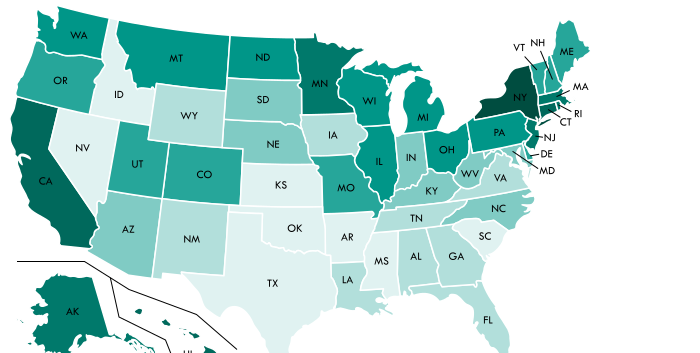
Most common states for site workers
| Rank | State | Population | # of jobs | Employment/ 1000ppl |
|---|---|---|---|---|
| 1 | Vermont | 623,657 | 133 | 21% |
| 2 | District of Columbia | 693,972 | 136 | 20% |
| 3 | South Dakota | 869,666 | 141 | 16% |
| 4 | Utah | 3,101,833 | 455 | 15% |
| 5 | Nebraska | 1,920,076 | 294 | 15% |
| 6 | Washington | 7,405,743 | 1,017 | 14% |
| 7 | Georgia | 10,429,379 | 1,326 | 13% |
| 8 | Virginia | 8,470,020 | 1,078 | 13% |
| 9 | Colorado | 5,607,154 | 737 | 13% |
| 10 | Oregon | 4,142,776 | 534 | 13% |
| 11 | West Virginia | 1,815,857 | 227 | 13% |
| 12 | Delaware | 961,939 | 122 | 13% |
| 13 | Wyoming | 579,315 | 71 | 12% |
| 14 | Florida | 20,984,400 | 2,335 | 11% |
| 15 | Tennessee | 6,715,984 | 755 | 11% |
| 16 | Missouri | 6,113,532 | 697 | 11% |
| 17 | Alabama | 4,874,747 | 539 | 11% |
| 18 | Connecticut | 3,588,184 | 410 | 11% |
| 19 | New Mexico | 2,088,070 | 228 | 11% |
| 20 | Idaho | 1,716,943 | 187 | 11% |
Most common cities for site workers
| Rank | City | # of jobs | Employment/ 1000ppl | Avg. salary |
|---|---|---|---|---|
| 1 | Bridgewater | 1 | 4% | $33,925 |
| 2 | Dover | 1 | 3% | $27,577 |
| 3 | Highlands Ranch | 1 | 1% | $28,598 |
| 4 | Durham | 1 | 0% | $25,440 |
| 5 | Fort Wayne | 1 | 0% | $26,295 |
| 6 | Pittsburgh | 1 | 0% | $30,850 |
| 7 | Raleigh | 1 | 0% | $25,404 |
Site Worker job outlook: Expert opinions
Our panel of site worker experts

Shasta College
What type of skills will young Site Workers need?
Becky Roe: The forest sector workforce will require the integration of many skills - both technical and less tangible. The most important skill graduates can bring is the knowledge of how to work in the woods SAFELY. Whether in the cab of a piece of logging equipment, conducting fire patrol on the ground, or driving a log truck into or out of a landing, SAFETY is the top priority. Because of the industrial nature of heavy equipment operation, there is no room for, nor tolerance of, the violation of employer drug and alcohol policies. Those pursuing a career in the woods need to have a foundational understanding of the types of mechanized logging equipment used in today's modern industry, and a coachable mindset ready to be mentored and refined by experienced operators.
Technology is integrated at many levels. Equipment cabs are air-conditioned and heated; joystick controls are intuitive, and modern displays provide operators with multiple data sets to assist in making the most efficient and safe decisions when needed. The less tangible skills all job seekers can bring to the table include a strong work ethic supported by a true passion for what he/she is doing. Logging and forest worker careers are not typical 9-5 jobs. The work can be seasonal, and the days are always long. Logging and forest professionals come from diverse backgrounds and are committed to their work, sharing a deep appreciation for the responsibility of stewardship, which they are given. They understand what they are doing in the forest has an impact on the landscape and they value and respect the renewable resources with which they are trusted.