Explore jobs
Find specific jobs
Explore careers
Explore professions
Best companies
Explore companies
Job outlook for social research assistants in the United States
Social research assistant job growth summary. After extensive research, interviews, and analysis, Zippia's data science team found that:
The projected social research assistant job growth rate is 19% from 2018-2028.
About 150,300 new jobs for social research assistants are projected over the next decade.
Social research assistant salaries have increased 14% for social research assistants in the last 5 years.
There are over 22,220 social research assistants currently employed in the United States.
There are 74,385 active social research assistant job openings in the US.
The average social research assistant salary is $52,089.
Are social research assistant jobs in demand?
Social research assistant job and salary trends over time
Social research assistant jobs over time
Social research assistant job growth rate over time
| Year | # of jobs | % of population |
|---|---|---|
| 2021 | 22,220 | 0.01% |
| 2020 | 27,363 | 0.01% |
| 2019 | 27,557 | 0.01% |
| 2018 | 26,759 | 0.01% |
| 2017 | 24,397 | 0.01% |
Average social research assistant salary over time
Social research assistant salary by year
| Year | Avg. salary | Hourly rate | % Change |
|---|---|---|---|
| 2025 | $52,089 | $25.04 | +3.6% |
| 2024 | $50,290 | $24.18 | +1.9% |
| 2023 | $49,369 | $23.73 | +1.4% |
| 2022 | $48,691 | $23.41 | +6.5% |
| 2021 | $45,717 | $21.98 | +1.7% |
Social research assistant jobs by state
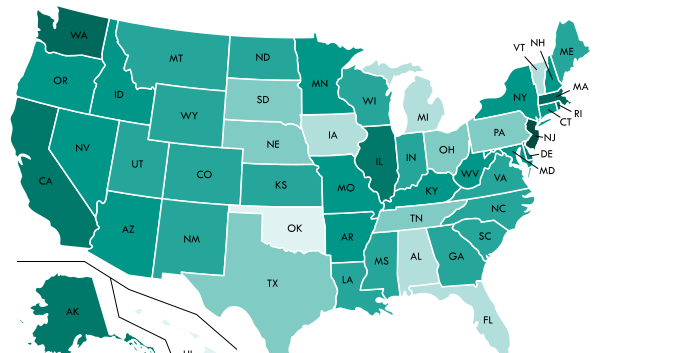
Most common states for social research assistants
| Rank | State | Population | # of jobs | Employment/ 1000ppl |
|---|---|---|---|---|
| 1 | District of Columbia | 693,972 | 215 | 31% |
| 2 | Massachusetts | 6,859,819 | 1,706 | 25% |
| 3 | Vermont | 623,657 | 149 | 24% |
| 4 | New Hampshire | 1,342,795 | 281 | 21% |
| 5 | Rhode Island | 1,059,639 | 221 | 21% |
| 6 | Oregon | 4,142,776 | 786 | 19% |
| 7 | Maine | 1,335,907 | 251 | 19% |
| 8 | Delaware | 961,939 | 181 | 19% |
| 9 | South Dakota | 869,666 | 167 | 19% |
| 10 | Wyoming | 579,315 | 96 | 17% |
| 11 | Minnesota | 5,576,606 | 900 | 16% |
| 12 | Colorado | 5,607,154 | 899 | 16% |
| 13 | Nebraska | 1,920,076 | 301 | 16% |
| 14 | Montana | 1,050,493 | 172 | 16% |
| 15 | North Dakota | 755,393 | 118 | 16% |
| 16 | Utah | 3,101,833 | 472 | 15% |
| 17 | New Mexico | 2,088,070 | 309 | 15% |
| 18 | California | 39,536,653 | 5,605 | 14% |
| 19 | New Jersey | 9,005,644 | 1,219 | 14% |
| 20 | Idaho | 1,716,943 | 233 | 14% |
Social Research Assistant job outlook: Expert opinions
Our panel of social research assistant experts
Ohio State University
University of Texas at Austin
Fairfield University
James Madison University
University of Wisconsin - Green Bay
Southern Illinois University Edwardsville
University of St Andrews

Seattle University
Adelphi University

Adelphi University

New Mexico State University

California State Polytechnic University, Pomona
Elizabethtown College

Creighton University
Grove City College

Rutgers, The State University of New Jersey-Newark
East Tennessee State University

Utah State University

University of Wisconsin – La Crosse
Dr. Judson Jeffries
ProfessorOhio State University
Ethnic, Cultural Minority, Gender, And Group Studies
What will help Social Research Assistants increase their earning potential?
Dr. Judson Jeffries: Grant writing ability. Scholars will become increasingly reliant on securing grants as universities and colleges continue to tighten their belts. This is especially true for state schools where some state legislatures are not as generous with funding as they once were. The state supported The Ohio State University is one such example. There are many more.
What general advice would you give to a Social Research Assistant?
Autumn Mathias Ph.D., LCSW: Similar to my answer for the first question, I think that this begins during college as students
build their overall portfolio of knowledge and skills. In addition to strategically selecting
courses, students might think about different volunteer activities (both on and off campus) and
experiential learning opportunities that could help them to further develop skills and build
professional connections. For instance, students can ask professors if there are opportunities for
them to work as a research assistant, or develop their own independent research project. In
addition, students can complete internships with public or private organizations within
community, or even through study abroad programs. In some cases, internships can provide a
bridge to employment post-graduation in that organization.
After students graduate and secure employment, they might consider different ways to engage in
professional development and continuing education. This can occur both within and outside
employer-sponsored activities. For instance, graduates might consider online courses on software
such as Excel, ArcGIS, Python, Tableau, or R. In addition, graduates may think of creative ways
to take leadership on projects in their respective organizations, and/or make a significant
contribution to their organization that will showcase their professional strengths. Finally,
graduates may consider pursuing graduate degrees according to their professional goals, such as
a Master of Social Work (MSW), Master of Public Health (MPH), Juris Doctor (JD), Master's in
Education (M.Ed.), or a Master of Public Administration (MPA).
What Social Research Assistant skills would you recommend for someone trying to advance their career?
Autumn Mathias Ph.D., LCSW: My general advice for undergraduate students majoring in sociology would be to begin thinking
(as early as possible) about how studying sociology might prepare you for different careers.
Explore resources online, including the websites of professional organizations such as the
American Sociological Association and the Society for the Study of Social Problems, and
occupational outlook data provided by the Bureau of Labor Statistics. In addition, I would advise
students to speak with their academic advisors, professors, and their college/university career
services personnel about their specific interests, strengths, and opportunities to further develop
various transferable skills throughout (and beyond) their college career. For some students, this
may mean taking certain electives (such as those geared towards maximizing research skills),
and/or adding a minor or a second major. This can also include internships and other experiential
learning opportunities. In addition, students should think about which subfields of sociology
interest them most, and how they see themselves applying their knowledge in a specific field.
Some subfields include urban sociology, medical sociology, political sociology, global and
transnational sociology, law and crime, social inequality, collective behavior, economic
sociology, environmental sociology, and the sociology of education. Sociology students develop
knowledge and skills that are valuable to several fields, including education, legal assistance,
business, public relations, human services/social work, government, public health, urban
planning, criminal justice, market and/or user experience research, and administration. Sociology
students learn to apply a historically and theoretically grounded lens to understanding human
behavior, social institutions, and the interactions between various actors in society across
national and cultural contexts. In addition, they develop both qualitative and quantitative
research skills and are uniquely positioned to apply these skills in a variety of roles to find
solutions to social problems. Accordingly, they are encouraged to develop both cultural humility
and cultural competence, which is critical for promoting diversity, equity, and inclusion in any
professional setting. As a result, sociology graduates may pursue jobs including (but not limited
to) the following: research assistant at a non-profit organization, probation officer, community
health worker, residential counselor, case manager, legislative aide, policy analyst, and user
experience researcher for a corporation.
In terms of job searching, I would recommend consulting with professors, advisors, and your
college/university's career services office on the best strategies for highlighting your transferable
skills and tailoring your resume and cover letter to specific job postings. Many organizations
utilize AI to review and narrow down job application materials before they are even reviewed by
human eyes. Also, I would encourage graduates to keep an open mind as they search job postings
as their knowledge and skills can be applied in a variety of settings. Additionally, students may
think about whether or not their long-term career goals require a graduate degree. Some
employers offer tuition reimbursement for graduate education.
What will help Social Research Assistants increase their earning potential?
Autumn Mathias Ph.D., LCSW: I think it is important for graduates to look at projections on the Bureau of Labor Statistics
website and to conduct general research on the state of certain industries at the time of
graduation. For instance, the tech industry is currently very saturated; some people who started
positions as user experience researchers just a few years ago were laid off. Individuals who have
years of experience in these positions will then have an advantage in securing new positions.
That being said, I believe that quantitative research skills in particular are advantageous for many
positions. This includes attaining coding skills and learning coding languages such as Python, R,
and Java.
In addition to the tech industry, the higher education market for individuals with a Master's
degree or PhD in sociology for tenure-track, full-time assistant professor positions in sociology
proves to remain highly competitive, as there are far more graduates than full-time positions.
That being said, some Master's programs emphasize an applied focus that prepares students for a
variety of research and evaluation positions.
In relation to research skills focused on data collection and analysis, sociology majors develop
writing and presentation skills that are crucial to success in any field. Also, the major's emphasis
on a critical global perspective along with cultural humility, cultural competence, empathy, and
overall interpersonal skills are sought-after skills in many fields. For instance, the U.S. is
experiencing a serious shortage of mental health professionals. Although some mental health
positions require a bachelor's or Master's degree in social work, others are also open to
individuals with a bachelor's degree in sociology or psychology.
Mary Neuburger
Director, Center for Russian, East European and Eurasian StudiesUniversity of Texas at Austin
Slavic, Baltic And Albanian Languages, Literatures, And Linguistics
What general advice would you give to a Social Research Assistant?
Mary Neuburger: Network as much as possible, online (LinkedIn or social media) and at events related to Russian studies or policy. These tend to be open to the public at most large er universities and some smaller. Attend, ask good questions, and introduce yourself to people. Make sure you highlight all of the skills you have gained on your CV-include projects in courses, extracurricular activities, study abroad etc.
What Social Research Assistant skills would you recommend for someone trying to advance their career?
Mary Neuburger: Language skills are always important, as well as research skills, and experience working on team projects. I also think deep interdisciplinary knowledge of Russia and its sphere of influence will continue to be important, as well as teachnical skills and knowledge of the information environment-and especially disinformation. UT Austin has a new Global Disinformation Lab, in which study of Russian disinformation (among other things) is carried out.
What will help Social Research Assistants increase their earning potential?
Mary Neuburger: Increase your experience and education in the field. Think about a Russian Studies master's program, for which you can get funding and gain more education and professional experience. UT Austin is looking for good applicants! Also think about doing workshops in various technical skills or platforms to bolster your resume. Think about initiating a club, small organization or project, and taking a leadership role. Highlight these efforts on your cv.
Alessandra Bryant PhD, LMFT
Assistant Professor, Marriage and Family Therapy Fairfield UniversityFairfield University
Human Development, Family Studies, And Related Services
What general advice would you give to a Social Research Assistant?
Alessandra Bryant PhD, LMFT: -Human development is an interdisciplinary major with multiple avenues to pursue post-bachelor's degree. You really need to pursue a master's degree post bachelor's to ensure job security post-grad. Have an idea in mind of what you'd like to pursue-whether it be education or mental health.
What Social Research Assistant skills would you recommend for someone trying to advance their career?
Alessandra Bryant PhD, LMFT: -Research proficiency-get involved in undergrad if you can. As the field progresses, we need innovative thinkers to keep advancing our knowledge.
What will help Social Research Assistants increase their earning potential?
Alessandra Bryant PhD, LMFT: -Pursue a master's degree in a more specific human development related field. Do your research-look for reputable programs in areas with earning potential post-grad.
Dr. Lindsey Harvell-Bowman
Associate ProfessorJames Madison University
School of Communication Studies
What skills will help Social Research Assistants earn the most?
Dr. Lindsey Harvell-Bowman: Having a strong background in statistical analysis will make you invaluable to any analytics department in the corporate world.
Mario Jimenez Chacon
Assistant ProfessorUniversity of Wisconsin - Green Bay
Humanities Department
What soft skills should all Social Research Assistants possess?
Mario Jimenez Chacon: Interpersonal skills, work ethic, the ability to work in teams, flexibility, and communication skills are all fundamental soft skills. Researchers are also humans and work with humans, so it's essential to have these soft skills to create a welcoming research community.
What skills will help Social Research Assistants earn the most?
Mario Jimenez Chacon: The skills that will make you earn the most depend very much on their field of research. However, doing the best research possible all the time, having great interpersonal skills, and understanding that one must never stop learning will make you an outstanding candidate in any field.
Dr. Sharon Locke Ph.D.
Director, Center for STEM Research, Education, and Outreach, Professor, Department of Environmental Sciences, ISSP Sustainability Excellence AssociateSouthern Illinois University Edwardsville
Department of Environmental Sciences
What soft skills should all Social Research Assistants possess?
Dr. Sharon Locke Ph.D.: -Strong written and oral communication are most important. If you cannot write well, you cannot be a successful scientist. Period.
-Evidence of skills in working as part of a team of diverse people and ability to understand the culture and language across scientific/technical disciplines--for example, an environmental chemist who understands something about policy or an environmental health specialist that would be able to collect and interpret data collected from community members.
-Willingness to be a lifelong learner.
-Something that helps an applicant stand out, such as experience with project management software or a foreign language.
Dr. Jeffrey Hughes
Deputy DirectorUniversity of St Andrews
Graduate School for Interdisciplinary Studies
What soft skills should all Social Research Assistants possess?
Dr. Jeffrey Hughes: The ability to communicate to academics and practitioners from out-with immediate disciplinary boundaries. The ability to listen to differing perspectives and work to understand differing perspectives through bridging knowledge gaps.
Harriet Phinney Ph.D.
Associate ProfessorSeattle University
Department of Anthropology and Sociology
What skills stand out on Social Research Assistant resumes?
Harriet Phinney Ph.D.: Understanding human diversity, Difference is viewed not as an obstacle but as an opportunity for generating new ideas, etc.
What soft skills should all Social Research Assistants possess?
Harriet Phinney Ph.D.: Understanding human diversity, effective communication (speaking and writing: the ability to convey complex ideas respectfully to a diverse audience) across differences, adept at working in groups, yet also independent thinkers.
What hard/technical skills are most important for Social Research Assistants?
Harriet Phinney Ph.D.: Empirical data collection: Research skills for collecting original data, analyzing the data, writing up the information collected, and presenting it in a professional manner.
What skills will help Social Research Assistants earn the most?
Harriet Phinney Ph.D.: Anthropologists are analysts and researchers with sharp thinking skills who have the ability to collect, manage, evaluate, and interpret large volumes of data on human behavior.
Lea Theodore Ph.D.
Director, School PsychologyAdelphi University
School Psychology and Institute for Parenting and Postgraduate Certificates in Infant, Child, & Adolescent Psychotherapy
What skills stand out on Social Research Assistant resumes?
Lea Theodore Ph.D.: Skills and experiences that show responsibility, organization, and specific aptitude for the project at hand. A successful resume emphasizes the ways the candidate's learning and experience meet the stated job requirements.
What soft skills should all Social Research Assistants possess?
Lea Theodore Ph.D.: The ability to have respectful communication with people in all roles: directors, supervisors, research participants, peers, and project staff. A 360-degree evaluation would show that everyone agrees that the candidate can be a good fit.
What hard/technical skills are most important for Social Research Assistants?
Lea Theodore Ph.D.: Statistical knowledge, assessment skills, knowledge of statistical software (SPSS)
What skills will help Social Research Assistants earn the most?
Lea Theodore Ph.D.: Entrepreneurship, creativity, initiative, integrity, perseverance, effective listening skills, good interpersonal skills, adaptability, and flexibility.
Joaniko Kohchi MPhil, LCSW, IECMH-E®
Director of the Institute for ParentingAdelphi University
School Psychology and Institute for Parenting and Postgraduate Certificates in Infant, Child, & Adolescent Psychotherapy
What skills stand out on Social Research Assistant resumes?
Joaniko Kohchi MPhil, LCSW, IECMH-E®: Skills and experiences that show responsibility, organization, and specific aptitude for the project at hand. A successful resume emphasizes the ways the candidate's learning and experience meet the stated job requirements.
What soft skills should all Social Research Assistants possess?
Joaniko Kohchi MPhil, LCSW, IECMH-E®: The ability to have respectful communication with people in all roles: directors, supervisors, research participants, peers, and project staff. A 360-degree evaluation would show that everyone agrees that the candidate can be a good fit.
What hard/technical skills are most important for Social Research Assistants?
Joaniko Kohchi MPhil, LCSW, IECMH-E®: Statistical knowledge, assessment skills, knowledge of statistical software (SPSS)
What skills will help Social Research Assistants earn the most?
Joaniko Kohchi MPhil, LCSW, IECMH-E®: Entrepreneurship, creativity, initiative, integrity, perseverance, effective listening skills, good interpersonal skills, adaptability, and flexibility.
Dr. David LoConto Ph.D.
Professor of Sociology, Interim Department HeadNew Mexico State University
Department of Sociology
What soft skills should all Social Research Assistants possess?
Dr. David LoConto Ph.D.: These days in the job market, the abilities, as mentioned previously, to understand human behavior, contextualize events, and frame what is occurring. The problems that STEM students have now are designing products for humans but do not have that training. Our students are trained to understand humans at the state, institutional, organizational, group, and individual levels in sociology. This allows our students to find jobs if they desire to gain employment in STEM fields and data analytics in general.
What hard/technical skills are most important for Social Research Assistants?
Dr. David LoConto Ph.D.: Increasingly, we see that the hard skills, due to technology changing so fast, become antiquated quickly. Employees must be retrained yearly or every other year. Therefore, the hard skills have lost some value. We provide our students the opportunity to learn not only statistical packages like SPSS and R, but they have the opportunity to do computational research, textual analysis, and data visualization. This provides our students the opportunity to learn skills they can apply to STEM fields, but our students have the bonus of understanding human behavior. Something that in the workforce is rarely taught.
What skills stand out on Social Research Assistant resumes?
Dr. David LoConto Ph.D.: Typically, especially now, would be proficiency in statistical analyses-specifically carried out in SPSS or R. Students also can develop a survey instrument and interview schedules. They can orchestrate several methodologies, including participant observation, historical analyses, focus groups, and a host of other skills. And they can understand human behavior to contextualize events and frame what is occurring.
What skills will help Social Research Assistants earn the most?
Dr. David LoConto Ph.D.: The hard skills at this point provide the most earning potential, but we are finding now that the soft skills that are learned in the social sciences, specifically here, Sociology, provide an avenue that has higher earning potential.
David Brown
Professor of HistoryElizabethtown College
History Department
What soft skills should all Social Research Assistants possess?
David Brown: It's critical to be able to work as a team. Empathy, understanding, a bit of diplomacy, and integrity - aside from the obvious need of technical competency - are highly valued. As always, motivation is terribly important and this can be conjoined with flexibility. If energy and attitude remain positive this will rub off on others and create an attractive dynamic that draws people in. Finally, the ability to make a decision and follow through with it is perhaps too little appreciated.
What will help Social Research Assistants increase their earning potential?
David Brown: Salaries have generally kept up with inflation, though with the decline of funding in the Humanities disciplines, the number of jobs has not been robust. There is a wide variance in compensation within a highly stratified university system that includes adjuncts, lecturers, visiting faculty and full-time faculty in the ranks of assistant, associate, and full professor. There is an increasing interest in pubic history - in museums, archives, and historical societies - that provide opportunities for those seeking opportunities outside of the academy.
Richard Witmer Ph.D.
Distinguished Professor of Government and PoliticsCreighton University
Department of Political Science
What are the biggest trends we'll see in the Social Research Assistant job market given the pandemic?
Richard Witmer Ph.D.: Students interested in preparing for life after the pandemic, and/or graduation will need to start online with internships. In-person opportunities will be harder to come by.
In addition, I expect the job market to continue to reward skilled applicants. This includes liberal arts students with evidence of research and presentation skills. Students with more advanced skills in quantitative research and statistical analysis should find the job search less daunting as well. Having the ability to show this on a resume is even more important now as new and recent grads compete for the same jobs.
What certifications/licenses/courses can have the biggest impact for Social Research Assistants?
Richard Witmer Ph.D.: With the move to online a few key ones are adaptability, a willingness to continue to learn, teamwork, and reliability.
What certifications/licenses/courses can have the biggest impact for Social Research Assistants?
DJ Wagner Ph.D.: I would have to say that the biggest impact is due not to the courses a student takes but to what professional opportunities outside of the classroom the student pursues. The employers with which I've spoken suggest that evidence of independent research projects and of the ability to work collaboratively are very important considerations in the hiring process. Networking is also key. At Grove City College, we encourage our physics majors to get involved in research starting their freshman year, and we provide many opportunities for them to network with alumni in the field and by attending conferences. Research builds several critical skills of value to employers: the ability to take ownership of a project and follow it through over a period of time, the ability to work as a team toward a common goal, the ability to operate and trouble-shoot apparatus (for experimental research), the ability to extract meaning from data, etc. Interacting with professionals in the field gives students a wide perspective about possible career paths, connections within those careers, and an understanding of the current state of the field not typically obtained in college courses.
When I have heard professionals speak to students at conferences, they often recommend that physics majors take communication and management courses in addition to their required physics curriculum. The skills and knowledge gained in those courses can help graduates navigate the corporate world successfully.
Dr. Rachel Emas Ph.D.
Assistant Teaching Professor, MPA Program DirectorRutgers, The State University of New Jersey-Newark
School of Public Affairs and Administration
What certifications/licenses/courses can have the biggest impact for Social Research Assistants?
Dr. Rachel Emas Ph.D.: The courses or certifications that have the greatest impact on a person's public service job prospects are highly dependent on that person's career goals. Some of the courses that are helpful for nearly all public servants include topics like grant writing, administrative ethics, leadership of organizations, equity and diversity, and evidence-based decision making.
What are the biggest trends we'll see in the Social Research Assistant job market given the pandemic?
Dr. Rachel Emas Ph.D.: The COVID-19 pandemic has highlighted the importance of good governance and effective public services. I believe that career opportunities in the public sector will grow as we better support our local and state governments. Public service careers in the nonprofit sector will also advance, as we have witnessed the significance of these organizations in supporting and uplifting people in times of crisis. Within the field of public administration, I believe that the healthcare, technology, infrastructure, and emergency management fields will be a critical focus. It is also important that public servants understand and address issues of inequity, injustice, and systemic oppression throughout all social systems and public institutions.
What certifications/licenses/courses can have the biggest impact for Social Research Assistants?
Paul Trogen Ph.D.: Some surveys suggest that as many as half of local government jobs may be filled by business graduates. One should take courses similar to what those business students study. One of our graduate students surveyed local governments, and found the skills most in demand included accounting, human resource management, budgeting, public relations, and risk management. The ability to use spreadsheets and communicate clearly with tables and graphs helps. Quantitative skills like linear programming, PERT/CPM, inventory models, and queuing theory will make you an indispensable problem solver. Some high demand niches that are unique to the public sector include geographic information systems (GIS), city planning, and economic development. Hard skills will increase your chances of landing an interview.
What soft skills should all Social Research Assistants possess?
Paul Trogen Ph.D.: Soft skills will smooth human interactions. Communicating clearly and politely is nearly as important as what you have to say. Active listening skills and a desire to see things from the other person's perspective help build rapport. Honesty and keeping your word help maintain that rapport. Learning about motivation and social psychology will enable you to help others to meet their goals by working towards organizational goals. Treating others as you would like them to treat you will help you build healthy work relationships.
Dr. John Stevens
Professor of StatisticsUtah State University
Department of Mathematics and Statistics
What certifications/licenses/courses can have the biggest impact for Social Research Assistants?
Dr. John Stevens: In statistics and data science, there are a lot of good jobs for people with BS degrees, and those who also have a MS degree have more opportunities longer-term for team leadership. For higher-level leadership (like VP-level), a lot of companies do look for the PhD degree, but in statistics and data science many students don't consider going that far because they can already get a good-paying job in industry with the BS or MS. I think those who look longest-term and seriously consider getting a PhD (even without any academic career goals) will have tremendous senior leadership opportunities down the road. That's not to say you can't develop those opportunities in other ways, and of course there's no substitute for good, hard work, in any field. For shorter-term boosts in job prospects, the hot things now are Python and R programming, but I'd emphasize the need to do more than just taste those things in a surface-level introduction. True understanding and value only come with deep experience, and deep experience requires real, dedicated time.
What are the biggest trends we'll see in the Social Research Assistant job market given the pandemic?
Dr. John Stevens: At the beginning of the pandemic in March 2020, I saw an almost immediate drop in hiring statisticians and data scientists -- not for lack of need, but more for lack of certainty on the part of the employers. I think a lot of companies had to pause to wait and see what the pandemic would bring. While the pandemic has lasted longer than most of us first thought it would, fortunately the hiring freezes didn't last as long. By September/October 2020 I started to see job openings more frequently, and while I can't say for certain that things are back to 'normal', it looks like a lot of companies have figured out their new path forward and are back to filling needed positions. Many of these positions now include greater flexibility in location and hours, but I've also noticed that the salaries are sometimes less than they would have been a year ago. At the same time, many positions are reopening with salaries as high as before. There does seem to be more salary variability now, and I don't know how long this will last.
Will there be an enduring impact of the coronavirus pandemic on Social Research Assistants?
Shelly Lesher: The coronavirus pandemic has been difficult for students entering their final years of studies as physics and engineering emphases hands-on skills. It has forced us to emphasis different skills that are of importance in today's ever-changing world. Advanced labs can emphasis modeling and simulations, while continuing to work with students on important data analysis and technical writing skills since hands-on experiments were only sporadically available over the last few semesters. Forcing classes online has also made our students more comfortable with communication software which is important since many science collaborations are national and international. Collaboration will continue to be important in physics/engineering and the pandemic has allowed us to help our students to develop additional skills to help them adapt.
UWL Physics sets itself apart by offering research experiences for students at all levels. The majority of these experiences were canceled during the summer of 2020, especially those in laboratory settings. This will continue to impact students hand-on skills and comfort in the lab for years to come.
What's a day at work look like for a Social Research Assistant?
Shelly Lesher: I don't see this changing much. Since most of our students are involved in hands-on work, they will be required to work in a laboratory of some sort. It will probably be masked and distanced but the same as pre-pandemic. I am concerned graduates will receive less training for this reason making their positions more frustrating at first.
What technical skills for a Social Research Assistant stand out to employers?
Shelly Lesher: Employers value our graduates for their ability to independently solve complex problems, whether in or out of the lab. This skill has not and will not change regardless of instructional mode.