Explore jobs
Find specific jobs
Explore careers
Explore professions
Best companies
Explore companies
Job outlook for social services supervisors in the United States
Are social services supervisor jobs in demand?
Social services supervisor job and salary trends over time
Social services supervisor jobs over time
Social services supervisor job growth rate over time
| Year | # of jobs | % of population |
|---|---|---|
| 2021 | 1,229 | 0.00% |
| 2020 | 1,234 | 0.00% |
| 2019 | 1,248 | 0.00% |
| 2018 | 1,210 | 0.00% |
| 2017 | 1,185 | 0.00% |
Average social services supervisor salary over time
Social services supervisor salary by year
| Year | Avg. salary | Hourly rate | % Change |
|---|---|---|---|
| 2026 | $58,822 | $28.28 | +2.6% |
| 2025 | $57,350 | $27.57 | +3.9% |
| 2024 | $55,207 | $26.54 | +1.9% |
| 2023 | $54,176 | $26.05 | +4.1% |
| 2022 | $52,034 | $25.02 | +3.2% |
Social services supervisor jobs by state
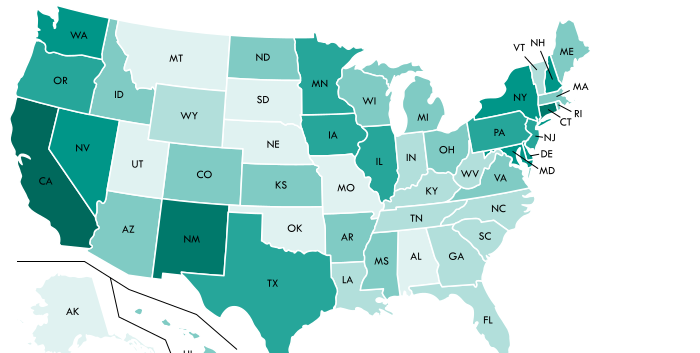
Most common states for social services supervisors
| Rank | State | Population | # of jobs | Employment/ 1000ppl |
|---|---|---|---|---|
| 1 | District of Columbia | 693,972 | 262 | 38% |
| 2 | Minnesota | 5,576,606 | 1,293 | 23% |
| 3 | Iowa | 3,145,711 | 700 | 22% |
| 4 | Massachusetts | 6,859,819 | 1,465 | 21% |
| 5 | Maine | 1,335,907 | 270 | 20% |
| 6 | New Hampshire | 1,342,795 | 245 | 18% |
| 7 | Delaware | 961,939 | 169 | 18% |
| 8 | South Dakota | 869,666 | 158 | 18% |
| 9 | Vermont | 623,657 | 112 | 18% |
| 10 | Nebraska | 1,920,076 | 322 | 17% |
| 11 | Montana | 1,050,493 | 174 | 17% |
| 12 | North Dakota | 755,393 | 129 | 17% |
| 13 | Alaska | 739,795 | 127 | 17% |
| 14 | Washington | 7,405,743 | 1,211 | 16% |
| 15 | Oregon | 4,142,776 | 662 | 16% |
| 16 | Utah | 3,101,833 | 481 | 16% |
| 17 | Idaho | 1,716,943 | 272 | 16% |
| 18 | Rhode Island | 1,059,639 | 168 | 16% |
| 19 | Maryland | 6,052,177 | 896 | 15% |
| 20 | Colorado | 5,607,154 | 845 | 15% |
Most common cities for social services supervisors
| Rank | City | # of jobs | Employment/ 1000ppl | Avg. salary |
|---|---|---|---|---|
| 1 | Palo Alto | 1 | 1% | $79,235 |
| 2 | Boston | 2 | 0% | $54,394 |
Social Services Supervisor job outlook: Expert opinions
Our panel of social services supervisor experts
Pomona College

California University of Pennsylvania

Tacoma Community College
Will there be an enduring impact of the coronavirus pandemic on Social Services Supervisors?
Gary Yeritsian: This is very hard to predict. In the near term, we can expect a lot more work from home than would have been the case prior. Government and government-funded work (many sociologists work for government agencies or nonprofits which receive both government and foundation funding) should remain a good option, given the size of the stimulus packages that have been passed in 2020 and especially 2021. Many sociology graduates go on to 2-3 years of professional school (e.g., in law, public health, social work, etc.) so for them I'd expect things to be close to 'normal' by the time they've completed graduate school.
What's a good job out of college for Social Services Supervisors?
Gary Yeritsian: For sociologists seeking work right out of college, entry-level jobs in government agencies (especially those that provide public services) or social change oriented nonprofits are ideal. Sociology majors combine a capacity for critical thinking with a concern for advancing social justice which can provide value for such organizations. Graduates in this category should aim to secure relevant internships in their third and fourth year of undergrad in order to be able to transition to full-time roles for those organizations or similar ones where that experience will be relevant.
What will help Social Services Supervisors increase their earning potential?
Gary Yeritsian: In the abstract, statistical/quantitative/coding skills. Anyone who has these in their portfolio can outshine job candidates who only possess qualitative/critical thinking/people-oriented skills. Sociology undergrads should aim to develop both sets of competencies.
More concretely, they should work to get two summer internships (during their undergrad studies) in organizations/sectors of real interest to them. This will give them an eventual foothold in the job market. This piece of advice is less about long term earning potential and more about landing the first job.
Will there be an enduring impact of the coronavirus pandemic on Social Services Supervisors?
Dr. T. Thao Pham Ph.D.: Having the field placements to allow graduates to learn about needed clinical and administrative skills in social work. The pandemic has resulted in reduced required field hours from our accrediting body but also the availability of field internships with face-to-face contact. Students often use telehealth to work with clients. On the other hand, students are graduating with more telehealth experience so that is an added skill set. They also must learn to be more resilient and better organized with the pandemic.
What's a day at work look like for a Social Services Supervisor?
Dr. T. Thao Pham Ph.D.: Recent graduates may find it more difficult to find work in traditional settings. Although many agencies in our area have openings, they are either scaling back until the pandemic is over or they are asking recent graduates to do more work if they get new positions. Recent graduates are asked to be more skillful and ready to take on challenging cases as soon as they start their post-master's employment.
What technical skills for a Social Services Supervisor stand out to employers?
Dr. T. Thao Pham Ph.D.: Agencies are looking for graduates with leadership skills, collaborative skills, grant-writing skills, clinical skills, and good organization skills. Graduates are expected to meet high expectations from employers early on and those who may find themselves moving quickly in the organization as administrators. We have many recent graduates who are now managers, supervisors, and coordinators within 3 years of graduating.
Barbara Peterson
Professor of Human ResourcesTacoma Community College
Human Services Program
What general advice would you give to a Social Services Supervisor?
Barbara Peterson: The work we do in Human Services and mental health is hard. We hear stories from people every day that are heart-wrenching. To be effective, we must take care of ourselves first. This is not being selfish. Just as we hear from the flight attendants every time we fly, we must put our oxygen masks on before assisting others. Self-care is vital and should be practiced every day. Self-care is about creating and maintaining a balanced life that includes proper nutrition, plenty of sleep, exercise, and creative activities and hobbies. Self-care also includes developing healthy relationships with people away from work and, when needed, a mental health professional's visit.
Will there be an enduring impact of the coronavirus pandemic on Social Services Supervisors?
Barbara Peterson: Thirty years ago, I had a conversation with a colleague about the concept of creating a remote mental health practice using emerging technology and the internet. He said it would never work. The current pandemic has proven that it can and does work. While we have been pushed into this new reality, my biggest concern is client confidentiality. Suppose new helpers take the appropriate actions to protect the clients. In that case, I believe remote helping will remain with us long after COVID is under control, especially for those folks that are place-bound for various reasons.