Explore jobs
Find specific jobs
Explore careers
Explore professions
Best companies
Explore companies
Job outlook for software development project managers in the United States
Software development project manager job growth summary. After extensive research, interviews, and analysis, Zippia's data science team found that:
The projected software development project manager job growth rate is 21% from 2018-2028.
About 284,100 new jobs for software development project managers are projected over the next decade.
Software development project manager salaries have increased 10% for software development project managers in the last 5 years.
There are over 34,215 software development project managers currently employed in the United States.
There are 331,412 active software development project manager job openings in the US.
The average software development project manager salary is $106,633.
Are software development project manager jobs in demand?
Software development project manager job and salary trends over time
Software development project manager jobs over time
Software development project manager job growth rate over time
| Year | # of jobs | % of population |
|---|---|---|
| 2021 | 34,215 | 0.01% |
| 2020 | 54,393 | 0.02% |
| 2019 | 39,334 | 0.01% |
| 2018 | 26,995 | 0.01% |
| 2017 | 24,108 | 0.01% |
Average software development project manager salary over time
Software development project manager salary by year
| Year | Avg. salary | Hourly rate | % Change |
|---|---|---|---|
| 2026 | $106,633 | $51.27 | +3.4% |
| 2025 | $103,120 | $49.58 | +2.3% |
| 2024 | $100,785 | $48.45 | +1.8% |
| 2023 | $99,005 | $47.60 | +1.7% |
| 2022 | $97,342 | $46.80 | +1.9% |
Software development project manager jobs by state
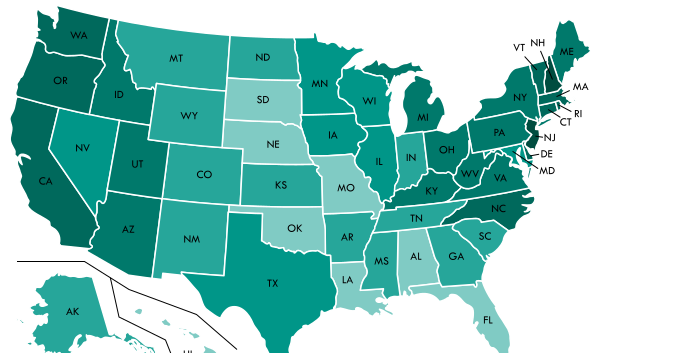
Most common states for software development project managers
| Rank | State | Population | # of jobs | Employment/ 1000ppl |
|---|---|---|---|---|
| 1 | District of Columbia | 693,972 | 823 | 119% |
| 2 | Washington | 7,405,743 | 4,876 | 66% |
| 3 | Massachusetts | 6,859,819 | 3,561 | 52% |
| 4 | Vermont | 623,657 | 314 | 50% |
| 5 | North Dakota | 755,393 | 362 | 48% |
| 6 | Montana | 1,050,493 | 481 | 46% |
| 7 | Delaware | 961,939 | 424 | 44% |
| 8 | Virginia | 8,470,020 | 3,645 | 43% |
| 9 | Rhode Island | 1,059,639 | 440 | 42% |
| 10 | Minnesota | 5,576,606 | 2,300 | 41% |
| 11 | South Dakota | 869,666 | 360 | 41% |
| 12 | Nebraska | 1,920,076 | 767 | 40% |
| 13 | Maryland | 6,052,177 | 2,342 | 39% |
| 14 | Oregon | 4,142,776 | 1,603 | 39% |
| 15 | Utah | 3,101,833 | 1,209 | 39% |
| 16 | New Mexico | 2,088,070 | 793 | 38% |
| 17 | Wisconsin | 5,795,483 | 2,134 | 37% |
| 18 | Kansas | 2,913,123 | 1,075 | 37% |
| 19 | New Hampshire | 1,342,795 | 503 | 37% |
| 20 | Alaska | 739,795 | 275 | 37% |
Most common cities for software development project managers
| Rank | City | # of jobs | Employment/ 1000ppl | Avg. salary |
|---|---|---|---|---|
| 1 | Rogers | 2 | 3% | $86,341 |
| 2 | McLean | 1 | 2% | $102,281 |
| 3 | Huntsville | 2 | 1% | $76,834 |
| 4 | Chicago | 2 | 0% | $94,410 |
| 5 | Boston | 1 | 0% | $108,063 |
| 6 | Washington | 1 | 0% | $110,875 |
Software Development Project Manager job outlook: Expert opinions
Our panel of software development project manager experts
California State University - Sacramento
Nova Southeastern University
Seminole State College of Florida
Northwestern University
Nova Southeastern University
Texas A&M University San Antonio
Ohio State University
Middle Georgia State University
Mount St. Joseph University
Heidelberg University
University of Richmond
Idaho State University

University of Pittsburgh at Johnstown

Kansas State University
University of Minnesota - Crookston
The University of Arizona

Rose-Hulman Institute of Technology

University of Toledo
Metropolitan State University of Denver
What general advice would you give to a Software Development Project Manager?
Kin Chung Kwan: Computer science is rapidly growing, with new technologies emerging daily. The desired skill set can vary from year to year. We should always stay updated on the latest global developments and prepare to learn something new. Keeping your skills up-to-date and aligning them with the current needs of employers and target customers is crucial to maximizing salary potential.
What will help Software Development Project Managers increase their earning potential?
Kin Chung Kwan: Programming is the cornerstone of computer science. Solving problems effectively through proficient programming is a vital key to career success. Learning programming is like athletic training. One cannot become a skilled athlete solely through attending lectures. Programming skills can only be improved with consistent practice. Learning new techniques and repeated practice can help professionals refine their programming abilities and achieve career success.
Junping Sun Ph.D.
ProfessorNova Southeastern University
Computer Software And Media Applications
What Software Development Project Manager skills would you recommend for someone trying to advance their career?
Junping Sun Ph.D.: Computer Science and its applications in various fields are very dynamic and constantly evolving, and anyone in the fields needs to prepare to be adaptive by lifelong learning.
What will help Software Development Project Managers increase their earning potential?
Junping Sun Ph.D.: Computer science is an algorithm science for problem solving in real world applications. The skills of problem solving require critical thinking with solid foundation of the professional knowledge in the relevant domains. It is crucial to have strong critical thinking skill with sophisticated logical and philosophical perspectives.
What will help Software Development Project Managers increase their earning potential?
Holger Findling: Technologies are changing very fast, and you must change with it. Don't be rigid. AI is going to increase in the next five years, and the demand for programmers will be high. You would have to take courses studying AI concepts. Bio-Medical fields and Biometrics will be expanding in capabilities and these fields will need a lot of programmers. Take some additional courses, for example Biology and Chemistry.
David Ostrowski
Northwestern University
Information Science/Studies
What will help Software Development Project Managers increase their earning potential?
David Ostrowski: Deep technical software skills, incorporating and innovating with AI, programming languages like Golang, Solidity, Rust, JavaScript, understanding and appreciation of the functional programming paradigm. Innovation and pushing the limits of technology.
What will help Software Development Project Managers increase their earning potential?
Dr. Frank Mitropoulos Ph.D.: As we look toward the future of careers in Computer Applications, several skills stand out for their growing importance. These skills revolve around specific technologies that are expected to continue to grow and evolve. Technologies related to Cloud Computing, Artificial Intelligence (AI), Cybersecurity, and Data Science are quickly evolving and being applied across the technology sector. Cloud Computing: Given the widespread adoption of Cloud services, Cloud computing expertise is indispensable. Understanding how to leverage platforms like Azure, AWS, and Google Cloud is crucial to developing scalable, efficient solutions that meet business needs. Artificial Intelligence: AI and Machine Learning are transforming the world. Skills in these areas to solve real-world problems will be even more critical in the future. Cybersecurity: Digital threats are becoming more sophisticated. Safeguarding data, networks, and systems will require encryption, intrusion detection, development, and regulation skills. Data Science: Skills in Data Science will be increasingly sought after as businesses embrace data-driven decision-making. Extracting meaningful insights from extensive datasets and effectively communicating these findings will be essential. Soft skills: Finally, soft skills such as teamwork, problem-solving, and effective communication cannot be overlooked. Adapting, communicating, and leading will be essential for success.
MARLA KRAMER
Assistant Vice President of Marketing and CommunicationsWhat will help Software Development Project Managers increase their earning potential?
MARLA KRAMER: It is unlikely that software development will be fully automated in the near future. Writing correct and efficient applications is a skill set that will only grow as we invent more ways to improve the quality of our lives. As more and more commerce and critical services migrate onto the internet, IS development will require a deeper knowledge of cybersecurity, data analytics, and cloud computing. According to the U.S. Bureau of Labor Statistics (BLS), Information Security Analysis jobs are expected to grow by 32% over the next 10 years. The BLS estimates Software Developers, Quality Assurance and Testing will grow by 25% over the next decade.
Right now, however, software development is going through a lull because of competition from abroad. Being an expert in at least two popular programming languages, having a solid theoretical foundation, and being able to innovate is pivotal. Artificial Intelligence is being deployed to solve some problems now, thanks to the powerful computers we have today. Learning to effectively use AI frameworks as part of your application development will add a lot of value to your skillset.
Izzat Alsmadi
Associate ProfessorTexas A&M University San Antonio
Computer Science
What Software Development Project Manager skills would you recommend for someone trying to advance their career?
Izzat Alsmadi: With the quick and rapid evolution language models, they are expected to be great assets in accelerating many jobs. Its important for new graduates to be aware of such models or tools and how they can be used
Programming skills will still be important but languages will be more mature and graduates need to be aware of the different available tools and resources online and how they can be used
Dr. Laura Deeter PhD
Professor of Practice: Horticulture and Crop ScienceOhio State University
Applied Horticulture And Horticultural Business Services
What general advice would you give to a Software Development Project Manager?
Dr. Laura Deeter PhD: Be open to learning and trying something outside of your comfort zone.
Be willing to work hard and don't expect to be project manager right out of school. Hard work will get you there fast enough.
What will help Software Development Project Managers increase their earning potential?
Dr. Laura Deeter PhD: There are more than enough positions out there to find one with a good starting salary. Apply for as many as you can.
Be willing to relocate to another city or state.
Tina Ashford
Professor of Information Technology/Faculty Curator of the Museum of Technology/DoIT Internship CoordinatorMiddle Georgia State University
Computer And Information Sciences And Support Services
What will help Software Development Project Managers increase their earning potential?
Tina Ashford: My first piece of advice is to embrace lifelong learning. Tech never sleeps, so neither should your curiosity. View mistakes as growth opportunities, and stay a student forever. Next, optimize your communication and teamwork skills to bridge the gap between techies and everyone else. Critical thinking is your secret sauce, so use it to solve problems creatively and anticipate the future. Finally, specialization is great, but keep an open mind. A broader skillset makes you adaptable, ready to seize unexpected opportunities. Network actively, build relationships, and most importantly, stay passionate. Let your tech enthusiasm fuel your career.
What Software Development Project Manager skills would you recommend for someone trying to advance their career?
Tina Ashford: Build relationships with professionals in your industry. This can lead to new opportunities and provide valuable insights. If you have multiple job offers, use them to negotiate a better deal. However, remember to consider factors like career growth and job satisfaction along with the salary. Keep improving your skills through courses, certifications, or volunteering. The more skilled you are, the higher your earning potential. Don't hesitate to seek advice from career coaches, mentors, or HR professionals. They can provide personalized guidance to help you navigate your career path. Remember, increasing your earnings is a continuous process, not a one-time event. By strategically investing in your skills and staying informed about your industry, you can confidently navigate and achieve a fulfilling and financially rewarding career.
Rebecca Allen
Mount St. Joseph University
Special Education And Teaching
What general advice would you give to a Software Development Project Manager?
Rebecca Allen: AI, for sure. I have heard it said that AI might not replace humans, rather humans who know how to use AI well may replace humans who don't.
What Software Development Project Manager skills would you recommend for someone trying to advance their career?
Rebecca Allen: Get hands-on experience. Join the workstudy program, take the co-op or the internship. Be sure to apply what you've learned!
Dr. Trish Berg
Associate Professor of Management, Heidelberg University, Tiffin, OhioHeidelberg University
Business Administration, Management And Operations
What Software Development Project Manager skills would you recommend for someone trying to advance their career?
Dr. Trish Berg: Daily, project managers create plans, create work schedules, build, and motivate teams, assign, and track work from start to finish, set project setting scopes and budgets, create workflow plans, and define what key performance indicators (KPIs) are which is how they can measure project success. Project managers must be both people focused, and task focused. Successful project managers understand what Sinek calls the power of the why in order to successfully motivate teams towards success.
What will help Software Development Project Managers increase their earning potential?
Dr. Trish Berg: One career field that is in high demand and growing is project management. With the complexity and flexibility needed in today's fast-paced culture, many organizations in diverse industries rely on project managers to complete jobs and organize teams to meet the needs of customers.
Daily, project managers create plans, create work schedules, build, and motivate teams, assign, and track work from start to finish, set project setting scopes and budgets, create workflow plans, and define what key performance indicators (KPIs) are which is how they can measure project success.
Project managers must be both people focused, and task focused. Successful project managers understand what Sinek calls the power of the why in order to successfully motivate teams towards success.
Ahmed Temani
Senior InstructorUniversity of Richmond
Computer/Information Technology Administration And Management
What general advice would you give to a Software Development Project Manager?
Ahmed Temani: A lot of the buzz is about using chatbots to improve coding efficiency. However, there is a great need for systems level thinking and design as software is deployed across cloud and edge computing devices. Gaining more experience in systems design provides you with additional skills that complement whatever AI-based technology gets deployed.
What Software Development Project Manager skills would you recommend for someone trying to advance their career?
Ahmed Temani: This one I'm not sure how to answer as it is too broad. I would say work hard and do quality work, but that seems obvious.
What Software Development Project Manager skills would you recommend for someone trying to advance their career?
Nikyra Capson: Don't be afraid of being rejected. If they see a job they want, apply. Even if they don't think they'll get it, still apply. The worst thing that could happen is being told no. Not applying is an automatic no, so they might as well try.
What will help Software Development Project Managers increase their earning potential?
Nikyra Capson: Understanding artificial intelligence and developing technology are essential skills for students to have so they're prepared for the future. Software is constantly updating, so designers need to be able to evolve with it and be constantly learning.
Travis Stouffer
Assistant Professor of Information Systems, ChairUniversity of Pittsburgh at Johnstown
Department of Information Systems
What general advice would you give to a Software Development Project Manager?
Travis Stouffer: Operate with a high-level of attention to detail. Superiors always appreciate a new or old employee who is self-sufficient and doesn’t need their hand to be held. Secondly, do everything you can to support the development process. You want to be seen a key cog in the development process, even if you are not writing code. You want to be the person with answers. Research APIs to use as datasources, write detailed requirements, support those requirements with detailed wireframes and mockups which blueprint the end-state of the application, test coded features and lastly just volunteer to do anything that will lighten the burden on the programmers of the team. Doing these things will also position you with a well-rounded experience that will help you ascend to project management type roles.
What will help Software Development Project Managers increase their earning potential?
Brett Horton Ph.D.: - Willingness to take on increased responsibility
- Willingness to move locations
- Willingness to work in different departments to learn and grow with the organization
What certifications/licenses/courses can have the biggest impact for Software Development Project Managers?
Brett Horton Ph.D.: The successful leaders are those who:
- Have a degree in hospitality management and understand what just occurred.
-There are few certifications necessary for work in the hospitality. Food safety is required for some positions, but this has likely been obtained while in school. Additional certifications may be obtained in the first 5 years of employment.
Christine Bakke
LecturerUniversity of Minnesota - Crookston
Math, Science & Technology Department
How have salaries changed over time for Software Development Project Managers?
Christine Bakke: In previous questions, I have used my own wording; however, the US Bureau of Labor Statistics is the most accurate source for an answer to this question:
The median pay for ITM, MIS, & CIS (all listed together at the US Bureau of Labor Statistics):
$146,360 per year
$70.37 per hour
"Employment in computer and information technology occupations is projected to grow 11 percent from 2019 to 2029, much faster than the average for all occupations. These occupations are projected to add about 531,200 new jobs. Demand for these workers will stem from greater emphasis on cloud computing, the collection and storage of big data, and information security. "
What certifications/licenses/courses can have the biggest impact for Software Development Project Managers?
Christine Bakke: MIS is a technical business degree which is offered with slightly different emphasis depending on the school's home department. For example, if a business department houses the degree it is often referred to as MIS; however, when Information Technology or Computer Science departments house this degree, the program would be called Information Technology Management (ITM) or Computer Information Systems (CIS). Each university has the autonomy to offer variations based on their specializations. Even though the programs can differ slightly, in general students receiving any of these three degrees receive an education in three areas: technical, management/business, and soft skills. Note that the US Bureau of Labor Statistics directs queries for all three fields (ITM, MIS and CIS) to the same data page (see answer to question 3).
What are the biggest trends we'll see in the Software Development Project Manager job market given the pandemic?
Christine Bakke: For many years remote tech support has been a growing field, but it was not the norm. Today, remote tech support and IT management have become crucial for daily operations. Remote work requires a solid IT infrastructure, cybersecurity, capable equipment, and quality software. The need for educated and experienced MIS / ITM / CIS will continue to increase.
Trends toward remote offices will become more acceptable and common; while some companies will return to the office en masse, others will allow more flexibility or become hybrid, and some will truly embrace the remote office. Use of remote tools such as Zoom will stay strong, as they provide global access at a huge cost benefit.
Tyler Conklin
LecturerThe University of Arizona
Computer science Department
What are the biggest trends we'll see in the Software Development Project Manager job market given the pandemic?
Tyler Conklin: The impact of the pandemic on the job market is limited in computer science. We are lucky to be in a field where remote work was routine long before the pandemic. This isn't true of all software engineering jobs, but many can be done with only a computer and internet access. The biggest changes come in the interviewing process and how the actual work will occur. It may be a long time before new hires ever meet their coworkers face to face.
What certifications/licenses/courses can have the biggest impact for Software Development Project Managers?
Tyler Conklin: A bachelor's degree in computer science will always help job prospects. I would consider it a great investment. However, some companies have made it clear that they are willing and happy to hire graduates of computer science boot camps. These are shorter courses aimed at teaching the student one specific technology or a very specific set of skills so that student can acquire a job in a certain subfield of software engineering. This is a much cheaper alternative than a traditional four-year degree. The tradeoff is less breadth of knowledge and more limited job options, and of course missing out on everything else that comes with a four-year degree. An even more efficient way to increase job prospects is to work on personal projects. Few things impress an interviewer more than a candidate showing off an application that he or she built on their own. What can show an interviewer that you can do the job better than a project demonstrating the required skills and knowledge?
How have salaries changed over time for Software Development Project Managers?
Tyler Conklin: Computer scientists and software engineers have been fortunate in seeing salaries continually increase in the field. Computer science student enrollment has continued to skyrocket, leading to a larger workforce, but it appears that demand continues to grow even faster.
Will there be an enduring impact of the coronavirus pandemic on Software Development Project Managers?
J.P. Mellor: I'm sure the pandemic will have an enduring impact on all of us. Our students are certainly experiencing new challenges as they strive to learn during the pandemic. They are aquiring skills and competencies associated with working remotely and engaging while doing so. These are skills that students in past years did not attain.
What's a day at work look like for a Software Development Project Manager?
J.P. Mellor: I'm not sure that what our graduates do has changed at all. How they do it has changed somewhat. All of us are learning to connect and engage remotely. Whether they're a recent grad or a not so recent grad they all are learning new skills as a result of the impact of the pandemic.
What will help Software Development Project Managers increase their earning potential?
J.P. Mellor: Our graduates are particularly good at making positive progress even when the way forward is not clear, they don't know how to do what needs to be accomplished, and/or they've never done it before. This is a skill set requires a solid technical foundation and makes our graduates especially valuable.that is part
What are the biggest trends we'll see in the Software Development Project Manager job market given the pandemic?
Jared Onyango Oluoch Ph.D.: We are already seeing a lot of professionals working remotely. This trend will likely continue especially in domains such as software engineering. With this may also occur lack of social connections and team building that we have seen over the years with people working in offices or facilities.
What certifications/licenses/courses can have the biggest impact for Software Development Project Managers?
Jared Onyango Oluoch Ph.D.: In databases - various Oracle database certifications; in networking - Cisco CCNA; in cybersecurity CompTIA security. Engineering and engineering technology graduates will boost their earning potentially by getting the Professional Engineer (PE) license.
How have salaries changed over time for Software Development Project Managers?
Jared Onyango Oluoch Ph.D.: I think salaries in academia especially in Computer Science and Engineering Technology are rising and are expected to given the demand of graduates in these areas.
Janos Fustos Ph.D.
ProfessorMetropolitan State University of Denver
Department of Computer Information Systems and Business Analytics
Will there be an enduring impact of the coronavirus pandemic on Software Development Project Managers?
Janos Fustos Ph.D.: I think the impact will not be that much on the graduates but on the environment where they start their professional career and how they have completed their studies.
This pandemic has changed many aspects of our lives - among others how we work (or stat to work) and how we learn. Being in higher education I can definitely see both. The home office became the standard working environment with all the advantages and several disadvantages. You do not have to go/travel to your corporate office, you may be available even at odd hours to work, some find the home environment more relaxing, there are less formalities, some might communicate easier in writing or from behind a turned-off camera, they could take advantage of personal schedule and individual peek times, more control over their schedules etc.
But even as you work at home you may experience more disruption, you are more available for personal/family affairs, you may not have that much opportunity to interact with colleagues and miss opportunities for meaningful discussions for extending your knowledge base, networking, you have to deal with technical issues on your own or less support etc.
Some similar issues can be mentioned when it comes to changes in the way we participate in education. Most of the class meetings are online with limited individual interaction and/or access to teachers, less direct interaction with classmates, technical challenges, home office setup challenges etc. All these together impact students/graduates differently: some take these as an advantage while some others are impacted more by the disadvantages. But whichever we look at that I think there is a definite impact of the pandemic on all of us and while we have already spent about 10-12 month in this "splendid isolation" and survived more or less so far, we do not know if it may have more enduring or serious impact on our lives - that needs to be seen from a much longer perspective.
What's a good job out of college for Software Development Project Managers?
Janos Fustos Ph.D.: I hope students are asking that question before they enroll in the first course at a college because otherwise, they would waste lot of time and money to work on a degree or a career path that does not fulfill their goals and personal interest. In that sense any job is a good job that somebody understands, feels that he/she is a good fit and can live up to the imposed challenges, and has the knowledge/skills to work in the field. There are interesting and self-fulfilling jobs to choose from. Certainly, it starts with the definition what a "good" means to an individual, what are the attributes of that definition: is that the professional area, is the salary, is it the challenging nature, is it more about the working environment and the people they can work with, is it the promotion options, the high impact etc. There are several lists available on the internet that provide recommendations and track the different aspects of job selection options for seekers.
What technical skills for a Software Development Project Manager stand out to employers?
Janos Fustos Ph.D.: These days - since we went to the home office - everybody is looking for solutions that gives more and better support to remote workers. Organizations are looking for options where they can connect back to the organizations'' networks to complete their work. But that means much more work for the IT folks to make that happen and do that safely and securely. That means they are looking for individuals with technical skills that are in or closely related fields: security engineers and analysts, business analysts, data administrators, cloud service operators, network specialists etc.
Also, employers are looking for more experienced professional who can hit the ground running because their needs are more pressing and immediate, so they do not have too much time for training and education. But they are also looking for trainers to better educate users about their working environments and the changing working conditions. Users have to rely a bit more on these trainings because they cannot enjoy the immediate and direct IT support in their homes. In addition to that (or to extend that) helpdesk people are also in high demand who have the technical and also the people's skills to troubleshoot the problems that occur in highly uncertain and diverse environments.