Explore jobs
Find specific jobs
Explore careers
Explore professions
Best companies
Explore companies
Job outlook for software integrator engineers in the United States
Software integrator engineer job growth summary. After extensive research, interviews, and analysis, Zippia's data science team found that:
The projected software integrator engineer job growth rate is 21% from 2018-2028.
About 284,100 new jobs for software integrator engineers are projected over the next decade.
Software integrator engineer salaries have increased 10% for software integrator engineers in the last 5 years.
There are over 50,334 software integrator engineers currently employed in the United States.
There are 309,116 active software integrator engineer job openings in the US.
The average software integrator engineer salary is $103,622.
Are software integrator engineer jobs in demand?
Software integrator engineer job and salary trends over time
Software integrator engineer jobs over time
Software integrator engineer job growth rate over time
| Year | # of jobs | % of population |
|---|---|---|
| 2021 | 50,334 | 0.01% |
| 2020 | 102,769 | 0.03% |
| 2019 | 68,561 | 0.02% |
| 2018 | 150,832 | 0.05% |
| 2017 | 141,871 | 0.04% |
Average software integrator engineer salary over time
Software integrator engineer salary by year
| Year | Avg. salary | Hourly rate | % Change |
|---|---|---|---|
| 2026 | $103,622 | $49.82 | +3.4% |
| 2025 | $100,207 | $48.18 | +2.3% |
| 2024 | $97,939 | $47.09 | +1.8% |
| 2023 | $96,209 | $46.25 | +1.7% |
| 2022 | $94,593 | $45.48 | +1.9% |
Software integrator engineer jobs by state
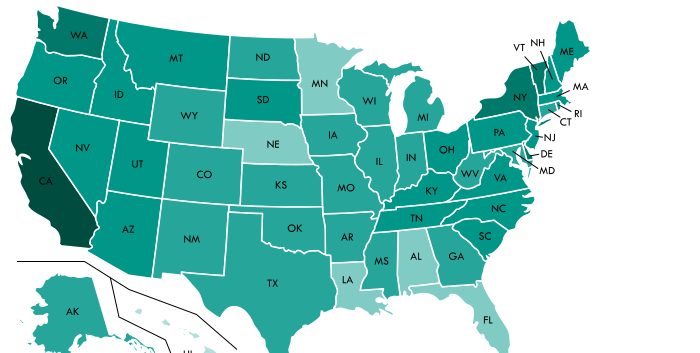
Most common states for software integrator engineers
| Rank | State | Population | # of jobs | Employment/ 1000ppl |
|---|---|---|---|---|
| 1 | District of Columbia | 693,972 | 1,143 | 165% |
| 2 | Washington | 7,405,743 | 6,113 | 83% |
| 3 | Virginia | 8,470,020 | 6,243 | 74% |
| 4 | Delaware | 961,939 | 661 | 69% |
| 5 | Massachusetts | 6,859,819 | 4,679 | 68% |
| 6 | Rhode Island | 1,059,639 | 719 | 68% |
| 7 | Vermont | 623,657 | 422 | 68% |
| 8 | Maryland | 6,052,177 | 4,016 | 66% |
| 9 | Oregon | 4,142,776 | 2,511 | 61% |
| 10 | Utah | 3,101,833 | 1,779 | 57% |
| 11 | Colorado | 5,607,154 | 2,975 | 53% |
| 12 | New Hampshire | 1,342,795 | 681 | 51% |
| 13 | California | 39,536,653 | 18,671 | 47% |
| 14 | Montana | 1,050,493 | 497 | 47% |
| 15 | Minnesota | 5,576,606 | 2,448 | 44% |
| 16 | Wyoming | 579,315 | 244 | 42% |
| 17 | North Dakota | 755,393 | 310 | 41% |
| 18 | Nebraska | 1,920,076 | 742 | 39% |
| 19 | Idaho | 1,716,943 | 676 | 39% |
| 20 | New Jersey | 9,005,644 | 3,289 | 37% |
Most common cities for software integrator engineers
| Rank | City | # of jobs | Employment/ 1000ppl | Avg. salary |
|---|---|---|---|---|
| 1 | Annapolis | 9 | 23% | $91,992 |
| 2 | Tewksbury | 4 | 14% | $99,097 |
| 3 | Marlborough | 5 | 13% | $99,141 |
| 4 | Cupertino | 3 | 5% | $137,859 |
| 5 | Burnsville | 2 | 3% | $82,492 |
| 6 | Santa Clara | 3 | 2% | $137,845 |
| 7 | Cedar Rapids | 2 | 2% | $88,994 |
| 8 | Columbia | 2 | 2% | $91,926 |
| 9 | Hawthorne | 2 | 2% | $122,369 |
| 10 | Los Angeles | 3 | 0% | $122,894 |
| 11 | San Diego | 3 | 0% | $119,033 |
| 12 | Washington | 3 | 0% | $111,842 |
| 13 | Atlanta | 2 | 0% | $86,915 |
| 14 | Boston | 2 | 0% | $99,214 |
| 15 | Houston | 2 | 0% | $91,130 |
Software Integrator Engineer job outlook: Expert opinions
Our panel of software integrator engineer experts
Seattle University
University of South Alabama
University of Minnesota - Duluth
New Jersey Institute of Technology
Weber State University
Southern Illinois University Edwardsville
California Polytechnic State University-San Luis Obispo
California State University - Sacramento
Nova Southeastern University
Carnegie Mellon University
Oklahoma State University Institute of Technology - Okmulgee
Seminole State College of Florida
University of South Alabama
Eastern Washington University
What general advice would you give to a Software Integrator Engineer?
Sepehr Mohammadian: 2. Computer science remains in high demand in today's job market, with California exemplifying this trend. In recent years, the number of open positions in the state has exceeded the average demand rate by 1.5 times. At the University of the Pacific, our CS program is designed to equip students with the necessary skills and experiences to thrive in this landscape. Through our co-op program, in collaboration with recruiters such as Nvidia, HP, and Lawrence Livermore National Lab, students have the opportunity to participate in paid internships lasting approximately 8 months. These internships provide invaluable exposure to real-world work settings and allow students to apply their knowledge in practical contexts and gain valuable industry insights. It is worth noting that many of our graduates choose to return to the same company post-graduation.
What Software Integrator Engineer skills would you recommend for someone trying to advance their career?
Sepehr Mohammadian: 1. This is a pretty broad question. CS degree graduates can engage in different tasks and responsibilities based on the nature of their profession. Examples include 1) software engineering, in which the individual's efforts are toward leading or contributing to software development projects, 2) IT management, where the individual mainly oversees technology strategies and their implementation, 3) cybersecurity, where the individual's responsibilities are associated with the protection of systems and data from cyber threats, and 4) data and AI engineering, where the individual works on machine learning applications and analyze and derive insights from large datasets.
What will help Software Integrator Engineers increase their earning potential?
Sepehr Mohammadian: 3. The appeal of computer science among students is often attributed to the relatively short journey from concept to execution. Unlike many engineering fields where hardware constraints can impede the swift realization of ideas, the development of software offers a streamlined process. With nothing more than access to a computer and relative proficiency in programming, individuals can swiftly transform their ideas into tangible solutions. This accessibility and agility contribute to the popularity of CS among aspiring students. On the other hand, CS heavily relies on abstract analysis as a fundamental skill for success. Students who struggle with grasping abstract concepts may find themselves frustrated or disengaged with the field.
Christopher Misorski FASM
Brunswick Technical Fellow-Materials Product Development & EngineeringWhat Software Integrator Engineer skills would you recommend for someone trying to advance their career?
Christopher Misorski FASM: While it is tough to predict the future with any accuracy, the best skill-set(s) for succeeding revolve around continuing education and learning what is possible with future materials or future manufacturing methods. Just remember, what you may learn at a conference or meeting may not be immediately relevant to your job, but down the road it could provide valuable solutions or insights into new problems that require “fixing”. In addition to continuing education in your field of interest, improving communication skills, both oral and written are important. Having the solution to a problem is useless unless the ideas can be communicated effectively and clearly to the audience that needs to hear the message. Remember, many in the audience are probably not materials engineers or any type of engineer potentially, so communicate at the appropriate level.
What will help Software Integrator Engineers increase their earning potential?
Christopher Misorski FASM: Maximizing salary potential at the start of your career is not a clear pathway generally. One way that you can be considered more valuable, and hence worth a better salary, is to have participated in a co-op or internship program with a company in your field. This experience gives employers some confidence that you were able to carry out assignments and thrive in a workplace environment. The employer that you worked for may be inclined to offer you a position upon graduation and you are now worth more because you have already proven to them your abilities. Even if they don’t offer you a job (no appropriate open position may be available) your ability to discuss your experiences with the HR recruiter or hiring manager at another company can instill confidence in your selection as a hire. Just remember, if you tell them you did a project, be prepared to explain it so it doesn’t appear you were just in the background of this project, just going along for the ride.
What Software Integrator Engineer skills would you recommend for someone trying to advance their career?
Thomas Congedo PhD: That comes from your ability to focus on technical product of the highest quality, always seeking to truly understand the customer’s needs. For example, often a customer will phrase a problem by stating the solution he or she assumes. Taking the time to respectfully draw out the thinking further can make you the customer’s hero, and this makes you the person likely to be selected for the challenging and most rewarded assignments.
What general advice would you give to a Software Integrator Engineer?
Dr. Sridhar Ramachandran: As a Computer Science graduate, it’s vital to work on independent projects outside of course projects or assigned tasks. This allows you to apply your knowledge and explore new areas and opportunities. Showcasing these projects in a digital portfolio provides a visual and tangible representation of your skills and growth. Emphasizing your attention to clean coding and documentation reflects your professionalism and attention to detail. The field is vast and rapidly evolving, so stay curious, keep learning, and enjoy your professional journey. Avoid getting caught up in fleeting trends. Understanding the difference between work, job, and career is crucial; find work and jobs that contribute to your long-term career aspirations while steadily maintaining your focus on your career goals. In addition, being aware of the organization’s environment and culture at the workplace you intend to work at is important. Familiarize yourself with workplace methodologies like Agile, Just-In-Time (JIT), DevOps, Scrum, Kanban, Lean, Feature-Driven Development (FDD), Extreme Programming (XP), Rapid Application Development (RAD), and Software Development Life Cycle (SDLC) (to name a few). Each organization will have its unique blend of these elements, and knowing what works best for you will help you thrive in your chosen career path. Remember, the key to success in this dynamic field is continuous learning and adaptation.
What Software Integrator Engineer skills would you recommend for someone trying to advance their career?
Dr. Sridhar Ramachandran: To optimize your earning potential in the field of Computer Science, it’s important to establish a solid educational foundation and master widely-used programming languages and technologies. Internships offer invaluable hands-on experience, and obtaining industrial certifications in specialized areas can significantly increase your marketability. Cultivating a robust professional network and honing your salary negotiation skills are also key. It’s important to stay updated with the latest technological advancements, salary trends, and consider focusing on a niche area in high demand. From the outset of your career conversations, it’s beneficial to communicate clear salary expectations. Conduct thorough research on the current market rates for the role you’re targeting to ensure your expectations are realistic. Understanding your worth in the market is crucial, and you should aim for a salary that not only reflects your skills and experience but also keeps you motivated and invested in your work. Remember, while salary is a significant factor, aspects like work-life balance and job satisfaction also play a vital role in your overall career satisfaction. Aim for a win-win salary negotiation where both you and your employer feel the compensation is fair and equitable.
What will help Software Integrator Engineers increase their earning potential?
Dr. Sridhar Ramachandran: The field of Computer Science is a dynamic and rapidly evolving landscape. Over the next 3-5 years, several skills will gain prominence. Artificial Intelligence and Machine Learning will be indispensable due to the surge in data generation. Cybersecurity will become critical as our reliance on digital systems intensifies, and it will be everyone’s prerogative to ensure the security of their digital assets. Essential cybersecurity skills will include understanding of network security, proficiency in security software tools, knowledge of threat and vulnerability assessment, and the ability to implement incident response and recovery plans. Proficiency in Cloud Computing platforms such as AWS, Google Cloud, and Microsoft Azure will be sought after as businesses increasingly transition to the cloud. Data Science and Analytics will continue to be pivotal for data-driven decision making. Quantum Computing, though nascent, holds the potential to revolutionize the field. Soft skills like communication, teamwork, and problem-solving will be vital in managing complex, interdisciplinary projects. In this dynamic field, employees who know how to learn, unlearn, and relearn will have a competitive advantage. This is particularly true with the emerging importance for AI programming languages like Julia, Swift for TensorFlow, and Rust.
Jhon Smith
Associate Professor and Director of MS in Structural EngineeringSeattle University
Civil Engineering
What general advice would you give to a Software Integrator Engineer?
Jhon Smith: Do not be afraid to ask questions to your supervisors (although do not take it to an extreme and become demanding—show initiative). You get the fundamentals of engineering at school and you are equipped to use them but it takes a few years to feel comfortable. Engineering is a profession of practice and it is only through practice that you best learn it.
What Software Integrator Engineer skills would you recommend for someone trying to advance their career?
Jhon Smith: Expand your network, join professional organizations and committees, become valuable in whatever company you work for, never stop learning, seek for opportunities for professional work, get your PE license. After these you will become more valuable naturally and could comfortably ask for a promotion or a salary increase because you’d know you deserve it.
What Software Integrator Engineer skills would you recommend for someone trying to advance their career?
Sean Walker: To maximize your salary, it is really essential to learn the tools and methods associated with Systems Engineering while also maintaining a sense of creativity. Employers are not only looking for engineers with the ability to apply specific tools but also the ability to think creatively to solve complex systems problems. I often encourage my students to maintain their creative hobbies so that they don't lose those skills. But, more immediately, gaining a graduate education in Systems Engineering can help any engineer increase their earning potential.
What will help Software Integrator Engineers increase their earning potential?
Richard Davis: Engineering offers career opportunities across various industries, from technology and healthcare to infrastructure and environmental sustainability. With technological advancements and the increasing complexity of global challenges, such as climate change, food and clean water, and urbanization, engineers are in high demand to develop innovative solutions. For example, environmental engineers are crucial in developing sustainable solutions to reduce pollution and conserve resources. Engineering provides opportunities for creativity and problem-solving, making it a rewarding career choice for those who enjoy tackling complex problems. The global focus on sustainability and renewable energy presents exciting prospects for engineers to contribute to meaningful projects that positively impact society and the environment.
What general advice would you give to a Software Integrator Engineer?
Mishah Salman Ph.D.: An underappreciated skill that I think will become more sought-after is the ability to validate computer-made decisions and their shortcomings. With the growing prominence of AI use in design, problem solving, and decision making, the engineering field will need experts to error-check decisions made using these technologies. Sometimes there are unexplored gaps that these technologies overlook, and sometimes there are biases or inappropriate assumptions baked into AI-based results. Humans are inherently imaginative and creative. We excel at picking up on things that computer algorithms may miss. Talented experts that recognize and address these issues will remain invaluable in the workforce. Another indispensable skill that is often overlooked in engineering is effective interpersonal communication. Whether in a teamwork context, a leadership role, or a client interaction, competent communication is crucial. This can take the form of conversation, live presentations, written correspondence, and beyond. People that hone their communication skills are often recognized, and tend to be the individuals that are promoted to more senior roles.
What will help Software Integrator Engineers increase their earning potential?
Mishah Salman Ph.D.: My advice to recent graduates is to be open to non-conventional roles. Taking on responsibilities beyond one’s official discipline provides broader value to employers. Many students that graduate with degrees in mechanical engineering (or similar disciplines) find great success by stepping outside of their expected job title. Sometimes exploring roles with titles like “analyst” or “manager” or “designer” can provide interesting opportunities to apply one’s engineering skillset in an alternate context. The real strength of your degree is the transferable skillset that you developed along your educational journey. Keep your options open!
What Software Integrator Engineer skills would you recommend for someone trying to advance their career?
Mansooreh Mollaghasemi Ph.D.: Concurrent with building technical skills, they must build soft skills such as communication, teamwork, problem-solving, and leadership. These skills are often the differentiators between good and great engineers.
What will help Software Integrator Engineers increase their earning potential?
Megumi Usui: Even after obtaining a degree, it is crucial to recognize that continuous learning is a fundamental aspect of professional development in the workplace. One must cultivate an open-minded attitude and demonstrate a willingness to acquire new knowledge and skills at any time and in any context. Effective communication with colleagues and clients is essential for successful collaboration and project execution. It is important to understand that the professional environment is significantly different from the academic setting. In a company, the focus is delivering work that meets the expectations and standards set by the employer and satisfies the needs of clients, rather than merely fulfilling personal criteria. Furthermore, it is imperative to produce high-quality work consistently. Mediocre performance is unacceptable, and organizations will not hesitate to seek replacements if the work delivered does not meet their standards. Ensuring that your work is thorough, precise, and aligns with the company's objectives is critical for maintaining the position and advancing their career.
What general advice would you give to a Software Integrator Engineer?
Michael Denn: 1. Become the expert in whatever you do. 2. Understand how your work fits into the bigger picture and keep that in mind when you do your work. 3. Keep learning! Your engineering degree is not the end of your education! 4. Take stretch assignments and opportunities whenever you can.
What will help Software Integrator Engineers increase their earning potential?
Michael Denn: The answers to this question are largely the same as the answer to question 1. However, here are some additional points: 1. Excel in your job. Become the person everyone goes to for whatever type of work you do. 2. Develop and maintain a career plan. Make sure your assignments and tasks align with your plan. When you have the opportunity to change positions, keep you plan in mind.
What Software Integrator Engineer skills would you recommend for someone trying to advance their career?
Dr. Elizabeth Adams PhD, PE: Understanding how technology can make jobsites more efficient is going to continue to grow in importance, from software that manages RFIs and submittal documents to keeping digital records of project progress and milestones to utilizing fully autonomous heavy machinery to accomplish large portions of the work. Develop skills and knowledge around industry technology and be proactive about staying up to date on what your company is using, what is available, and what is coming down the line in the near future.
What general advice would you give to a Software Integrator Engineer?
Kin Chung Kwan: Computer science is rapidly growing, with new technologies emerging daily. The desired skill set can vary from year to year. We should always stay updated on the latest global developments and prepare to learn something new. Keeping your skills up-to-date and aligning them with the current needs of employers and target customers is crucial to maximizing salary potential.
What Software Integrator Engineer skills would you recommend for someone trying to advance their career?
Kin Chung Kwan: We are in an Artificial Intelligence (AI) revolution. AI development will continue to be a global priority and dominate the tech landscape in the next few years. For computer scientists seeking career progression, gaining a comprehensive understanding of AI is crucial. Furthermore, understanding limitations, ethical considerations, safety and security measures associated with AI is an important responsibility that every computer scientist should be aware of.
What will help Software Integrator Engineers increase their earning potential?
Kin Chung Kwan: Programming is the cornerstone of computer science. Solving problems effectively through proficient programming is a vital key to career success. Learning programming is like athletic training. One cannot become a skilled athlete solely through attending lectures. Programming skills can only be improved with consistent practice. Learning new techniques and repeated practice can help professionals refine their programming abilities and achieve career success.
Junping Sun Ph.D.
ProfessorNova Southeastern University
Computer Software And Media Applications
What general advice would you give to a Software Integrator Engineer?
Junping Sun Ph.D.: Being capable to perform, being competitive to excel, being able to communicate as a team player, being a connoisseur to act, being a clairvoyance to perceive, being creative to innovate, being conscientious with professional integrity.
What Software Integrator Engineer skills would you recommend for someone trying to advance their career?
Junping Sun Ph.D.: Computer Science and its applications in various fields are very dynamic and constantly evolving, and anyone in the fields needs to prepare to be adaptive by lifelong learning.
What will help Software Integrator Engineers increase their earning potential?
Junping Sun Ph.D.: Computer science is an algorithm science for problem solving in real world applications. The skills of problem solving require critical thinking with solid foundation of the professional knowledge in the relevant domains. It is crucial to have strong critical thinking skill with sophisticated logical and philosophical perspectives.
What general advice would you give to a Software Integrator Engineer?
Jonathan Aldrich: Hone your skills so you are great at what you do, and gradually build to be great at what you want to do next. When you are confident in your current position, look for the next step--which may be a promotion in your current organization or a new job outside it.
What Software Integrator Engineer skills would you recommend for someone trying to advance their career?
Jonathan Aldrich: AI is a powerful new tool but it is also unreliable. Learn how you can use it but also what its limitations are, so that you can protect yourself and your customers from those limitations. Always have a way to double-check that the results of AI are sensible and appropriate. No one is a lone coder anymore--you'll be more effective if you can work with other people and with tools that multiply your capabilities. Work on your teamwork skills and keep your eye out for new tools and technologies that make you more effective.
What will help Software Integrator Engineers increase their earning potential?
Jonathan Aldrich: Be open to new experiences and focus on learning from them. A degree in computing gives you a foundation but there will be new challenges in every job; always be thinking about what you can do to become more effective at your tasks.
Jim Gordon
Faculty- Construction ManagementOklahoma State University Institute of Technology - Okmulgee
Electromechanical Technologies/Technicians
What will help Software Integrator Engineers increase their earning potential?
Jim Gordon: Computer skills will only increase in importance and drone technology will be huge. Fluency in the software your firm uses will be a must-have skill.
What general advice would you give to a Software Integrator Engineer?
Holger Findling: Most companies have a fixed range in salary for new hires. There is very limited space to negotiate a higher pay. It used to be a standard practice not to stay more than three years with a company because salary increases are associated with labor grade ranges. A larger salary increase can be realized by moving to a different company. Typically, 5% increase vs 3% salary increase. However, a programmer needs to continue studying in the field of interest. Earn a master's degree. Be the best you can be!
What Software Integrator Engineer skills would you recommend for someone trying to advance their career?
Holger Findling: Decide what technical area you would like to work in your field of expertise. Do you like to work for the aerospace industry? Decide what specific component you are interested in. Aircraft, Missiles, Energy, Navy - ships, Finance? The issue is that these components are developed in different states. For instance, in Florida Mid-Range missiles are developed and flight simulators. However, aircrafts are developed in Texas, Georgia, and Arizona, not in Florida. There are a lot of programmers needed for financial software. Most likely these jobs would be in New York, New Jersey, Atlanta, California and Massachusetts. In other words understand what industry you would like to work for, and understand that the industries are clustered in different states.
What will help Software Integrator Engineers increase their earning potential?
Holger Findling: Technologies are changing very fast, and you must change with it. Don't be rigid. AI is going to increase in the next five years, and the demand for programmers will be high. You would have to take courses studying AI concepts. Bio-Medical fields and Biometrics will be expanding in capabilities and these fields will need a lot of programmers. Take some additional courses, for example Biology and Chemistry.
Edmund Spencer
Associate ProfessorUniversity of South Alabama
Electrical, Electronics, And Communications Engineering
What Software Integrator Engineer skills would you recommend for someone trying to advance their career?
Edmund Spencer: Look for jobs that have the highest technical content, and try to develop entrepreneurial skills early.
Dan Tappan
Eastern Washington University
Computer Software And Media Applications
What general advice would you give to a Software Integrator Engineer?
Dan Tappan: As much as possible, become a subject matter expert in the domain you're working in. The biggest problems we have are in not understanding the customer's problem and not understanding the customer's problem domain. Neither side is conversant in the other's world. We can't expect the customer to learn software development, so we have to learn about their world to bridge this gap.
What Software Integrator Engineer skills would you recommend for someone trying to advance their career?
Dan Tappan: This field changes so rapidly, it's hard to predict. Artificial intelligence has really taken off recently. There's no clear distinction between AI, machine learning, big data, and related areas anymore. They all blend together. These aren't just used as solutions to problems; they're also playing an ever-larger role in the tools we use to solve those problems. ChatGPT, for example, helps in writing documentation, and Google products help in writing code. Solid skills in these areas can streamline the development process.
What will help Software Integrator Engineers increase their earning potential?
Dan Tappan: There's not much room for salary negotiation as a new graduate with no experience. Every CS graduate shares roughly the same required background. What often distinguishes one applicant from another, or boosts the salary, is non-required experience with personal projects, contributions to open-source development, and so on. This shows not only applications of the required background, but also the initiative to learn and do more than is expected for the degree.
What general advice would you give to a Software Integrator Engineer?
Daniel Armentrout: The excessive number of baby boomer engineers are retiring at high rates and you as a new engineering graduate are desperately needed to make up for their loss in the workforce. You will face challenges in your career we could not anticipate or prepare you for in your education. You will have to adapt and continue to learn new fields of study which did not exist when you graduated. We have given you tools to learn and you will have to use those tools to remain relevant throughout your career. Find your place as an engineer when you can be effective, help humanity, and have fun. Plot a career path where you can utilize your strengths and challenge your mind to do new things. Contribute to making a better world and you will be able to enjoy immense satisfaction and a sense of accomplishment.