Explore jobs
Find specific jobs
Explore careers
Explore professions
Best companies
Explore companies
Job outlook for solar applications development engineers in the United States
Are solar applications development engineer jobs in demand?
Solar applications development engineer job and salary trends over time
Solar applications development engineer jobs over time
Solar applications development engineer job growth rate over time
| Year | # of jobs | % of population |
|---|---|---|
| 2021 | 10 | 0.00% |
| 2020 | 16 | 0.00% |
| 2019 | 11 | 0.00% |
| 2018 | 24 | 0.00% |
| 2017 | 22 | 0.00% |
Average solar applications development engineer salary over time
Solar applications development engineer salary by year
| Year | Avg. salary | Hourly rate | % Change |
|---|---|---|---|
| 2026 | $96,352 | $46.32 | +3.4% |
| 2025 | $93,177 | $44.80 | +2.3% |
| 2024 | $91,068 | $43.78 | +1.8% |
| 2023 | $89,460 | $43.01 | +1.7% |
| 2022 | $87,957 | $42.29 | +1.9% |
Solar applications development engineer jobs by state
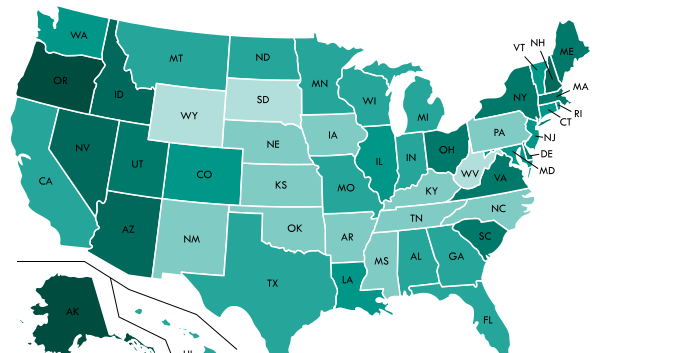
Most common states for solar applications development engineers
| Rank | State | Population | # of jobs | Employment/ 1000ppl |
|---|---|---|---|---|
| 1 | District of Columbia | 693,972 | 568 | 82% |
| 2 | Washington | 7,405,743 | 3,394 | 46% |
| 3 | Delaware | 961,939 | 329 | 34% |
| 4 | Montana | 1,050,493 | 332 | 32% |
| 5 | Massachusetts | 6,859,819 | 2,085 | 30% |
| 6 | Maine | 1,335,907 | 396 | 30% |
| 7 | Alaska | 739,795 | 222 | 30% |
| 8 | Virginia | 8,470,020 | 2,396 | 28% |
| 9 | North Dakota | 755,393 | 211 | 28% |
| 10 | Nebraska | 1,920,076 | 515 | 27% |
| 11 | Vermont | 623,657 | 168 | 27% |
| 12 | Arizona | 7,016,270 | 1,748 | 25% |
| 13 | Georgia | 10,429,379 | 2,468 | 24% |
| 14 | Maryland | 6,052,177 | 1,447 | 24% |
| 15 | Kansas | 2,913,123 | 693 | 24% |
| 16 | Indiana | 6,666,818 | 1,566 | 23% |
| 17 | Iowa | 3,145,711 | 713 | 23% |
| 18 | Rhode Island | 1,059,639 | 241 | 23% |
| 19 | South Dakota | 869,666 | 198 | 23% |
| 20 | Oregon | 4,142,776 | 923 | 22% |
Most common cities for solar applications development engineers
| Rank | City | # of jobs | Employment/ 1000ppl | Avg. salary |
|---|---|---|---|---|
| 1 | Columbus | 1 | 0% | $97,647 |
Solar Applications Development Engineer job outlook: Expert opinions
Our panel of solar applications development engineer experts

Fairfield University
Xavier University

East Tennessee State University

University of Nebraska–Lincoln

Liberty University

Rose-Hulman Institute of Technology
Northern Michigan University
Elon University

University of Maryland

Crafton Tull
What general advice would you give to a Solar Applications Development Engineer?
Dr. Harvey Hoffman: Graduates need to be flexible and open to taking on new projects, exploring new industries, perhaps non-traditional areas where they see growth, while building and maintaining their networking relationships. Go where the demand is for the role you seek. I hate to use a cliche, but remember that your engineering career is a journey that may take you in many directions. Be open to change.
A professional in any field must continue to learn. Your engineering degree gave you the necessary tools. You must engage in lifelong learning to increase your knowledge and improve your skills and competencies to set yourself apart.
Dr. Heidrun Schmitzer
Professor and ChairXavier University
Department Of Physics
What skills stand out on Solar Applications Development Engineer resumes?
Dr. Heidrun Schmitzer: Programming languages, numerical design and simulation tools, knowledge of various measurement equipment.
What soft skills should all Solar Applications Development Engineers possess?
Dr. Heidrun Schmitzer: Communication, teamwork.
Jared Wilson
Assistant Professor and Faculty CoordinatorEast Tennessee State University
Surveying and Mapping
Will there be an enduring impact of the coronavirus pandemic on Solar Applications Development Engineers?
Jared Wilson: The information I have been provided is positive when the outlook is concerning the workload that is being performed by the professional industry. Land surveying, and subsequently, land surveyors, have been deemed essential; thus, work is still being performed. The profession, as a whole, is driven highly by the status of the economy, and in the current economic state, the current workload is in demand. Thus, graduates should be able to find gainful employment regardless of the impact COVID-19 has. As with all professions, adaptation is necessary, and the profession is adapting well.
How do you envision technology impacting Solar Applications Development Engineers in the next 5 years?
Jared Wilson: Technology is rapidly changing many professional fields, and land surveying is not immune from the change; however, it is not technology that makes the professional decisions necessary for the field; it is the individual. Technology is a tool, and as such, the correct tool needs to be selected for the task at hand. My opinion is that technology will drive the speed of data collection and analysis, but it has been and will be the professional who ultimately makes the final decisions.
Dr. Sohrab Asgarpoor
Associate Dean for Undergraduate Programs, Professor of Electrical and Computer EngineeringUniversity of Nebraska–Lincoln
College of Engineering
How do you envision technology impacting Solar Applications Development Engineers in the next 5 years?
Dr. Sohrab Asgarpoor: Adopting new technology should be an exciting (and expected) reality for those with an engineering degree. The virtual space will continue to grow as folks seek jobs and work online more. But what holds paramount, no matter what particular technological changes arise, is the ability to adapt-and to demonstrate that critical aptitude in their application documents and through their interviews, always highlighting those moments they've done so and articulating their propensity for learning.
What experience really stands out on Solar Applications Development Engineer resumes?
Robert Rich: -Certification such as green belt, black-belt, machine learning, Lean Manufacturing, and APICS supply chain/inventory
-Specialized undergraduate research projects that go deep into various leading-edge topics like integrating AI with manufacturing and logistics
-Consulting experience/real projects within areas of undergraduate research
Dr. Galen Duree
Head of the Department of Physics and Optical Engineering and ProfessorRose-Hulman Institute of Technology
Department of Physics and Optical Engineering
What experience really stands out on Solar Applications Development Engineer resumes?
Dr. Galen Duree: It depends on what you are applying for. If you are working on product development, then internships or co-ops provide a definite advantage. If you are working on developing new ways of doing things, research experiences in academia or companies are advantageous. Either case, this shows a certain maturity in your career path - you have participated in an activity related to the career you are currently pursuing.
What technology do you think will become more important and prevalent for Solar Applications Development Engineers in the next 3-5 years?
Dr. Galen Duree: People with knowledge, even introductory experience, in quantum effects, quantum computing, optics in general (communication, measurements, imaging, illumination, detection), material science and engineering, biotechnology, and nanotechnology, will be in high demand.
Will there be an enduring impact of the coronavirus pandemic on Solar Applications Development Engineers?
Michael Rudisill: It depends on what you really mean by enduring, but for all practical purposes, once the pandemic has passed, the economy will return, and anyone in the engineering field who wants a job will have many opportunities. Obviously, the short-term effect can be brutal for new graduates as jobs are not as plentiful as "usual"-but in the long term, those that persevere will end up in great careers. In some ways, it will be harder on the senior engineers who haven't stayed employed, as they are missing out on years when their income should be the highest. New graduates are missing relatively low earning years, so the long-term effects should not be as bad looking at lifetime earnings.
How do you envision technology impacting Solar Applications Development Engineers in the next 5 years?
Michael Rudisill: Technology will continue to advance-which will increase the need for trained engineers. Even areas such as sales that not many people would think would be looking for engineers when dealing with technologically advanced products need people who understand how the product works, perform, etc.-in other words-trained engineers.
How would you rate the starting salaries for Solar Applications Development Engineers, as well as the prospects for salary advancement?
Michael Rudisill: From what we've seen, salaries haven't been reduced, even though demand is down. I would expect wages and salary progression to remain strong as the need for engineering will only continue to grow.
What type of skills will young Solar Applications Development Engineers need?
John Ring: While our universities consistently educate engineering students with hard skills and strong engineering fundamentals, tomorrow's engineers need to be strong communicators, collaborators, and critical thinkers. Our professional environments are filled with data and information, and the constraint is typically how much time individuals can dedicate to solving a problem. At Elon University, we educate tomorrow's engineers to have the hard skills necessary to analyze the information and situations, apply critical thinking techniques to determine ways to solve the issue, and then concisely and efficiently communicate with colleagues as solutions are being set in motion.
How do you envision technology impacting Solar Applications Development Engineers in the next 5 years?
John Ring: An engineering student learns "how to learn" during their time in college. Technology will evolve, and tomorrow's engineers must learn at the same pace so that new technology can be applied to solve a problem.
Will there be an enduring impact of the coronavirus pandemic on Solar Applications Development Engineers?
Craig Carignan: Yes, it will have an enduring impact on aerospace grads, especially those going into aeronautical engineering. The airline industry has been hit especially hard by the pandemic, and commercial aircraft manufacture has come to a screeching halt. That means not just the airplane manufacturers being affected but all of the hundreds of aircraft parts suppliers too. The other factor is that people are learning how to attend conferences and meetings virtually, through applications like Zoom and Teams, which also saves a lot of money on travel. So even when things do start returning to normal, I think that the demand for air travel will not return to the same levels as before.
Some long term impact may also be felt by the space industry. Even though there are quarantine precautions in place (before and after a flight), human space flight might be seen as riskier due to possible infection from viruses that may not show symptoms. So we might try to do more from the ground using robotics. Also, the density of workers in a lot of places in the aerospace industry is very high, and I would expect telecommuting to become more common.
What general advice would you give to a Solar Applications Development Engineer?
Libby Toping: It has definitely been a unique time to start my first job. COVID-19 has caused many of my peers to struggle to find a job, so I think it has caused me to recognize how thankful I am to have a job that I enjoy working and that allows me to improve my community, even in the midst of a pandemic. There are certainly struggles with virtual meetings and mask-wearing, but learning to be flexible and adaptable are skills that I think will make me a better engineer in the long run!