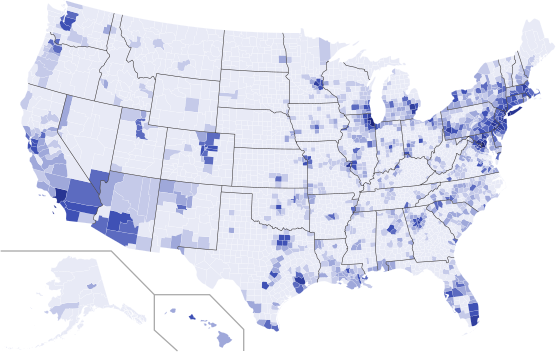
Special education collaborative program teacher demographics and statistics in the US
Special education collaborative program teacher demographics research summary. Zippia estimates special education collaborative program teacher demographics and statistics in the United States by using a database of 30 million profiles. Our special education collaborative program teacher estimates are verified against BLS, Census, and current job openings data for accuracy. Zippia's data science team found the following key facts about special education collaborative program teachers after extensive research and analysis:
- There are over 110,140 special education collaborative program teachers currently employed in the United States.
- 81.0% of all special education collaborative program teachers are women, while 19.0% are men.
- The average special education collaborative program teacher age is 42 years old.
- The most common ethnicity of special education collaborative program teachers is White (71.6%), followed by Hispanic or Latino (11.4%), Black or African American (9.1%) and Unknown (4.0%).
- In 2022, women earned 99% of what men earned.
- 8% of all special education collaborative program teachers are LGBT.
- Special education collaborative program teachers are 90% more likely to work at education companies in comparison to private companies.
Special education collaborative program teacher gender statistics
- Female, 81.0%
- Male, 19.0%
Special education collaborative program teacher gender ratio
| Gender | Percentages |
|---|---|
| Female | 81.0% |
| Male | 19.0% |
Special education collaborative program teacher gender pay gap
Women earn 99¢ for every $1 earned by men


Special education collaborative program teacher gender ratio over time
Special education collaborative program teacher gender ratio by year
| Year | Male | Female |
|---|---|---|
| 2010 | 16.90% | 83.10% |
| 2011 | 14.39% | 85.61% |
| 2012 | 17.09% | 82.91% |
| 2013 | 15.31% | 84.69% |
| 2014 | 15.71% | 84.29% |
| 2015 | 16.32% | 83.68% |
| 2016 | 16.46% | 83.54% |
| 2017 | 16.51% | 83.49% |
| 2018 | 17.12% | 82.88% |
| 2019 | 16.40% | 83.60% |
| 2020 | 19.07% | 80.93% |
| 2021 | 18.97% | 81.03% |
Special education collaborative program teacher related jobs gender ratio
We compared special education collaborative program teachers with similar job titles to see how gender ratios vary. As you can see, auto collision repair instructor and automotive technology instructor have the biggest gender ratio gaps.
| Job title | Male | Female |
|---|---|---|
| Child Development Associate Teacher | 3% | 97% |
| Prekindergarten Teacher | 5% | 95% |
| Infant And Toddler Teacher | 5% | 95% |
| Special Education Collaborative Program Teacher | 19% | 81% |
| Automotive Instructor | 96% | 4% |
| Automotive Technology Instructor | 96% | 4% |
| Auto Collision Repair Instructor | 98% | 2% |
Special education collaborative program teacher demographics by race
- White, 71.6%
- Hispanic or Latino, 11.4%
- Black or African American, 9.1%
- Unknown, 4.0%
- Asian, 3.6%
- American Indian and Alaska Native, 0.3%
Special education collaborative program teacher race
| Special education collaborative program teacher race | Percentages |
|---|---|
| White | 71.6% |
| Hispanic or Latino | 11.4% |
| Black or African American | 9.1% |
| Unknown | 4.0% |
| Asian | 3.6% |
| American Indian and Alaska Native | 0.3% |
Special education collaborative program teacher race and ethnicity over time
See how special education collaborative program teacher racial and ethnic diversity trended since 2010 according to the United States Census Bureau data.
Special education collaborative program teacher race and ethnicity by year
| Year | White | Black or African American | Asian | Hispanic or Latino |
|---|---|---|---|---|
| 2010 | 75.51% | 10.91% | 2.13% | 9.14% |
| 2011 | 74.49% | 11.14% | 2.41% | 9.41% |
| 2012 | 75.86% | 9.53% | 2.63% | 9.71% |
| 2013 | 76.58% | 9.92% | 2.54% | 8.40% |
| 2014 | 73.72% | 10.80% | 3.21% | 9.68% |
| 2015 | 73.41% | 10.87% | 2.76% | 10.21% |
| 2016 | 73.09% | 10.42% | 2.87% | 10.36% |
| 2017 | 72.86% | 10.01% | 3.19% | 11.06% |
| 2018 | 73.80% | 9.02% | 3.13% | 11.37% |
| 2019 | 75.82% | 9.67% | 2.57% | 9.67% |
| 2020 | 72.71% | 9.30% | 3.16% | 10.57% |
| 2021 | 71.57% | 9.15% | 3.59% | 11.37% |
Special education collaborative program teacher wage gap by race
| Ethnicity | Salary |
|---|---|
| Unknown | $45,978 |
| White | $45,572 |
| Black or African American | $45,468 |
| Asian | $47,099 |
| Hispanic or Latino | $46,385 |
Average special education collaborative program teacher age
Special education collaborative program teacher age by race and gender
| Race | Male age | Female age |
|---|---|---|
| Black or African American | 42 | 47 |
| Unknown | 36 | 40 |
| Asian | 47 | 42.5 |
| Hispanic or Latino | 40 | 41 |
| White | 42 | 42 |
| American Indian and Alaska Native | 42 |
Special education collaborative program teacher age breakdown
Special education collaborative program teacher age breakdown
| Special Education Collaborative Program Teacher Years | Percentages |
|---|---|
| 40+ years | 58% |
| 30-40 years | 28% |
| 20-30 years | 13% |
Special education collaborative program teacher educational attainment
- Bachelor's, 64%
- Master's, 26%
- Doctorate, 5%
- Associate, 3%
- Other Degrees, 2%
Special education collaborative program teachers by degree level
| Special education collaborative program teacher degree | Percentages |
|---|---|
| Bachelor's | 64% |
| Master's | 26% |
| Doctorate | 5% |
| Associate | 3% |
| Other Degrees | 2% |
Special education collaborative program teacher jobs you might like
Special education collaborative program teacher wage gap by degree level
| Education | Salary |
|---|---|
| Master's Degree | $53,331 |
| Bachelor's Degree | $48,231 |
| Doctorate Degree | $53,573 |
Special education collaborative program teacher employment statistics
Company size where special education collaborative program teachers work
Special education collaborative program teacher jobs by employer size
| Company size | Percentages |
|---|---|
| < 50 employees | 2% |
| 50 - 100 employees | 15% |
| 100 - 500 employees | 36% |
| 500 - 1,000 employees | 2% |
| 1,000 - 10,000 employees | 30% |
| > 10,000 employees | 15% |
Special education collaborative program teacher jobs by company type
Special education collaborative program teacher jobs by sector
| Company type | Percentages |
|---|---|
| Education | 90% |
| Private | 6% |
| Government | 4% |
Special education collaborative program teacher jobs by industry
The most common industries for special education collaborative program teachers are education, manufacturing and government.
Special education collaborative program teacher industry statistics
| Industry | Percentages |
|---|---|
| Education | 79% |
| Manufacturing | 4% |
| Government | 4% |
| Health Care | 4% |
| Professional | 4% |
| Finance | 2% |
| Non Profits | 2% |
| Utilities | 2% |
Special education collaborative program teacher turnover and employment statistics
Special education collaborative program teacher unemployment rate over time
Special education collaborative program teacher unemployment rate by year
| Year | Special education collaborative program teacher unemployment rate |
|---|---|
| 2010 | 3.76% |
| 2011 | 2.84% |
| 2012 | 2.73% |
| 2013 | 2.09% |
| 2014 | 2.34% |
| 2015 | 2.46% |
| 2016 | 1.61% |
| 2017 | 1.66% |
| 2018 | 0.99% |
| 2019 | 0.83% |
| 2020 | 1.65% |
| 2021 | 1.41% |
Average special education collaborative program teacher tenure
Special education collaborative program teacher tenure statistics
| Number of years | Percentages |
|---|---|
| Less than 1 year | 25% |
| 1-2 years | 37% |
| 3-4 years | 19% |
| 5-7 years | 13% |
| 8-10 years | 4% |
| 11+ years | 4% |
Special education collaborative program teacher LGBT ratio compared to similar jobs
| Job title | LGBT | Job openings |
|---|---|---|
| Infant Lead Teacher | 5.04% | 54,563 |
| Special Education Collaborative Program Teacher | 7.55% | - |
| Drama Teacher | 8.89% | 61,650 |
| Agriscience Instructor | 11.94% | 24,419 |
Similar special education collaborative program teacher jobs LGBT demographics
| Profession | Percentages of LGBT | Job openings |
|---|---|---|
| Infant Lead Teacher | 5.04% | 54,563 |
| Drama Teacher | 8.89% | 61,650 |
| Agriscience Instructor | 11.94% | 24,419 |
Foreign languages spoken by special education collaborative program teachers
- Spanish, 41.7%
- Braille, 16.7%
- French, 16.7%
- Portuguese, 8.3%
- German, 8.3%
- Other, 8.3%
Special education collaborative program teacher languages spoken
| Foreign language | Percentages |
|---|---|
| Spanish | 41.7% |
| Braille | 16.7% |
| French | 16.7% |
| Portuguese | 8.3% |
| German | 8.3% |
| Other | 8.3% |