Explore jobs
Find specific jobs
Explore careers
Explore professions
Best companies
Explore companies
Job outlook for staff biologists in the United States
Staff biologist job growth summary. After extensive research, interviews, and analysis, Zippia's data science team found that:
The projected staff biologist job growth rate is 1% from 2018-2028.
About 100 new jobs for staff biologists are projected over the next decade.
Staff biologist salaries have increased 16% for staff biologists in the last 5 years.
There are over 22,595 staff biologists currently employed in the United States.
There are 69,516 active staff biologist job openings in the US.
The average staff biologist salary is $65,292.
Are staff biologist jobs in demand?
Staff biologist job and salary trends over time
Staff biologist jobs over time
Staff biologist job growth rate over time
| Year | # of jobs | % of population |
|---|---|---|
| 2021 | 22,595 | 0.01% |
| 2020 | 21,276 | 0.01% |
| 2019 | 20,964 | 0.01% |
| 2018 | 20,976 | 0.01% |
| 2017 | 20,112 | 0.01% |
Average staff biologist salary over time
Staff biologist salary by year
| Year | Avg. salary | Hourly rate | % Change |
|---|---|---|---|
| 2026 | $65,292 | $31.39 | +4.6% |
| 2025 | $62,436 | $30.02 | +2.6% |
| 2024 | $60,844 | $29.25 | +3.5% |
| 2023 | $58,812 | $28.27 | +4.3% |
| 2022 | $56,403 | $27.12 | --0.5% |
Staff biologist jobs by state
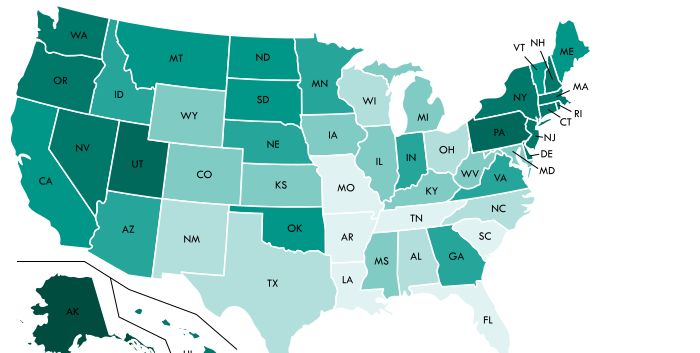
Most common states for staff biologists
| Rank | State | Population | # of jobs | Employment/ 1000ppl |
|---|---|---|---|---|
| 1 | District of Columbia | 693,972 | 160 | 23% |
| 2 | Massachusetts | 6,859,819 | 1,239 | 18% |
| 3 | Rhode Island | 1,059,639 | 139 | 13% |
| 4 | Pennsylvania | 12,805,537 | 1,582 | 12% |
| 5 | California | 39,536,653 | 4,189 | 11% |
| 6 | Maine | 1,335,907 | 148 | 11% |
| 7 | Vermont | 623,657 | 67 | 11% |
| 8 | Oregon | 4,142,776 | 406 | 10% |
| 9 | New Hampshire | 1,342,795 | 129 | 10% |
| 10 | Illinois | 12,802,023 | 1,164 | 9% |
| 11 | New Jersey | 9,005,644 | 774 | 9% |
| 12 | Washington | 7,405,743 | 665 | 9% |
| 13 | Maryland | 6,052,177 | 561 | 9% |
| 14 | Minnesota | 5,576,606 | 520 | 9% |
| 15 | Utah | 3,101,833 | 284 | 9% |
| 16 | Virginia | 8,470,020 | 661 | 8% |
| 17 | Colorado | 5,607,154 | 442 | 8% |
| 18 | Alabama | 4,874,747 | 376 | 8% |
| 19 | Nebraska | 1,920,076 | 161 | 8% |
| 20 | Montana | 1,050,493 | 86 | 8% |
Most common cities for staff biologists
| Rank | City | # of jobs | Employment/ 1000ppl | Avg. salary |
|---|---|---|---|---|
| 1 | Paramount | 1 | 2% | $66,190 |
| 2 | Santa Maria | 1 | 1% | $70,539 |
| 3 | Thousand Oaks | 1 | 1% | $67,255 |
| 4 | Bakersfield | 1 | 0% | $69,865 |
| 5 | Irvine | 1 | 0% | $65,591 |
| 6 | San Diego | 1 | 0% | $64,415 |
Staff Biologist job outlook: Expert opinions
Our panel of staff biologist experts
University of Northern Iowa
Texas A&M University - Kingsville
Pennsylvania State University - Berks
Lake Superior State University
University of Alaska Fairbanks
Coastal Carolina University
University of Rhode Island
Stockton University
Macalester College
Southern Connecticut State University
Pennsylvania State University - York
Cornell University
Saint Xavier University
Norfolk State University
What general advice would you give to a Staff Biologist?
Amy Welsh Ph.D.: I think people like the freedom that the job enables. Many biologists have flexibility with scheduling. In addition, when they are at work they are doing something that really interests them anyway. Wildlife professionals aren't paid as much as some other professions so that would be a negative but there are trade offs that are rewarding.
What Staff Biologist skills would you recommend for someone trying to advance their career?
Amy Welsh Ph.D.: Funding is very good for wildlife management in America. There are many different kinds of specific jobs someone can find depending on their interests (how much they want to work inside vs. outside, do they want to supervise, do they want to be a project leader, etc.)
What will help Staff Biologists increase their earning potential?
Amy Welsh Ph.D.: Depends on the specific job and the specific day. There are species project leaders (in fish, game, or conservation) that have specific research projects that require field work but also inside data analysis and writing. Most of these people have a M.S. degree. Someone entering the field with a B.S. typically does more outside work. This would depend on their specific job but may be data collection, taking care of wildlife management areas, etc.
Alison Hamilton
Assistant Teaching ProfessorWhat general advice would you give to a Staff Biologist?
Alison Hamilton: (As an aside----You do realize that you have asked this question of an academic biologist, right? Someone who spent way too much time in school earning way too many degrees and living on very little money until finally getting a “real” job after 16 years of post-graduate training and education……and still makes less than some of my students do when they graduate…..:) This is clearly something that I know NOTHING about😊)
Again, I think that having some experience will help. If you worked in the industry for 6 months while working on your degree you may be able to start at a higher salary than someone with no previous experience. The same may well be true for having in-demand coding or data analysis skills or even for experience with developing professional looking presentations, websites, or podcasts. Expertise and experience could result in a better offer and they will certainly increase interest in your resume.
What Staff Biologist skills would you recommend for someone trying to advance their career?
Alison Hamilton: The co-op advisers at UML work with lots of different employers in this area and they have told me that in addition to laboratory skills (which all of our biology majors have lots of exposure to) they are looking for students with strong written and oral communication skills. Other skills in demand are critical thinking, problem solving, and analytical skills. Given the innovations and new technologies in scientific fields, expertise in a particular technique or methodology may become less essential or be learned on the job, yet strong communication skills and expertise in data analysis will remain sought after by employers across the biological sciences.
Getting hands on experience and exposure to research is a great way to discover what you love, make your resume stand out and build professional relationships and networks that can help you secure a job when you graduate. I know that many of the students in Biological Sciences at UML who participated in a co-op with a local employer went on to work for that company after graduation.
What will help Staff Biologists increase their earning potential?
Alison Hamilton: Be sure to emphasize your strengths—even if they might not seem directly applicable to a position you are interested in. Your resume should include techniques, skills, and approaches with which you have experience, but think about other things you have accomplished, whether paid or volunteer. You don’t know when your language skills, fundraising experience, public speaking, partnership with a local community non-profit, or teenage years helping with the family fishing or farming business may matter. Biology is such a diverse discipline and new career pathways using the skills and education inherent in a biology degree are evolving all the time.
What general advice would you give to a Staff Biologist?
Vicki Singer Ph.D.: The biggest difference in what one would do on a daily basis as a bioscientist is between someone entering professional life with an undergraduate versus a graduate degree rather than on the specific discipline one chooses to study.
What will help Staff Biologists increase their earning potential?
Vicki Singer Ph.D.: Postdoctoral training may become more and more essential, to allow new entrants to effectively compete with other highly trained professionals re-entering the workforce after recent pharma/biopharma layoffs.
What general advice would you give to a Staff Biologist?
Theresa Spradling: All of the jobs that biologists do help other people, and that brings biologists personal satisfaction with their job.
What Staff Biologist skills would you recommend for someone trying to advance their career?
Theresa Spradling: The world needs more people who are prepared to work in healthcare, who can understand and protect nature, who can research diseases, or teach. All of the fields that biologists work in are experiencing job growth.
What will help Staff Biologists increase their earning potential?
Theresa Spradling: Biology is the study of life, including bacteria, plants, animals, and people, so biology is an incredibly diverse field! What biologists do day to day depends on the area of biology that the biologist works in. Some biologists work in the field of conservation to protect animals and plants, some work in scientific research labs to advance our knowledge of nature and of medicines, some biologists teach, and some biologists specialize in helping people in healthcare settings by serving as doctors, nurses, physicians assistants, physical therapists, genetic counselors, dentists, and more. Each of these people have jobs that differ day to day and hour to hour.
Scott Henke PhD
Regents ProfessorTexas A&M University - Kingsville
Wildlife And Wildlands Science And Management
What will help Staff Biologists increase their earning potential?
Scott Henke PhD: The trend in the wildlife field is to seek employees with higher degrees (i.e., MS degrees +), especially when seeking middle management or higher levels (research type job) or supervisory level positions. Therefore to ensure your competitiveness as you develop in your career, seek at least a MS level education. True story: I had a student (let’s call him Bill) who was not interested in a higher education nor did he take his coursework during his BS degree too seriously. Bill graduated from our wildlife program with a satisfactory GPA (~2.75, which is a C+ level). Not stellar, but good to graduate. Bill interviewed well and got a job with the state wildlife agency. After a year of working Bill was asked to train a new employee (who had a MS degree). That new employee eventually became Bill’s boss because the new employee held an advanced degree. Again, Bill was asked to train another student (again with a MS degree) and the same outcome happened again. This time Bill decided to never let it happen again and he desired to earn a MS degree. Unfortunately, Bill’s GPA from his BS degree (2.75) was insufficient to get accepted into a graduate level program. Bill is most likely as high a level as possible in his career, even though he is at best considered mid-career. The moral of this story is to make sure you do as well as possible in your BS program. Stay in school and retake classes if you must, but do not graduate with a BS degree unless you have at least a 3.0 GPA (3.25+ is better). You may not have a desire to ever get a graduate degree (MS or PhD); however, if the opportunity arises or if your job situation changes where a higher degree is needed, at least that door is still available to you. Look at your life in the long-term. Graduate school may not be desired NOW, but it may become necessary or desirable later. Don’t close that door on yourself by the age of 20. That’s too young to make a decision that could affect the rest of your life.
Maureen Dunbar PhD
Program Chair/Associate Professor of BiologyPennsylvania State University - Berks
Information Science/Studies
What general advice would you give to a Staff Biologist?
Maureen Dunbar PhD: The most important skill is flexibility and the ability to be a self-learner. Laboratory sciences change incredibly fast, and it is important to keep up with the changes and to be willing and able to learn new techniques and skills.
What Staff Biologist skills would you recommend for someone trying to advance their career?
Maureen Dunbar PhD: For graduates entering the field of biology, I would recommend that they be persistent and open-minded when looking for jobs, especially in the pharmaceutical industry. The most important criteria for a career in biology (or really any laboratory science) is experience. You may need to accept an entry-level position for a year or so, but if you work hard you will advance in the company quickly.
What will help Staff Biologists increase their earning potential?
Maureen Dunbar PhD: To maximize your starting salary, try to get as much lab experience as possible during your college years. Undergraduate research, internships, and co-op experiences are wonderful opportunities for students to gain lab experience. If that is not possible, be open to positions that will give you as much lab experience as possible even if you can't see yourself in that specific area long term.
What general advice would you give to a Staff Biologist?
Dr. Kevin Kapuscinski Ph.D.: Traditional fisheries skills such as setting and lifting nets, and collecting biological data from fish will continue to be important. Managing, analyzing, and interpreting data using spreadsheets and statistical software are also essential in fisheries. Other skills such as acoustic telemetry (deploying & maintaining receivers, implanting fish with transmitters), analyzing spatial data or other 'big data' sets, and laboratory skills (e.g., eDNA, water quality, emerging contaminants) are likely to increase in demand as technologies continue to develop.
What Staff Biologist skills would you recommend for someone trying to advance their career?
Dr. Kevin Kapuscinski Ph.D.: For fisheries technicians, salary potential can be maximized by obtaining special skills and certifications (e.g., geospatial data analysis, captain's license). For fisheries biologists and researchers, salary potential can be maximized by earning a graduate degree.
What will help Staff Biologists increase their earning potential?
Dr. Kevin Kapuscinski Ph.D.: Recent graduates in the areas of aquaculture, fishery science, and fisheries management should say yes to opportunities and challenge themselves. This might mean moving across the country for their first job, going to a workshop to learn a new skill, or presenting at a professional conference. Having a growth mindset will help early career professionals find the path that is best for them and build a rewarding career.
What general advice would you give to a Staff Biologist?
Jennifer Slate PhD: Because there are so many types of jobs in biology, there is a job to suit everyone! Jobs may be people-oriented, focus primarily on labwork, or even allow one to spend time outdoors. Many (but not all) jobs in biology require further education after finishing the bachelor’s degree. Biology graduates often go on to health professional programs, to obtain teaching certification, or to obtain a master’s or PhD degree.
What Staff Biologist skills would you recommend for someone trying to advance their career?
Jennifer Slate PhD: There is currently a huge demand for workers in biology and other STEM professions. Healthcare workers are especially needed in nursing, medicine, and physical therapy. There is a shortage of teachers, particularly those who can teach biology or other sciences. The huge amount of biological data that is available, such as in genetics and environmental biology, means that scientists with analytical skills have great job opportunities.
What will help Staff Biologists increase their earning potential?
Jennifer Slate PhD: There are so many different types of jobs in biology, to suit people of different interests. Biologists work in health care, in research labs, in environmental protection, and in teaching- just to name a few fields. Responsibilities on a day-to-day basis will depend upon the particular job field. Common skills required on a daily basis include use of computer software, ability to make and record detailed observations, and teamwork/communication skills.
What general advice would you give to a Staff Biologist?
Falk Huettmann: FH Many problems these days are complex in nature, and involve aspects of the living world. To be fluent on those aspects is essential and expertise is needed. A Biology degree can provide that skill set.
What Staff Biologist skills would you recommend for someone trying to advance their career?
Falk Huettmann: FH Some people might dismiss education overall, others do not like to acknowledge, or work on, environmental or biological aspects. But reality remains, we are living beings and surrounded by the living world. We are part of the world's biology; so it's best to be fluent on those matters and well educated.
What will help Staff Biologists increase their earning potential?
Falk Huettmann: FH Biology is a very big topic and a large discipline. Many biologists work on microbiological aspects. In my case our graduates often do biodiversity and species work, employing data, using geographic information system (GIS) mapping and modeling predictions using machine learning and Artificial Intelligence (AI) for environmental applications worldwide, e.g. climate change, impact and risk assessments. That's a big field for employment across the board.
What general advice would you give to a Staff Biologist?
Danielle Silvia: There are many emerging trends and changes in the natural world making biology a fascinating career to embark on. According to the US Bureau of Labor Statistics, the field of biology is predicted to see a 5% increase in job growth through 2032, as biologists are in high demand across areas such as healthcare, environmental science, sustainability, biotechnology, and more. Due to pressing issues like climate change, the disappearance of species and nature, public health crises, drug development, and genetic engineering, becoming a biologist today will provide career advancement tomorrow. You’ll have the opportunity to make a difference in important areas of society while pursuing an intellectually stimulating career for the long-term.
What Staff Biologist skills would you recommend for someone trying to advance their career?
Danielle Silvia: A day in the life of a biologist typically involves researching various forms of life, such as bacteria, animals, plants, how they impact the world around them, and vice versa. Biologists may run experiments to work towards answering these questions, using some of the latest and greatest scientific tools and techniques in a laboratory setting. The job scope also includes collecting and reviewing data from research and experiments, and creating reports based on findings to solve important problems. Biologists work at all levels on organisms from the molecular to the whole organism to populations.
What will help Staff Biologists increase their earning potential?
Danielle Silvia: Working in the field of biology offers a variety of distinct occupations, and the likes and dislikes may vary from person to person. However, if you’re somebody who enjoys thinking analytically, asking big questions then testing them, and exploring natural environments, this career path may be the right fit for you.
Derek Crane Ph.D.
Associate ProfessorCoastal Carolina University
Ecology, Evolution, Systematics, And Population Biology
What general advice would you give to a Staff Biologist?
Derek Crane Ph.D.: The great thing about biology is that it is an incredibly broad and diverse field that people with a variety of skill sets and interests can work in. Based on the field of biology someone is in, their day-to-day activities can vary from sampling and observing plants and animals, working in a lab processing samples, or analyzing data and communicating results (sometimes all within a single day for someone!). Entry-level biologists are typically involved in more of the hands-on work in the field or lab, collecting data, and as they gain experience they become more involved in the analytical and communication aspects of the job.
What Staff Biologist skills would you recommend for someone trying to advance their career?
Derek Crane Ph.D.: I think that people enjoy careers in biology because they can continuously learn, the work can differ from day to day, and it allows them to be creative. Because biology is a science, learning in biology is based on data and evidence, and when data and evidence are ignored or not used in a decision-making process it can be frustrating.
What will help Staff Biologists increase their earning potential?
Derek Crane Ph.D.: Some of our greatest challenges as a global society, such as food security under a changing climate, predicting, preventing, and handling of future pandemics, and rapid loss of biodiversity are based in biology. We need smart, energetic, and motivated people to address these issues.
What general advice would you give to a Staff Biologist?
Brian Plouffe PhD: Recent graduates in the biological sciences traditionally have a broad education in the many aspects of biology. Recent graduates are well prepared to enter the fields of pharmaceuticals, healthcare, agriculture, food processing and safety, environmental, and biotechnology. Graduates in the biological sciences may work outside in the field collecting samples for analysis or farms growing crops. Others may work in a research lab doing bench work in cell biology, microbiology, or genetics. Many graduates work in healthcare assisting with disease diagnostics and therapeutics. Given the broad nature of the field, the possibilities are endless on what someone could do with their career. No two days may be the same, and it is a very dynamic field to enter.
What Staff Biologist skills would you recommend for someone trying to advance their career?
Brian Plouffe PhD: The biological sciences are an ever-evolving field, so graduates may be at the forefront of innovation in the fields of drug discovery and development, agriculture, and healthcare. With the new advances in genetic engineering and molecular biology, graduates will be involved in future advances that may change the work of medicine, food insecurity and sustainability, and climate control. The broad education of recent graduates will also give the foundation to find and keep a career in a wide variety of fields and industries.
What will help Staff Biologists increase their earning potential?
Brian Plouffe PhD: People in the field of biological sciences see the impact of their work on society, which drives them in their career. Biologists are involved in many of the advances that are happening in medicine, agriculture, and climate change, so people in these fields have fulfillment in their careers. That being said, as the field is advancing and growing, the field is also becoming more complex and advanced degrees have become more commonplace in the field. The biological sciences have become a field that is starting to demand more from their scientists, and the pay has not followed suit with these demands. Additionally, many biologists put in long hours and this time at the lab, in the field, and at lectures and conferences all contribute to many biologists' lack of a personal life outside the discipline.
What general advice would you give to a Staff Biologist?
Dr. Adam Aguiar Ph.D.: Biology offers a variety of career opportunities in labs, industry, journalism, environmental organizations, policy-making, teaching, etc. The field is essential for addressing societal challenges and is stable in society.
What Staff Biologist skills would you recommend for someone trying to advance their career?
Dr. Adam Aguiar Ph.D.: Biologists enjoy different aspects such as fieldwork, lab work, data analysis, and communicating scientific concepts. Some find fulfillment in teaching and public seminars, while others may have preferences for specific tasks within the field.
What will help Staff Biologists increase their earning potential?
Dr. Adam Aguiar Ph.D.: The daily routine of a biologist can vary on a day-to-day basis, involving being out in the field collecting data, working in a lab using special instruments, or at a computer organizing and analyzing data. Writing for publications and grant proposals is also essential.
What general advice would you give to a Staff Biologist?
Elena Tonc: Big data analysis is becoming an increasingly important skill in both ecology and molecular biology fields so getting as much experience through classes and internships will be valuable, as well as bioinformatic experience specifically with genomics and proteomics for graduates interested in biomedical research. Further, the ability to collaborate across disciplines within biology and outside are becoming increasingly important for tackling complex biological challenges.
What Staff Biologist skills would you recommend for someone trying to advance their career?
Elena Tonc: Stay curious and keep learning-the field is constantly evolving with new techniques and building on previous knowledge so it will be important to stay up-to-date. Also, more generally, there is always something new to learn in biology or explore a new subfield. Another thing to keep in mind is building relationships. Reach out to professionals who are on the career path you desire and schedule informational interviews as they are a fantastic way to gain insights, advice, and potentially even mentorship. Learning from others' experiences can help you navigate your career path more effectively and open up opportunities you might not have considered otherwise. The diversity of career trajectories in biology means there's no one-size-fits-all approach, so being proactive in seeking guidance and learning from others' journeys can be immensely valuable.
What will help Staff Biologists increase their earning potential?
Elena Tonc: Having a specialized skillset is one way to increase your compensation potential early in your career as those jobs are high in demand and companies might offer bigger salary incentives as a recruitment tool. Of course, negotiation is a big part too-don't be afraid to ask for higher compensation after researching salary ranges for similar positions in your location.
What general advice would you give to a Staff Biologist?
William Farley PhD: Make sure to find out the real story when it comes to careers that are available to people studying what you are passionate about and what you are majoring in. Don't read those terrible lists of "worst majors for your career" because they generally traffic in pure stereotypes and involve zero research. Besides the obvious answers that tons of employers are looking for the skills you get with a degree in something like Anthropology or Sociology or Philosophy - oftentimes those disciplines have their own industries that can be lucrative on their own. Case in point, I'm an archaeologist. There is a whole archaeology industry called Cultural Resource Management that is in a desperate labor shortage and will be for at least the next decade. Folks with a master's degree can earn $100k or more in that industry, and state and federal government agencies hire lots of archaeologists for jobs with good pay and great benefits. Get to know the faculty who might have contacts in those industries, because there are probably internships, paid work, or grant-funded projects that will make you a desirable candidate for those jobs. Find out what skills that industry needs and think about how you can start developing them before you graduate, or where you can get them in entry-level jobs after graduation.
What Staff Biologist skills would you recommend for someone trying to advance their career?
William Farley PhD: Critical thinking, communication, and creativity are key skills in so many industries, and that will only become more important in a future that relies increasingly on computer-generated content. Creative flexibility and a passion for learning and growing will put you in a great position as new technologies continue to transform just about every industry. Critical thinking will be essential as scams and misinformation become increasingly auto-generated. Knowing how to write well will make your work stand out even brighter when compared to the junk others will be churning out with ChatGPT.
What will help Staff Biologists increase their earning potential?
William Farley PhD: In general, I think trying to find information about how to advance in a career on the internet has limited benefits. It's a great place to start, but ultimately mentorship is the best way to start and advance in a career. Maybe that's a faculty member, maybe that's your supervisor at your first job out of school, or it might be your colleagues who are just a year or two ahead of you. All of these folks can teach you so much about how to actually advance and to make more money. Do you need a graduate degree? How do you get one? Do you need certain skills? How do you learn those skills? Every industry is ultimately so niche, general advice can quickly become useless. Advice from people who have real experience in that industry is essential.
What general advice would you give to a Staff Biologist?
Jessica Petko: Teaching - Use of technology (virtual reality, AI, remote teaching) and active learning techniques. Research - For cell and molecular biology, experience with bioinformatics (computer programming, working with large datasets, experience with various genome sequencing platforms) and experience with histology and imaging.
What Staff Biologist skills would you recommend for someone trying to advance their career?
Jessica Petko: For teaching my advice for new biology professors is to take an active approach to teaching. During COVID, I redesigned my courses as flipped classes, where students watch lectures outside of class, and then do activities applying the material during lecture time. This has increased retention of introductory material through upper-level course work. I also suggest bringing your research into the classroom for examples where possible. It's a great recruiting tool for getting research students. Lastly, if you are just starting out in teaching, you will have to realize that your first semester will not be perfect. It takes about three times teaching a class to adapt it to your student population. Don't be hard on yourself and be open to suggestions from students. For research at a small campus, I have two pieces of advice. First, find an area of research that you are passionate about, but one where you won't be competing with researchers at huge universities. Second, develop collaborations with experienced researchers.
What will help Staff Biologists increase their earning potential?
Jessica Petko: While it is possible to enter a teaching position right after your PhD, it is encouraged to get postdoctoral experience. As a postdoc, you will learn new techniques, gather data, and develop projects you can take with you into a tenure track position. The additional experience will be taken into consideration for compensation. Also, negotiate not only for your starting salary but also start-up funds.
Professor Marvin Pritts
Professor of HorticultureCornell University
International Agriculture
What general advice would you give to a Staff Biologist?
Professor Marvin Pritts: Everyone has to eat, and as the population grows and resources diminish, there is ever increasing demand for more and better-quality food. Even the animals we eat rely on plant-based food. There will never be a time when plant science becomes obsolete. New pests and climate change require that the genetics of our crops and the ways crops are managed change as well. Preservation of our remaining natural areas is critical for ecosystem functioning and quality of life. When COVID hit, attendance at parks skyrocketed and has not diminished. Participation at pick-your-own farms went way up as people rediscovered a connection with nature and their food. So it's a great time to pursue a profession in plant science.
What Staff Biologist skills would you recommend for someone trying to advance their career?
Professor Marvin Pritts: Some jobs are mostly lab-based while others are field-based. Still others involve education or data management so would occur mostly inside. I think the best type of job is one that involves all three components, and a career in plant science can allow for one to participate in all of these. Lab-based jobs typically involve some sort of research, genetic studies, propagation, or analyses of samples. Field-based jobs typically involve growing or propagating plants, data collection or scouting, pest management, plant breeding, or crop and natural area management. The number of careers that fall under the plant science category is very diverse so there is no typical day. Even within a particular career, what is done in a day varies greatly by season of the year.
What will help Staff Biologists increase their earning potential?
Professor Marvin Pritts: Some jobs are mostly lab-based while others are field-based. Still others involve education or data management so would occur mostly inside. The best type of job involves all three components, and a career in plant science allows for one to participate in all of these. Lab-based jobs typically involve research, genetic studies, propagation, or analyses of samples. Field-based jobs involve growing or propagating plants, data collection or scouting, pest management, plant breeding, or crop and natural area management. The number of careers under plant science is diverse so there is no typical day. Even within a particular career, daily tasks vary greatly by season of the year.
What general advice would you give to a Staff Biologist?
Kristen Willems PhD: At the beginning of your career it is most important to keep learning from those around you with more experience. There is a lot of knowledge about the day to day hands-on work in Biology which they can teach you in and out of the lab.
What Staff Biologist skills would you recommend for someone trying to advance their career?
Kristen Willems PhD: Being familiar with new technologies like CRISPR and skills in immunobiology will become more important in the next few years but the fundamental skills like cell culture, PCR and western blotting will continue to be used in every area of Biological research.
What will help Staff Biologists increase their earning potential?
Kristen Willems PhD: Know your worth. How much are other companies and schools paying someone in this position? What are the different expectations and benefits in these positions as well. There are other things to consider when weight job offers than just salary.
Tatiana Tatum Ph.D.
ProfessorSaint Xavier University
Health/Medical Preparatory Programs
What general advice would you give to a Staff Biologist?
Tatiana Tatum Ph.D.: For a graduate starting their career in biology, my general advice would be to stay curious and open-minded. Biology is a vast and rapidly evolving field, so it's important to keep learning and adapting to new developments. Network with professionals in your field, seek out mentorship opportunities, and don't be afraid to explore different areas of biology to find where your passions lie. Additionally, gaining practical experience through internships, volunteer work, or research assistantships can be invaluable in building your skills and credibility.
What Staff Biologist skills would you recommend for someone trying to advance their career?
Tatiana Tatum Ph.D.: In the next 3-5 years, several skills are likely to become more important and prevalent in the field of biology. These include proficiency in data analysis and bioinformatics, as advancements in technology generate vast amounts of biological data that need to be interpreted and analyzed. Additionally, interdisciplinary skills, such as the ability to collaborate with experts in fields like computer science, engineering, and mathematics, will be increasingly valuable as biology becomes more integrated with other disciplines. Furthermore, expertise in emerging areas such as synthetic biology, gene editing technologies like CRISPR, and personalized medicine could offer significant opportunities for growth and impact.
What will help Staff Biologists increase their earning potential?
Tatiana Tatum Ph.D.: Maximizing salary potential when starting a career in biology involves several strategies. Firstly, pursue advanced education and training, such as obtaining a master's or doctoral degree, which can lead to higher-paying positions and increased opportunities for advancement. Specializing in high-demand areas of biology, such as biotechnology, pharmacology, or bioinformatics, can also enhance your earning potential. Additionally, gaining relevant work experience through internships, co-op programs, or research positions can make you more competitive in the job market and command higher salaries. Finally, consider seeking employment with companies or organizations in regions with a high demand for biologists and a higher cost of living, as salaries tend to be higher in these areas.
Nazir Barekzi Ph.D.
Associate ProfessorNorfolk State University
Biology
What general advice would you give to a Staff Biologist?
Nazir Barekzi Ph.D.: In order to maximize the salary potential in the field of Biology, stay focused to the fundamental basics and use your skillset to problem solve obstacles and overcome them with confidence. You are no longer in the classroom, so it's time to show off all that you know. In addition, leverage your skills learned in hands-on labs to maximize your salary potential.
What Staff Biologist skills would you recommend for someone trying to advance their career?
Nazir Barekzi Ph.D.: In the field of Biology, it is easy to see that genome analysis and integrating genetic counseling with medical treatment will become more prevalent and common place. Counseling in general will be linked to the biology field as we prepare for future pandemics and realize the importance of mental health.
What will help Staff Biologists increase their earning potential?
Nazir Barekzi Ph.D.: As a graduate with a degree in Biology, I advise that you keep up with the technology in the biomedical field. In the age of gene editing, personalized medicine, and advanced implants, the biology degree is a valuable asset to have.