Explore jobs
Find specific jobs
Explore careers
Explore professions
Best companies
Explore companies
Job outlook for staff reporters in the United States
Staff reporter job growth summary. After extensive research, interviews, and analysis, Zippia's data science team found that:
The projected staff reporter job growth rate is -10% from 2018-2028.
About -5,100 new jobs for staff reporters are projected over the next decade.
Staff reporter salaries have increased 16% for staff reporters in the last 5 years.
There are over 15,365 staff reporters currently employed in the United States.
There are 70,415 active staff reporter job openings in the US.
The average staff reporter salary is $44,906.
Are staff reporter jobs in demand?
Staff reporter job and salary trends over time
Staff reporter jobs over time
Staff reporter job growth rate over time
| Year | # of jobs | % of population |
|---|---|---|
| 2021 | 15,365 | 0.00% |
| 2020 | 16,348 | 0.00% |
| 2019 | 17,338 | 0.01% |
| 2018 | 15,315 | 0.00% |
| 2017 | 15,996 | 0.00% |
Average staff reporter salary over time
Staff reporter salary by year
| Year | Avg. salary | Hourly rate | % Change |
|---|---|---|---|
| 2026 | $44,906 | $21.59 | +3.5% |
| 2025 | $43,383 | $20.86 | +3.0% |
| 2024 | $42,138 | $20.26 | +4.8% |
| 2023 | $40,208 | $19.33 | +4.1% |
| 2022 | $38,625 | $18.57 | +4.0% |
Staff reporter jobs by state
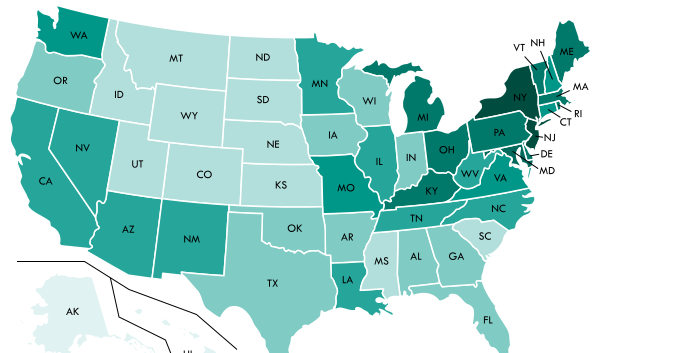
Most common states for staff reporters
| Rank | State | Population | # of jobs | Employment/ 1000ppl |
|---|---|---|---|---|
| 1 | District of Columbia | 693,972 | 168 | 24% |
| 2 | Massachusetts | 6,859,819 | 1,182 | 17% |
| 3 | Pennsylvania | 12,805,537 | 1,523 | 12% |
| 4 | Rhode Island | 1,059,639 | 129 | 12% |
| 5 | Minnesota | 5,576,606 | 531 | 10% |
| 6 | Oregon | 4,142,776 | 408 | 10% |
| 7 | Maine | 1,335,907 | 139 | 10% |
| 8 | New Hampshire | 1,342,795 | 128 | 10% |
| 9 | Vermont | 623,657 | 61 | 10% |
| 10 | Illinois | 12,802,023 | 1,183 | 9% |
| 11 | New Jersey | 9,005,644 | 774 | 9% |
| 12 | Maryland | 6,052,177 | 518 | 9% |
| 13 | Nebraska | 1,920,076 | 165 | 9% |
| 14 | Washington | 7,405,743 | 623 | 8% |
| 15 | Missouri | 6,113,532 | 473 | 8% |
| 16 | Colorado | 5,607,154 | 447 | 8% |
| 17 | Iowa | 3,145,711 | 256 | 8% |
| 18 | Montana | 1,050,493 | 83 | 8% |
| 19 | Ohio | 11,658,609 | 801 | 7% |
| 20 | Delaware | 961,939 | 69 | 7% |
Staff Reporter job outlook: Expert opinions
Our panel of staff reporter experts
University of Cincinnati Clermont College
SUNY College at Oswego
Utah State University
Fairfield University
The University of Findlay
Northwestern State University of Louisiana
University of San Francisco
The University of the Arts
Western Kentucky University
University of Miami
California State University - Fullerton
Georgia State University
Kutztown University of Pennsylvania
New Mexico State University
Dallas Baptist University
Metropolitan State University
Metropolitan State University of Denver
University of Missouri - Kansas City
What general advice would you give to a Staff Reporter?
Laura Wilson: Writing and editing will always be important and prevalent. Clear communication is increasingly important. Encourage writers to work WITH AI by learning how to use the software and edit the output. Encourage exploration of certificates to make them more marketable.
What Staff Reporter skills would you recommend for someone trying to advance their career?
Soma Frazier: Take on a variety of jobs. For instance, while teaching and writing creative works, I was also freelancing and writing grants. In doing so, I developed multiple income sources as well as a broad skill base that ultimately equipped me to secure higher-paying opportunities. Beyond that, each job shaped my creative writing: crafting pithy articles taught me to revise down, while developing grant proposals taught me to make a specific mission or topic feel relevant to the everyday reader. You may hit the jackpot and land your dream career straight out of school. If you're like the rest of us, though, there will be a period of uncertainty in which you're building your portfolio and finding your stride. That's the perfect time to take a note from improv comedians and be receptive to opportunities and ideas by saying 'Yes.'
What general advice would you give to a Staff Reporter?
Shane Graham: Remember the skills you honed as an English major: pay close attention to detail, ground your thinking in evidence, find reliable sources of information, and put things in their larger context. All of these skills will serve you well in whatever job you pursue.
What Staff Reporter skills would you recommend for someone trying to advance their career?
Shane Graham: All the skills I mentioned above. Humanities degrees, and the kinds of thinking they encourage, will only become more important in the years to come. AI chatbots can only regurgitate and mimic thinking that already exists in the world; the well-trained human brain can create something new.
Rachel Robinson-Zetzer PhD
Assistant Professor of the Practice and Assistant Director of Core WritingFairfield University
Rhetoric And Composition/Writing Studies
What general advice would you give to a Staff Reporter?
Rachel Robinson-Zetzer PhD: People are scared of the blank page. Too often, they think that what they write needs to be perfect in its first iteration; however, that’s a myth and a romantic notion of the lone, solitary writer. In fact, much writing happens in collaboration with others, and people are either drawn to that environment, or they aren’t. Once people realize that writing is malleable, meaning it can be changed and revised again and again, that desire to seek perfection lessens, and Writers are more willing to kill their darlings.
What Staff Reporter skills would you recommend for someone trying to advance their career?
Rachel Robinson-Zetzer PhD: Writing is a great profession to enter now because it’s a way to reach a specific audience for a specific purpose. With all the misinformation in the world today, Writers have a lot of power. It’s an exciting time to let your voice be heard, whether that’s through fiction, newswriting, memoir, cartoon, or something else.
What general advice would you give to a Staff Reporter?
Amy Rogan: Many think that journalism is dying when in actuality is evolving. There are so many media sites out there that are not actual journalism and yet, our society needs real journalism now more than ever. Misinformation and disinformation spread so quickly, it contaminates the media landscape. But we need journalists willing to build their reputation and their audience so that trained professional journalists drown out the fiction or infotainment.
What Staff Reporter skills would you recommend for someone trying to advance their career?
Amy Rogan: Journalists do a number of things and no two days look alike. Journalists need to have sound, solid news judgement and know their audience and what their audience needs to know. They pitch stories to their editors, producers, or managers, then they research their story topic, find the appropriate interviews and set those up. Once they complete the interviews and gather all their research they then have to craft a story that captures the readers’ or viewers’ attention and serves the community. Typically, that is just one day of work unless you’re working on a special project. Multimedia skills are in high demand because journalists are on so many platforms these days. You need to know how to write for print, digital, and broadcast. And, if you know how to shoot and edit video as well as write, your name goes to the top of the list.
What will help Staff Reporters increase their earning potential?
Amy Rogan: People working in journalism probably most dislike the hours and the pay but it’s truly one of the most rewarding fields to work in. It can be stressful but also exciting and challenging. Whether at the local level or a larger stage, it’s truly a service to your community to provide vital information.
What Staff Reporter skills would you recommend for someone trying to advance their career?
Dr. Allison Rittmayer: Don't undercut your skills and experience. You are likely qualified for more jobs than you think you are. You need to promote your experience writing in different genres and across media. Likewise, don't be afraid to take on new projects in unfamiliar formats or unfamiliar roles. That is the key to continual growth.
What Staff Reporter skills would you recommend for someone trying to advance their career?
Dean Rader: Well, writing, reading, and communication skills are always going to be vital. AI won't change that. In fact, the very things AI can't do yet is be human. And no major trains people better to interact with humans than English. Right now, video game manufacturers need writers, tech companies need editors, Websites need copywriters. But, every field can use an English major. Every field needs people with vision and ideas. The world needs people with clarity, who can articulate ideas, and who can make connections. That defines an English major.
What general advice would you give to a Staff Reporter?
Paul Cook: English is way more than just the study of literature. English majors learn how to read, write, and speak well—three essential and timeless skills that will serve you well in your professional lives, in a knowledge economy, and in the (post)digital era.
What will help Staff Reporters increase their earning potential?
Michael Pennell: Gain experience while in college, through internships, coursework, service, etc. Find your niche and differentiate yourself from others in the field. Consider how a specific minor or certificate may give you an edge. For example, a certificate or minor in professional and technical writing can enhance a candidate's appeal to employers, as well as maximize salary potential. Adding an internship and other 'real world' experience on top of that minor or certificate further maximizes one's earning potential. Develop a strong portfolio! Finally, networking may also maximize salary potential—do people know you and do they see you as an asset for their company or organization? Much of this advice applies equally to those pursuing freelance and contract work, as well.
What Staff Reporter skills would you recommend for someone trying to advance their career?
Professor Mac McKerral: Fact checking. Ethical use of AI. Getting back to dealing with sources face-to-face. Using literary writing devices to tell great stories.
Prof. Laura Betz PhD
Associate Teaching Professor and Director of Undergraduate Studies in EnglishWhat Staff Reporter skills would you recommend for someone trying to advance their career?
Prof. Laura Betz PhD: Any graduate beginning a career should feel very confident in the skills of critical thinking, writing, and public speaking that the English major has provided, and should be bold in putting those skills to work in many different professional contexts.
What general advice would you give to a Staff Reporter?
Jaswinder Bolina Ph.D., M.F.A.: Salary follows success. If you invest yourself deeply and fully into whatever sector you find yourself in, whatever postgraduate degree you decide to pursue, you will become the kind of rare and original thinker the world needs and that employers reward. Be yourself and pursue your passions, and if you’re stuck in a job that doesn’t match those passions, then figure out a way to bring them into that space. Or find someplace else to work. We don’t always have the luxury of the latter option, but we do always have a chance to bring what we love to whatever it is we happen to be doing, whether writing our own novels and poems, working on PowerPoint presentations and white papers, or slinging coffee or cocktails. Your job isn’t you, so shape your job to fit the person you really are and the person you hope to be.
What Staff Reporter skills would you recommend for someone trying to advance their career?
Jaswinder Bolina Ph.D., M.F.A.: As large-language model artificial intelligence permeates the marketplace, those with truly unique reading, writing, and analytical skills will become more important than ever. Most crucial will be the ability to quickly identify formulaic writing and thinking done by machines while offering vibrant, original, and human solutions to social, political, and economic problems. Your English major taught you how artful and inventive language can offer singular and vital perspective. Seek out that kind of language and insight. Relish every opportunity to produce it yourself.
What Staff Reporter skills would you recommend for someone trying to advance their career?
Irena Praitis: English majors are excellent communicators, collaborators, and critical thinkers. Communication skills are highly sought as are skills for people working together. Graduates should emphasize their communication and critical thinking skills, emphasizing also creative thinking and working with and understanding others.
What will help Staff Reporters increase their earning potential?
Irena Praitis: Always ask for the top of the salary range offered. Stress that the skills you bring will strengthen and grow as you learn and adapt to a particular organization's work environment.
What general advice would you give to a Staff Reporter?
Helen Cauley Ph.D.: The best way is to show you already have experience, and the employer won’t need to train you. An applicant who arrives ready to hit the ground running stands a better chance of getting the job and the top salary over someone who has never been published, taken a photo, put together a video story or – most important! – proved they can meet a deadline under pressure.
What Staff Reporter skills would you recommend for someone trying to advance their career?
Helen Cauley Ph.D.: The need for people who can tell accurate, engrossing stories in a variety of media is increasing. That means being able to write concisely, speak with authority and take photos/video/sound that engage an audience. Don’t expect to have a camera crew or editor at your elbow. The more proficient you can be in mastering those tasks, the more valuable you will be.
Dr. Arthur Garrison LP.D.
ProfessorKutztown University of Pennsylvania
Criminal Justice And Corrections
What Staff Reporter skills would you recommend for someone trying to advance their career?
Dr. Arthur Garrison LP.D.: Don’t chase salary. Seek a job that will point you in the direction you want to go. Your first job is not your last. You have your whole life ahead of you. You don’t need to have all the answers to your life’s plans. You still have time to learn what you want in life and what you can achieve.
What general advice would you give to a Staff Reporter?
Darren Phillips M.A.: Truth and accuracy must take center stage moving forward as media distrust and just the rise of misinformation and outright propaganda continue to drive wedges and sow discord in the world. A strong, almost fanatical commitment to journalistic ethics should be foundational to anyone starting out in a media career — especially news reporting. This requires one to pay hawk-like attention to detail. Spell names correctly, get dates right, quote people accurately 100% of the time, and know enough about the topic at hand to include accurate and relevant context every time. No exceptions. Beyond that, new journalists will need to be open-minded and flexible. The media market is expanding every day, but the traditional career path of 20-30 years ago, or even 5-10 years ago, has completely changed. This has everything to do with technological innovation. Journalists must embrace technological change including changing business models. Be open to new ways of communicating and telling stories. Try to cut your teeth in a staff job for the first few years, but consider your long-term viability and influence as a media professional may well require you to strike out on your own. Why not freelance fulltime or start your own media company? Consider taking courses in small business management, develop your entrepreneurial instincts, be willing to take some risks and think horizontally. Career success does not necessarily equal ladder-climbing in this day and age. Finally, lean into social media outlets as both marketing tools and storytelling platforms in and of themselves. And learn everything you can about generative AI. For better or worse, it’s here to stay, and the media industry will demand people with the skills to use it responsibly and effectively.
What Staff Reporter skills would you recommend for someone trying to advance their career?
Darren Phillips M.A.: First and foremost, I would advise journalists starting out to be curious and to read, read, and read some more. The best storytellers are voracious consumers of information — credible information — and they’re infinitely curious about world events, politics, history, and the like. Knowledge is power. It’s also marketability. Be an expert, or at least know enough about the wider world to be able to bring relevant context and nuance to your work. This requires you to read. For journalism students still in school, this also means taking elective courses in government and economics, geography, and other subjects outside your major that will help you make greater sense of complex topics. Reading and just a life-long commitment to learning are so important.
What will help Staff Reporters increase their earning potential?
Darren Phillips M.A.: Maximizing salary potential as a media professional starts with everything I’ve already mentioned. Journalists and even PR and advertising professionals must be extremely well informed on a broad range of topics. This starts with reading and just being a voracious media consumer. This also requires one to think critically, to consume media from disparate sources, to not shy away from contrarian viewpoints, and to work hard and in good faith to synthesize information responsibly. This ties in with maintaining strict allegiance to industry best practices including media ethics. Reputation is everything. Make sure your employers, prospective employers, and clients all understand and appreciate your professional integrity and just your commitment to truth and accuracy. Moreover, embrace change, lean into technological change, and become a bit of a techno geek. Work hard making contacts and building a professional network. Work hard, generally. Hard work goes a long way in any vocation. Beyond that, attend industry conferences, pay close attention to your online presence, curate your social media profiles carefully and put some real time and thought into things like your LinkedIn profile and online portfolio. Lastly, don’t be put off by rejection. Rejection comes with the territory in any competitive career field. Believe in yourself, stay positive, stay open minded, learn all you can, read like crazy, keep grinding, and success will follow eventually.
What will help Staff Reporters increase their earning potential?
Chance Gamble: More important? Confidence. When I graduated, I walked straight into a field of business I knew nothing about. I was later hired as a professional private tutor by a company that charged our clients $150 for an hour of my time. I believe that is because they saw I was confident that I could do whatever was asked of me. By confidence, I don't mean arrogance. Confidence is that peace that comes from knowing who you are, what you have accomplished, and how hard you will work to overcome future challenges. It is cultivated by a quality education, and it's authentic. In a meta-world of virtual realities where we can't trust the validity of the photos or videos we see, genuine, solid people will only increase in necessity and value. More prevalent? Creativity. Digital humanities is an exciting branch of academia exploring literature, composition, and rhetoric through digital mediums, and English majors are increasingly pushed to consider their interests through multiple modalities. As they move into the workforce, they will bring a blend of technological expertise and literary acumen that will be an explosive, distinct creativity in a world inundated by soulless AI generations.
Dr. Belo Cipriani
Metropolitan State University
Liberal Arts And Sciences, General Studies And Humanities
What will help Staff Reporters increase their earning potential?
Dr. Belo Cipriani: Students who take my courses graduate with a Bachelor of Arts in Creative Writing. Many of them dream of working for large media companies and publications. I encourage them to in addition to applying to jobs with the big players, to also look at jobs with smaller organizations, as this will help them cast a wider net. I explain to them that by being open to working at a smaller business they will be shortening their job search. Moreover, I relate that many writers at major brands got their start with a lesser known company, but eventually found themselves with their dream employer.
What general advice would you give to a Staff Reporter?
Alfredo Sanchez ACUE: Embarking on a career in news television broadcasting is a thrilling journey, filled with opportunities and challenges that will push you to grow and excel. The students must develop strong writing skills. I'd appreciate it if you could practice writing scripts for various news stories to hone your skills in delivering information effectively to your audience. They also need to focus on building a diverse demo reel. Showcase your versatility by gaining experience in different areas of broadcasting, such as reporting, anchoring, producing, and editing. And watch the news to stay informed. Stay updated on current events and what is going on in your community. Finally, practice your on-air presence. Practice in front of a camera and ask for feedback from mentors or peers. Work on your delivery, tone, and body language to build confidence and credibility on camera. One last thing, it's crucial to develop a thick skin. Journalism can be a demanding and sometimes stressful field. By developing resilience, you can handle criticism, rejection, and pressure with grace and composure, feeling more prepared for the challenges you may face.
What Staff Reporter skills would you recommend for someone trying to advance their career?
Alfredo Sanchez ACUE: Students will need to become more digital and Social Media savvy. As digital platforms continue to reshape how audiences consume news and information, digital and social media proficiency will be increasingly crucial. However, Multimedia Storytelling must be a cornerstone of our industry. Integrating multimedia elements such as video, audio, graphics, and interactive elements will become more prevalent in broadcast journalism. Professionals who can tell compelling stories using a combination of multimedia formats will be in high demand. I always encourage students to enroll in Data Visualization courses. The ability to extract meaningful insights from data and present them visually engagingly will help broadcasters provide deeper insights and context to their stories. We must remember Mobile Journalism (MoJo). Using your mobile devices to capture, edit, and publish news content will become a standard for journalists. Last but not least, journalists must build meaningful connections with audiences through interactive storytelling, live chats, audience polls, and user-generated content will become increasingly important. Broadcasters who can foster active engagement and dialogue with their audience will be able to cultivate loyal viewership and build community around their content.
What will help Staff Reporters increase their earning potential?
Alfredo Sanchez ACUE: Let’s be honest. Your chances of becoming a millionaire in this broadcast industry are slim. Most recently graduated students in the news industry would likely move to a middle-of-nowhere market to start their careers. The pay will not be great, but the opportunities to gain valuable experience will be unique. However, there are some tips you should consider. For example, make sure you research the industry standards. Websites like Glassdoor, PayScale, or industry-specific salary surveys can provide valuable insights into salary ranges for different positions. Also, make sure that you highlight your skills and experience during your interview. Negotiate with confidence. Feel free to negotiate your salary offer. Remember that in addition to your salary, consider negotiating other benefits such as health insurance, retirement contributions, vacation time, and professional development opportunities. It would be best to stay updated on industry trends impacting the demand for specific skills and expertise. Networking with industry professionals, mentors, and colleagues can provide valuable insights into salary trends, job openings, and potential career advancement opportunities. Of course, you must be willing to relocate. In some cases, being open to relocating to markets with higher demand for broadcast professionals can increase your salary potential.
What Staff Reporter skills would you recommend for someone trying to advance their career?
Antonio Byrd PhD (he/they): According to The Hamilton Project, the earning potential for English majors is the same as other majors. The best ways to maximize earnings potential is more education. An additional two-year master's degree will put English majors in a better position to maximize their earnings.