Explore jobs
Find specific jobs
Explore careers
Explore professions
Best companies
Explore companies
Job outlook for structures engineers in the United States
Structures engineer job growth summary. After extensive research, interviews, and analysis, Zippia's data science team found that:
The projected structures engineer job growth rate is 7% from 2018-2028.
About 22,100 new jobs for structures engineers are projected over the next decade.
Structures engineer salaries have increased 6% for structures engineers in the last 5 years.
There are over 59,942 structures engineers currently employed in the United States.
There are 20,778 active structures engineer job openings in the US.
The average structures engineer salary is $73,391.
Are structures engineer jobs in demand?
Structures engineer job and salary trends over time
Structures engineer jobs over time
Structures engineer job growth rate over time
| Year | # of jobs | % of population |
|---|---|---|
| 2021 | 59,942 | 0.02% |
| 2020 | 59,260 | 0.02% |
| 2019 | 61,230 | 0.02% |
| 2018 | 60,281 | 0.02% |
| 2017 | 58,878 | 0.02% |
Average structures engineer salary over time
Structures engineer salary by year
| Year | Avg. salary | Hourly rate | % Change |
|---|---|---|---|
| 2026 | $73,391 | $35.28 | +1.7% |
| 2025 | $72,140 | $34.68 | +0.5% |
| 2024 | $71,792 | $34.52 | +2.2% |
| 2023 | $70,242 | $33.77 | +1.5% |
| 2022 | $69,223 | $33.28 | +1.6% |
Structures engineer jobs by state
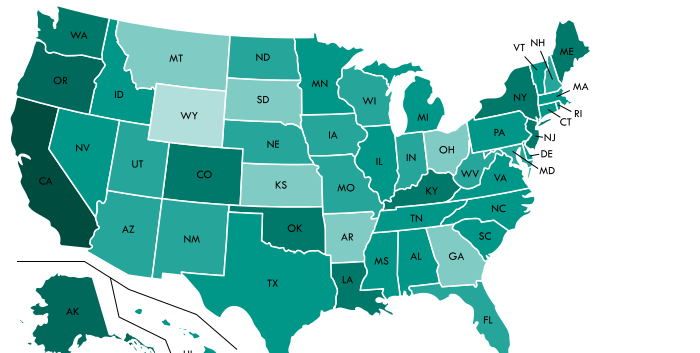
Most common states for structures engineers
| Rank | State | Population | # of jobs | Employment/ 1000ppl |
|---|---|---|---|---|
| 1 | District of Columbia | 693,972 | 235 | 34% |
| 2 | Virginia | 8,470,020 | 864 | 10% |
| 3 | Colorado | 5,607,154 | 544 | 10% |
| 4 | Montana | 1,050,493 | 106 | 10% |
| 5 | Delaware | 961,939 | 95 | 10% |
| 6 | Alaska | 739,795 | 72 | 10% |
| 7 | Washington | 7,405,743 | 583 | 8% |
| 8 | Maryland | 6,052,177 | 487 | 8% |
| 9 | Oregon | 4,142,776 | 352 | 8% |
| 10 | Massachusetts | 6,859,819 | 470 | 7% |
| 11 | Vermont | 623,657 | 42 | 7% |
| 12 | California | 39,536,653 | 2,337 | 6% |
| 13 | Georgia | 10,429,379 | 628 | 6% |
| 14 | Utah | 3,101,833 | 175 | 6% |
| 15 | Nebraska | 1,920,076 | 110 | 6% |
| 16 | Hawaii | 1,427,538 | 89 | 6% |
| 17 | Maine | 1,335,907 | 76 | 6% |
| 18 | North Dakota | 755,393 | 45 | 6% |
| 19 | Wyoming | 579,315 | 37 | 6% |
| 20 | Alabama | 4,874,747 | 239 | 5% |
Most common cities for structures engineers
| Rank | City | # of jobs | Employment/ 1000ppl | Avg. salary |
|---|---|---|---|---|
| 1 | East Hartford | 17 | 33% | $73,897 |
| 2 | Englewood | 6 | 18% | $77,323 |
| 3 | West Palm Beach | 11 | 10% | $65,033 |
| 4 | Huntsville | 9 | 5% | $70,086 |
| 5 | Denver | 25 | 4% | $77,240 |
| 6 | Tallahassee | 7 | 4% | $67,359 |
| 7 | Atlanta | 15 | 3% | $63,106 |
| 8 | Orlando | 7 | 3% | $66,134 |
| 9 | Baton Rouge | 6 | 3% | $75,586 |
| 10 | Boston | 15 | 2% | $74,051 |
| 11 | Indianapolis | 14 | 2% | $67,073 |
| 12 | Sacramento | 8 | 2% | $97,181 |
| 13 | Miami | 7 | 2% | $64,586 |
| 14 | Tampa | 7 | 2% | $66,173 |
| 15 | Chicago | 21 | 1% | $71,798 |
| 16 | Los Angeles | 20 | 1% | $87,831 |
| 17 | Phoenix | 17 | 1% | $67,142 |
| 18 | Washington | 10 | 1% | $70,209 |
| 19 | San Francisco | 8 | 1% | $97,477 |
| 20 | Detroit | 6 | 1% | $70,006 |
Structures Engineer job outlook: Expert opinions
Our panel of structures engineer experts
University of Wisconsin - Milwaukee
California State Polytechnic University, Pomona
Northeastern University
University of New Mexico
Ohio University
University of Texas at Tyler
North Dakota State University
Rockhurst University
University of Miami
George Fox University
Pace University
Santa Clara University
Caribbean University
San Diego State University
Oklahoma State University

The University of Texas Rio Grande Valley

Villanova University
University of Alaska Anchorage
Old Dominion University
What general advice would you give to a Structures Engineer?
Xiaowei Shi Ph.D.: Start by focusing on building a solid foundation in both theoretical and practical aspects of civil engineering. It’s crucial to stay curious and continuously learn, as the field is constantly evolving with new technologies and methodologies. Develop strong problem-solving skills and learn to work effectively in multidisciplinary teams since civil projects often require collaboration across different fields. Networking is key—attend industry conferences, join professional organizations, and connect with peers and experts in the field. Finally, be proactive in seeking opportunities that align with your interests and skills, whether in academia, government, or the private sector.
What general advice would you give to a Structures Engineer?
Simeng Li Ph.D.: I would like to say the most important is to be proactive and take initiative in your work – show your enthusiasm and willingness to take on new challenges. Being proactive not only leads to opportunities for advancement, but also helps great mentors to notice you and makes them want to help you navigate through the complexities of the industry because your attitude reminds them of their younger selves. While improving your technical skills, keep polishing your soft skills for collaborating effectively at the present and leading projects in the near future.
What Structures Engineer skills would you recommend for someone trying to advance their career?
Simeng Li Ph.D.: Most of the time, your salary is positively correlated with the value you can create for your employer. Therefore, make yourself marketable by obtaining your PE license as soon as possible and getting other certifications in your specialized area whenever possible. Stay updated with industry trends and continuously improve your skills and build your reputation. Lastly but most importantly, be comfortable with negotiating your salary for your new position or promotion. Articulate your value based on your skills, education, and experience.
What will help Structures Engineers increase their earning potential?
Simeng Li Ph.D.: I believe the ability to analyze large datasets and utilize AI for predicative modeling, optimization, and decision-making will be increasingly important. The field of civil engineering is continuously evolving, which also requires all of us stay curious and committed to learning new technologies and adapt to changing conditions. As sustainability becomes more critical, knowledge of green building practices, sustainable materials, and environmental impact assessments will also be vital. Civil engineers will need to integrate sustainable solutions into their projects to meet regulatory standards and societal expectations.
Serena Alexander Ph.D.
Associate Professor of Environmental Policy and EngineeringNortheastern University
Civil Engineering
What general advice would you give to a Structures Engineer?
Serena Alexander Ph.D.: Be determined, patient, and resilient. Civil and environmental engineers often deal with projects that take time and persistent effort; unexpected obstacles might arise at any time. Your ability to deal with uncertainties and address challenges with determination is key to your success. You also must be patient—with your team, clients, contractors, governmental and community organizations. You cannot solve problems without critically listening to what all these players have to say about the project and its challenges. Lastly, if things do not go as planned, your ability to bounce back quickly and develop an effective, alternative plan is important.
What will help Structures Engineers increase their earning potential?
Serena Alexander Ph.D.: Get your PE license, continue educating yourself about the new and innovative tools and techniques in your field, learn how to lead a team and deliver a project efficiently and effectively, and always negotiate. Never forget why you became an engineer in the first place; I doubt the salary was the main motivation. Most people become an engineer because they want to solve big problems. Strive to be the best problem-solver in your sub-field and your salary will increase to match your abilities and potentials.
What general advice would you give to a Structures Engineer?
Susan Halter PhD, PE, F.ASCE: Civil engineers can work in a variety of positions. Some civil engineers focus on designing solutions to solve some of our most critical problems, including providing clean drinking water and making sure our roads are safe for all users. Civil engineers who focus on design solutions typically work in collaborative groups with other engineers in an office setting. Civil engineers also work on making these designs a reality by managing complex construction projects. Civil engineers who focus on construction project management often work outside an office at the construction site. Civil engineers working in project management need good communication skills to work with the different partners on large, complex construction projects. Someone entering the field for the first time will typically work with a more experienced engineer on small aspects of larger projects. This could include small design tasks, visits to job sites, and answering requests for information from a construction project.
What Structures Engineer skills would you recommend for someone trying to advance their career?
Susan Halter PhD, PE, F.ASCE: Civil engineers like knowing that they are helping society by solving critical problems and providing safe, sustainable, and resilient infrastructure.
What will help Structures Engineers increase their earning potential?
Susan Halter PhD, PE, F.ASCE: There is a critical need for infrastructure to address growth and to update older facilities. In addition, the U.S. government has committed significant funding for infrastructure improvement, which will require civil engineers to see it through.
What Structures Engineer skills would you recommend for someone trying to advance their career?
Bhaven Naik PhD, PE, PTOE, RSP: Ability to analyze data … course in statistics will be very helpful. As well, the core classes in Civil Engineering are going to be very beneficial. As much as the new technology and all is quickly taking shape, there is going to be a need for the basics in the coming years.
What will help Structures Engineers increase their earning potential?
Bhaven Naik PhD, PE, PTOE, RSP: By being proactive … researching the current job salaries – ASCE have a great site for doing that. By continuous learning … getting licensure (PE, PTOE etc.) and also a Master’s degree (Civil or MBA).
Dr. Mena Souliman Ph.D., P.E., F.IRF.
Ronald D. Brazzel Endowed Professor of Civil EngineeringUniversity of Texas at Tyler
Civil Engineering
What general advice would you give to a Structures Engineer?
Dr. Mena Souliman Ph.D., P.E., F.IRF.: Civil engineering is a solid profession to enter for several reasons. First, there's a growing demand for infrastructure development globally, which creates job opportunities. Second, civil engineering offers a diverse range of career paths, from transportation to environmental engineering, providing flexibility and options for specialization. Additionally, advancements in technology are reshaping the field, offering opportunities for innovation and problem-solving. Lastly, civil engineers play a crucial role in addressing pressing issues like sustainability and resilience, making it a meaningful career choice for those who want to make a positive impact on society and the environment.
What Structures Engineer skills would you recommend for someone trying to advance their career?
Dr. Mena Souliman Ph.D., P.E., F.IRF.: Civil engineers handle a wide range of tasks daily, such as designing infrastructure, managing construction projects, analyzing data, and ensuring compliance with regulations. Someone entering the field might start with more hands-on work like site inspections, drafting plans, or assisting senior engineers in project management. Over time, they'll likely take on more responsibilities and eventually lead projects themselves.
What will help Structures Engineers increase their earning potential?
Dr. Mena Souliman Ph.D., P.E., F.IRF.: People often appreciate the variety of projects and the opportunity to solve real-world problems that come with being a civil engineer. Additionally, seeing tangible results, such as completed infrastructure projects, can be rewarding. However, challenges like dealing with bureaucratic processes, long hours during project deadlines, and the potential for work to be affected by external factors like weather or funding constraints can be sources of frustration. Overall, satisfaction in the field often depends on individual preferences and the specific work environment.
What general advice would you give to a Structures Engineer?
Mijia Yang: Sure, I can answer the questions you might have. Please send them my way and I will try to answer them the best I can.
What Structures Engineer skills would you recommend for someone trying to advance their career?
Mijia Yang: This is perfect! Thank you so much. We will be sure to feature your response in the article and send a draft over for your review before we promote it.
What will help Structures Engineers increase their earning potential?
Mijia Yang: Attached please find my answers to the questions you asked. Hope they could benefit these students who want to purse the Civil Engineering field.
What Structures Engineer skills would you recommend for someone trying to advance their career?
John Kevern Ph.D., P.E., F.ASCE, FACI, LEED AP: Communicating effectively both written and verbally is and always is hugely important. This includes the ability to utilize AI successfully to write and check documents as a tool but not as a crutch.
What general advice would you give to a Structures Engineer?
Joseph Reichenberger PE [CA AZ HI NM NV], BCEE, F.ASCE: The Civil Engineering profession is different then many professions as there are many sub-
disciplines to enter such as structures, environmental, water resources, land development, ports
and harbors, water and wastewater treatment, solid waste management, geotechnical (dams,
levees, foundations), transportation (light rail, heavy rail, airports, roads, multi-modal, etc.),
traffic, construction and others. Many civil engineers will change their sub-disciplines as their
interests change and the "market" changes. For example, there was no "Superfund" and
environmental clean-up in the early 1980s. This created the environmental mitigation sub-
discipline. So civil engineers do not have to remain stagnant.
Civil engineers can work in an office or be outdoors working in construction or a combination of
both. That is attractive. It is also an occupation where you serve the public and there are great
opportunities to using their creative skill to improve society and the environment with their
projects. Our projects are now emphasizing sustainability, which is attracting a lot of young
people into the profession.
I don't know anyone that dislikes civil engineering. I have been practicing for 60 years and enjoy
it. I still teach full time and take on a wide variety of consulting projects in the water, wastewater
and recycled water areas. If an individual does not like a particular subdiscipline, they can
change. Our education, mandated by our accrediting agency ABET, requires graduates to be
proficient in a minimum of 4 sub-disciplines; so graduates have the basic skills if they want to
change. Many, as they advance in their careers, start their own civil engineering consulting
company - work for themselves, or construction and land development companies. There are
many of these opportunities.
It is also a profession where you can branch out of civil engineering. Several of our graduates
have gone into law (patent, environmental, construction); we have had a few employed by the
large financial corporations like Ernst and Young.
What Structures Engineer skills would you recommend for someone trying to advance their career?
Joseph Reichenberger PE [CA AZ HI NM NV], BCEE, F.ASCE: Infrastructure is on the minds of governments and funding agencies have supported
infrastructure. The federal Infrastructure Investment and Jobs Act, passed in November 2021,
authorized $1.2 trillion dollars for a variety of infrastructure projects.
From: https://home.treasury.gov/news/featured-stories/infrastructure-investment-in-the-united-states
Civil engineers are involved in most if not all of these types of projects. So the job market for
civil engineers for the near term is excellent.
Afifa Mushtaque in an article published 03102024 entitled "20 Highest Paying Countries for Civil
Engineers" https://www.insidermonkey.com/blog/20-highest-paying-countries-for-civil-engineers-
1271941/, stated the global civil engineering market is looking for major growth as $13.7 trillion
dollars is expected by 2030 and forecasts a compound annual growth rate of nearly 6% from
2023 to 2030.
Civil engineering has generally always been a good field for jobs. Civil engineering jobs tend to
follow the housing market so it is not all roses. There was a significant reduction in employment
for civil engineers, along with many others in the early 1980s and recently in the recession in
2010 or so. But the recovery has been substantial and continuing as stated above.
We are blessed with an influx of well prepared, young graduates with skills in the latest
technology replacing retiring civil engineers. Our typical class here at Loyola Marymount
University (LMU) typically has 30 to 40% women. It is a great profession for women and work
force is quite diverse.
What will help Structures Engineers increase their earning potential?
Joseph Reichenberger PE [CA AZ HI NM NV], BCEE, F.ASCE: It depends somewhat on the career path: private engineering consulting company, private
industry as facilities engineer, construction, education, or public sector.
If you work in construction you are on the job site typically, although you may be working in the
office preparing estimates and bids for the next potential project. If they are on the job site, they
are monitoring the construction activities, answering questions from subcontractors and material
suppliers, coordinating work etc. If you are working for an agency or consultant, you are
observing the construction, interpretating the plans, answering questions from the general
contractor, ensuring the construction meets the requirements of the plans and specifications as
the owner's on-site representative, and documenting job site activities in the event of a claim.
If you work for a consulting engineering firm, as an entry level engineer, you will be given
assignments to develop layouts and plans using computer drawing programs, making
calculations, reviewing documents submitted by contractors for equipment used on a project
under construction, performing computer modeling of structures or water systems, or highway
systems. As you gain more experience you will be mentoring entry level engineers in addition to
doing more advanced design work eventually moving into project, department, and office
management. At that stage you are doing more management and less engineering. But your job
moves to developing clients and securing "new" work. The work can be fast paced and you are
expected to be a self-starter and always learning. There are usually no formal training
programs, though many larger companies provide formal training for managers. Promotions are
"ad hoc" depending on an individual's skills.
Working for a public agency is not too much different. Promotions are done through exams and
formal interviews for open positions. Also the form of communication, particularly with the
"outside" is very formal through "chain of command." It can be frustrating at times. Many
agencies have formal rotational training programs for entry level staff.
Esber Andiroglu PhD, PE, LEED AP
Associate Professor of Practice, Dept. of Civil & Architectural Engineering, Director of Construction Management ProgramsUniversity of Miami
Architectural Engineering
What general advice would you give to a Structures Engineer?
Esber Andiroglu PhD, PE, LEED AP: Interdisciplinary and transformative design and construction approaches; integration of emerging technological innovations into practice; integration of software tools into everyday problem solving; solid knowledge about smart systems and AI applications; good understanding and ability to use data analytics
What Structures Engineer skills would you recommend for someone trying to advance their career?
Esber Andiroglu PhD, PE, LEED AP: Be flexible; highlight that you are a team player with solid leadership skills; be self driven, resourceful and confident; share your vision for your new role stemming from the strengths and knowledge that you bring based on your training, education and prior work experience.
Ben Giudice Ph.D.
Associate Professor of Civil EngineeringGeorge Fox University
Department of Mechanical, Civil, and Biomedical Engineering
What soft skills should all Structures Engineers possess?
Ben Giudice Ph.D.: Soft skills are vital in civil engineering, and the ones that are most important at the early stages of people's careers include both written and oral communication. Writing memos and reports, emails, talking to people in the field or on the phone - all of these are incredibly important to civil engineering.
What will help Structures Engineers increase their earning potential?
Ben Giudice Ph.D.: There is a huge demand for civil engineers across the nation. All of the junior civil engineering students at George Fox University this year had internships for the summer lined up by the end of March. Every senior either had a job offer signed by the end of March, or had multiple offers they were still weighing. The need for civil engineers will never go away, as society will always need qualified civil engineers to support all aspects of civilization. You can also work nearly anywhere in the world, as practically wherever there are people, there is a need for civil engineering.
James Albrecht
Professor of Criminal Justice and Homeland Security, retired NYPD Captain/Commanding OfficerPace University
Criminal Justice and Homeland Security Department
What soft skills should all Structures Engineers possess?
James Albrecht: Never underestimate having effective "people skills." You must be able to listen, communicate and express yourself in a competent and empathetic manner. Asking questions for more specific insight into project objectives and posing your own questions that delineate target hardening options to clients and potential customers will add the necessary human touch, not only to the field of civil engineering but to any profession.
What skills will help Structures Engineers earn the most?
James Albrecht: Clearly possessing a thorough and exceptional understanding of the basic skills needed in civil engineering is extremely critical. In addition, by expressing concerns or describing options for target hardening, you will also show your client that you have their safety and welfare in mind. Conducting a historical assessment of weather, sensational incidents, area crime rate, population density, and peak daily usage, and combining that with an evaluation of nearby sites that may be appealing to tourists or that routinely draw large crowds, e.g., nearby subway or bus station, should cause a client to be impressed with your comprehensive understanding and analysis of project-related issues. Undoubtedly, any "people skills" you can bring to the table that highlights your empathetic nature will surely inspire a customer or potential client.
Will there be an enduring impact of the coronavirus pandemic on Structures Engineers?
Amin Ghafooripour Ph.D.: I don't think so, I have not seen a meaningful change.
What certifications/licenses/courses can have the biggest impact for Structures Engineers?
Amin Ghafooripour Ph.D.: Teaching at University requires advanced degrees, Licensed engineers may have a better chance.
What will help Structures Engineers increase their earning potential?
Amin Ghafooripour Ph.D.: Consultancy and research projects with external funding.
Dr. Luis Campos
ProfessorCaribbean University
Civil Engineering Department
What are the biggest trends we'll see in the Structures Engineer job market given the pandemic?
Dr. Luis Campos: The biggest trends which, in my opinion, is not for professionals. On-line commerce continues to be leading the jobs market...and will continue, at least, during the next 2 years.
What technical skills for a Structures Engineer stand out to employers?
Dr. Luis Campos: Use of computer and on-line navigating are the leading skills.
How have salaries changed over time for Structures Engineers?
Dr. Luis Campos: Salaries and unemployment have decreased to dangerous low levels. Increase in poverty levels are obvious.
Janusz Supernak Ph.D.
Professor and ChairSan Diego State University
Department of Civil, Construction, and Environmental Engineering
Will there be an enduring impact of the coronavirus pandemic on Structures Engineers?
Janusz Supernak Ph.D.: COVID-19 had an impact on all of us, graduates included. The transition to switch into remote learning on a short - just 10 days notice - in mid March 2020 was challenging for professors and students alike. Yes, not all consequences were negative. The pandemic just accelerated the process of transitioning into a hybrid type of instruction where the online
course delivery will have a more prominent role - even after the lockdowns are over. The transitioning was actually smoother than expected. We used this situation as an opportunity to check if the pandemic affected students' perception about the effectiveness of their learning. Although the "COVID period" scores were generally lower than the "pre-COVID period" scores, only 21% were actually statistically significant. Interestingly, student outcomes scores in the Senior Design course were actually higher under pandemic than before COVID. More on this in a Jan. 2021 publication:
Supernak, J et al, (2021), "COVID-19: How Do Engineering Students Assess its Impact on Their Learning?", Advances in Applied Sociology, 11, 14-25,
doi:10.2436/associ.2021.111002
Out of necessity, the overall computer literacy has increased during the pandemic which is a good outcome.
What's a good job out of college for Structures Engineers?
Janusz Supernak Ph.D.: All fields are different. In Civil Engineering, there will be a lot of work in any foreseeable future. According to ASCE, American infrastructure needs a $3 trillion (!) investment to be back in great shape. This is an example of a "good job out of college". Two factors: 1) good prospects for sustainable employment, and 2) good prospects for a high salary when demand for civil engineers and constructors is higher than supply of new graduates.
What will help Structures Engineers increase their earning potential?
Janusz Supernak Ph.D.: Ability to adjust to changes is one important factor. COVID-19 was a test that some passed better than others. Effective use of the newest technology is the key. Of course, salaries go up in the fields of great demand. Still, a lot depends on politicians who may or may not see the American infrastructure upgrade as a very high priority. Current political climate should accelerate civil engineering projects - and improve the earning potential of our most recent graduates.
Will there be an enduring impact of the coronavirus pandemic on Structures Engineers?
Norb Delatte Ph.D.: I believe that employment in civil engineering will recover quickly. Actually, hiring has remained strong throughout the crisis.
What's a good job out of college for Structures Engineers?
Norb Delatte Ph.D.: Civil engineering offers a wide variety of jobs in both the public sector and private sector. Public sector includes state transportation agencies and city and local engineering offices. Private sector jobs include consulting firms and construction.
What technical skills for a Structures Engineer stand out to employers?
Norb Delatte Ph.D.: Employers are looking for strong design technical skills, and the ability to master design software rapidly. Professional and people skills are also important, because many of these positions deal with the public and with stakeholders.
Jorge Vidal
Undergraduate CoordinatorThe University of Texas Rio Grande Valley
Department of Civil Engineering
What skills stand out on Structures Engineer resumes?
Jorge Vidal: Active participation in student organizations, particularly the ASCE and internshipsCivil/Structural Engineer related to the civil profession or AEC industry (Arch, Engr. & Constr)
Eric Musselman Ph.D.
Associate Professor, Department Chair, Civil and Environmental EngineeringVillanova University
Department of Civil and Environmental Engineering
What are the biggest trends we'll see in the Structures Engineer job market given the pandemic?
Eric Musselman Ph.D.: I think one big trend in Civil Engineering resulting from the pandemic will revolve around the changing workplace. Companies will be looking to either modify existing spaces or purchase new spaces to better accommodate their needs as more employees work from home at least part of the time. This will likely result in significant changes to land development and building design.
What skills stand out on Structures Engineer resumes?
Eric Musselman Ph.D.: Skills that stand out on resumes include leadership roles in student groups/organization, demonstrations of your ability to communicate effectively with technical and non-technical audiences, and an understanding of systems thinking and sustainability.
What are the biggest trends we'll see in the Structures Engineer job market given the pandemic?
Scott Hamel: There will be a continued blurring of work and home for both an employee's time and space. This will be both beneficial, with employers allowing more flexibility for parents of young children or caring for elders, and detrimental, as work encroaches even more on personal time. Employers will continue to be wary of taking on recent graduates until the pandemic is under control, because it is a challenge for them to provide good mentorship and guidance. However, once work-from-home orders have been lifted, hiring will be strong, as there is pent-up demand.
What skills stand out on Structures Engineer resumes?
Scott Hamel: In Civil Engineering, employers are always looking for recent graduates with either construction or drafting experience (or both). A new employee can much more easily connect their academic degree with engineering design or review tasks if they have spent time seeing and assisting in the construction process. And with the continued implementation of BIM and 3D terrain modeling, young engineers spend more time as hybrid designers/drafters, so coming in with those skills means less training.
Are there any particularly good places in the United States for Structures Engineers to find work opportunities?
Scott Hamel: Alaska! Despite abbreviated drops in oil prices, hiring continues to be very strong for Civil Engineering graduates. Large scale infrastructure and military project spending tends to lag recessions by a few years, and so construction has continued to be strong through the pandemic. Post-pandemic federal stimulus spending will likely continue this strength and it's possible there will be no dip in the AEC industry at all. Climate change and the opening of the northwest passage has caused a renewed interest in the arctic, spurring infrastructure investment in Ports and transportation infrastructure. In addition, Baby Boomers continue to retire in large numbers, leaving a lot of opportunity for capable young engineers in the 49th state.
What are the biggest trends we'll see in the Structures Engineer job market given the pandemic?
Sherif Ishak Ph.D.: In my opinion, the job market for civil engineers remains strong despite the pandemic situation. Needless to say, it has been very challenging for some sectors of the market to sustain the impact of the pandemic which has resulted in hiring slowdowns or even freeze in many companies and agencies. However, in this day and age, technology came to the rescue for all of us, allowing telecommuting and distance learning to prevail during travel restrictions and lockdowns. The civil engineering job market is driven by infrastructure need for expansion and repairs. This remains a top priority for the US in the years to come and will create more job opportunities for civil engineers. Perhaps, the work environment will be slightly different in the post pandemic era where people will have the option and flexibility to work remotely.
What skills stand out on Structures Engineer resumes?
Sherif Ishak Ph.D.: Technical competencies are important to show on resumes. However, in today's market, employers are looking for other skill sets such as communication, leadership, entrepreneurship, and evidence of professional development at time of graduation. It is very important to emphasize such skill set on the resume to convince employers that you are a well rounded person and have the capacity to continue learning and gaining experience on the job.
Are there any particularly good places in the United States for Structures Engineers to find work opportunities?
Sherif Ishak Ph.D.: The civil engineering job market is very broad and extends over the geographical area of the US. Wherever infrastructure exists, civil engineering jobs will too. The job outlook for civil engineering is very promising and the opportunities to work in the public, private, and government sectors are always there.