Explore jobs
Find specific jobs
Explore careers
Explore professions
Best companies
Explore companies
Job outlook for student development specialists in the United States
Are student development specialist jobs in demand?
Student development specialist job and salary trends over time
Student development specialist jobs over time
Student development specialist job growth rate over time
| Year | # of jobs | % of population |
|---|---|---|
| 2021 | 333 | 0.00% |
| 2020 | 315 | 0.00% |
| 2019 | 310 | 0.00% |
| 2018 | 289 | 0.00% |
| 2017 | 278 | 0.00% |
Average student development specialist salary over time
Student development specialist salary by year
| Year | Avg. salary | Hourly rate | % Change |
|---|---|---|---|
| 2026 | $41,280 | $19.85 | +2.4% |
| 2025 | $40,299 | $19.37 | +0.6% |
| 2024 | $40,075 | $19.27 | +0.8% |
| 2023 | $39,739 | $19.11 | +2.3% |
| 2022 | $38,857 | $18.68 | +1.4% |
Student development specialist jobs by state
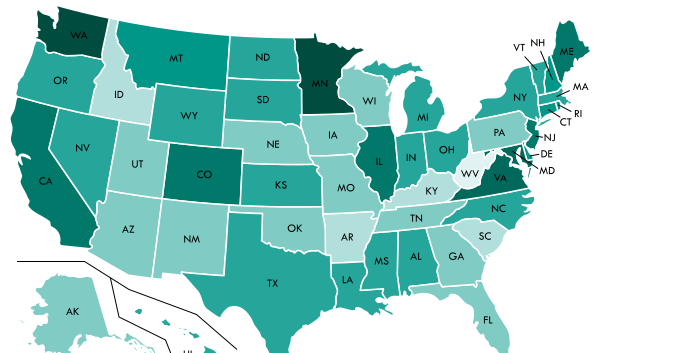
Most common states for student development specialists
| Rank | State | Population | # of jobs | Employment/ 1000ppl |
|---|---|---|---|---|
| 1 | District of Columbia | 693,972 | 221 | 32% |
| 2 | North Dakota | 755,393 | 228 | 30% |
| 3 | Wyoming | 579,315 | 161 | 28% |
| 4 | Nebraska | 1,920,076 | 509 | 27% |
| 5 | South Dakota | 869,666 | 232 | 27% |
| 6 | Minnesota | 5,576,606 | 1,437 | 26% |
| 7 | Alaska | 739,795 | 184 | 25% |
| 8 | Iowa | 3,145,711 | 738 | 23% |
| 9 | New Mexico | 2,088,070 | 445 | 21% |
| 10 | Kansas | 2,913,123 | 575 | 20% |
| 11 | Arkansas | 3,004,279 | 557 | 19% |
| 12 | Pennsylvania | 12,805,537 | 2,265 | 18% |
| 13 | Arizona | 7,016,270 | 1,292 | 18% |
| 14 | Georgia | 10,429,379 | 1,809 | 17% |
| 15 | Indiana | 6,666,818 | 1,103 | 17% |
| 16 | Missouri | 6,113,532 | 1,009 | 17% |
| 17 | Wisconsin | 5,795,483 | 984 | 17% |
| 18 | Delaware | 961,939 | 166 | 17% |
| 19 | Texas | 28,304,596 | 4,284 | 15% |
| 20 | Michigan | 9,962,311 | 1,494 | 15% |
Most common cities for student development specialists
| Rank | City | # of jobs | Employment/ 1000ppl | Avg. salary |
|---|---|---|---|---|
| 1 | Sarasota | 1 | 2% | $37,060 |
| 2 | Aurora | 1 | 0% | $48,590 |
| 3 | Chandler | 1 | 0% | $33,584 |
| 4 | San Jose | 1 | 0% | $47,515 |
Student Development Specialist job outlook: Expert opinions
Our panel of student development specialist experts
Saint Xavier University
University of Alaska Fairbanks
University of Memphis
Edgewood College

University of Alaska Anchorage
University of Central Missouri
The Catholic University of America
University of Kentucky

University of Maryland Global Campus
West Virginia State University
The University of Texas at Arlington
Saint Mary’s University of Minnesota
University of Utah

Advance CTE

Rowan University

Virginia Community College System
North Carolina Central University
ETSTech-Ops

Forsyth County, Georgia
David Parker LL.M. Human Rights Law, LL.M. National Security Law, JD, MBA, CFE
Associate ProfessorSaint Xavier University
Business, Management, Marketing, And Related Support Services
What general advice would you give to a Student Development Specialist?
David Parker LL.M. Human Rights Law, LL.M. National Security Law, JD, MBA, CFE: Critical thinking and problem-solving, Technological literacy / digital literacy, Resiliency, stress tolerance and flexibility, Creativity, originality and ideation, Emotional intelligence & interpersonal skills, and Curiosity and active/continuous learning.
What will help Student Development Specialists increase their earning potential?
Jaunelle Celaire: Learn from everything. Remember every moment is a learning opportunity from everyone around you, no matter their title. Pay attention when things go well and clue in and pay extra attention when they do not; watch how people react to it. Build relationships and network with the people who face problems by being their solution.
Ali Fatemi
Ring Companies Professor and Chair of Mechanical EngineeringUniversity of Memphis
Mechanical Engineering
What Student Development Specialist skills would you recommend for someone trying to advance their career?
Ali Fatemi: Research the company you will be working for and see how your skillsets and strengths, both academic and personal, match the needs of the company. Try to differentiate yourself from others with the same degree with unique qualifications, such as strong communication, teamworking, organizational, and leadership skills.
Dr. Tom Holub Ph.D.
Director of Curriculum & InstructionEdgewood College
Department of Curriculum and Instruction
What are the biggest trends we'll see in the Student Development Specialist job market given the pandemic?
Dr. Tom Holub Ph.D.: From my vantage point, and the research we are engaging in, it is clear that emotional wellness has been, and will continue to become, a major issue in society. The wide-ranging concerns for emotional and mental health cross lines of all demographics. Specialist, interventionists and therapists will be needed for children and adults post-pandemic. The specialization of needs, for example in adolescent interaction with the pandemic, will further complicate our nation's critical needs in this area. To this end, the opportunities for employment will grow in our field and the benfits of high quality training programs will become a priority.
How have salaries changed over time for Student Development Specialists?
Dr. Tom Holub Ph.D.: There has been great stability in the field, with salaries increasing over time. The new and improved alliances with insurance companies have eased some pressure that families have felt. Previously, in many cases, families did not seek out the assistance of a certified RPSE because of the hourly fees. More contemporarily insurance coverage has made this access much better. The efficacy of our interventions is increased when families do not have deep-seated worries about paying for these necessary services.
Anonymous Professor
What's a good job out of college for Student Development Specialists?
Anonymous Professor : A good first job out of college is one that pays enough to cover expenses and save, but also makes you happy. It might also further your educational experience by providing real-world experience and helping young adults refine their goals and aspirations. What that looks like "on the ground" is different for everyone.
Ginger Blackmon
Assistant Professor of Educational LeadershipUniversity of Alaska Anchorage
College of Arts and Science; School of Education; Educational Leadership Program
What Student Development Specialist skills would you recommend for someone trying to advance their career?
Ginger Blackmon: If a graduate needs to take a gap year, gaining skills and experience in working among diverse groups of school-age children in non-school settings will enhance their work as teachers. Volunteering in after-school programs, sports programs, boys and girls clubs, and academic/arts programs will give graduates opportunities to build meaningful relationships with children. Gaining experience in building meaningful relationships with children and families outside of the stress and pressure of the modern classroom will enhance their success as they begin their teaching careers.
What general advice would you give to a Student Development Specialist?
Ginger Blackmon: The general advice I would give to a graduate beginning their career as an educational professional is to first and foremost understand that students, colleagues, and parents need to know that you care. Authentic, caring, and positive relationships build the foundation for the success and well-being of students and adults within the school setting. Second, I would suggest that they continue to learn. Understanding that educators leave their preparation programs simply knowing enough to get started. Not only is there so much more to learn, but engaging in and modeling lifelong learning is critical in order to address the learning needs of an ever-changing student population, and to educate the next general to address the problems confronting an ever-changing world only enhances the ability to build strong relationships with students, colleagues, and parents.
Lea Porta
InstructorUniversity of Central Missouri
Early Childhood Education Department
Will there be an enduring impact of the coronavirus pandemic on Student Development Specialists?
Lea Porta: Endure, yes, we must endure. The students I've encountered are facing these challenges head on and then overcoming these new obstacles. These students are thinking on their feet! Learning and even adapting to real time change. Although, I wish none of us were in this position, it has moved the bar and standards up. I think our students are achieving lifelong skills.
What type of skills will young Student Development Specialists need?
Lea Porta: Technology is obvious... But I feel UCM's block classes give students a real opportunity to work in classes and be more prepared for student teaching and graduation.
Agnes Cave Ph.D.
Chair, Director of Teacher Education, Coordinator, Master's in Learning and Instruction, Coordinator, Elementary Education, Associate Professor of EducationThe Catholic University of America
Department of Education
What are the biggest trends we'll see in the Student Development Specialist job market given the pandemic?
Agnes Cave Ph.D.: a. If schools have the funds (and many do not), they will need to hire more student-teachers to deliver instruction online. The student teaching ratio will have to be lower to deliver instruction online effectively, so those schools that can afford it will try to hire two teachers in each classroom where teachers will collaborate or teach smaller groups of students.
b. As I mentioned in my previous point, teachers will need to collaborate with one another more because of the higher demands of online instruction; i.e., challenges to engage students (especially the younger ones) meaningfully (e.g., the logistics of hands-on activities in the online environment) and also because of the difficulties in managing classroom behavior virtually.
c. Teachers also have to become proficient end-users of various platforms, programs, and apps to deliver content online; e.g., Zoom, Google Meet, Google Classroom, Microsoft Teams, etc.
Dr. Kun Huang Ph.D.
Assistant Professor of Instructional Systems DesignUniversity of Kentucky
Department of Curriculum & Instruction
What type of skills will young Student Development Specialists need?
Dr. Kun Huang Ph.D.: They will need a good balance of theories and practice. On the theories side, they will need to develop a solid understanding of how people learn, factors facilitating or hindering the learning process, models, principles, and best practices of learning experience design, just to name a few. On the practice side, it would be helpful for students to develop hands-on expertise designing instructional solutions using technology. Familiarity with technology packages used by the industry would be beneficial.
Dr. Francine Blume Ph.D.
Assistant Vice PresidentUniversity of Maryland Global Campus
Career Development Office
What skills stand out on Student Development Specialist resumes?
Dr. Francine Blume Ph.D.: Skills that stand out depend on the field, but you always want to point out your tech skills, language skills and especially "soft" skills, such as communication and initiative.
For tech skills, you can demonstrate proficiency by citing certifications. For language skills, be as accurate as you can regarding proficiency in reading, writing, and speaking. For soft skills, make sure they are evident in the descriptions of your accomplishments and duties. Don't just say, "I have strong problem-solving skills and I learn fast." Anyone can say that, but you should quantify your experience and skills to demonstrate those soft skills.
Dr. Mark Wilson
Associate Professor of EconomicsWest Virginia State University
Economics Department
What skills stand out on Student Development Specialist resumes?
Dr. Mark Wilson: Job skills that stand out: two skills that every job seeker should now cultivate are: proficiency with spreadsheets and proficiency with online conferencing (e.g., Zoom, Skype). Most graduates have low skills in spreadsheets and will be trying to learn these skills on-the-fly. Proficient spreadsheet users are able to take their skills to the next level. As for teleconferencing, we are just scratching the surface of what COVID has taught us about online meetings. Newbies in the job market should be skilled enough in teleconferencing that they can share screens, do hosting, and know etiquette of conference calling.
What skills stand out on Student Development Specialist resumes?
Michael Ward: Doing well in coursework is great, but what sells a job candidate is the initiative in an activity that shows that you have synthesized and applied what you have learned across multiple courses. This is a big ask but, there are plenty of ways to do this. You can join an extra-curricular club, but better is providing the leadership to enhance the club experience. You can take a part-time job, but better is founding a small entrepreneurial business that fills an unmet need. You can write term papers for classes, but better is helping draft and implement action plans for, say, a non-profit. If you have an interest in a hobby, a sport, or an industry, show that you have developed it into an expertise. All resumes include coursework, but activities that demonstrate initiative will stand out.
What are the biggest trends we'll see in the Student Development Specialist job market given the pandemic?
Mike Hagarty: Job trends are volatile and segmented. With unemployment ranging from a record high of 14.7 percent in April (Bureau of Labor Statistics) to 6.7 percent in November (Trading Economics), we are on a roller coaster, and it is hard to predict when and where we will land post COVID-19. For example, U.S. private businesses were projected to hire 410,000 workers in November, and that was off by more than 100,000 with the significant rise in COVID cases and lockdowns (Trading Economics).
The impact of the pandemic will hit different segments of the economy differently. For example, healthcare and online services (Amazon alone has added nearly 500,000 jobs during the first several months of the pandemic) are strong and growing. Other Industries, including hospitality and travel, are experiencing significant reductions.
Students entering the workforce should not wait until their preferred segment of the economy bounces back or stabilizes but should look at who is hiring and find an opportunity there that matches their skills and abilities.
What Student Development Specialist skills would you recommend for someone trying to advance their career?
Mike Hagarty: The most important element of a gap year for a graduate is to do it with purpose and a plan. Before taking the gap year try to answer the question, "What do I want to be true at the end of the year?" For example, if you are a college graduate and you want to apply (or re-apply) to graduate school next year, what do you need to do in the gap year to succeed at being accepted (e.g., entrance exam practice, work or internship experience that will make you more qualified)? If you want to change direction or don't have a career direction yet, what will help you arrive at clarity or prepare you for the transition (perhaps testing a new field, volunteering, learning a new culture)? If you want to land a position at a dream company, set specific networking or skill-building goals (including certificates and other professional credentials) so that you are at a different place at the end of the gap year.
I know this is a graduate question, but if you are an incoming freshman and decide on a gap year, the same concept holds - fill the year with learning experiences that will bring clarity, experience, and direction. In all cases, set SMART goals (Specific, Measurable, Actionable, Realistic, and Timed) to be intentional about growing your knowledge, skills, abilities, and network of support.
Are there any particularly good places in the United States for Student Development Specialists to find work opportunities?
Sarah Kovalesky: This is kind of like the common, "what do I do with this degree" question I get as a Career Coach. I wish I had a magical folder to pull out with all of the answers in one place. Location and its place in the job search are based on the individual. It will be a non-negotiable, while for others, it might just be another factor to consider. As I mentioned, with the pandemic's impact, there is so much that a graduate could do with a psychology degree that could take them all over the country.
Will there be an enduring impact of the coronavirus pandemic on Student Development Specialists?
Kimberly Green: Career Technical Education (CTE) instructors are the backbone of high-quality and equitable delivery of CTE. Today's educational landscape brings new challenges to the delivery of CTE but in that challenge is the opportunity for CTE instructors to be creative in developing and delivering high-quality CTE programs in virtual or socially distanced environments. Designing with equity and quality in mind, especially for learners who face multiple barriers to engaged virtual learning, is vital. Facing the dual challenge of being a new educator and doing so in a remote and/or hybrid environments, we encourage new instructors to look to their state CTE agencies as their partners and sources of best practices, support and information. For more information on your state CTE agency, visit https://careertech.org/cte-your-state.
Dr. Kate Seltzer Ph.D.
Assistant ProfessorRowan University
Department of Language, Literacy and Sociocultural education
What general advice would you give to a Student Development Specialist?
Dr. Kate Seltzer Ph.D.: Overall, my advice to a graduate starting their career in education would be to reflect deeply on their stance - their core beliefs and philosophy about teaching more generally. Educational policies change all the time, what we call "best practices" change. But developing a strong stance, rooted in care and regard for students, their families, and the community, will help graduates navigate these changes while staying true to what matters.
How would you rate the starting salaries for Student Development Specialists, as well as the prospects for salary advancement?
Dr. Kate Seltzer Ph.D.: Educators are not paid nearly enough. However, working in a state with strong teachers' unions helps to ensure a starting salary that recent graduates can live off of and growth opportunities, albeit modest, over their careers.
Celeste J. Hall
Career Coach Training Specialist Facilitating Career Development InstructorVirginia Community College System
What experience really stands out on Student Development Specialist resumes?
Celeste J. Hall: While the pandemic is changing the work of the school counselor and the ways that they interact with students, it seems that the demand for school counselors will not decrease because of the pandemic. In fact, because of the need to schedule courses based on virtual and face-to-face instruction, meeting the needs of students with disabilities and the increased mental health needs of students, families, and school personnel, the demand for school counselors may increase. The work of career specialists may be more heavily impacted by the challenges of less face-to-face interaction with students, and career development programming may be seen as less vital in the face of the pandemic. Career Specialists will continue to compete for classroom time, whether it is in person or in the virtual space.
School counselors and career specialists may find opportunities in companies that offer virtual school programming and to support those students who decide to continue with home-schooling, post-transition.
School Career Counselors and Specialists could use this time as an opportunity to pivot away from the notion that the future is stable and predictable and; therefore, students can focus on choosing one occupation for life. They can instead help students to understand that the world has many uncertainties and teach them how to plan with flexibility and build resilience in the face of unplanned or unexpected events. They can emphasize the value of work-based learning experiences and the benefits of considering a variety of educational pathways to prepare for a career. Coming out of the pandemic, four-year colleges will need to focus on proving the value of their program, relative to their costs, and students may be willing to consider options other than traditional dormitory living and on-campus, in-person learning.
How do you envision technology impacting Student Development Specialists in the next 5 years?
Celeste J. Hall: School Counselors and Career Specialists will need to continue to hone their skills with technologies that help them connect to students in the virtual environment. They will need to learn to apply helping skills to virtual platforms and use verbal interactions when they may have been able to read body language pre-pandemic. They will need to reach out to students through e-mail or text, and learn how to make and post videos to provide information and to demonstrate processes. School and counseling websites will need to be upgraded to include more information and ways to connect with counselors and career specialists.
Ethical considerations will need to be applied to the virtual world. Student privacy, crisis interventions, and student engagement are issues that need to be considered with the use of digital and virtual platforms.
Elisha Blankson
Program Director NCCU, Assistant ProfessorNorth Carolina Central University
Communication Disorders Department
What type of skills will young Student Development Specialists need?
Elisha Blankson: Graduates will need a skill set about the field in which they received training and additional skills useful to the job market. For example, with the changing demographics in the United States, extra skills in information technology and foreign languages will be a plus when entering the job market.
Are there any particularly good places in the United States for Student Development Specialists to find work opportunities?
Nola Pearce: Depending on your chosen career scope, there are opportunities across the United States - urban, suburban, rural. If you have a wide range of interests and career experience, geographic possibilities are endless. If you are very specific within an industry, material, or application, there are pockets of locations that might be better than another. I recommend that you reach out to professionals within the industry or profession that you have interest in.
Are there any particularly good places in the United States for Student Development Specialists to find work opportunities?
Donna Kukarola: This one, not so sure of, the southeast continues to see options as well as mid-western states.