Explore jobs
Find specific jobs
Explore careers
Explore professions
Best companies
Explore companies
Job outlook for summer law associates in the United States
Summer law associate job growth summary. After extensive research, interviews, and analysis, Zippia's data science team found that:
The projected summer law associate job growth rate is 10% from 2018-2028.
About 80,200 new jobs for summer law associates are projected over the next decade.
Summer law associate salaries have increased 7% for summer law associates in the last 5 years.
There are over 12,940 summer law associates currently employed in the United States.
There are 10,848 active summer law associate job openings in the US.
The average summer law associate salary is $125,756.
Are summer law associate jobs in demand?
Summer law associate job and salary trends over time
Summer law associate jobs over time
Summer law associate job growth rate over time
| Year | # of jobs | % of population |
|---|---|---|
| 2021 | 12,940 | 0.00% |
| 2020 | 12,810 | 0.00% |
| 2019 | 14,336 | 0.00% |
| 2018 | 14,088 | 0.00% |
| 2017 | 13,203 | 0.00% |
Average summer law associate salary over time
Summer law associate salary by year
| Year | Avg. salary | Hourly rate | % Change |
|---|---|---|---|
| 2026 | $125,756 | $60.46 | +3.2% |
| 2025 | $121,823 | $58.57 | +1.7% |
| 2024 | $119,792 | $57.59 | +1.4% |
| 2023 | $118,147 | $56.80 | +0.9% |
| 2022 | $117,067 | $56.28 | +2.0% |
Summer law associate jobs by state
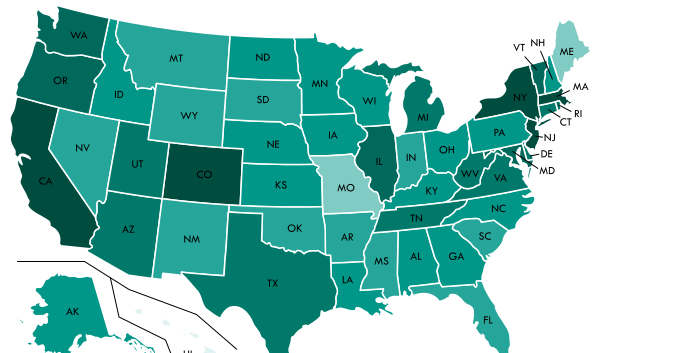
Most common states for summer law associates
| Rank | State | Population | # of jobs | Employment/ 1000ppl |
|---|---|---|---|---|
| 1 | District of Columbia | 693,972 | 163 | 23% |
| 2 | Delaware | 961,939 | 28 | 3% |
| 3 | California | 39,536,653 | 681 | 2% |
| 4 | Virginia | 8,470,020 | 128 | 2% |
| 5 | Massachusetts | 6,859,819 | 121 | 2% |
| 6 | Washington | 7,405,743 | 112 | 2% |
| 7 | Minnesota | 5,576,606 | 103 | 2% |
| 8 | Colorado | 5,607,154 | 86 | 2% |
| 9 | Kansas | 2,913,123 | 59 | 2% |
| 10 | Nebraska | 1,920,076 | 46 | 2% |
| 11 | New Mexico | 2,088,070 | 33 | 2% |
| 12 | Montana | 1,050,493 | 20 | 2% |
| 13 | North Dakota | 755,393 | 17 | 2% |
| 14 | Alaska | 739,795 | 13 | 2% |
| 15 | Vermont | 623,657 | 11 | 2% |
| 16 | Illinois | 12,802,023 | 180 | 1% |
| 17 | Michigan | 9,962,311 | 110 | 1% |
| 18 | New Jersey | 9,005,644 | 97 | 1% |
| 19 | Arizona | 7,016,270 | 74 | 1% |
| 20 | Tennessee | 6,715,984 | 44 | 1% |
Most common cities for summer law associates
| Rank | City | # of jobs | Employment/ 1000ppl | Avg. salary |
|---|---|---|---|---|
| 1 | New York | 1 | 0% | $128,920 |
Summer Law Associate job outlook: Expert opinions
Our panel of summer law associate experts
University of North Dakota
University of Cincinnati

Lewis and Clark School of Law
The University of Illinois at Chicago

California University of Pennsylvania

University of Iowa

Drake University

University of Houston - Clear Lake

University of California - Davis

University of North Carolina at Chapel Hill

Faulkner University
Ferris State University

New England Law | Boston

Texas Tech University

Southern Illinois University
-1.jpg?auto=format&w=150&h=225&crop=faces&fit=crop&fm=jpeg&q=90)
Illinois State University
University of New Hampshire Franklin Pierce School of Law

University of Maryland - Baltimore County

University of Connecticut
What general advice would you give to a Summer Law Associate?
Kimberly Dasse: The concept of a legal career encompasses a wide array of roles, extending beyond the traditional associate-partner trajectory. I therefore recommend that law students plan early. While still in school, seek out internships or externships that afford opportunities to explore diverse roles, such as placements at non-profits, district attorney’s offices, public defender’s offices, and law firms. This type of exposure will help students to determine what roles align best with their personal circumstances, identity, and aspirations. Once a course is set, pursue that path with determination. As practitioners, they should strive to excel by applying their academic knowledge and life experiences to their work. Pose thoughtful questions that reflect genuine engagement and consideration for the work. Cultivate mentoring relationships with seasoned professionals who can offer guidance in navigating legal practice and office dynamics. The above steps are particularly important for first-generation professionals. As new entrants to the profession, one may not have a built-in or pre-existing network, so building connections early in law school can yield significant benefits later when transitioning into the profession.
What Summer Law Associate skills would you recommend for someone trying to advance their career?
Kimberly Dasse: By taking the steps I have outlined above, new entrants will set themselves up for success by finding the right roles for themselves and developing valued skills.
What will help Summer Law Associates increase their earning potential?
Kimberly Dasse: Lawyers must adeptly navigate a diverse array of roles, ranging from advisors to counselors to planners, writers, researchers, supervisors, and more. Aside from producing quality legal work, reflect on your other strengths and dedicate time to developing yourself further. A skilled lawyer who is also an excellent manager of people offers a unique set of skills that may appeal to upper legal management in your organization. As the legal landscape evolves, I believe two key skills will emerge: technology and teamwork. The integration of AI into legal services is reshaping the profession with more innovation on the horizon. For our clients, blockchain technology, data analytics, and digitized workplaces are becoming standard. Thus, technology will become more embedded into an array of fields, not just “techie” industries. Those who follow and understand technological developments will engage the worlds our clients live in, enhance their own efficiency within their firms and deliver cost-effective services. Consequently, I urge new entrants to deepen their technological understanding and remain abreast of advancements. Additionally, collaboration lies at the heart of legal work, but its dynamics are transforming. While a solid grasp of technology is pivotal for future legal careers, honing interpersonal skills is equally vital. The future legal team may encompass a wide range of professionals in virtual settings. Thus, lawyers with high emotional intelligence who are adept at motivating individuals, building teams, and integrating the work of diverse professionals will become a valued skill. Accordingly, as lawyers consider ways to develop their skills, they should consider refining their skills as managers, supervisors, or coaches.
What general advice would you give to a Summer Law Associate?
Charity Rohlfs J.D.: Find a mentor and be involved with your local legal associations. Porter Gale said, “your network is your net worth.” And, I couldn’t agree more! As a new paralegal, legal operations specialist, or attorney, growing your network helps in all aspects of your career. You will gain new skills, increase your business development ability, engage in meaningful volunteering opportunities, and truly find an area of law you want to specialize in.
What Summer Law Associate skills would you recommend for someone trying to advance their career?
Charity Rohlfs J.D.: GenAI! Which means highlights the importance of skills like organization, communication, and consensus building. The legal field has historically been technology hesitant, but the pandemic and AI have forced the use and adaptation of technology. AI’s exponential growth will require new skills at a lightning fast pace. A bellwether in the legal field is eDiscovery as it requires the ability to organize massive amounts of information as well as clearly and concisely communicate the information. AI is helping paralegals and attorneys do just this! Finally, in a world that often hides behind screens, having the ability to build consensus and connect with others will be invaluable.
What will help Summer Law Associates increase their earning potential?
Charity Rohlfs J.D.: Do your research and clearly communicate your ask with supporting evidence. A simple internet search will provide you actual salary ranges. An applicant then needs to take this information and explain why X is the amount based on individual specifics. Also, never negotiated against yourself—meaning sometimes you need to be silent and wait.
James Tomaszewski
Director of the Center for Professional DevelopmentUniversity of Cincinnati
College of Law
What hard/technical skills are most important for Summer Law Associates?
James Tomaszewski: Excellent writing skills.
What skills will help Summer Law Associates earn the most?
James Tomaszewski: Hard work, excellent writing, and interpersonal finesse.
What skills stand out on Summer Law Associate resumes?
James Tomaszewski: Demonstrated commitment to a particular practice area, especially experiential learning opportunities such as externships and clinics.
What soft skills should all Summer Law Associates possess?
James Tomaszewski: Engagement, Resilience, Responsiveness, Respectfulness, Integrity.
What certifications/licenses/courses can have the biggest impact for Summer Law Associates?
Joel Silverman: We are unique, in that we are looking for team players and attorneys that want to market and learn about the business of law. For us, it is imperative that an attorney keep an open mind towards learning about more than just the law, but about psychology, business, marketing, sales and the law. We aren't looking for experts, but those that want to grow in a more wholistic sense, within the practice of law.
How have salaries changed over time for Summer Law Associates?
Joel Silverman: Absolutely. Salaries have gone up by 50%, since I started, 20 years ago. Unfortunately, the cost of education has gone up faster than the increase in salaries. With that said, an attorney truly has a sky's the limit to their salary. If an attorney can understand the business of the practice of law, then that attorney has a leg up on all other competition. The business of the practice will also change, based upon the firm you are working in, at the time. However, the end result is that the better you understand the business (which isn't taught in law school), then the more you will make within the practice.
What are the biggest trends we'll see in the Summer Law Associate job market given the pandemic?
Joel Silverman: I believe that the biggest trend we will see in the job market is that job seekers are going to have to become more flexible. Not only are they going to have to think about what is going to get them a job, but what are they going to bring to the table for an employer in a rapidly changing market? How can the recent graduate bring more than just the same old legal knowledge? Do they have marketing and sales experience? How can a new attorney help a firm with their social media presence? IT experience and remote learning/educating? Technology continues to evolve and shape the way in which we practice our craft and market our skills. The new graduate has the potential for a set of skills that the employer does not have and therefore, the graduate has to make that part of their practice shine.
What are the biggest trends we'll see in the Summer Law Associate job market given the pandemic?
Mark Wojcik: The economy is in a "K-shaped recovery." Some businesses and industries are in the upper part of that "K," and they're doing well. Other businesses and industries are in decline -- the lower part of that "K." Law firms that represent clients in the upper part of that K are succeeding. These client companies are expanding and have legal work for firms.
Law firms also did well when their clients were able to take advantage of pandemic relief funding. These clients were often larger companies that benefitted from that government support.
I recommend that students and new lawyers get involved in bar associations. You'll be able to network and learn about which firms are doing well. Be active in a visible way -- volunteer to speak at an upcoming meeting or write an article for the bar journal or a committee newsletter.
What soft skills should all Summer Law Associates possess?
Mark Wojcik: New lawyers need to have good communication skills. Even in an age of Zoom meetings, new lawyers have to be able to pick up a phone and be comfortable having a phone conversation. Law firm partners tell me that their associates know how to text someone but they don't know how to call someone. If you're a law student or new lawyer and you recognize that you're uncomfortable making phone calls, pick up a phone and practice!
When lawyers do text or email, it's important to read that message before you hit send. You might be surprised, for example, to see that AutoCorrect changed the name of your client. Read that message before you click send. And if you can't read it, why should anyone else?
How have salaries changed over time for Summer Law Associates?
Mark Wojcik: Some firms have skipped or reduced year-end bonuses, but that may be a temporary reduction during the pandemic. Other firms, however, did give bonuses and some even gave double bonuses, particularly where the firms had lower office overhead when attorneys worked from home.
Public sector salaries have stayed constant. Some salaries may have risen slightly to keep up with cost of living.
And at small-to-midsize firms, salaries are similar to what they have been for over a decade. Salaries at those firms are more dependent upon practice area, experience level, and volume of business. And even at small firms that may start new grads at $50-60K, there are usually opportunities to add to that salary by developing business for the firm.
What are the biggest trends we'll see in the Summer Law Associate job market given the pandemic?
Brian Kohlhepp: I think that many folks have taken advantage of workplace flexibility and have sought additional education. This increased enrollment in Master's degree as well as post-graduate certificate programs.
What certifications/licenses/courses can have the biggest impact for Summer Law Associates?
Brian Kohlhepp: Largely, this would be acquiring a Master's degree. Many folks obtain this degree for an advancement at their current employer or in order to make themselves a more attractive candidate to the overall job field.
How have salaries changed over time for Summer Law Associates?
Brian Kohlhepp: Salaries have definitely increased especially for those with advanced degrees. We have seen a rise in need for those with advanced degrees in Legal Studies, Criminal Justice, and Homeland Security.
What are the biggest trends we'll see in the Summer Law Associate job market given the pandemic?
Bram Elias: Yes, definitely. (What will the enduring impact be? Ah. I have pretty much no idea. I happily defer to the wisdom of Melissa in Career Services!)
What soft skills should all Summer Law Associates possess?
Bram Elias: So much of legal work is research, analysis and writing - so any job that involves learning new things and synthesizing what you've learned into a written final product is helpful, especially if you have to get work done on tight deadlines. Journalism is great. Advocating on behalf of others is great. Policy advocacy, politics, non-profit work - all great. Doing something you care about. For folks who haven't had any exposure to lawyers in their life, it can be useful to have some time seeing what lawyers really do all day so you know what you're getting into - so working as a paralegal, an investigator for lawyers, a translator for lawyers, or for a court system - all great. Really, any job at all is great, as long as it's a job you care about and want to do well. And no job at all is fine too! The most important thing is knowing why you want to go to law school in the first place.
What will help Summer Law Associates increase their earning potential?
Bram Elias: Building good professional networks always helps. The best way to do that is to make friends and be a good colleague to your fellow law students. The main reason to do that is because it is the decent and pleasant thing to do - but I guess it's nice to know that not being a jerk is a good career strategy, too.
What are the biggest trends we'll see in the Summer Law Associate job market given the pandemic?
Katie Atkinson Overberg: The legal market is learning a little later than others how remote work can be successful. Hopefully this will allow attorneys to better balance their professional commitments with personal needs. Remote work can also help law students, for example, if they can remotely compete for an internship that may have otherwise been geographically unavailable to them, allowing them to experience new fields of law. Finally, most employers seem to prefer in-person recruitment when possible, although we all now know we have the flexibility and capability to hold successful recruitment events virtually if the need arises.
What soft skills should all Summer Law Associates possess?
Katie Atkinson Overberg: The pandemic has shown us how important it is to be a problem-solver, to be adaptable, and to be a team player. In addition, skills such as empathy, emotional intelligence, and resiliency will always add to a lawyer's talents.
How have salaries changed over time for Summer Law Associates?
Katie Atkinson Overberg: Legal salaries vary greatly by employer size and geography. The Midwest, and Iowa in particular, has maintained a steady yet conservative increase before the pandemic and held steady during the pandemic, hoping to avoid the cuts and layoffs that occurred during 2008.
What are the biggest trends we'll see in the Summer Law Associate job market given the pandemic?
Vanessa Johnson: The biggest trends that I have noticed are:
-More remote / work from home opportunities.
-Stagnant and/or reduced compensation (e.g., delayed or smaller merit increases, limited bonuses, reducing or eliminating company match on 401K) due to the economic uncertainty.
-Layoffs, accompanied by severance packages with reduced benefits (compared to pre-pandemic)
-Reduced participation by women in the workforce due to childcare difficulties caused by the pandemic.
-More of a focus on recruiting and retaining diverse talent (driven by the racial unrest / exposure of systemic racism, not the pandemic)
What technical skills for a Summer Law Associate stand out to employers?
Vanessa Johnson: Data and/or statistical analysis skills, accounting / financial management skills, and coding / programming skills are the technical skills that come to mind. Many people don't think of human resources are a quantitative function, but analytical and financial skills are foundational to all corporate functions. Additionally, because of the overall influence of technology in business, basic coding / programming skills are becoming increasingly important in all corporate functions. Finally, I don't know whether or not language skills fall into the "technical skills" category, but I have seen growth in the requirement of or preference for employees that are bilingual (English and Spanish).
How have salaries changed over time for Summer Law Associates?
Vanessa Johnson: Generally, I think that human resources salaries mirror the broader market, varying based on location, industry, and specialization. The growth in pay is lower in industries that have been hit hard by the pandemic. However, I think the move to more remote work will result in increased demand for, and therefore the salaries of, compensation specialists. Companies will probably adjust their pay strategies and practices to respond to these changes.
What are the biggest trends we'll see in the Summer Law Associate job market given the pandemic?
Kevin Johnson: The job market continues to be robust. Hiring by many employers was put off from August to January. Besides the timing change, the hiring market has the hiring of our students has been steady.
What certifications/licenses/courses can have the biggest impact for Summer Law Associates?
Kevin Johnson: Sucess in courses, not curriculum selection, seems to be most important to most employers.
How have salaries changed over time for Summer Law Associates?
Kevin Johnson: Salaries do not seem to have change much to this point in time.
Will there be an enduring impact of the coronavirus pandemic on Summer Law Associates?
Robert Birrenkott: I think there will be enduring impacts of the pandemic on recent law graduates entering the legal profession in 2021. The pandemic forced nearly every segment of the legal sector to adopt technological solutions at the exact same time. Whether it was courts allowing parties to appear by video platforms, law offices transitioning to work from home arrangements, or client meetings that used to take place in person now occurring virtually, the vast majority of the legal profession simultaneously made these adjustments.
As a result, I think the legal industry collectively has become more accepting of these platforms and realized that there can be increases in efficiency without adversely impacting the delivery of legal services. So, while I think these changes were forced by the pandemic, the legal profession will elect to retain them, and in that sense, the pandemic will create an enduring impact on recent graduates. These changes may afford more flexibility for recent graduates in terms of working from home, but if this is the case, it may also make it more difficult for recent graduates to build relationships with others within their organizations.
What's a day at work look like for a Summer Law Associate?
Robert Birrenkott: I think the very nature of what it means to be "at work" is currently up for consideration. Before the pandemic, there would have been a very clear understanding of what this meant. Now, this is more open for debate. Lawyers have realized that their work can be done in a remote fashion in a manner that may reduce costs and increase productivity. I would not be surprised if a segment of recent graduates were "at work" despite not leaving their home.
What will help Summer Law Associates increase their earning potential?
Robert Birrenkott: First, recent graduates should be prepared to work hard and demonstrate the ability to deliver a high quality product. In a law firm setting, a recent graduate's "client" is likely to be an internal lawyer with more seniority, and it is important to demonstrate to your client the ability to provide outstanding service and produce outstanding work. Second, seek out more established associates at the firm with stellar reputations, and learn how they were able to advance so you can follow in their footsteps.
Third, begin to strengthen client development skills and identify outside organizations to become involved in. While there is not an expectation that you will bring in new business in the early stage of your career, that does not mean recent graduates should ignore beginning to develop skills in this arena... begin to cultivate relationships that will develop over time. Fourth, take care of yourself and be patient. There is a steep learning curve for recent graduates, so be kind to yourself, develop good habits, and keep the big picture in mind as you begin your legal career.
Will there be an enduring impact of the coronavirus pandemic on Summer Law Associates?
Bryan Morgan: The Class of 2021 has dealt with the coronavirus for an entire year and it has impacted their in-person classes, clinical training where students can assist clients and moot court and trial competition.
However, the Class of 2021 has adapted well with video capabilities provided by the law school for classes and simulated trial training as well as their individual use of Zoom, Skype and Facetime to conduct interviews for jobs. This ability to adapt could prove to be the best skill this graduating class will have in the new job market.
What certifications/licenses/courses can have the biggest impact for Summer Law Associates?
Bryan Morgan: Passing the State Bar Exam in the states where our graduates will practice is the key certification for each graduate. Preparation for the exam and the actual taking of the exam are impacted by the coronavirus but all of the State Bars have given several exams in the coronavirus environment.
What soft skills should all Summer Law Associates possess?
Bryan Morgan: As mentioned earlier, the Class of 2021 can adapt and are also resilient which should help them succeed in their legal careers.
What are the biggest trends we'll see in the Summer Law Associate job market given the pandemic?
Nancy Hogan Ph.D.: Within the Criminal Justice system, the job market has been open despite the pandemic. Those with the master's degree or are working on their degree are being hired quicker than those with just a B.S. Case in point--one student just got hired last week at the Department of Health & Human Services.
What certifications/licenses/courses can have the biggest impact for Summer Law Associates?
Nancy Hogan Ph.D.: In Michigan, to be a police officer you must have MCOLES certification and to be a correctional officer you need the MCOTC certification, which Ferris offers both for the undergraduate. We also have defensive tactics and firearms available for students as well. On the master's level, though, the degree itself works to 1) get on the ground floor of a desired job, 2) get federal employment, 3) prepare for law school, and 4) to apply to a Ph.D. program as well as 5) get promoted within the field. Thus, if an undergraduate has MCOLES certification and the master's degree, they get hired quicker than those who don't have the master's degree.
What's a good job out of college for Summer Law Associates?
Nancy Hogan Ph.D.: In our field, policing, probation, jail or prison correctional officer, or social services (whether private or public) are very good jobs, particularly if they are state employed or federally employed.
Peter Towne
Assistant Director of Career Services and Pro Bono CoordinatorNew England Law | Boston
Career Services Department
What are the biggest trends we'll see in the Summer Law Associate job market given the pandemic?
Peter Towne: The legal world has been fortunate in not being hit as hard by the pandemic as other sectors of the economy. As with others though, we've seen a big shift towards remote work and increased flexibility in the workplace location. Thankfully, even now with many courthouses shifting to remote hearings and appearances for the time being, the past year has proven that most legal work can be done in a remote capacity and so there are still jobs and opportunity to be had. A silver lining here as well is that anything that was litigation based and had significant slowdowns due to the initial shutdown, will still likely see consistent work increases moving forward due to the now mounting backlog in the court system that will keep litigators busy for years to come.
Also, we are likely to see other upward shifts in legal work similar to other economic down turns, as there tends to be an uptick in the kinds of legal work that helps sort out the challenges faced when things go poorly. In other words, any areas where there are widespread economic challenges, the fallout tends to create legal work. For example, we'll likely see increases in bankruptcy filings, mortgage/foreclosure related litigation, evictions/housing disputes, issues around unemployment benefits, and general consumer protection actions related to consumer debt and predatory lending practices. Interestingly, despite the challenges of the pandemic, another area that has seen consistent work is real estate, resulting from the positive impact of lower borrowing costs, and perhaps some urban flight. There also is likely to be a continued uptick in divorce filings and family law related disputes.
Long term there will inevitably be other unique or novel challenges that crop up that attorneys will be called in to assist with as a result of the current crisis. Some of these may be related to contract disputes in the entertainment industry or event planning, as well as possible changes in the insurance landscape relating to business interruption insurance, workers compensation coverage, or health insurance issues.
What technical skills for a Summer Law Associate stand out to employers?
Peter Towne: In a typical law office or other legal setting, technical skills aren't the biggest priority as much of the work in the legal world was still highly analog prior to 2020. Overall, the expectations are set fairly low in this category for legal practitioners as a result, but there is a certain amount of basic skill that is assumed in using software for word processing, spreadsheets, and presentations. The past year has created some opportunity for those that are skilled in a virtual setting, i.e. using video conferencing or knowing how to file documents electronically, to stand out.
I would encourage any law student to take advantage of the various opportunities in law school to learn as much as they can about using legal research platforms, including certifications offered by Lexis and Westlaw. Though it can be difficult to predict what methods a legal employer will use for this part of the job, the skills are easily transferrable. In a similar way, familiarity with practice management, billing, or administrative software can be an advantage. It may not be a "need to have" for a candidate to get a great job, but certainly a "nice to have" that can help boost a candidates profile.
What's a good job out of college for Summer Law Associates?
Peter Towne: Out of law school, a good job can look very different depending on each person's interests and aspirations. That being said, generally a good job is one in legal practice, i.e. requires bar passage a license to practice law, or a position that requires a level of skill or knowledge that having a juris doctor degree provides an advantage, such as in compliance, regulatory affairs, corporate governance, data privacy/security, HR, or risk management.
Will there be an enduring impact of the coronavirus pandemic on Summer Law Associates?
Paula Smith: The answer to this is yes, but it will include both positive and negative impacts. I think the job market for law jobs remains a bit under previous years at this time. It may take more time for a robust rebound to the hiring levels of previous years. We are seeing constant, small steps toward recruiting both upcoming graduates and laterals. On the positive side, our upcoming graduates have proven themselves with resilience and agility to meet the challenges of remote learning and they maintain an expectation of success. I think the grit and determination of this group will be the enduring characteristics of the Class of 2021.
What's a good job out of college for Summer Law Associates?
Paula Smith: The first professional legal job out of law school covers every area of law and every geography. Every legal job provides opportunity for growth and experience in the profession. Students choose law firms, government agencies, and public interest jobs according to their interest and passion. Some graduates work in civil litigation, others work in criminal prosecution or criminal defense. Some choose a more client-centered practice area including family law, personal injury, or legal aid services.
What technical skills for a Summer Law Associate stand out to employers?
Paula Smith: Legal employers are seeking young lawyers with a good academic grasp of the law, excellent legal research and writing skills, advocacy abilities including negotiation, trial, and appellate exposure, and personal attributes of integrity, teamwork, diligence, resilience, and an expectation of success.
What are the biggest trends we'll see in the Summer Law Associate job market given the pandemic?
Jennifer Brobst: Legal job growth often follows political conflict and calls for reform. In this respect, I think there will be an array of health law positions addressing the health insurance market, in both private practice and as counsel for insurance companies or for state and federal government agencies. We also continue to see the fallout from the 2008 economic crisis, where wages for all but the highest earners never seemed to recover, only to be exacerbated by the pandemic and resulting job losses.
This current administration will probably try to address this disparity by increasing government agency middle income positions in housing, employment, and education. Lawyers will be needed to fill those new agency positions and if grant funding increases to nonprofits, then starter positions in legal advocacy nonprofits will be interesting, but lower-paid jobs for new attorneys, particularly for the reform-minded Millennials and Gen Z cadre. The international global market is more important than ever and attorneys able to be mobile may find more opportunities in the larger firms and as corporate counsel if, and when, the pandemic shutdowns finally disappear. An interesting area of increasing need will be in the medical-legal and public health fields, where an Executive Order from President Biden has already put in place a new COVID-19 board to coordinate federal public health efforts and the creation of a national public health surveillance database. Privacy attorneys and those advocating for and against expansion of traditionally local public health law into a federal oversight approach will be needed. I also think that job opportunities will continue to grow for attorneys working for the online legal technology companies like LegalZoom, as cross-jurisdictional practice relaxes, as seen in some of the reform of the Rules of Professional Conduct and related ethics opinions.
Traditional job opportunities in small and medium-sized regional firms engaged, for example, in family law, small business law, and trusts and estates, may be fewer for awhile, as middle-class clients may not be able to afford legal services until their own employment situations recover. Positions in the criminal justice legal fields are more difficult to predict. Crime rates have been declining for decades, but movements against mass incarceration and racial injustice may support better resources for public defender offices that are cash-strapped and under-staffed.
What soft skills should all Summer Law Associates possess?
Jennifer Brobst: Two soft skills come to mind immediately: kindness and self-restraint. I have noticed that this generation of new attorneys is less accustomed to taking conflict in stride. What I mean is that in a social media world, one can overreact without facing the other person or simply walk away without responding to a text or post that seems confrontational or disrespectful. In person, there is usually no way to walk away without making the situation worse, so we get better and better at figuring out how to respond with kindness, humor, and patience. That is an excellent skill to have with clients who naturally feel stressed, or with overworked or overzealous opposing counsel or judges.
As to self-restraint, many ethics violations occur among attorneys who feel overwhelmed by their workload. Law school is the best place to learn how to figure out how to manage one's time, and to learn self-restraint -- i.e., when to stop and move on to the next task. This quality of self-restraint will not only help to make sure that new attorneys are reliable on behalf of their clients, but that they are happy with their job for the long-haul. There will always be more clients, but an attorney who knows their limits, but still gets the job done, will be glad to be an attorney throughout their career.
What's a day at work look like for a Summer Law Associate?
Jennifer Brobst: Recent graduates who are newly employed will be relieved to learn that there is always some leeway given to the new hire, at least for a little while. Even the harshest supervising attorneys will put together some form of onboarding. If they don't, and a recent graduate working as a deputy prosecuting attorney, for example, is sent to court without instruction, then it will show if they appear lost as to what to do. It's a little humiliating, but the best of attorneys have been through it. Recent graduates need to be willing to be professional and ask court clerks, opposing counsel, judges, and others in the profession basic questions when necessary.
On the other hand, new attorneys in large firms may find the onboarding process frustrating if it is very extensive, as they may want to jump in the deep end and have more responsibility more quickly. If the pandemic continues to impact whether attorneys must work from home, it may be a little lonely at first, working remotely at a new job. However, this will be temporary, and all new attorneys hopefully will remember to appreciate that they have successfully finished law school and passed the bar, a major accomplishment, in itself. During the pandemic, attorneys have been considered essential workers and there is a reason for that. They genuinely are of service to their communities, especially in times of crisis.
Jason Cieslik
Assistant Professor & Academic Advisor of Legal StudiesIllinois State University
Department of Politics & Government
What are the biggest trends we'll see in the Summer Law Associate job market given the pandemic?
Jason Cieslik: In terms of trends in specific areas of law, it is expected that the legal field will see an increase in workload in labor and employment, family law, healthcare, bankruptcy, and estate planning. Some general practitioners have been able to sustain a healthy workload where there has been a decrease in one area of law, but an increase in others due to the pandemic, such as family law and bankruptcy.
Since the pandemic began, we are seeing firms realize that much of the workload can be conducted remotely. Thus, firms are downsizing their workspaces and opting for smaller offices. This has allowed some firms to save money on physical space and hire additional personnel. However, some firms are asking their employees to work from the office, at least some days during the week. This requires some legal navigation with employee's health and safety concerns. Thus, management must have a social distancing policy in place, as well as taking into account privacy concerns of each employee.
Obviously, hiring practices have changed dramatically since the pandemic. Traditionally, interviews would take place in-person. However, most interviews are taking place via Zoom or some other interactive online format. Both firms and those seeking jobs in the legal field have had to adjust their advertising and job search methods due to the pandemic. In-person networking is not feasible. Thus, paralegals and attorneys seeking work have been advised to join professional organizations that meet online for the purpose of networking and sharing information. Jobs are available, but employers and future employees need to be creative and adjust to this alternative format of networking. Those seeking work need to be flexible, diligent in their search, and aggressive in following up with leads.
What skills stand out on Summer Law Associate resumes?
Jason Cieslik: Proofread, proofread, proofread! This is one absolute that the pandemic has not changed. The legal profession places a high value on written communication. Grammatical mistakes are an easy way to guarantee that you will not receive an opportunity to interview.
Since many employers are permitting their employees to work from home, the resume should demonstrate the ability to be a self-starter, ability to resolve a problem on their own, and computer literacy. Legal professionals that have training in specific legal technology platforms should make sure they emphasize those skills on their resume. Most ABA Approved Paralegal Programs require their students to take a course in legal technology. These skills should be emphasized, especially if they are going to be expected to work from home. On the flip side, employers should be as specific as possible in their job advertisements as to what qualities and skills they are seeking in a future employee.
When applying for any legal position, the applicant should modify their resume to the job that they are applying for, emphasizing the skills and qualities that the employer is seeking. Obviously, no applicant should stretch the truth, because those "facts" will eventually become exposed. Thus, if an applicant were applying for a position as a litigation paralegal, the applicant should emphasize the discovery experience they obtained during their internship, as opposed to their familiarity with probate law.
Are there any particularly good places in the United States for Summer Law Associates to find work opportunities?
Jason Cieslik: The old saying in the legal profession used to be that 80% of the available legal jobs are not posted. Attorneys communicated their need to hire a legal professional by word of mouth and in-person interaction at social legal functions. It's not certain that this old adage holds true today. Attorneys may be utilizing more traditional methods of posting job opportunities.
Jobs are available, but certain legal specialties may be thriving more than others. However, this cyclical trend tends to hold true regardless of whether the country is experiencing a pandemic or not. Rather than focusing on the specific location of where jobs are located around the country, it appears that legal professionals seeking employment should focus on areas of law that have work and need employees to complete that work. The great aspect of the legal profession is that attorneys and paralegals have always been more than willing to assist one another. Employment is no different. Legal professionals seeking work need to start making as many connections as possible with other legal professionals by phone, email, and other socially distant forms of communication to establish a network.
Hanna Royce
Assistant Dean of Career ServicesUniversity of New Hampshire Franklin Pierce School of Law
Career Services Department
What are the biggest trends we'll see in the Summer Law Associate job market given the pandemic?
Hanna Royce: The pandemic has shown many law firms that their employees can work successfully in a remote environment. I expect to see more remote opportunities. Job seekers also need to be prepared to convey themselves professionally through virtual interviews.
What Summer Law Associate skills would you recommend for someone trying to advance their career?
Hanna Royce: The key to success is to add new and relevant legal experience to their resume. If graduates are not taking on full-time roles, this could mean completing document review or project work on a contract basis.
What general advice would you give to a Summer Law Associate?
Hanna Royce: Graduates should keep their network active. This includes them taking the time to re-engage with the members of their network on a regular basis and continuing to make new contacts. They should make it a priority to stay in touch with their classmates and professors. They might be looking for a new position in the future, and their legal network can help them locate opportunities through the hidden job market.
Many graduates are securing remote positions. To be successful in a remote environment, employees need to make the extra effort to communicate and stay connected with colleagues. Even when employees are telecommuting, they should dress as if they are going into the office. This can help them with productivity and illustrate their professionalism when meeting with colleagues or clients.
What are the biggest trends we'll see in the Summer Law Associate job market given the pandemic?
Amy Froide Ph.D.: Ability to work remotely, ability to master changing technology and digital formats; ability to work independently without much direct supervision, ability to communicate in writing since we are geographically dispersed.
History majors are poised for these changes because we emphasize independent and project research; digital literacy, and writing and communication skills.
What skills stand out on Summer Law Associate resumes?
Amy Froide Ph.D.: Volunteer/internship work; foreign languages; computer and web-based skills; project learning.
Employers particularly are intrigued by History majors who combine the major with skills in another field, whether those are web or digital, languages, or art and design skills.
Are there any particularly good places in the United States for Summer Law Associates to find work opportunities?
Amy Froide Ph.D.: For History majors we are located in an ideal part of the country. History majors interested in working in government, or in public history sites like archives, museums, and historic homes benefit from opportunities in Maryland and in D.C. Our History students often get internship experiences because we are close to many of these sites and then get hired after graduation.
Joseph McAlhany Ph.D.
Assistant Professor of HistoryUniversity of Connecticut
Department of History
Will there be an enduring impact of the coronavirus pandemic on Summer Law Associates?
Joseph McAlhany Ph.D.: The pandemic, with all the changes it brought to higher ed as well as daily life, will remain a watershed moment for many graduates, and I'm sure it has affected all of us in ways as that will only be recognized years from now. But I think there should be some optimism about the way many graduates have handled a difficult situation: they were required to adapt suddenly to a whole new way of doing things, and on the whole met those challenges successfully. Many graduates can now have confidence in their ability to overcome unforeseen obstacles in unusual circumstances, and that's a valuable lesson difficult to learn without experiencing it first-hand.
What type of skills will young Summer Law Associates need?
Joseph McAlhany Ph.D.: In recent years, the stereotype of millennials in the workplace had become something of a running gag: they required constant affirmation, were unable to function independently, and believed the workplace should accommodate their individual needs. Whatever grains of truth in that stereotype, it is clear that adaptability, flexibility, and independence are the skills they will now need, as workplaces will expect employees to be able to adjust to drastically different circumstances on the fly, and to do so without the necessary processes and structures already in place.
What experience really stands out on Summer Law Associate resumes?
Joseph McAlhany Ph.D.: Because so many students are encouraged to fill up their resumes with extracurricular activities, these no longer stand out as they once did, and in fact a CV with a lengthy list of organizations and clubs more likely raises a suspicion that the student was never sincerely committed to any one of them. But now I think independent extracurriculars stand out-creating something from scratch, even on a small scale, or engaging in an independent research project with a faculty member. These types pf projects demonstrate a range of qualities an employer would find attractive: having an original idea, developing a research plan or agenda, seeking support and funding, carrying out the research, and producing a result. Every college and university has some support for undergraduate research, and I think too few students, particularly in the humanities, take advantage of these opportunities. Simply having the motivation to apply for one of these is a positive indicator to a prospective employer.