Explore jobs
Find specific jobs
Explore careers
Explore professions
Best companies
Explore companies
Job outlook for system software analysts in the United States
System software analyst job growth summary. After extensive research, interviews, and analysis, Zippia's data science team found that:
The projected system software analyst job growth rate is 9% from 2018-2028.
About 56,000 new jobs for system software analysts are projected over the next decade.
System software analyst salaries have increased 8% for system software analysts in the last 5 years.
There are over 15,391 system software analysts currently employed in the United States.
There are 252,955 active system software analyst job openings in the US.
The average system software analyst salary is $83,974.
Are system software analyst jobs in demand?
System software analyst job and salary trends over time
System software analyst jobs over time
System software analyst job growth rate over time
| Year | # of jobs | % of population |
|---|---|---|
| 2021 | 15,391 | 0.00% |
| 2020 | 20,802 | 0.01% |
| 2019 | 14,110 | 0.00% |
| 2018 | 23,687 | 0.01% |
| 2017 | 23,245 | 0.01% |
Average system software analyst salary over time
System software analyst salary by year
| Year | Avg. salary | Hourly rate | % Change |
|---|---|---|---|
| 2026 | $83,974 | $40.37 | +3.4% |
| 2025 | $81,208 | $39.04 | +2.3% |
| 2024 | $79,369 | $38.16 | +0.5% |
| 2023 | $78,949 | $37.96 | +1.2% |
| 2022 | $78,010 | $37.50 | +1.7% |
System software analyst jobs by state
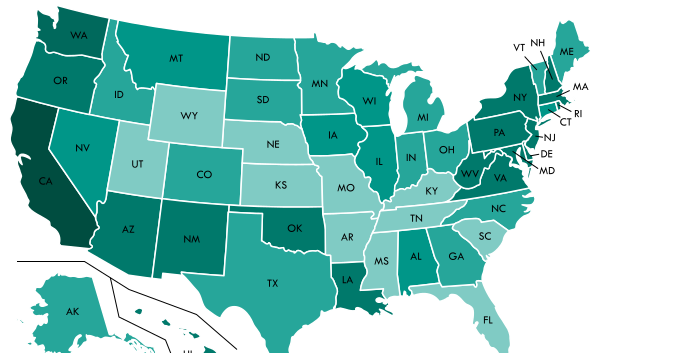
Most common states for system software analysts
| Rank | State | Population | # of jobs | Employment/ 1000ppl |
|---|---|---|---|---|
| 1 | District of Columbia | 693,972 | 650 | 94% |
| 2 | Delaware | 961,939 | 358 | 37% |
| 3 | Virginia | 8,470,020 | 3,007 | 36% |
| 4 | Maryland | 6,052,177 | 2,098 | 35% |
| 5 | Massachusetts | 6,859,819 | 2,289 | 33% |
| 6 | Vermont | 623,657 | 200 | 32% |
| 7 | Colorado | 5,607,154 | 1,542 | 28% |
| 8 | Rhode Island | 1,059,639 | 301 | 28% |
| 9 | South Dakota | 869,666 | 228 | 26% |
| 10 | Washington | 7,405,743 | 1,830 | 25% |
| 11 | Utah | 3,101,833 | 784 | 25% |
| 12 | Oregon | 4,142,776 | 1,005 | 24% |
| 13 | New Hampshire | 1,342,795 | 308 | 23% |
| 14 | Alaska | 739,795 | 171 | 23% |
| 15 | California | 39,536,653 | 8,752 | 22% |
| 16 | Wisconsin | 5,795,483 | 1,263 | 22% |
| 17 | Minnesota | 5,576,606 | 1,153 | 21% |
| 18 | New Mexico | 2,088,070 | 432 | 21% |
| 19 | Idaho | 1,716,943 | 357 | 21% |
| 20 | Arizona | 7,016,270 | 1,386 | 20% |
Most common cities for system software analysts
| Rank | City | # of jobs | Employment/ 1000ppl | Avg. salary |
|---|---|---|---|---|
| 1 | Leavenworth | 1 | 3% | $69,920 |
| 2 | Huntsville | 2 | 1% | $80,993 |
| 3 | Camarillo | 1 | 1% | $104,736 |
System Software Analyst job outlook: Expert opinions
Our panel of system software analyst experts
University of North Dakota
Widener University
SUNY College at Geneseo
Siena College
University of Maine
West Virginia University
Mount Saint Mary's University
Washington and Lee University
Nova Southeastern University
The University of the South
Quinnipiac University
Ashford University
University of Connecticut
What will help System Software Analysts increase their earning potential?
Sepehr Mohammadian: 3. The appeal of computer science among students is often attributed to the relatively short journey from concept to execution. Unlike many engineering fields where hardware constraints can impede the swift realization of ideas, the development of software offers a streamlined process. With nothing more than access to a computer and relative proficiency in programming, individuals can swiftly transform their ideas into tangible solutions. This accessibility and agility contribute to the popularity of CS among aspiring students. On the other hand, CS heavily relies on abstract analysis as a fundamental skill for success. Students who struggle with grasping abstract concepts may find themselves frustrated or disengaged with the field.
What System Software Analyst skills would you recommend for someone trying to advance their career?
Dr. Swagata Banerjee PhD: Digital literacy: As technology continues to evolve, proficiency in digital tools and platforms will become increasingly essential. Adaptability: The ability to quickly learn new skills and adapt to changing circumstances will be crucial in a rapidly evolving industry landscape. Data literacy: Understanding and analyzing data will become more important for making informed decisions and optimizing strategies. Interdisciplinary skills: The ability to work across different disciplines and collaborate effectively with diverse teams will be highly valued. Emotional intelligence: Soft skills such as empathy, communication, and teamwork will continue to be in demand as workplaces become more interconnected and dynamic.
What System Software Analyst skills would you recommend for someone trying to advance their career?
Adam Roth: I recommend that students start by identifying a specific skill in demand within your field, such as data analysis or social media marketing, and focus on developing expertise in that area. Research salary ranges and living costs in particular areas where you’re interested in working to ensure your compensation aligns with the local market. Always negotiate a salary and consider other aspects of the offer, such as funds for continuing education, technology and more. Continuing to network and establish demand for your services is essential; attend industry events, join professional associations, and engage with professionals in your field. Never miss an opportunity to reach out to and check in with your professional contacts. Pursue additional learning opportunities and education, such as certifications or advanced degrees, to provide a competitive advantage and increase your earning potential over time.
What will help System Software Analysts increase their earning potential?
Bradley Andrew Ph.D.: Once you have your first job, ask about or determine the 20% of your supervisor’s job that they hate and start doing that for them. They will love you for it and it will quickly get you recognition. You’ll also be well on your way to learning your boss’s job. Continue doing this as you progress in your career (Kudos to Theo Epstein, former GM for the Red Sox, for this recommendation)
No matter the task you’re given, do it to the absolute best of your abilities. In the professional world, you may often be given menial tasks or tasks that you don’t believe are part of your job description. Doing those tasks to the absolute best of your ability leads to increased trust, recognition and responsibility and will put you “above class.” If asked, the coffee you bring should be the best your boss has ever had. You never know who’s watching.
Don’t expect credit and don’t ask for credit when things go right; give the credit to others.
Yvette Koepke
Associate Dean for Academic SuccessUniversity of North Dakota
Ethnic, Cultural Minority, Gender, And Group Studies
What general advice would you give to a System Software Analyst?
Yvette Koepke: Advice: Be open! Your knowledge and skills could be valuable to any position in any field, so don’t limit yourself to jobs with certain titles or organizations---but you need to be able to make your case. Also be open to opportunities that might arise unexpectedly through talking with people around you about your background and interests.
Tongyang Yang Ph.D.
Assistant Professor of Economics and Business AnalyticsWidener University
Business/Commerce
What general advice would you give to a System Software Analyst?
Tongyang Yang Ph.D.: There are many reasons that people like about being a business analyst, including reasons listed as follows: 1. Analytical Skills and Data Exploration: BAs often analyze data to understand trends and identify areas for improvement. Seeing a successful implementation and its positive impact can be very rewarding. 2. Problem-solving. BAs get to identify inefficiencies and propose solutions that can improve how a business operates. 3. Continuous learning. Business analysts may work on a range of projects and the field of business analysis may be constantly evolving, which required BAs to actively cultivate skills in new businesses. For example, the coming of the AI era requires BAs to master AI fundamentals and data fluency. 4. While some thrive on the problem-solving and communication aspects of a BA role, others may find them less appealing. Carefully consider your personality and preferences to see if this aligns with your career goals.
What System Software Analyst skills would you recommend for someone trying to advance their career?
Tongyang Yang Ph.D.: The rise of AI has brought many opportunities for the professions like business analysts in terms of AI integration. Businesses will need analysts who can bridge the gap between AI and human needs and focus on more strategic areas like identifying ethical considerations of AI implementation, developing plans to mitigate AI bias, and designing human-AI collaboration workflows. For people who are interested in entering this profession, I would suggest adapting your skillset to include AI understanding, data storytelling, and strategic thinking to be well-positioned in the future.
Jasmine Tang
SUNY College at Geneseo
Bilingual, Multilingual, And Multicultural Education
What System Software Analyst skills would you recommend for someone trying to advance their career?
Jasmine Tang: Be confident of their major/minor or the subject they like and do best of the field they like for themselves not for money or please their parents or fulfill the dream of others.
What will help System Software Analysts increase their earning potential?
Jasmine Tang: I always advise the students to apply any job that accept their degree or go for the one they really like.
What general advice would you give to a System Software Analyst?
Sunita Goel PhD: Great. Will send you the responses soon. Please let me know the latest deadline by which you need them.
What System Software Analyst skills would you recommend for someone trying to advance their career?
Sunita Goel PhD: Great. Will send you the responses soon. Please let me know the latest deadline by which you need them.
What general advice would you give to a System Software Analyst?
Dr. Ryan LaRochelle Ph.D.: Be flexible. Today's job market is not the same as the one that your parents or grandparents entered into. It's unlikely that you'll be with the same company for your entire working career, so look at every experience as a potential opportunity to learn and explore. Also, the work environment you're joining is more important than the job title and position description. Do some research about what it's like to work at the place that is looking to hire you, and don't be afraid to reach out to current employees to get some candid feedback. Your job title and job description is much easier to change or renegotiate over time, but it's really hard to completely transform a toxic organizational culture and environment.
What System Software Analyst skills would you recommend for someone trying to advance their career?
Robert Bentz: The obvious one is artificial intelligence. Many people are concerned that they may be replaced by AI, but nothing can be further from the truth. Those who learn to work with AI are going to be the ones that excel. There's a skill to knowing what you can and can't get from this remarkable new technology.
Peter Antoniou MIBA, DBA
Business & Management ProfessorMount Saint Mary's University
International Business
What System Software Analyst skills would you recommend for someone trying to advance their career?
Peter Antoniou MIBA, DBA: We are operating in One Global environment! There is ONe global demand and One Global supply. You just happen to be located in one geographical area in the world. Look at Any product and follow its supply chain and one can easily realize that the majority of the components are manufactured or sources overseas. The same applies for services! One can engineer, design, provide support services to anyone in the world. Time difference is an advantage because you can do work when others are sleeping!
What general advice would you give to a System Software Analyst?
Oliver Keys Jr: The power of mentorships and networking early in your career will be beneficial in the long run. Also, understanding that professional skills can be half the battle. Showing up on time, dressing appropriately, and communicating effectively can be challenging for some students. Internships and externships are great for students to get technical and professional experience.
What System Software Analyst skills would you recommend for someone trying to advance their career?
Michelle Cowan Ph.D.: I’m not sure about this question since I haven’t really discussed this with any business analysts. I’ll pass this question on and see if I get a response. Otherwise, ask me about content strategy, UX, writing, and communication jobs, and I can speak more freely, since that’s what I did for 15 years before moving into academia.
What System Software Analyst skills would you recommend for someone trying to advance their career?
Prof. Kim Jovanovich P.E.: Attached please see the responses to your interview questions. I hope this sheds some light on the questions you asked!
Junping Sun Ph.D.
ProfessorNova Southeastern University
Computer Software And Media Applications
What System Software Analyst skills would you recommend for someone trying to advance their career?
Junping Sun Ph.D.: Computer Science and its applications in various fields are very dynamic and constantly evolving, and anyone in the fields needs to prepare to be adaptive by lifelong learning.
What will help System Software Analysts increase their earning potential?
Joseph Taylor: The role of a Business Analyst can vary greatly from company to company, and even from department to department, so it is very important to look at the details of a particular position that you are applying for. One common factor from all Business Analyst is that they are generally expected to make sense of data, and to be effective communicators that can apply insights to real-world problems.
Rick DelVecchio
Director of Career DevelopmentQuinnipiac University
Liberal Arts And Sciences, General Studies And Humanities
What general advice would you give to a System Software Analyst?
Rick DelVecchio: Internships and experiential learning help you build a portfolio of skills and experiences that prove you can bring value to future organizations. Make the most of those opportunities and make sure your resume shows the impact you had. Also, be sure to negotiate your initial job offer! Most employers have a range rather than a set number for compensation. Always negotiate the first offer you receive and try to maximize your initial earnings. Lastly, money follows impact. Track your own performance against the key performance metrics for your role. Be ready to go into your first performance review with data that proves you make a difference for the organization to justify any promotion or compensation increase you are seeking.
What will help System Software Analysts increase their earning potential?
Anil Agarwal: Some skills will always be in Demand - such as Interpersonal communications , Project Management , Learning different languages and having great listening skills. What new skills will be in demand : Social media, content and Digital marketing. Data Analytics and or Business Analytics. Cross cultural management , Leadership Skills. Financial Management . Getting an MBA, MFS ( Masters of Finance ) , MSM ( Masters in Analytical Marketing ) or a Masters in Economics or an MHA ( Masters in Health Sciences. The fields of Bio Technology are also exploding if that is your bent of mind.
Travis Grosser Ph.D.
Associate Professor of Management (@ UConn School of Business)University of Connecticut
Human Resources Management And Services
What System Software Analyst skills would you recommend for someone trying to advance their career?
Travis Grosser Ph.D.: The following are critical skills that will grow in importance in the coming years:
1. Innovative and Critical Thinking: The ability to think creatively and critically to solve complex problems will be highly valued, especially in a rapidly changing business landscape.
2. Emotional Intelligence: The ability to understand and manage one's own emotions, as well as empathize with others, will be crucial for successfully navigating a workplace where change, diversity, and collaboration will continue to increase.
3. Leadership and Change Management: Skills in leading teams, managing change, and inspiring innovation will be essential as businesses navigate through transitions and transformations.
4. Digital Literacy and Technological Proficiency: As technology continues to evolve rapidly, proficiency in digital tools and platforms will be crucial. Understanding emerging technologies like artificial intelligence, blockchain/Web3, and data analytics will be increasingly valuable.