Explore jobs
Find specific jobs
Explore careers
Explore professions
Best companies
Explore companies
Job outlook for technology implementation managers in the United States
Technology implementation manager job growth summary. After extensive research, interviews, and analysis, Zippia's data science team found that:
The projected technology implementation manager job growth rate is 16% from 2018-2028.
About 82,400 new jobs for technology implementation managers are projected over the next decade.
Technology implementation manager salaries have increased 11% for technology implementation managers in the last 5 years.
There are over 10,626 technology implementation managers currently employed in the United States.
There are 100,728 active technology implementation manager job openings in the US.
The average technology implementation manager salary is $102,840.
Are technology implementation manager jobs in demand?
Technology implementation manager job and salary trends over time
Technology implementation manager jobs over time
Technology implementation manager job growth rate over time
| Year | # of jobs | % of population |
|---|---|---|
| 2021 | 10,626 | 0.00% |
| 2020 | 10,015 | 0.00% |
| 2019 | 9,504 | 0.00% |
| 2018 | 8,572 | 0.00% |
| 2017 | 8,009 | 0.00% |
Average technology implementation manager salary over time
Technology implementation manager salary by year
| Year | Avg. salary | Hourly rate | % Change |
|---|---|---|---|
| 2026 | $102,840 | $49.44 | +3.3% |
| 2025 | $99,581 | $47.88 | +2.7% |
| 2024 | $96,975 | $46.62 | +2.4% |
| 2023 | $94,723 | $45.54 | +2.5% |
| 2022 | $92,396 | $44.42 | +3.2% |
Technology implementation manager jobs by state
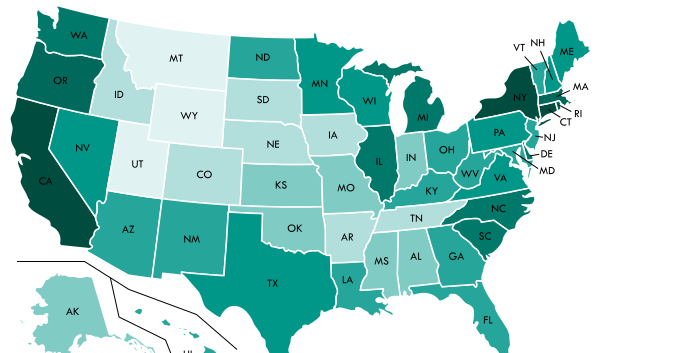
Most common states for technology implementation managers
| Rank | State | Population | # of jobs | Employment/ 1000ppl |
|---|---|---|---|---|
| 1 | District of Columbia | 693,972 | 349 | 50% |
| 2 | Washington | 7,405,743 | 1,566 | 21% |
| 3 | Massachusetts | 6,859,819 | 1,397 | 20% |
| 4 | Vermont | 623,657 | 125 | 20% |
| 5 | Virginia | 8,470,020 | 1,589 | 19% |
| 6 | Oregon | 4,142,776 | 741 | 18% |
| 7 | Utah | 3,101,833 | 569 | 18% |
| 8 | North Dakota | 755,393 | 138 | 18% |
| 9 | New Hampshire | 1,342,795 | 223 | 17% |
| 10 | Delaware | 961,939 | 165 | 17% |
| 11 | Nebraska | 1,920,076 | 311 | 16% |
| 12 | Rhode Island | 1,059,639 | 174 | 16% |
| 13 | Montana | 1,050,493 | 169 | 16% |
| 14 | South Dakota | 869,666 | 135 | 16% |
| 15 | Maryland | 6,052,177 | 917 | 15% |
| 16 | Wyoming | 579,315 | 89 | 15% |
| 17 | Illinois | 12,802,023 | 1,811 | 14% |
| 18 | New Jersey | 9,005,644 | 1,258 | 14% |
| 19 | Minnesota | 5,576,606 | 787 | 14% |
| 20 | Connecticut | 3,588,184 | 500 | 14% |
Most common cities for technology implementation managers
| Rank | City | # of jobs | Employment/ 1000ppl | Avg. salary |
|---|---|---|---|---|
| 1 | Plant City | 1 | 3% | $87,336 |
| 2 | Waltham | 1 | 2% | $106,497 |
| 3 | Atlanta | 1 | 0% | $87,181 |
| 4 | Denver | 1 | 0% | $76,884 |
| 5 | Jacksonville | 1 | 0% | $86,673 |
| 6 | Minneapolis | 1 | 0% | $93,855 |
| 7 | Tampa | 1 | 0% | $87,408 |
Technology Implementation Manager job outlook: Expert opinions
Our panel of technology implementation manager experts

Indiana University
Loyola University Chicago
What are the biggest trends we'll see in the Technology Implementation Manager job market given the pandemic?
Bipin Prabhakar: Technology will become a strategic enabler for most businesses. There will be increasing demand for graduates who can help create this technology (Computer Science/Data Science) and for graduates who can leverage technology (information Systems) to create business value.
What type of skills will young Technology Implementation Managers need?
Peter Dordal Ph.D.: I'm leaving off software developers, and answering about our Information Technology graduates.
IT students entering the business world will need to know how to get the maximum leverage out of business systems. In many cases, this will mean writing their own specialized queries to extract the precise business intelligence needed; general-purpose "canned" queries just won't cut it. They will need a broad understanding of what software can accomplish for the enterprise and how to deploy new software effectively; this applies to software used in the office as well as to software used in manufacturing and shipping. And they will need to understand how to lease storage and computing resources from the cloud to meet not only predictable, long-term demands but also sudden short-term business projects.
Students working in database administration and management will need to be able to manage much larger volumes of data than a few years ago. They will need to be familiar with the great variety of new databases in order to pick the best tool for the job.
Students working in network management will need to be able to ensure that everyone has the bandwidth and server access they need, as those demands expand to include extensive video, low-latency real-time connectivity, and the regular transfer of huge amounts of data.
Students in cybersecurity will need to be fully acquainted with all the recommended best practices. However, they will also have to be able to anticipate and guard against potential new vulnerabilities. "By the book" protection is no longer sufficient.