Explore jobs
Find specific jobs
Explore careers
Explore professions
Best companies
Explore companies
Job outlook for technology integration specialists in the United States
Technology integration specialist job growth summary. After extensive research, interviews, and analysis, Zippia's data science team found that:
The projected technology integration specialist job growth rate is 10% from 2018-2028.
About 83,100 new jobs for technology integration specialists are projected over the next decade.
Technology integration specialist salaries have increased 9% for technology integration specialists in the last 5 years.
There are over 6,585 technology integration specialists currently employed in the United States.
There are 110,959 active technology integration specialist job openings in the US.
The average technology integration specialist salary is $80,077.
Are technology integration specialist jobs in demand?
Technology integration specialist job and salary trends over time
Technology integration specialist jobs over time
Technology integration specialist job growth rate over time
| Year | # of jobs | % of population |
|---|---|---|
| 2021 | 6,585 | 0.00% |
| 2020 | 6,234 | 0.00% |
| 2019 | 6,298 | 0.00% |
| 2018 | 4,641 | 0.00% |
| 2017 | 4,463 | 0.00% |
Average technology integration specialist salary over time
Technology integration specialist salary by year
| Year | Avg. salary | Hourly rate | % Change |
|---|---|---|---|
| 2025 | $80,077 | $38.50 | +3.4% |
| 2024 | $77,438 | $37.23 | +2.3% |
| 2023 | $75,685 | $36.39 | +1.5% |
| 2022 | $74,542 | $35.84 | +1.7% |
| 2021 | $73,325 | $35.25 | +1.6% |
Technology integration specialist jobs by state
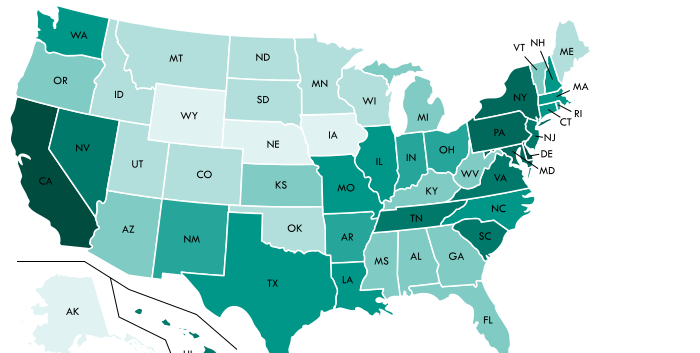
Most common states for technology integration specialists
| Rank | State | Population | # of jobs | Employment/ 1000ppl |
|---|---|---|---|---|
| 1 | District of Columbia | 693,972 | 438 | 63% |
| 2 | North Dakota | 755,393 | 225 | 30% |
| 3 | Vermont | 623,657 | 184 | 30% |
| 4 | Delaware | 961,939 | 237 | 25% |
| 5 | Wyoming | 579,315 | 145 | 25% |
| 6 | Virginia | 8,470,020 | 2,038 | 24% |
| 7 | Massachusetts | 6,859,819 | 1,502 | 22% |
| 8 | Utah | 3,101,833 | 678 | 22% |
| 9 | Nebraska | 1,920,076 | 421 | 22% |
| 10 | Rhode Island | 1,059,639 | 230 | 22% |
| 11 | South Dakota | 869,666 | 188 | 22% |
| 12 | New Hampshire | 1,342,795 | 277 | 21% |
| 13 | Maryland | 6,052,177 | 1,186 | 20% |
| 14 | Colorado | 5,607,154 | 1,102 | 20% |
| 15 | Iowa | 3,145,711 | 632 | 20% |
| 16 | Oregon | 4,142,776 | 799 | 19% |
| 17 | Montana | 1,050,493 | 204 | 19% |
| 18 | Alaska | 739,795 | 141 | 19% |
| 19 | Washington | 7,405,743 | 1,331 | 18% |
| 20 | Arizona | 7,016,270 | 1,234 | 18% |
Most common cities for technology integration specialists
| Rank | City | # of jobs | Employment/ 1000ppl | Avg. salary |
|---|---|---|---|---|
| 1 | Columbus | 3 | 6% | $74,726 |
| 2 | Mililani Town | 1 | 4% | $88,408 |
| 3 | Kailua | 1 | 3% | $88,395 |
| 4 | Kaneohe | 1 | 3% | $88,399 |
| 5 | Waipahu | 1 | 3% | $88,341 |
| 6 | Pearl City | 1 | 2% | $88,369 |
| 7 | Fort Myers | 1 | 1% | $66,173 |
| 8 | Huntsville | 1 | 1% | $68,126 |
| 9 | Los Angeles | 1 | 0% | $101,812 |
| 10 | Urban Honolulu | 1 | 0% | $88,297 |
Technology Integration Specialist job outlook: Expert opinions
Our panel of technology integration specialist experts
Fairfield University
University of Kansas

Indiana University Southeast

Rowan University

Binghamton University, SUNY

The Ohio State University at Lima
North Carolina Central University

University of Minnesota

Lasell University
Western Illinois University
Carson-Newman a Christian University

American Public University System
Hotel Effectiveness

Forsyth County, Georgia

Rollins College
What general advice would you give to a Technology Integration Specialist?
Rich Miller III: People enjoy the variety of problems encountered and the need for quick thinking, problem-solving, and thinking outside the box. Dislikes include the rapid advancement of technology, which can make it challenging to stay ahead.
What Technology Integration Specialist skills would you recommend for someone trying to advance their career?
Rich Miller III: Educational Technology is a booming field that leverages technology to enhance teaching and learning. It allows for the simulation of real-world tasks for students, making them better prepared for the real world.
What will help Technology Integration Specialists increase their earning potential?
Rich Miller III: Ed tech is an all-encompassing field that can involve hands-on support, teaching and learning, project management, installing A/V equipment, and more. No two days are alike, and problem-solving skills are essential.
What general advice would you give to a Technology Integration Specialist?
Joshua Elliott Ed.D.: The biggest piece of advice I would give is to stay current. There are a few areas to focus with this. The International Society for Technology in Education (ISTE) is the most important organization in the field There are local organizations in various states that are associated with ISTE also. The ISTE Standards are the driving standards in the field.
* Be proficient with the different tools, but do not get too attached. A lot of people are particularly attached to a particular Device (IPad vs Chromebooks) or tool (Kahoot vs Polleverywhere) but true educational technology leaders need to be flexible. You will be at a real disadvantage if you only work with Apple products but get a job in a district with a one to one Chromebook plan.
* Focus on skills rather than tools.
What Technology Integration Specialist skills would you recommend for someone trying to advance their career?
Joshua Elliott Ed.D.: Educational technology is something that evolves by its very nature. The big thing is to stay current. The most likely trend is the continued growth and evolution of Artificial Intelligence, but that could always change.
What will help Technology Integration Specialists increase their earning potential?
Joshua Elliott Ed.D.: There are two main ways. You can take on leadership roles in districts. There are technology directors who focus on the more technical aspects, but there are also educational technology leaders in an increasing number of districts. The latter usually have more knowledge about the learning piece as opposed to the technical aspect. Of course, there will always be overlap in these roles.
* If your schedule permits, delivering professional development or coaching teachers in best practices is always a great option for making more money.
What experience really stands out on Technology Integration Specialist resumes?
Cari Ann Kreienhop: This is a tricky question because organizations can be focused on very different things in a given hiring search. I think what should be important to applicants in crafting their application materials is that they highlight their experience and achievements and highlight these attributes within the context of the organization's mission and strategic plan. The resume is the blueprint of how an applicant can fit into and contribute to an organization's growth; if the applicant doesn't take the time to match their resume experience to the job posting, hiring managers aren't going to take the extra time to read between the lines.
What technology do you think will become more important and prevalent for Technology Integration Specialists in the next 3-5 years?
Cari Ann Kreienhop: I posed this question to our alumni in the field and received the response that GIS (ESRI) and Smart City technologies like Advanced Meter Reading (Xylem/Sensus is a big brand name in the water sector, for example) are the most likely evolving platforms and uses they will encounter. Additionally, it's essential to keep abreast of thematic trends related to technology: an awareness of cybersecurity threats, best practices, and defensive tactics. Understanding the language, concepts, and strategies to manage better, and support IT, and protect the organization is critical.
Beyond specific technology, leaning into logical analysis and data-gathering skills are critical to bringing a well-rounded perspective into an organization. Mastering Excel and R are great for hitting the ground running in an organization, but being versatile and savvy with data analytics will be an asset to any organization.
What general advice would you give to a Technology Integration Specialist?
Dr. Mindy Badía Ph.D.: The three P's: be patient, be persistent, and be prepared.
What technology do you think will become more important and prevalent for Technology Integration Specialists in the next 3-5 years?
Dr. Mindy Badía Ph.D.: I would say information/communication technologies.
Dr. Kate Seltzer Ph.D.
Assistant ProfessorRowan University
Department of Language, Literacy and Sociocultural education
What general advice would you give to a Technology Integration Specialist?
Dr. Kate Seltzer Ph.D.: Overall, my advice to a graduate starting their career in education would be to reflect deeply on their stance - their core beliefs and philosophy about teaching more generally. Educational policies change all the time, what we call "best practices" change. But developing a strong stance, rooted in care and regard for students, their families, and the community, will help graduates navigate these changes while staying true to what matters.
What technology do you think will become more important and prevalent for Technology Integration Specialists in the next 3-5 years?
Dr. Kate Seltzer Ph.D.: I think the pandemic we live through will fundamentally change how schools manage to learn in the next 3-5 years. More platforms are available, more "tools" and "strategies" for virtual learning, and more emphasis on the benefits of hybrid instruction. I think, to go back to my answer to the first question, if graduates can focus on building relationships with their students, developing a strong foundation in their content area, and finding teaching approaches - both virtual and more traditional - that engage and respond to students' lives and interests, they can learn any new technologies.
How would you rate the starting salaries for Technology Integration Specialists, as well as the prospects for salary advancement?
Dr. Kate Seltzer Ph.D.: Educators are not paid nearly enough. However, working in a state with strong teachers' unions helps to ensure a starting salary that recent graduates can live off of and growth opportunities, albeit modest, over their careers.
Matthew McConn
Associate Professor of English Education, Department ChairBinghamton University, SUNY
Department of Teaching, Learning and Educational Leadership
What general advice would you give to a Technology Integration Specialist?
Matthew McConn: It's best to be fully certified before you sit for an interview. That means completing the EdTPA and all certification exams. Students tend to put off the EdTPA portfolio, and it hurts their chances when interviewed, since administrators would have to risk the applicant not passing their exam. However, during the pandemic, there have been some alternative options for candidates, so I would strongly recommend they familiarize themselves with those alternatives.
What technology do you think will become more important and prevalent for Technology Integration Specialists in the next 3-5 years?
Matthew McConn: If this pandemic has shown us anything, it's that in-person teaching is an integral part of learning and our community.
How would you rate the starting salaries for Technology Integration Specialists, as well as the prospects for salary advancement?
Matthew McConn: Here, in the state of New York, I think the salaries are competitive, depending on where you live.
What type of skills will young Technology Integration Specialists need?
Leah Herner-Patnode: Graduates in the field of education need to understand platforms such as Google Classroom. Even when things get better with Covid, many schools will still use this as a supplement. They also have to be aware of how to find appropriate sources. The days of just accepting the history textbooks are gone. Using primary sources is very important, and a skill teachers need to teach to students.
Are there any particularly good places in the United States for Technology Integration Specialists to find work opportunities?
Leah Herner-Patnode: Usually, urban areas of bigger cities and southern states, such as North Carolina, have many openings. Maine, Florida, California, Hawaii, Washington, and Texas are the most open positions.
How do you envision technology impacting Technology Integration Specialists in the next 5 years?
Leah Herner-Patnode: Technology and how to use it in a classroom is essential. How to find reputable sources is necessary. How to use Schoology and Google Classroom are tools that will help any educator succeed. Teaching children to code is also an important skill to cultivate.
Elisha Blankson
Program Director NCCU, Assistant ProfessorNorth Carolina Central University
Communication Disorders Department
What type of skills will young Technology Integration Specialists need?
Elisha Blankson: Graduates will need a skill set about the field in which they received training and additional skills useful to the job market. For example, with the changing demographics in the United States, extra skills in information technology and foreign languages will be a plus when entering the job market.
How do you envision technology impacting Technology Integration Specialists in the next 5 years?
Robert Henery Ph.D.: The pandemic has accelerated the need for competence in using technology. Hopefully, the epidemic will be a temporary event. Still, school districts have realized, more than ever before, that they need to hire teachers that are not only comfortable using technology but can leverage the use of technology in the classroom in new and dynamic ways. In special education, that means using technology for instructional purposes and as practical support for our students with disabilities.
Overall, we do not see any diminishment in need of new special education teachers. If anything, the demand is even greater.
Dr. Deirdre Donovan
Associate Professor of Mathematics, Program Chair for Mathematics and Data ScienceLasell University
Mathematics Department
What type of skills will young Technology Integration Specialists need?
Dr. Deirdre Donovan: Entering the workforce in 2020 will require a flexible skillset. Problem-solving, technology, and team-building skills will be at the forefront of this hiring season. Mathematics and data science students are uniquely educated to meet this challenge. The disciplines are built on mathematical problem solving and using technology to aid in the process.
How do you envision technology impacting Technology Integration Specialists in the next 5 years?
Dr. Deirdre Donovan: Math and data science are already technology-driven fields. The pandemic and Zoom culture will only accelerate the proliferation of technology to other aspects of the industry. Remote work and virtual software will become the norm as more and more companies turn to data to stay ahead.
Dr. Richard Filipink Ph.D.
ProfessorWestern Illinois University
History Department
What are the biggest trends we'll see in the Technology Integration Specialist job market given the pandemic?
Dr. Richard Filipink Ph.D.: An emphasis on remote work skills and adaptability. The ability to professionally use Zoom, Google Meets, Microsoft Teams, and the like will become a fundamental skill for word processing. Being willing and able to alternate from an office to a home work site will become more of a norm.
Will there be an increase or decrease in demand for Technology Integration Specialists in the next 5 years?
Dr. Richard Filipink Ph.D.: Much of this depends on budgets and response to the pandemic. If budgets tighten to pay off the debts caused by how the epidemic was handled in 2020, then a decrease in demand. If things improve in 2021-22, then there should be an increase in demand.
Philip Bailey
Assistant Professor of Business; Director of the MBA ProgramCarson-Newman a Christian University
Business Department
How would you rate the starting salaries for Technology Integration Specialists, as well as the prospects for salary advancement?
Philip Bailey: The starting salaries in entry-level marketing jobs are very comparable to other professional careers. The entry-level jobs usually have a modest salary with good benefits. I encourage our graduates to sharpen their skills in these jobs for about 18 months, and then move on to more responsibilities and more money. This industry reward success and experience. As the number of opportunities increased, the entry-level positions have more experienced marketing manager positions. The outlook for marketing as a long-term career is bright indeed.
Dr. Elizabeth Keavney Ph.D.
Associate ProfessorAmerican Public University System
Public Administration Department
What type of skills will young Technology Integration Specialists need?
Dr. Elizabeth Keavney Ph.D.: The ability to examine all sides of an issue, to include long-term consequences and short-term consequences and unintended consequences and intended outcomes is vital. A focus on goals and objectives, instead of depending on an emotional response, will help lead to the best solutions. Public servants should be adaptable and able to work with people from various cultures. They need to have an understanding of how to work with and motivate individuals and groups. Those who can stay engaged and exercise good judgment will fare best in fluid and changing times.
Are there any particularly good places in the United States for Technology Integration Specialists to find work opportunities?
Dr. Elizabeth Keavney Ph.D.: Some areas are hiring public servants around the United States; however, many places are cutting back, since so many sites had experienced budget cuts, even before COVID-19 lockdowns caused further revenue reductions. If you can't find a full-time job right away, try taking a part-time job, an internship, or a position with a non-profit as a way to continue learning and to give yourself a chance to show the quality of your work.
What technology do you think will become more important and prevalent for Technology Integration Specialists in the next 3-5 years?
Del Ross: 3-5 years is an eternity in technology. Even so, we should expect that tomorrow's technology will be much "smarter" than today's. This will show up mainly in tech's ability to predict future conditions and to anticipate scenarios, needs, opportunities, and challenges. We will continue to see significant changes in guest-facing technologies from how they shop and buy travel, how they pay for it, and how they consume it. Guests will assume that hoteliers will anticipate their needs and preferences and tailor the experience's delivery to reflect them - all without even being recognized for doing so.
On the operations side, smarter technology will replace old-school, "the way we have always done it" processes and programs in every area. Front desk, housekeeping, maintenance, F&B, back-office - every one of these areas will be directed and enabled by data-driven technology in ways that we could not have anticipated just a few years ago. This will make the workplace more efficient but may make individual jobs more complicated. Managers will have to be taught new ways to support and develop their associates to attract, retain, and deploy effective teams. "Simple" tasks such as weekly labor scheduling will use automated systems like Hotel Effectiveness to save time, improve productivity, and turn cost centers into profit drivers.
How would you rate the starting salaries for Technology Integration Specialists, as well as the prospects for salary advancement?
Del Ross: In 2019, the Assistant General Manager position was one of the highest turnover roles in every hotel. With low unemployment, tomorrow's industry leaders' best and brightest were routinely leaving the hotel business to pursue careers in other areas. As a result, there will be many opportunities for new graduates and increased competition for this talent as the economy and the hotel business recovers from COVID19. While starting salaries and wage rates for hotel staff will remain low, compared to other industries, new hires' growth potential will be unprecedented. We expect a modest increase in starting wages over the next 24 months, followed by an acceleration of the promotion cycle to fill the gap in management depth created before the pandemic even began.
What type of skills will young Technology Integration Specialists need?
Donna Kukarola: Without a doubt, the need for computer literacy will continue to expand, the ability to work with people, communication skills, being a team member/collaborative. So, in other words, many of the "soft" skills will need the skills they trained for their industry/vocation.
Are there any particularly good places in the United States for Technology Integration Specialists to find work opportunities?
Donna Kukarola: This one, not so sure of, the southeast continues to see options as well as mid-western states.
Will there be an enduring impact of the coronavirus pandemic on Technology Integration Specialists?
Donna Kukarola: The procurement field is an opportunity; each day will have its own set of challenges and opportunities. Obtaining the right item/service at the right time, at the right price, is not all that procurement does. They are strategic members, sourcing, timing, keeping up with trends, laws, best practices, and advising that the resource desired is already available!
This year, entering the workforce will be different for many interviews to be held electronically - even, perhaps, teleworking when they get the job. Training is a bit more of a challenge then, and it can be hard to get a real feel of the "attitude." Keeping an open mind and being flexible is a must; during this pandemic, we have all had to learn how to do our jobs differently and navigate our careers.
What experience really stands out on Technology Integration Specialist resumes?
Claire Strom Ph.D.: I don't read resumes, but I would argue that a graduate needs to narrate their college experiences effectively and talk about them in terms of skills gained.
What technology do you think will become more important and prevalent for Technology Integration Specialists in the next 3-5 years?
Claire Strom Ph.D.: The benefits and detriments of remote work have become much more apparent over the last few months. Luckily, upcoming graduates have had plenty of opportunities to master the necessary technologies.