Explore jobs
Find specific jobs
Explore careers
Explore professions
Best companies
Explore companies
Job outlook for telemetry technicians in the United States
Telemetry technician job growth summary. After extensive research, interviews, and analysis, Zippia's data science team found that:
The projected telemetry technician job growth rate is 10% from 2018-2028.
About 14,700 new jobs for telemetry technicians are projected over the next decade.
Telemetry technician salaries have increased 6% for telemetry technicians in the last 5 years.
There are over 30,521 telemetry technicians currently employed in the United States.
There are 63,712 active telemetry technician job openings in the US.
The average telemetry technician salary is $35,758.
Are telemetry technician jobs in demand?
Telemetry technician job and salary trends over time
Telemetry technician jobs over time
Telemetry technician job growth rate over time
| Year | # of jobs | % of population |
|---|---|---|
| 2021 | 30,521 | 0.01% |
| 2020 | 30,642 | 0.01% |
| 2019 | 30,713 | 0.01% |
| 2018 | 30,959 | 0.01% |
| 2017 | 30,724 | 0.01% |
Average telemetry technician salary over time
Telemetry technician salary by year
| Year | Avg. salary | Hourly rate | % Change |
|---|---|---|---|
| 2025 | $35,758 | $17.19 | +2.4% |
| 2024 | $34,923 | $16.79 | +1.5% |
| 2023 | $34,397 | $16.54 | +2.9% |
| 2022 | $33,441 | $16.08 | --0.5% |
| 2021 | $33,622 | $16.16 | +1.3% |
Telemetry technician jobs by state
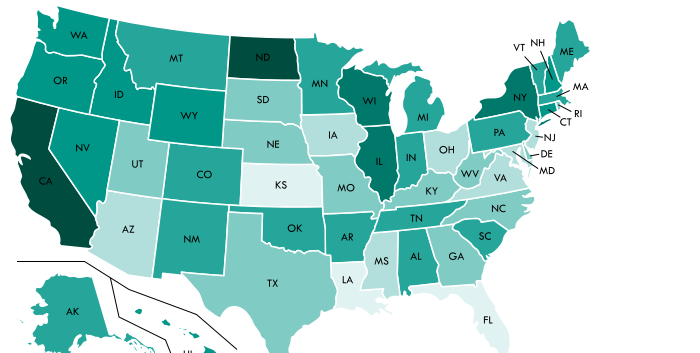
Most common states for telemetry technicians
| Rank | State | Population | # of jobs | Employment/ 1000ppl |
|---|---|---|---|---|
| 1 | Alaska | 739,795 | 152 | 21% |
| 2 | South Dakota | 869,666 | 167 | 19% |
| 3 | District of Columbia | 693,972 | 129 | 19% |
| 4 | Florida | 20,984,400 | 3,875 | 18% |
| 5 | Arizona | 7,016,270 | 1,273 | 18% |
| 6 | Colorado | 5,607,154 | 933 | 17% |
| 7 | Iowa | 3,145,711 | 539 | 17% |
| 8 | Arkansas | 3,004,279 | 522 | 17% |
| 9 | Massachusetts | 6,859,819 | 1,098 | 16% |
| 10 | Connecticut | 3,588,184 | 581 | 16% |
| 11 | Maine | 1,335,907 | 209 | 16% |
| 12 | North Dakota | 755,393 | 124 | 16% |
| 13 | New Hampshire | 1,342,795 | 205 | 15% |
| 14 | Vermont | 623,657 | 93 | 15% |
| 15 | New Jersey | 9,005,644 | 1,223 | 14% |
| 16 | Washington | 7,405,743 | 1,010 | 14% |
| 17 | Indiana | 6,666,818 | 903 | 14% |
| 18 | Delaware | 961,939 | 139 | 14% |
| 19 | Alabama | 4,874,747 | 652 | 13% |
| 20 | Montana | 1,050,493 | 137 | 13% |
Most common cities for telemetry technicians
| Rank | City | # of jobs | Employment/ 1000ppl | Avg. salary |
|---|---|---|---|---|
| 1 | Mankato | 4 | 10% | $36,214 |
| 2 | Mount Pleasant | 2 | 8% | $36,034 |
| 3 | Pontiac | 4 | 7% | $35,663 |
| 4 | Port Huron | 2 | 7% | $35,914 |
| 5 | Bay City | 2 | 6% | $36,102 |
| 6 | Alexandria | 2 | 4% | $27,004 |
| 7 | Miami | 13 | 3% | $23,435 |
| 8 | Arlington Heights | 2 | 3% | $43,607 |
| 9 | Flagstaff | 2 | 3% | $29,773 |
| 10 | Chula Vista | 2 | 1% | $49,284 |
| 11 | Mobile | 2 | 1% | $36,529 |
| 12 | Wichita | 2 | 1% | $26,600 |
| 13 | Ann Arbor | 1 | 1% | $35,460 |
| 14 | Antioch | 1 | 1% | $51,549 |
| 15 | San Diego | 6 | 0% | $49,345 |
| 16 | Dallas | 3 | 0% | $30,360 |
| 17 | Mesa | 2 | 0% | $29,552 |
Telemetry Technician job outlook: Expert opinions
Our panel of telemetry technician experts

Georgia State University

Georgia State University

Carlow University

ACVP - Alliance of Cardiovascular Professionals

University of Wisconsin Oshkosh
Holy Names University

Eastern Michigan University

Northwestern Oklahoma State University

Bellevue College

Fairfield University
What are the biggest trends we'll see in the Telemetry Technician job market given the pandemic?
Joan Cranford: -Increase in hiring
-More internshipsprograms to prepare new nurses
-More across state line licensin
-Increased telehealth training to care for non-COVID patients
-Unemployed and retired nurses returning to work
-Ability to cope in stressful situations
What skills stand out on Telemetry Technician resumes?
Joan Cranford: -Exposure to caring for COVID patients
-Knowledge of appropriate infection control standards i.e. use of personal protective equipment
-Critical care experience
-High level nursing skills
-Initiative
-Ability to deal and work in stressful situations
Traci Sims
Clinical Associate ProfessorGeorgia State University
Byrdine F. Lewis College of Nursing and Health Professions
What are the biggest trends we'll see in the Telemetry Technician job market given the pandemic?
Traci Sims: - Increase in hiring
- More externship programs to prepare new nurses
- More across-state line licensing
- Increased telehealth training to care for non-COVID patients
- Unemployed and retired nurses returning to work
Janice Nash
Professor, Director of the Undergraduate Nursing ProgramCarlow University
College of Health and Wellness
Are there any particularly good places in the United States for Telemetry Technicians to find work opportunities?
Janice Nash: A graduate should find opportunities in almost every region of the country at this point.
Are there any particularly good places in the United States for Telemetry Technicians to find work opportunities?
Peggy McElgunn: Frankly, cardiovascular care is still the most robust field in healthcare. This is mainly because it remains the number one killer (heart disease), but COVID 19 has impacted this. We know COVID 19 effects the heart, as well. And there are places for qualified graduates EVERYWHERE! Most hospitals offer fantastic onboarding incentives, too. And of course, they all have their protocols and policies - again, speaking the value and importance of flexibility!
Of course, again, membership in the Alliance of Cardiovascular Professionals offers graduates a chance to network and learn directly from those working in the field. They are also the first to hear about opportunities and openings and often drive possibilities through these connections.
How do you envision technology impacting Telemetry Technicians in the next 5 years?
Peggy McElgunn: There is NO DOUBT technology is moving at a pace unimagined before COVID19. The primary way this will affect cardiovascular technology is, we will be better able to see disease processes and, therefore, more capable of managing them more effectively. Interventional cardiology and cardiac imaging are where the enormous impact will be felt. But unlike radiology, where we see much in the way of AI driving change, people will need to continue to interact with patients in interventional cardiology and cardiac imaging. Therefore, technology will serve to advance practice but not displace a workforce.
What type of skills will young Telemetry Technicians need?
Peggy McElgunn: More than anything, they will need to be flexible and adaptable. Through the pandemic, thus far, we have learned that the ability to support health care on demand is critical. So being able to work many different roles, or be identified to support various aspects of cardiovascular technology, is suggested. Towards that end, seeking credentials demonstrating your abilities is advised, too. In addition to your degree, validation through voluntary credentialing programs will go a long way towards ensuring a place and then advancement in the workforce. Careers are built on flexibility and adaptability: willingness to learn as much as possible.
One of the best ways to learn about the latest approaches and advancements is participation in the ONLY national association representing cardiovascular professionals: the Alliance of Cardiovascular Professionals (Visit ACP). Membership is a great way to build flexibility and learn about adaptations in practice.
What general advice would you give to a Telemetry Technician?
Jason Mott Ph.D.: I think the best advice for new graduates is to be flexible. Things are going to change daily. It is essential to be able to go with the flow. Also, take time for yourself. As the numbers of covid patients increase, staff members are at high risk of developing burnout. It is essential to take time for yourself to relax and get away from everything, even if for only a few minutes. That way, you can prevent becoming burned out.
What technology do you think will become more important and prevalent for Telemetry Technicians in the next 3-5 years?
Jason Mott Ph.D.: In terms of technology, I think that telemedicine will continue to grow and be a crucial part of the health care system. Nurses need to be more comfortable with this technology.
Dr. Pamela Stanley
Interim DeanHoly Names University
School of Nursing
How do you envision technology impacting Telemetry Technicians in the next 5 years?
Dr. Pamela Stanley: COVID-19 has also changed the way we deliver care, learn, and have meetings. Telehealth has been fast-forwarded by ten years, in my opinion. Nurses who had requested, for years, to complete telehealth work at home and were denied have been working remotely at home now for months.
Michael Williams Ph.D.
Director and Associate ProfessorEastern Michigan University
School of Nursing
What technology do you think will become more important and prevalent for Telemetry Technicians in the next 3-5 years?
Michael Williams Ph.D.: Many technologies are growing in importance in healthcare. Healthcare trackers, wearables, and sensors will continue to grow and allow patients to self-monitor and report their health findings to providers in real-time. Wearable diabetes monitors that provide real-time blood sugar reports and control have revolutionized a person's life with diabetes. FitBit and other technologies can monitor heart rate, rhythm, blood pressure, and oxygen saturation will also expand in use.
The electronic health record (EHR) integration continues to build in decision aids and artificial intelligence for making better decisions. The EHR has made accessing patient information more available to other practitioners and patients themselves. Another technology that will continue to expand in use is a point of care testing (POC). POC allows for greater flexibility to meet the patient wherever they are, and will see continued expansion. And perhaps, the technology that has indeed expanded, out of necessity during the pandemic, is telehealth.
While telehealth has been available for many years, particularly in rural areas, it wasn't nearly as common in high population areas--patients were expected to go to the provider. Telehealth can eliminate many unnecessary "non-emergency" visits to emergency rooms and can be available, quite easily, in off-hours.
How do you envision technology impacting Telemetry Technicians in the next 5 years?
Shelly Wells Ph.D.: As technology continues to evolve and change healthcare, there will always be a role for nurses. Technology will continue to provide ways to diagnose and treat many more conditions with less invasiveness and lost time. Technology will be used to improve communication between the patient and healthcare providers as telehealth grows. New robotic surgery techniques will allow patients to recover quicker than more invasive procedures. Electronic platforms for storing health care information will improve from the current time-intensive frameworks. As the improvements continue to emerge, there will be no replacement for the problem-solving and patient-teaching skills that the registered nurse brings to the health care arena.
How do you envision technology impacting Telemetry Technicians in the next 5 years?
Katrina Malkin: Enhanced A/V technology, both in the delivery of telehealth - allowing RNs to go virtually into people's homes and see how they live, will give us an edge for delivering more sustainable and holistic care - and get buy-in from our clients to make lifestyle changes in the context of their lives, not our sterile clinic settings.
Simulation education - We have ramped up an already burgeoning trend to use simulation to move our nursing students into the "hot seat" to give them opportunities to exercise their clinical reasoning skills in myriad dynamic simulated client case scenarios. Learning how to use their brains and bodies to deliver care in simulation - where they can risk trying what they think is the right move, without risk to a real client. We have sim manikins that speak, have pulses, breathe, have a heartbeat, their pupils dilate, we can make them pee and bleed, start IVs on them, and manipulate the whole client/RN experience from behind a one-way mirror. It's powerful.
During COVID, we are experimenting with live-action avatars. Since students can't come to campus, we, the faculty, are serving as their avatar-they remote in, via Zoom, and direct us. We are also exploring the use of virtual reality to give dynamic, low-risk experiential education to nursing students; how all of this translates to bridging the divide between real human client interactions and the virtual world remains to be seen. Will tech translate? Will we be able to sustain meaningful engagement with real human bodies? Technology has the potential to bring us closer or add layers of distance and divide.
How do you envision technology impacting Telemetry Technicians in the next 5 years?
Dr. Linda Roney: Technology is a significant part of healthcare. For example, we have seen a significant expansion of telemedicine during the pandemic, and there will be opportunities to expand its use. Innovation is central to advancing health, and while this sometimes involves the use of technology, nurses are experts at remembering what really matters-holistic care of our patients.