Explore jobs
Find specific jobs
Explore careers
Explore professions
Best companies
Explore companies
Job outlook for unix systems engineers in the United States
Unix systems engineer job growth summary. After extensive research, interviews, and analysis, Zippia's data science team found that:
The projected unix systems engineer job growth rate is 5% from 2018-2028.
About 18,200 new jobs for unix systems engineers are projected over the next decade.
Unix systems engineer salaries have increased 9% for unix systems engineers in the last 5 years.
There are over 35,319 unix systems engineers currently employed in the United States.
There are 85,208 active unix systems engineer job openings in the US.
The average unix systems engineer salary is $112,085.
Are unix systems engineer jobs in demand?
Unix systems engineer job and salary trends over time
Unix systems engineer jobs over time
Unix systems engineer job growth rate over time
| Year | # of jobs | % of population |
|---|---|---|
| 2021 | 35,319 | 0.01% |
| 2020 | 20,723 | 0.01% |
| 2019 | 22,717 | 0.01% |
| 2018 | 11,414 | 0.00% |
| 2017 | 11,688 | 0.00% |
Average unix systems engineer salary over time
Unix systems engineer salary by year
| Year | Avg. salary | Hourly rate | % Change |
|---|---|---|---|
| 2025 | $112,085 | $53.89 | +3.4% |
| 2024 | $108,392 | $52.11 | +2.3% |
| 2023 | $105,938 | $50.93 | +1.2% |
| 2022 | $104,712 | $50.34 | +1.8% |
| 2021 | $102,904 | $49.47 | +2.4% |
Unix systems engineer jobs by state
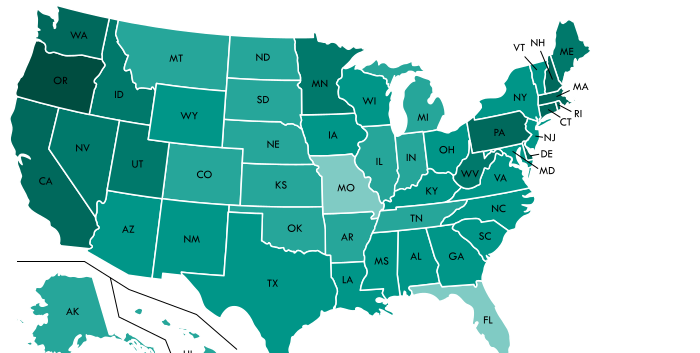
Most common states for unix systems engineers
| Rank | State | Population | # of jobs | Employment/ 1000ppl |
|---|---|---|---|---|
| 1 | District of Columbia | 693,972 | 664 | 96% |
| 2 | Maryland | 6,052,177 | 2,325 | 38% |
| 3 | Virginia | 8,470,020 | 3,167 | 37% |
| 4 | Colorado | 5,607,154 | 1,529 | 27% |
| 5 | Massachusetts | 6,859,819 | 1,478 | 22% |
| 6 | New Hampshire | 1,342,795 | 269 | 20% |
| 7 | Vermont | 623,657 | 127 | 20% |
| 8 | Washington | 7,405,743 | 1,413 | 19% |
| 9 | Utah | 3,101,833 | 577 | 19% |
| 10 | Delaware | 961,939 | 182 | 19% |
| 11 | Alaska | 739,795 | 144 | 19% |
| 12 | Oregon | 4,142,776 | 698 | 17% |
| 13 | New Mexico | 2,088,070 | 357 | 17% |
| 14 | Wyoming | 579,315 | 100 | 17% |
| 15 | Nebraska | 1,920,076 | 300 | 16% |
| 16 | Rhode Island | 1,059,639 | 169 | 16% |
| 17 | North Dakota | 755,393 | 124 | 16% |
| 18 | California | 39,536,653 | 5,862 | 15% |
| 19 | Minnesota | 5,576,606 | 841 | 15% |
| 20 | Alabama | 4,874,747 | 715 | 15% |
Most common cities for unix systems engineers
| Rank | City | # of jobs | Employment/ 1000ppl | Avg. salary |
|---|---|---|---|---|
| 1 | Pocatello | 2 | 4% | $108,795 |
Unix Systems Engineer job outlook: Expert opinions
Our panel of unix systems engineer experts
University of South Alabama
Massachusetts Maritime Academy
Northwood University

Albertus Magnus College

University of Washington
University of Colorado at Colorado Springs

University of New Hampshire

Kennesaw State University
What general advice would you give to a Unix Systems Engineer?
Sean Walker: Model Based Systems Engineering (MBSE) and Artificial Intelligence (AI) are going to be incredibly important in Systems Engineering over the next 3-5 years. MBSE has already become quintessential to the practice of Systems Engineering, which is why it has become a staple of our Master's and Doctoral programs. AI, of course, is changing almost every technical field and will be important to Systems Engineers as well. For Systems Engineers, the challenge will be understanding how and when to apply AI to solve systemic problems. Of course, both of these elements must be applied with an understanding of sociotechnical systems concerns. An engineer with the skills to apply MBSE and AI without losing sight of the humans in the system will be highly sought after.
What Unix Systems Engineer skills would you recommend for someone trying to advance their career?
Sean Walker: To maximize your salary, it is really essential to learn the tools and methods associated with Systems Engineering while also maintaining a sense of creativity. Employers are not only looking for engineers with the ability to apply specific tools but also the ability to think creatively to solve complex systems problems. I often encourage my students to maintain their creative hobbies so that they don't lose those skills. But, more immediately, gaining a graduate education in Systems Engineering can help any engineer increase their earning potential.
What will help Unix Systems Engineers increase their earning potential?
Sean Walker: I think the best advice for a new Systems Engineer, or really any engineer, is to be observant. One of the best things you can do when starting to apply the theoretical aspects that you've learned in school to your new career is to watch and listen to how experienced Systems Engineers practice in the field. This doesn't mean that you can't offer ideas or perspectives that are new, but that there will be challenges in your field that - due to the breadth of Systems Engineering - may not have been covered in your education.
What Unix Systems Engineer skills would you recommend for someone trying to advance their career?
Mark Whalen P.E.: Many system engineers enjoy working across all technologies at a higher organizational level, and interacting with all types of technologists to manage and implement complex technical systems.
Many system engineers can feel challenged by their lack of depth of understanding of particular technologies compared to technical specialists.
What will help Unix Systems Engineers increase their earning potential?
Mark Whalen P.E.: There are many complex systems in existence or being developed that require knowledge and experience across many different technologies. Also, system engineering careers can often lead to managerial positions like becoming a project manager, operations manager or chief engineer.
Professor David Sanford
Associate Professor an Department Chair (MIS, CS, CYB MGT, IS CYB)Northwood University
Computer And Information Sciences
What general advice would you give to a Unix Systems Engineer?
Professor David Sanford: Workers like that they are challenged to solve problems and lead technological innovations.
They appreciate the diversity of projects
They enjoy the need for continuous improvement and education
Many see the global impact of their work.
They also desire and appreciate the need for versatile skills
A competitive salary is also an item that employees like
Workers dislike that the work can be stressful
Dealing with tight deadlines and/ or cybersecurity concerns.
This is a positive and a negative: The need to constantly stay up to date with technology can be a bit overwhelming for some.
There may be times of isolation, and
The unexpected system failures can be frustrating as they often require extra hours or the need to be on-call.
The multiple responsibilities and managing repetitive tasks are also issues workers point out in this field.
In short, the workplace offers exciting opportunities but comes with its fair share of pressures and challenges. Different people have different experiences based on their roles and personal preferences.
David Garaventa
Director, Computer Information Systems and Cybersecurity Programs, Assistant Professor, CISAlbertus Magnus College
Business Administration and Management Department
What skills stand out on Unix Systems Engineer resumes?
David Garaventa: The skills/attributes required across a variety of jobs in the IT fields.
Will there be an enduring impact of the coronavirus pandemic on Unix Systems Engineers?
Les Atlas: Most certainly an impact, a very strong impact. The best lesson for us is from the 1919 Spanish Flu pandemic. That strain of flu still circulates as a seasonal virus. Over 100 years laters, it is now considered a Phase 6 pandemic by the World Health Organization. While it is reduced due to current social distancing and mask wearing, the 1919 Spanish Flu virus still causes community-level outbreaks in multiple parts of the globe. Societal changes from this event of over 100 years ago are still with us.
In fact, they changed society. As is well-documented, after a high level of immunity was reached in the 1920's, the resulting labor shortage enabled workers to demand better living and working conditions, as well as better wages and public health care. As just one example of the societal changes due to the 1919 pandemic, the drop in the male labor force empowered male workers, and also changed the gender composition.
The aftermath of the 1919 pandemic was the start of women joining the labour force. In the United States, the proportion of women in the labour force rose from 18 per cent in 1900 to almost 21 per cent in 1920. In that same year, with the ratification of the 19th Amendment of the Constitution, the Congress of the United States guaranteed all American women the right to vote.
The current COVID-19 pandemic will certainly change the way we live, be it our mobility or the kinds of career options people have. After our current year-long experience in remote learning and work, will we go back to the inefficiencies of going to our office every work day? Or will remote work be acceptable, where one's residence will not be dependent upon the locations of employment. Will we avoid future hotspots of infection, choosing to instead reside and travel in areas where infection is decreasing? Will we prefer to travel on aircraft which are certified to be virus-free and frequent restaurants which are documented to be safer? Future marketing will likely make a sharp turn in this direction.
What type of skills will young Unix Systems Engineers need?
Les Atlas: With an expected increase in mobility, companies will have a larger pool of employees to search over and interview. Potentially orders of magnitude more. Searches for employees need not be regional. Thus, if a specific specialization is needed, the pool of applicants, which will likely come from a search over a large region, state-wide or larger, or even international.
Thus specializations will become more important, both in terms of depth and fit to the needs of an employer. Advanced graduate degrees will become more necessary. It seems very likely that filed which help understand data for epidemiology and disease forecasting and geographical hotspots will continue to be especially pertinent.
Dr. T.S. Kalkur
Department ChairUniversity of Colorado at Colorado Springs
Electrical and Computer Engineering Department
Will there be an enduring impact of the coronavirus pandemic on Unix Systems Engineers?
Dr. T.S. Kalkur: Yes, students complained that, while they are earning an online degree, they aren't learning as much.
What experience really stands out on Unix Systems Engineer resumes?
Dr. T.S. Kalkur: Internship experience and tools used in design.
Marc Lessard
ProfessorUniversity of New Hampshire
Physics and Astronomy Department and Space Science Center
What type of skills will young Unix Systems Engineers need?
Marc Lessard: This is a very good and important question. Graduates who can address complex problems in creative ways will be the most successful. This might sound obvious, but there seems to be a trend developing where younger engineers tend to want to follow written procedures or instructions for solving problems.
What is more valuable, of course, is being able to use a broad-based background to provide new and creative solutions, or at least to suggest new ideas and engage in discussions to further develop those ideas. The cliche of "thinking outside the box" will always be important.
What experience really stands out on Unix Systems Engineer resumes?
Marc Lessard: Students who have been significantly involved in research projects have a distinct advantage over those who haven't. Those who began such work (which is typically paid) as sophomores or juniors often will have played a significant role in these real-world research efforts, which can be very different than what might be tackled as part of a capstone project.
Written and oral presentation skills are also essential!
What experience really stands out on Unix Systems Engineer resumes?
Adeel Khalid Ph.D.: It is the age of diversity. A graduate can stand out when their resume shows a broad portfolio of experiences. In addition to a solid academic record, students who demonstrate that they can take on challenging tasks and work beyond a degree's basic requirements are more likely to be successful. I advise students to get involved in various activities, including undergraduate research projects, student design competitions, student organizations, internships, co-ops, etc. All of these should be highlighted on the resume. When a recruiter sees an overview of a student that shows relevant work experience in the form of work-study, internships, or co-op or research, their resume automatically comes to the top of the pile.