Explore jobs
Find specific jobs
Explore careers
Explore professions
Best companies
Explore companies
Job outlook for user support analysts in the United States
User support analyst job growth summary. After extensive research, interviews, and analysis, Zippia's data science team found that:
The projected user support analyst job growth rate is 10% from 2018-2028.
About 83,100 new jobs for user support analysts are projected over the next decade.
User support analyst salaries have increased 9% for user support analysts in the last 5 years.
There are over 260,643 user support analysts currently employed in the United States.
There are 116,372 active user support analyst job openings in the US.
The average user support analyst salary is $79,842.
Are user support analyst jobs in demand?
User support analyst job and salary trends over time
User support analyst jobs over time
User support analyst job growth rate over time
| Year | # of jobs | % of population |
|---|---|---|
| 2021 | 260,643 | 0.08% |
| 2020 | 281,637 | 0.08% |
| 2019 | 271,525 | 0.08% |
| 2018 | 181,013 | 0.05% |
| 2017 | 174,328 | 0.05% |
Average user support analyst salary over time
User support analyst salary by year
| Year | Avg. salary | Hourly rate | % Change |
|---|---|---|---|
| 2025 | $79,842 | $38.39 | +3.4% |
| 2024 | $77,211 | $37.12 | +2.3% |
| 2023 | $75,463 | $36.28 | +1.5% |
| 2022 | $74,323 | $35.73 | +1.7% |
| 2021 | $73,110 | $35.15 | +1.6% |
User support analyst jobs by state
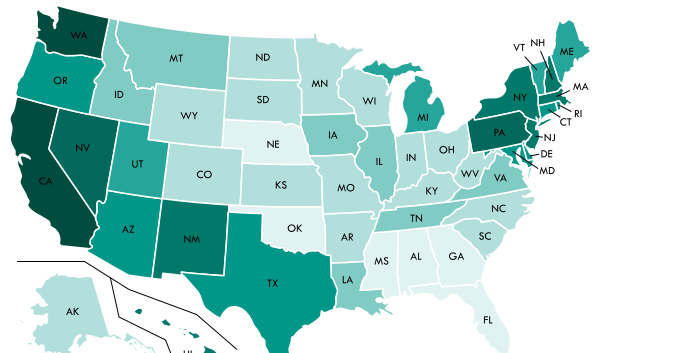
Most common states for user support analysts
| Rank | State | Population | # of jobs | Employment/ 1000ppl |
|---|---|---|---|---|
| 1 | District of Columbia | 693,972 | 616 | 89% |
| 2 | South Dakota | 869,666 | 232 | 27% |
| 3 | North Dakota | 755,393 | 180 | 24% |
| 4 | Virginia | 8,470,020 | 1,950 | 23% |
| 5 | Vermont | 623,657 | 142 | 23% |
| 6 | Utah | 3,101,833 | 678 | 22% |
| 7 | Rhode Island | 1,059,639 | 229 | 22% |
| 8 | New Hampshire | 1,342,795 | 288 | 21% |
| 9 | Alaska | 739,795 | 156 | 21% |
| 10 | Massachusetts | 6,859,819 | 1,397 | 20% |
| 11 | Maryland | 6,052,177 | 1,238 | 20% |
| 12 | New Mexico | 2,088,070 | 417 | 20% |
| 13 | Delaware | 961,939 | 188 | 20% |
| 14 | Missouri | 6,113,532 | 1,171 | 19% |
| 15 | Montana | 1,050,493 | 196 | 19% |
| 16 | Colorado | 5,607,154 | 989 | 18% |
| 17 | California | 39,536,653 | 6,630 | 17% |
| 18 | South Carolina | 5,024,369 | 848 | 17% |
| 19 | Oregon | 4,142,776 | 687 | 17% |
| 20 | Arkansas | 3,004,279 | 499 | 17% |
Most common cities for user support analysts
| Rank | City | # of jobs | Employment/ 1000ppl | Avg. salary |
|---|---|---|---|---|
| 1 | Rahway | 3 | 10% | $87,336 |
| 2 | Brownsburg | 1 | 4% | $55,564 |
| 3 | Fairfax | 1 | 4% | $65,867 |
| 4 | DeLand | 1 | 3% | $51,408 |
| 5 | Orchard Park | 1 | 3% | $82,506 |
| 6 | Atlanta | 1 | 0% | $51,485 |
| 7 | Irvine | 1 | 0% | $96,332 |
| 8 | Richmond | 1 | 0% | $63,694 |
| 9 | Tampa | 1 | 0% | $53,531 |
| 10 | Wichita | 1 | 0% | $60,954 |
User Support Analyst job outlook: Expert opinions
Our panel of user support analyst experts
Texas A&M University San Antonio

University of California, Irvine
Arizona State University

American University

SUNY Oswego

Rowan University
Lawrence Technological University

University of Nebraska at Omaha
Grand Valley State University
Tiffin University

California State University - Long Beach

Grantham University
Utah Valley University
Dominican University

Governors State University

New York Institute of Technology

Carleton College
Tufts University
University of North Texas

Slippery Rock University
Robert Vinaja Ph.D.
Assistant Professor of Computer Information SystemsTexas A&M University San Antonio
Computer Information Systems Department
What skills stand out on User Support Analyst resumes?
Robert Vinaja Ph.D.: The skills that stand out will depend on the job position you apply for. I do not think there is a set of universal skills that will stand out for any job. Instead, your resume skills must match the expected requirements for a specific job.
What soft skills should all User Support Analysts possess?
Robert Vinaja Ph.D.: -Ability to work as part of a team.
-Attention to detail.
-Problem-solving and analytical skills.
What hard/technical skills are most important for User Support Analysts?
Robert Vinaja Ph.D.: -Programming.
-Understand algorithms and data structures.
What skills will help User Support Analysts earn the most?
Robert Vinaja Ph.D.: My personal view is that instead of following the skills that command higher salaries, one should focus on a field that you like and feel at ease with. Instead of following the money, one should follow your heart, and money will eventually follow.
David Feldman Ph.D.
Professor of Urban Planning and Public Policy and Political Science, Director, Water UCI, Director, MPP ProgramUniversity of California, Irvine
Urban Planning and Public Policy
What skills stand out on User Support Analyst resumes?
David Feldman Ph.D.: Succinct writing, critical thinking, strong quantitative analytical skills.
Robert Rucker
LecturerArizona State University
School of Computing, Informatics, and Decision Systems Engineering
What skills stand out on User Support Analyst resumes?
Robert Rucker: Being articulate/communicative is a real positive - being able to write up a coherent report is a big plus.
What soft skills should all User Support Analysts possess?
Robert Rucker: Being able to learn a new technology very quickly is critical since that is what my students encounter.
What hard/technical skills are most important for User Support Analysts?
Robert Rucker: From step 2, knowing a particular technology very well may not match the employer's needs, so there is a real need to articulate principles (the hard part of education). For example:
1. Need to know how to design and implement ( or contribute to) a 'principled' information base (this is a skill my students encounter routinely)
a. Designing an information system requires knowing multiple levels of analysis and synthesis
- I teach the undergrad and graduate levels of database
( I have been teaching' conceptual level modeling --- using Object role modeling ( this is a layer above ER and relational, and has been underappreciated IMO
b. relational level analysis using SQL
implementational level using T-SQL
c. NoSQL using Couchbase and SQL++ and hence the key-value mode of storage
implementation ( SQL + NoSQL seem essential in this world of federated databases !)
d. Of course, there is the underlying substrate of approaching an info task in the first place!
2. For what it's worth, I also teach big data. Again, finding (understanding) and exemplifying the principles underlying the algorithms and data development is crucial.
Anthony Baron
Teaching Assistant, Associate Software EngineerAmerican University
What skills stand out on User Support Analyst resumes?
Anthony Baron: For new graduates, the main skills that stand would definitely include which programming languages (Java, JavaScript, Python, etc.) have been used along with a depth of knowledge, which frameworks and libraries (React, Django, Flask, etc.) were used throughout projects and internships, and showing work experience. Most introductory and required courses will teach programming languages but do not always teach frameworks, which is why I would always recommend people to do personal projects and internships throughout college. Many positions at the entry-level are often very general. However, positions that are looking for specifics will look for certain skills and experience. For example, positions looking more towards web development would be more interested in whether a user used frameworks used to build websites. Showing leadership and trustworthiness is also a helpful skill to stand out via work experience and university clubs.
What soft skills should all User Support Analysts possess?
Anthony Baron: The main soft skills I would say are needed for Computer Science software engineering are patience, perseverance, creativity, respect, teamwork, and openness to learning and teaching. Programming involves a lot of trial and error, researching, and learning better techniques for solving a problem. Due to this, patience and perseverance to reach the final goal in mind are crucial. When it comes to the learning aspect, there are many languages, frameworks, and libraries, and working with them involves a steeper learning curve than others. On top of this, there are often more elegant ways to program a solution, and many new frameworks and libraries are released throughout the industry. This is where patience and perseverance is also a virtue. Lastly, programming and creating a product are often done in teams, where working together and learning from each other is important.
What hard/technical skills are most important for User Support Analysts?
Anthony Baron: The main technical/ hard skills, I would say, are mainly the same as in part 1. Another hard skill that will come through with experience in programming is learning how to Google, more specifically knowing exactly what to search to solve an issue in the code.
What skills will help User Support Analysts earn the most?
Anthony Baron: By earning, do you mean financially, career-wise, or most growth? Career-wise, it really depends on what the final goal is. For web developers, learning the programming languages and frameworks for web development would be the way to go. In general, any experience with programming and knowing a little about a lot will be helpful. Having top-level theory knowledge (some but not in-depth) is also very helpful. It will help you better understand what is happening under the hood and determine which methods are more efficient than others. Financially, it really depends on what skills are most in-demand today. Also, getting a Masters opens doors to more job opportunities, and in some companies, allows for a pay increase. However, this is not the case everywhere.
What type of skills will young User Support Analysts need?
Mario Bkassiny Ph.D.: In addition to their academic skills, young graduates should be able to effectively communicate across multiple platforms and be able to adapt to changing work environments. Given the various means of communications and collaborations that are available nowadays, young graduates should be able to clearly express their ideas either in a video conference or through the traditional email communications. Effective communication will be essential to succeed as a member of any engineering team.
How do you envision technology impacting User Support Analysts in the next 5 years?
Mario Bkassiny Ph.D.: There has been recently a great focus on certain engineering technologies that enable smart systems with fast communications abilities. This has led to a revolution in several technologies such as robotics, artificial intelligence, wireless communications and cloud computing. Innovation in these fields will be essential in the upcoming years in order to keep up with the social and economic needs of modern life. The benefits of these innovations will have a long-lasting effect on our society.
What general advice would you give to a User Support Analyst?
Mario Bkassiny Ph.D.: Young graduates should continuously seek every learning opportunity to enhance their professional skills. With the fast growth of engineering technology, it is important for engineers to remain up to date with the most recent innovations in their fields. The learning process does not stop at graduation, but instead, it extends beyond college to the workplace where engineers can gain expert knowledge in their fields.
Will there be an enduring impact of the coronavirus pandemic on User Support Analysts?
Patricia Coughlan: Human communication has experienced a paradigm shift due to the COVID 19 pandemic. Overly reliant "face to face" communication has shifted to embrace, even reluctantly, tech mediated communication. Yes, before the pandemic some of society was comfortable with emails and mobile phone use, while youthful society was more active on smartphones and social media, but now most everyone is experimenting and getting better at virtual communication. When the Oxford English Dictionary announced that it was not choosing one "Word of the Year" in 2020 but instead listed a series of words that reflect major societal change, it was not surprising to find many words related to workplace communication.
Words including unmute, remote, remotely, were up from previous years' usage by 300% or more (Collins, 2020). Plus, new words were coined and quickly became common place; Have you Zoomed? Were you Zoombombed? Clearly the popularity of workplace communication in our everyday speech shows that attitudes towards tech mediated communication has changed. The hesitance of both employers and jobseekers towards tech-mediated communication is no more. The barriers to using online professional resources or hosting/attending virtual events has diminished and is altering our notion of workspace and carbon footprints. Employers and jobseekers are seeing the potential benefits for maintaining brand relevance, posting timely information, and career networking. A new willingness to use tech is improving site navigation and personal online savviness. Competition in the workplace is now driven by deliberate acts of communication. Jobseekers are more conscious in the information they post.
Employers vet their job postings for accuracy and expectations to entice the most competitive of candidates. The ability at all hours of the day to seek jobs and hire employees from diverse global locations and times zones creates a cosmopolitan workforce. At the minimum, a best of all worlds approach that integrates tech-mediated platforms with "in person" components may exist after COVID-19 distancing restrictions are lifted. Future job opportunities will be better served through tech mediated communication platforms.
Collins, Barry. (2020). Zoom zings into the oxford dictionary words of the year. Forbes. Retrieved February 17, 2021, from forbes.com/sites/barrycollins/2020/11/23/zoom-zings-into-the-oxford-dictionary-words-of-the-year/?sh=5e8b0d78a465
Will there be an enduring impact of the coronavirus pandemic on User Support Analysts?
Oriehi Destiny Anyaiwe: There is a high possibility that the impact of the coronavirus pandemic will endure but one cannot easily put a time frame to it. This impact will be felt by everyone, not just graduates or computer science graduates in particular. Jobs have been lost, companies are finding it hard to turn a profit and some are needing to close, whereas some others like the tech companies are prospering and doing well. Due to the coronavirus pandemic, the scope and teaching of computer science courses including students' senior projects and research have been coined to groom students to meet unprecedented standards. Thus, I can confidently say that computer science graduates stand at an advantageous position in the post pandemic marketplace; however, there will still be hills to climb so long as the synergy that hitherto existed between the crop of companies suffer.
What's a day at work look like for a User Support Analyst?
Oriehi Destiny Anyaiwe: What's a day at work going to look like for a recent graduate?
This pandemic has highly promoted keeping to one's space. A typical day at work be it work-from-home (online), traditional in-person or hybrid will naturally divide the work force into two groups; employees who perform best as lone players vs the socialists/collaborationist. Today, most companies keep as many employees as they can online. Workers are beginning to reorganize their lives around this type of schedule, and they are growing their comfort with this new norm. I think that there are sundry reasons why expectations from employers and employees will have to be adjusted in this regard post pandemic era.
What technical skills for a User Support Analyst stand out to employers?
Oriehi Destiny Anyaiwe: Attitude. Anyone can memorize a programming language and have a perfect syntax, but if you cannot find your way out of a paper bag you do the company no good. In today's marketplace, problems/business are tackled with a collaborative view. Employers will like to hire employees that have the skill set and potential to explain problems/solutions to non experts as well as working amicably with them.
Deepak Khazanchi Ph.D.
Associate Dean for Academic Affairs, Community Engagement & Internationalization Officer, Professor of Information Systems & Quantitative Analysis, Director, Executive Master’s of Science in Information Technology (EMIT) Program, Executive Director, Center for Management of IT (CMIT), Fulbright Grantee (Specialist 2014; Core 2020-21)University of Nebraska at Omaha
College of Information Science & Technology
What are the biggest trends we'll see in the User Support Analyst job market given the pandemic?
Deepak Khazanchi Ph.D.: Employment in the computer and information technology field were expected to grow by 11 percent between 2019 and 2029, according to the United States Department of Labor's Bureau of Labor Statistics (BLS). I do not think this will be lower post-Covid; in fact the demand for talented IT workers will substantively higher.
High tech entry level jobs will continue to be in areas such as software development (Java, Javascript, Python, etc.); Agile Methodology; Automation Engineers; AI/ML Developers/Analysts; Cybersecurity; Data Analysts/Data Engineers; Natural Language Processing; DevOPS; Project Management; Cloud Technologists; Parallel Computing; Quantum Computing; Digitalization or Supply Chain and Business Process Automation; Medical/Bio/Health Informaticians with a computing focused understanding of life and medical sciences. The ones in bold are what I would consider hot skills for the future and these will absolutely grow.
I also think general understanding of these important emerging areas will become important for non-IT employees as well. I would argue that all jobs will be "tech" jobs to some extent as automation and industry 4.0/5.0 takes hold across sectors; all college graduates will need to have exposure, if not competence, in aspects of technology that affect all business functions.
What technical skills for a User Support Analyst stand out to employers?
Deepak Khazanchi Ph.D.: Please refer to the prior response for purely technical skills; however, I believe that beyond "technical" skills, capabilities such as abstraction, computational thinking, problem solving, sensemaking, empathy, and multidisciplinarity of thinking will become important assets.
What's a good job out of college for User Support Analysts?
Deepak Khazanchi Ph.D.: I think the "best" and "interesting" jobs in my view will be those that leverage emerging technical skills such as AI/ML, data analytics, cybersecurity and medical informatics, with the nontechnical capabilities mentioned above.
What technical skills for a User Support Analyst stand out to employers?
Chirag Parikh Ph.D.: If you ask me, I consider valuable experience over good paycheck. Once you have gained that experience the paycheck will follow. As soon as you are out of college, the knowledge gained is very fresh and raring to go. If put into the right place can enhance your technical skills and you can do wonders.
As a Computer Engineering professor, I would say the job opportunities are tremendous for students out of college as they can venture into hardware field (technical support, hardware engineer, test engineer and much more) as well as software field (software engineer, software developer, software tester and much more). The possibilities are endless.
With COVID and employees working remotely there is still ample opportunity to enhance your technical and interpersonal skills as I believe remote working might stay for a while till things get back to normal.
What are the biggest trends we'll see in the User Support Analyst job market given the pandemic?
Chirag Parikh Ph.D.: The biggest trend according to me right now would be digital transformation of workplace. Workplace activities that were happening in-person has now become virtual and technology literacy is going to play a vital role. Cross disciplinary expertise is also going to be very crucial.
Biggest trends in job market according to me would be in the area of robotics, automation, AI, software development, cyber-security and healthcare for sure. This pandemic has created a sense of health awareness among people and we are seeing lot of students opting for healthcare programs (undergraduate and graduate).
What's a good job out of college for User Support Analysts?
Chirag Parikh Ph.D.: It is given that technical skills are required as you enter the job market. In the area of Computer Engineering, I feel that graduates should have a breadth of knowledge in most areas of computer engineering and a greater depth of knowledge in at least one area. Programming skills are of utmost importance, as you might not know every possible programming language or its syntax but the basic understanding of programming logic is necessary.
I personally value debugging skills as a must to have as having this makes you a well-rounded engineer no matter what area of engineering you belong to. Next in my list is technical writing and verbal communication skill. Most of the engineers are known to underperform in this skill. I value this skill, as employers would want their engineers to be able to create technical documents as well as present their design to other co-workers and sometimes to other stakeholders.
The last skill I feel that employers would like their employees to have would be to work in a multidisciplinary environment with co-workers from different branches of engineering and other backgrounds.
Will there be an enduring impact of the coronavirus pandemic on User Support Analysts?
George Miller: Yes. I think this idea of working from home is here to stay. Prior to the coronavirus pandemic companies had a reluctance in allowing individuals to work from home. But companies were forced to have employees work from home during the pandemic and are seeing in the data that productivity has not suffered (Schrotenboer, 2020). Graduates will enter the workforce facing a different environment than any previous generation. Graduates with a degree in information systems (IS) should be geared more to working remotely because of their technology knowledge and their ability to learn quickly about new and different technology. An IS degree is often housed in a business school at a college (but students take a higher concentration of information system and technology classes). Many students do not end up working in their field of study (O'Shaughnessy, 2013). So IS graduates can easily slide into management roles not related to information systems and have the skill sets to remotely manage subordinates.
What type of skills will young User Support Analysts need?
George Miller: Many organizations realize graduates cannot learn everything in college about their major but want the graduate to have a solid foundation on their field of study. The organization wants to mold the graduate to their company environment with how they do things related to the field of study. Most companies want college graduates to have good communication skills (both oral and written), critical thinking skills and be able to work well in teams. These skills have been a staple for graduates since I can remember. This is why a college graduate takes many general education courses related to these skills and many of their major courses emphasize these skills.
Going back to the previous answer I believe graduates in all fields of study will need a better knowledge of technology and easier adaptability to changing technology. Again, an IS degree is already preparing students for this.
What experience really stands out on User Support Analyst resumes?
George Miller: For graduates any experience stands out on a resume and it does not need to be related to their field of study. I tell students to do whatever to get experience. This can be with community volunteer work, at their college through clubs and organization and with professional employment.
There are many organization and government paid internship and co-op opportunities for students within all fields. There is no reason why every student cannot find some sort of internship/co-op during a summer break. Many times, an internship/co-op turns into full time employment. Often high schools and colleges are doing major technology upgrades within the summer months (because they are shut down during this period) and would welcome a student as an IS major as an intern. But volunteer work at the local church or favorite charity can also provide valuable experience. As I opened with this answer any experience stands out on a resume. The experience shows that a graduate has drive and determination.
What are the biggest trends we'll see in the User Support Analyst job market given the pandemic?
Dr. Lesley Farmer: Many employees have trouble pivoting to online work so in the short term, tech support and instructional design jobs are in high demand. Data privacy and security are also hot topics and need ed tech expertise. Tech maintenance, including cloud services and networks, continue to be needed, rather like car maintenance. Thinking forward, software development is another area of need, particularly with more online-based education. If grads have data analytics expertise, they can find jobs on data management and learning analytics.
Disabilities continue to be an issue, particularly in terms of equity, so jobs dealing with assistive technology and other ed tech supports are possible. Finally, grads should broaden their concept of educational settings; informal education is more important than ever: in business/HR, libraries and museums, recreational and youth-serving clubs, mass media, government and non-profit agencies. All of these entities are involved in training, outreach, PR, and public awareness/education. Be creative and persistent.
What User Support Analyst skills would you recommend for someone trying to advance their career?
Dr. Lesley Farmer: Internships are probably the best option, even if unpaid. Some institutions provide career placement services, and grads could contact their instructors about possible options. Companies, professional associations, and non-profits also advertise internships.
What general advice would you give to a User Support Analyst?
Dr. Lesley Farmer: Get to know the site before interviewing, and remember that even interviews are an opportunity to practice communication skills-and to see if there's a good match between you and the site. Once hired, learn about the organizational culture and develop trustful relationships. Make one memorable contribution the first month, but focus on becoming an expert before changing others. In addition, join a local and national professional association to keep current and network.
What experience really stands out on User Support Analyst resumes?
Lisa Sietstra: The job seeker's experiences will stand out when they've described previous accomplishments and shown a potential employer the value they have added in the past. Students/recent graduates (or really any job seeker at all) need to include quantifiable data in their statements; clearly painting a picture of achieved results. Connect the dots for the recruiter or hiring manager and really show that you have the potential to join the team and immediately contribute in positive ways.
Add details about academic projects if you do not yet have work experience in your field. Include a section of highlights from your coursework that applies to what the company is asking for in the job description.
Curtis Welborn
ProfessorUtah Valley University
Computer Science Department
Will there be an enduring impact of the coronavirus pandemic on User Support Analysts?
Curtis Welborn: Not that I can see. The high tech sector and jobs for CS students remains very strong, and as the economy recovers, these areas will continue to grow as they have over the past 40 years.
What type of skills will young User Support Analysts need?
Curtis Welborn: First, they need a strong fundamental understanding of Computer Science. People think they have to learn language X or environment Y or this thing or that thing because it is hot. Well, the thing to know about Computer Science jobs is there is always some new thing, always some new language better than the last, always something that is hot. Learning the hottest new thing might get you a job today, but it will not keep you a job tomorrow.
Having strong fundamental skills in Computer Science will equip you to learn ANY new thing. A good fundamental education in CS includes knowledge of programming languages, data structures, database, computer architecture, internet programming and networking, incremental design and development, and some advanced topic, which can vary based on a person's interest. Beyond this, everyone should have a basic understanding of math and the ability to write clearly because you always have to write something.
What experience really stands out on User Support Analyst resumes?
Curtis Welborn: That can really depend upon the company. Some companies want people with a strong background in machine learning right now. But I've met people who shy away from hiring people with too much machine learning on their resume even when the company wants someone to do machine learning because too many of these people only want to, or only can, do machine learning. They don't have a strong fundamental understanding of Computer Science (see No. 2). Our students who complete the Compiler course get jobs, not because companies are building a compiler but because companies know that someone who can build a compiler can most likely do anything they would want done. So people should not focus on finding that thing that makes their resume look good today. Just be great at everything you do. Take hard classes, and excel at them. Learn EVERYTHING you can, and companies will want you.
What are the biggest trends we'll see in the User Support Analyst job market given the pandemic?
Kate Marek Ph.D.: Probably an acceleration of existing trends - remote working, skill-set based job openings (rather than degree-specific), along with an ongoing need for necessary skills such as writing, problem-solving, collaboration, and project management.
What User Support Analyst skills would you recommend for someone trying to advance their career?
Kate Marek Ph.D.: If possible, find a paid internship in your area of interest, which will help expand your professional network and build your skillset. Use this time to keep scanning job ads to identify skill sets in demand; look for online mini-courses to make those skill sets.
What general advice would you give to a User Support Analyst?
Kate Marek Ph.D.: Choose an organization in tune with one's values. Look for a job in growth areas, such as data asset management, data analysis, etc.
What are the biggest trends we'll see in the User Support Analyst job market given the pandemic?
Stephen Hyzny: Security, as more people need online services, the protection behind that technology will be needed.
What technology do you think will become more important and prevalent for User Support Analysts in the next 3-5 years?
Stephen Hyzny: IoT having small devices connected to networks that control everything in our lives will become more integrated into our lives.
Will there be an increase or decrease in demand for User Support Analysts in the next 5 years?
Stephen Hyzny: As everything involves technology, more educated people will need it in the future. As our cars, houses, and lives connect, people will be required to make it all work.
What technology do you think will become more important and prevalent for User Support Analysts in the next 3-5 years?
Babak Beheshti Ph.D.: -The enormous growth of IoT and wearables. The number of connected devices is expected to be more than 26 billion in 2020. That includes things like household appliances, controllable lighting, and much more. This trend is likely to continue as it is expected to see the industry grow to 661 billion dollars by 2021.
-We will be witnessing a more widespread commercial deployment of 5G in 2020. With the implementation of the Standalone 5G devices based on the 3gpp release 16, we should be seeing the more robust mobile broadband deployment of 5G, wider availability of 5G smartphones, and a push towards an all 5G Network in select urban areas around the world.
-Significant growth in AI-based technologies, from face recognition and voice recognition to business intelligence and market predictions. As machines and deep learning algorithms get integrated into many applications, many industries will undergo substantial changes. AI systems will continue to interact with our phones; cars will interpret and analyze their surroundings and intelligently drive themselves. Online vendors will monitor our browsing habits, and Google decides what kind of search results to give us, based on who it thinks we are.
What type of skills will young User Support Analysts need?
Joshua Davis Ph.D.: Studying mathematics is good practice for rigorous thinking and problem solving, which are valued across the workforce. For science and engineering applications, it is often also helpful to have R, Python, Matlab, or another popular programming language. But technical abilities get the graduate-only so far. They need interpersonal communication skills so that they can understand the needs of stakeholders and cooperate with colleagues. For this reason, many faculty at my school emphasize writing, speaking, listening, and teamwork skills.
How do you envision technology impacting User Support Analysts in the next 5 years?
Joshua Davis Ph.D.: Electronic communication has enabled new collaborative projects in academic math, sometimes involving tens of mathematicians, spontaneously organizing around new problems. In industrial math, computers' ever-increasing power is getting more and more math turned into practical technology. Many of today's biggest buzzwords --- machine learning, self-driving cars, etc. --- are based on sophisticated math and statistics. I expect that math will only grow in importance as these technologies become more prevalent in society.
Are there any particularly good places in the United States for User Support Analysts to find work opportunities?
Joshua Davis Ph.D.: Math is arguably the highest of high-tech, in the sense that it leads to other high-tech fields. For example, differential geometry and complex analysis were developed in the early 1800s; they became central to the language of physics in the early 1900s; those physics led to consumer products such as GPS and electronics in the present day. So it's unsurprising that companies in technology centers with research and development divisions often employ mathematicians. But I also have friends in the financial industry, the video game industry, the federal government, etc.
Will there be an increase or decrease in demand for User Support Analysts in the next 5 years?
Ming Chow: On the one hand, there are many opportunities in tech currently. On the other hand, new college hires will be competing with crowds of people with real experience who were laid off during COVID. Five years is too far ahead to predict.
What are the biggest trends we'll see in the User Support Analyst job market given the pandemic?
Ming Chow: -Need to hit the ground running as many employees and companies don't have the time, energy, and training infrastructure.
-The soft skills, including communications, how to deal with change and the basics are becoming more critical-things like using a calendar, following-up, etc.
What technology do you think will become more important and prevalent for User Support Analysts in the next 3-5 years?
Ming Chow: Infrastructure, including cloud and networking, Security, Machine Learning, and Data Science.
References:
1. cybersecurity
2. cybersecurity
What experience really stands out on User Support Analyst resumes?
Mark Albert Ph.D.: Projects. For resumes, it needs to be beyond a standard course final project. This can include a capstone team effort, a consistent theme among course projects, or engaging with faculty as a part of multi-year research pursuits. Also, we encourage our students to engage in the local community and seek internships to validate further their ability to work as part of a team.
How do you envision technology impacting User Support Analysts in the next 5 years?
Mark Albert Ph.D.: AI is impacting everything we do, and the Biomedical Engineering program is integrating both human-based decision making and moral, well-validated, artificial intelligence into research and development. We also engage students in the MS in AI program and Data Engineering, both of which have Biomedical Engineering concentrations as part of the course sequence.
Will there be an enduring impact of the coronavirus pandemic on User Support Analysts?
Mark Albert Ph.D.: They are now better at working remotely than ever before! It sure did accelerate the transition. Interestingly, our students are now more engaged beyond our academic borders than before, given remote collaboration capabilities.
Abdou Karim Jallow Ph.D.
Associate ProfessorSlippery Rock University
Department of Information Systems
Will there be an enduring impact of the coronavirus pandemic on User Support Analysts?
Abdou Karim Jallow Ph.D.: It is obvious that the COVID-19 pandemic has impacted and transformed the lives of many people, including students all over the world. A major effect is requiring students to stay and learn from home because of the closure of educational institutions as a precautionary measure. Missing saying the traditional goodbye to friends, fraternities, and sororities, and having to watch commencement ceremonies in bedrooms online will leave an indelible mark in graduates.
This means a great U-shift in memories of college life, including physical interaction and learning environment, and systems adopting a new way of doing things. Graduates will enter the job market with uncertainties of availability of traditional jobs and how to work in a new normal. Many graduates will find themselves having to search for jobs virtually and having to start working remotely from the beginning in most cases and in most industries. What would have been a new beginning, along with the excitement of stepping through the doors of the new office and career, will not be there physically. This will have an impact on these graduates because of the transformation of society as a result of the pandemic.
Are there any particularly good places in the United States for User Support Analysts to find work opportunities?
Abdou Karim Jallow Ph.D.: Sometimes new graduates from college can find it hard to get the perfect or preferred job location. This may be different for those with information sciences or information systems and related degrees. Luckily there are big companies, multinational companies as well as some-sized enterprises who need skills in that discipline. Most of these can be found in some of the big cities beyond Silicon Valley such as NY, San Francisco, Seattle, Los Angeles, Pittsburgh, Atlanta, Denver, Colorado, Philadelphia, Chicago, DC, Charlotte, Houston, Boston, Dallas, and Minneapolis, just to name a few.
Some of these locations are where some of the big tech companies reside, such as Google, Microsoft, Apple, Amazon, Facebook, Twitter, IBM, HP, SAP, etc. The advantage of this degree is that graduates not only can work for tech companies but any company because of the need to manage data, information, process, and technology. Companies all over have or are putting together strategies to harness the potential of big data, and graduates with information sciences, information systems, and related degrees are sought after continuously.
How do you envision technology impacting User Support Analysts in the next 5 years?
Abdou Karim Jallow Ph.D.: The trend we have witnessed in the past two decades in terms of development in technology is unprecedented. This has a ripple effect on the field of information sciences and systems. Most traditional jobs have changed or rebranded. For example, consider how information and data processing and management (IDPM) has revolutionized into what is today information management or management information systems; business intelligence is almost transformed into business analytics, data science; high-performance computing, and grid computing is today predominantly engulfed by cloud computing services.
These are changing how data and information are managed. The decision-making process is changing in various information and knowledge-intensive and process-oriented industries such as healthcare, banking, transportation, engineering, education, security, just to name a few, despite the fact that roles and services still remain. New and emerging disciplines and services are added, driven by the advancement and greater capabilities of technology. Without a doubt, in the next few years, data and information services will be revolutionized by technology hugely. Consider the development in artificial intelligence, data science, blockchain, 5G, and broadband networks, all of which have huge potential to impact the discipline. This means that information sciences and information systems courses must adapt to take into consideration the emerging skills required by the professionals and businesses of the future. The education and training of professionals in this domain have to be continuously changing to prepare graduates adequately.