Explore jobs
Find specific jobs
Explore careers
Explore professions
Best companies
Explore companies
Job outlook for validation scientists in the United States
Are validation scientist jobs in demand?
Validation scientist job and salary trends over time
Validation scientist jobs over time
Validation scientist job growth rate over time
| Year | # of jobs | % of population |
|---|---|---|
| 2021 | 716 | 0.00% |
| 2020 | 832 | 0.00% |
| 2019 | 839 | 0.00% |
| 2018 | 794 | 0.00% |
| 2017 | 737 | 0.00% |
Average validation scientist salary over time
Validation scientist salary by year
| Year | Avg. salary | Hourly rate | % Change |
|---|---|---|---|
| 2025 | $77,661 | $37.34 | +3.1% |
| 2024 | $75,353 | $36.23 | +4.7% |
| 2023 | $71,975 | $34.60 | +3.3% |
| 2022 | $69,667 | $33.49 | +1.9% |
| 2021 | $68,343 | $32.86 | --2.1% |
Validation scientist jobs by state
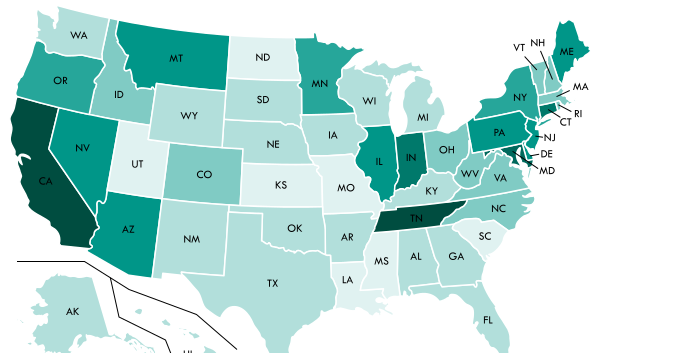
Most common states for validation scientists
| Rank | State | Population | # of jobs | Employment/ 1000ppl |
|---|---|---|---|---|
| 1 | Massachusetts | 6,859,819 | 1,771 | 26% |
| 2 | Delaware | 961,939 | 159 | 17% |
| 3 | Maryland | 6,052,177 | 942 | 16% |
| 4 | District of Columbia | 693,972 | 108 | 16% |
| 5 | New Jersey | 9,005,644 | 1,138 | 13% |
| 6 | Virginia | 8,470,020 | 1,065 | 13% |
| 7 | South Dakota | 869,666 | 104 | 12% |
| 8 | Washington | 7,405,743 | 797 | 11% |
| 9 | New Hampshire | 1,342,795 | 152 | 11% |
| 10 | North Dakota | 755,393 | 83 | 11% |
| 11 | Vermont | 623,657 | 66 | 11% |
| 12 | Oregon | 4,142,776 | 430 | 10% |
| 13 | Rhode Island | 1,059,639 | 104 | 10% |
| 14 | California | 39,536,653 | 3,616 | 9% |
| 15 | Pennsylvania | 12,805,537 | 1,174 | 9% |
| 16 | North Carolina | 10,273,419 | 965 | 9% |
| 17 | Montana | 1,050,493 | 95 | 9% |
| 18 | Illinois | 12,802,023 | 1,000 | 8% |
| 19 | Minnesota | 5,576,606 | 432 | 8% |
| 20 | Connecticut | 3,588,184 | 297 | 8% |
Most common cities for validation scientists
| Rank | City | # of jobs | Employment/ 1000ppl | Avg. salary |
|---|---|---|---|---|
| 1 | Lenexa | 2 | 4% | $57,008 |
| 2 | San Jose | 2 | 0% | $113,953 |
Validation Scientist job outlook: Expert opinions
Our panel of validation scientist experts
Washburn University of Topeka
University of Hawaii at Manoa
University of Dallas
University of San Diego
Southern Illinois University Carbondale
Washington State University
University of Pittsburgh
University of Nebraska - Omaha
Quinnipiac University
Coastal Carolina University

Won Institute

Vanguard University of Southern California

The University of North Carolina Asheville

Caldwell University

American University

Stephen F. Austin State University
Drexel University
What will help Validation Scientists increase their earning potential?
Frank David MD, PhD: In basic research jobs, the key lab-related skills will continue to be the ones that are commonly used for discovering and developing new therapies: mammalian cell culture, in vitro assays, transfection, immunoprecipitation, Western blots, etc. It’s typically not necessary to 'check all the boxes' in terms of bench skills for a job, but having a few of these key techniques under your belt will give a company confidence that you can learn others. In general across the industry, effective written communication and project management are key skills that cut across almost all jobs and divisions within biotech and pharma. Anything you can do to build and highlight those capabilities will serve you in good stead.
Susan Bjerke
Associate Professor of BiologyWashburn University of Topeka
Biological And Physical Sciences
What will help Validation Scientists increase their earning potential?
Susan Bjerke: Some of the skills that will be important in the next 3-5 years will be general critical thinking skills and the ability to adapt to changing technology. Almost all science fields are increasingly dependent on technology, so being able to learn new skills and change the way you do things in your job will be important. Being an effective communicator, both in writing and orally, is an overlooked skill in the sciences and is always an important asset.
What Validation Scientist skills would you recommend for someone trying to advance their career?
Qing Li: AI will become more important and prevalent in the field in the next 3-5 years but laboratory experiments will continue to make new discoveries.
What will help Validation Scientists increase their earning potential?
Meghan McGee-Lawrence Ph.D.: Cast a wide net! A huge variety of career paths can be pursued with a degree like this, including industry, academic research, healthcare, education, and more. It is a very versatile degree, and can be a foundation for a multitude of different professions. Talk to recent graduates from your program (as many as possible!) and see what they did with their degree – the more information you can collect, the better prepared you’ll be to seek out opportunities yourself. Take the time to figure out where your interests lie – and understand that you may have to try a few different paths out before you find the right one for you. The first position you land after graduation doesn’t have to be the job you perform for the next 30 years of your life – so use each opportunity as a learning experience to figure out what you’d really like to do long-term.
What will help Validation Scientists increase their earning potential?
Kristopher Koudelka Ph.D.: Always keep learning. These fields change fast! The leading edge is always unveiling new information that can be applied to the area you are working on, and there will be new techniques developed that allow you to answer questions in more efficient ways. You must learn to regularly update yourself through conversations, reading, conferences, and trainings. This change is fun and exciting, embrace it. It will keep your job feeling new.
What general advice would you give to a Validation Scientist?
Jacob Nordman: Salary potential in my field of neuroscience almost always involves publications, awards, and technical acumen. Therefore, as I mentioned, it is important to start early looking for opportunities that can strengthen these areas. Another important aspect of getting high-profile, and thus high-paying, positions, is being able to tell a story with your research and career. Employers want to see that you have thought deeply and strategically about your career and where it’s going. This will allow them to believe you are a safe bet and worthy of their investment.
What will help Validation Scientists increase their earning potential?
Jacob Nordman: In the field of neuroscience, the field is increasingly concerned with cellular and pathway specificity – what are the cell types and pathway that control ever-specific physiological functions. Some tools necessary to probe these questions include the powerful single-cell RNA sequencing method, genetic tools like optogenetics and chemogenetics that allow for neural pathway-specific manipulations, and increasingly sophisticated computer models that incorporate machine learning and artificial intelligence. These techniques will only become more precise and integral, so familiarity with them now will set you up to learn the newer versions later.
What will help Validation Scientists increase their earning potential?
Lindsey du Toit: Take every opportunity you can to learn, network, and build an effective team of people that bring a greater breadth and depth of skills and expertise to the work on which you will be focusing. Cultivate a life-long sense of intellectual curiosity and learning. Don’t be afraid to ask questions. Treat ignorance as an opportunity to learn. Questions demonstrate you want to understand the situation/problem effectively and that you are paying attention. Always demonstrate integrity in your work. It is one of the most valuable traits you can bring to your career. Be kind and supportive of your colleagues.
What will help Validation Scientists increase their earning potential?
Arjumand Ghazi Ph. D: Having an advanced degree such as a PhD and even a few years postdoc is a good way to start at a higher level. It often allows one to make up for the reduced earnings during the training periods while increasing long-term earnings.
Andrew Riquier Ph.D.
InstructorUniversity of Nebraska - Omaha
Neurobiology And Neurosciences
What general advice would you give to a Validation Scientist?
Andrew Riquier Ph.D.: Apply for the positions you want, even if you feel underqualified. I know plenty of people who have applied for jobs they didn't quite meet the requirements for, and got hired for other reasons. In my experience, many recent graduates choose to take time to strengthen their resumes by retaking classes, working jobs they don't particularly want to get experience, etc. There is some value in that, particularly if you have been unsuccessful attaining the position you want, or if you want to see if you even enjoy that type of work. But if you are confident in what you want to do, go for it; in the worst-case scenario, you are in the same position you would be if you hadn't applied, but now you have experience applying and have potentially gained a contact in the field.
Lisa Cuchara Ph.D.
Professor of Biomedical SciencesQuinnipiac University
Microbiological Sciences And Immunology
What Validation Scientist skills would you recommend for someone trying to advance their career?
Lisa Cuchara Ph.D.: The first and foremost would be Critical Thinking. We live in a world where facts can be easily acquired, sometimes even by asking Siri/Alexa/ChatGPT/Google/etc. But critical thinking is timeless and priceless. I can ask anyone on the street what xyz is and they can look it up, but can they provide advice or interpret.
Also being a good steward towards science and being willing and able to communicate not just with peers as we are trained, but also with the public, the politicians, the board members. John Holdren*, stated that Scientists should be tithing at least 10 percent of their time to public service ... including activism. In the ever growing science denialism that is happening in our country being able to communicate science with the public is important. As Peter Hotaz states, "Anti-science propaganda is "killing Americans in unprecedented numbers,""
*Holdren is an American scientist who served as the senior advisor to President Barack Obama on science and technology issues through his roles as assistant to the president for science and technology, director of the White House Office of Science and Technology Policy, and co-chair of the President's Council of Advisors on Science and Technology and a Research Professor in Harvard University's Kennedy School of Government
What will help Validation Scientists increase their earning potential?
Lisa Cuchara Ph.D.: Be passionate! Be curious! When I write a letter of recommendation I write a little about the obligatory "IQ" elements, how well their exam/assignment/course grade were, then I speak to their EQ, are they kind, helpful, respectful, considerate, etc. and I try to include an example of something that I witnessed regarding EQ. But the majority of the letter discussing PQ and CQ, their passion quotient and their curiosity quotient. A can write a much much better LOR for a student with high PQ and CQ than I can for one with just good grades. What have they read and what do they do in their spare time (and don't say that you can't afford a hobby, you can't afford not to have a hobby or an outlet, otherwise stress takes too much of a toll. Some of my most memorable student conversations are conversations that involved their curiosity, like a conversation about Bonnie Bassler's quorum sensing. Make sure that as you go through life you embrace Einstein's quote 'There are only two ways to live your life. One is as though nothing is a miracle. The other is as though everything is a miracle.'
The second piece of advice is: Know what you know, know what you don't know, be willing to admit what you don't know, and don't be afraid to ask questions, but try not to ask questions about simple things that one can easily look up as that indicates laziness rather than inquisitiveness.
The third piece of other advice would be to never give up. As "Nothing in this world can take the place of persistence. Talent will not: nothing is more common than unsuccessful men with talent. Genius will not; unrewarded genius is almost a proverb. Education will not: the world is full of educated derelicts. Persistence and determination alone are omnipotent." Calvin Coolidge
What general advice would you give to a Validation Scientist?
Lisa Cuchara Ph.D.: Practice both public speaking (presentations, journal clubs, research meetings) as much as possible and also practice "elevator speeches".
Do more than the minimum. Is there a conference you can present at, a journal club you can be involved in, an ASM branch or student chapter to participate in.
Dr. Paul Richardson
Chair of Chemistry Professor of BiochemistryCoastal Carolina University
Chemistry
What Validation Scientist skills would you recommend for someone trying to advance their career?
Dr. Paul Richardson: You need to keep up with the role AI has in the field. As the power and sophistication improves, it will play a bigger role in basic tasks in laboratory science. Someone that understands that role and has a mastery of Ai will continue to have job security
Rev. Grace Song
Won Buddhist Studies Department ChairWon Institute
What skills stand out on Validation Scientist resumes?
Rev. Grace Song: -High degree of emotional intelligence
-Ability to facilitate discussion and various meditation exercises
-Experience teaching online and offline
-High level of cultural humility
What soft skills should all Validation Scientists possess?
Rev. Grace Song: -Clear communicator
-Good time management skills
-Ability to resolve conflicts
-Self-aware
-Values collaboration
What hard/technical skills are most important for Validation Scientists?
Rev. Grace Song: -Comfortable using tech (eg. zoom)
-Certificated mindfulness instructor
-Experience running retreats/workshops
What skills will help Validation Scientists earn the most?
Rev. Grace Song: -Teaching experience
-Published works on mindfulness
Kristen Lashua
Chair, Department of History and Political Science, Associate Professor of HistoryVanguard University of Southern California
Department of History and Political Science
What hard/technical skills are most important for Validation Scientists?
Kristen Lashua: Social science majors have a number of hard skills, including research, analysis (often, this includes quantitative and qualitative analysis), and written and oral communication.
Susan Clark Ph.D.
Associate Professor of ManagementThe University of North Carolina Asheville
Management Department
What soft skills should all Validation Scientists possess?
Susan Clark Ph.D.: Emotional and social intelligence is absolutely critical to career success, including in management science. Emotional intelligence involves the ability to self-regulate one's own emotions and emotional state, as well as to read the emotions in others and to manage difficult situations with grace and confidence. Interpersonal skills include the ability to start and participate in engaging, intelligent conversations, the confidence and ability to sell ideas, technologies, and innovations, as well as the ability to contribute holistically to team efforts. Successful candidates will demonstrate strong character and reliability as well as an ability to respectfully and enthusiastically engage in conversations with diverse stakeholders.
What skills will help Validation Scientists earn the most?
Susan Clark Ph.D.: Perhaps ironically, the academic research consistently reveals that if you are motivated primarily by carrots and sticks, that is, monetary compensation or other extrinsic rewards, that this can actually hinder the highest levels of performance on complex and creative tasks. Artificial intelligence will soon be applied to tasks that are simple, straightforward, and algorithmic. Those 20th-century tasks of being a good executor of simple mechanical tasks like programming and data analysis are a great fit for extrinsic motivators like pay and promotions. The increasingly mission-critical 21st-century tasks of navigating through risk, uncertainty, rapid technological, social, and environmental changes are the best fit with intrinsic motivators. If you are driven by autonomy, mastery, and purpose--that is, if your goal is to make a dent in the universe and make the world a better place--then you are well-positioned for success. In that case, money follows your passion rather than having your work efforts driven by pay for performance.
Sara Tedrick Parikh Ph.D.
Associate Professor, Faculty, Psychology and CounselingCaldwell University
School of Psychology and Counseling
What skills stand out on Validation Scientist resumes?
Sara Tedrick Parikh Ph.D.: -Part of what sets Social Scientists apart is our ability to take in, process, analyze, apply, and act on new information. Highlight ways that you have used these skills in class, especially any service-learning experiences or in internships and jobs.
-Social Scientists are trained to understand, predict, and interact with other people, and every business in the world involves interacting with people!
-Many social scientists have work experience as babysitters, camp counselors, tutors, or resident assistants. These jobs use many communication, empathy, and management skills that could be relevant to jobs such as case managers or group home assistants. To really capitalize on these widely applicable experiences, tailor your resume for each job you apply for. Identify key skills by carefully analyzing the job ad and looking up descriptions of similar positions, then think carefully about how your paid and unpaid experiences have prepared you for the position.
-Remember that your resume is used to get you the interview, where you can talk in more detail about skills and experiences relevant to the job. Do not feel pressured to fit everything relevant into the resume, but have someone else read the resume and job ad side-by-side to see if you have clearly made your case.
J. Alberto Espinosa Ph.D.
Professor of Information Technology and AnalyticsAmerican University
Kogod School of Business
What soft skills should all Validation Scientists possess?
J. Alberto Espinosa Ph.D.: Without question, it is what we call "storytelling." Analytics is not useful unless you can gain insights and report them to management or clients. This includes the ability to interpret results and articulate them in plain business language to management and clients, as well as presentations, visuals, and writing.
What are the biggest trends we'll see in the Validation Scientist job market given the pandemic?
Darrell Fry: Hiring among chemists and biochemists will remain stronger as compared to the average unemployment rate during the pandemic, in part because chemists and biochemists produce "essential" items. However, connecting with an employer will be more difficult. Traditional avenues for employers and potential employees to make contact, such as the biannual National American Chemical Society Meeting, have been radically changed during the pandemic. Moreover, travel for potential employees to the job site for an interview are problematic.
What certifications/licenses/courses can have the biggest impact for Validation Scientists?
Darrell Fry: Earning a degree from an University that takes time and effort to be accredited by either the American Chemical Society (ACS) and/or the American Society for Biochemistry and Molecular Biology(ASBMB) ensures the graduate will have marketable skills. Chemistry is a broad field, and there are numerous niches that a candidate can find; however, each niche has specialized skills. Younger chemists profit from being well read and having several mentors. Together, the candidate and their mentors, can build a marketable skill sets.
How have salaries changed over time for Validation Scientists?
Darrell Fry: According to the American Chemical Society (ACS) salary survey, salaries have increased over the past 15 years.
What are the biggest trends we'll see in the Validation Scientist job market given the pandemic?
Dr. Richard Knight Ph.D.: Based on a relatively small Materials Science and Engineering (MSE) class size (20-30 students), there appear to be an increased number of graduating students going into industrial rotational programs (Greene Tweed, J&J, etc.), and also of post-baccalaureate students pursuing graduate school opportunities, mostly PhD programs. Some employers offer financial support for graduate studies, such as a part-time technical MS or an MBA. These trends are likely to grow as employers seek to invest in new hires in order to add technical and business skills and also to retain new hires.
Jobs at larger, well established, companies are likely more attractive to current graduating students since they offer longer term job security than jobs in smaller companies. Startups are perceived as riskier, especially by students with loan repayments to make,
Drexel is a co-op school, and the majority of MSE majors complete three 6-month co-op jobs in industry during their 5-years of study, thus graduating with 18 months of hands-on, experiential learning. For the MSE class of 2020, 7 out of 9 students who had jobs prior to graduation reported them as being jobs with a previous co-op employer. Employers clearly value the relationships developed during co-op when hiring into full-time positions.
In terms of expectations from employers, undergraduate students with hands-on laboratory/research experience also tend to do well when seeking employment. Approximately 50 % of Drexel MSE undergraduates engage in undergraduate research during their studies, and some have co-author opportunities on journal publications.
Adaptability, flexibility and the ability to pivot quickly due to changing circumstances are also important skills. During the COVID-19 pandemic, with courses being taught largely remotely, Drexel students have been able to select a Pass/No-Pass option for grades as an alternative to the standard letter grade earned. While this obviously allows students protects a good CUM GPA it may not accurately reflect to prospective employers how well, or poorly, students have performed in their classes given that in many cases the Pass grade for a class can be as low as 50%. Students who have quickly adapted and embraced remote instruction and online learning, as imperfect as these may be, have, in general, done well and maintained good GPAs.
As ever, good written and oral communication skills are highly valued by employers, and can, to an extent, compensate for slight deficiencies in other areas. Enhanced "soft skills" will become increasingly important for new graduates, especially written skills. Employers are typically looking to hire graduates who will "fit in" with their existing corporate structures, and become good "team players".
Student mental health issues have increased noticeably during the pandemic, and are unlikely to abruptly cease upon graduation, so employers will need to become increasingly aware of and provide increased resources and support for new hires as they adjust/adapt to the working environment. One area of particular concern are students who receive ADA Accommodations (e.g. extra time on quizzes and exams, reduced distraction testing environments, etc.) in college. How well are these being handled in industrial environments? Are Universities doing enough to prepare students for the transition?
What certifications/licenses/courses can have the biggest impact for Validation Scientists?
Dr. Richard Knight Ph.D.: MSE majors, at least at Drexel, typically do not complete the Fundamentals of Engineering (FE) exam while in college. In the last 5 or 6 years only one student has done this. Few graduating students enter into careers in the Product Liability or Expert Witness areas for which PE licensure would be necessary. A small number of students have taken classes relating to lean manufacturing/Six-Sigma techniques, which are increasingly important in industry.
A significant number of MSE majors do, however, pursue a broad range of minors in addition to their MSE major. Popular minors include Chemistry, Business, Nuclear Engineering, and other Engineering disciplines.
How have salaries changed over time for Validation Scientists?
Dr. Richard Knight Ph.D.: Starting salaries for MSE program graduates have increased steadily over time. Pandemic era starting salaries for 2020 and 2021 appear to be holding up reasonably well compared to previous years. For MSE majors who graduated in 2020, and for whom only their final term was impacted by the pandemic, more than 60% reported starting salaries in the $80-90k range. In contrast, MSE majors graduating in 2021, for whom the majority of their senior year was remote/online, and who already have a job, report starting salaries in the $75-80k range, somewhat lower. Over time, more packages include incentives such as signing bonuses, relocation expenses, assistance with finding accommodation, and competitive benefits packages.