Explore jobs
Find specific jobs
Explore careers
Explore professions
Best companies
Explore companies
Job outlook for video specialists in the United States
Are video specialist jobs in demand?
Video specialist job and salary trends over time
Video specialist jobs over time
Video specialist job growth rate over time
| Year | # of jobs | % of population |
|---|---|---|
| 2021 | 2,236 | 0.00% |
| 2020 | 2,756 | 0.00% |
| 2019 | 3,269 | 0.00% |
| 2018 | 3,357 | 0.00% |
| 2017 | 3,215 | 0.00% |
Average video specialist salary over time
Video specialist salary by year
| Year | Avg. salary | Hourly rate | % Change |
|---|---|---|---|
| 2025 | $53,491 | $25.72 | +4.4% |
| 2024 | $51,248 | $24.64 | +4.9% |
| 2023 | $48,859 | $23.49 | +3.7% |
| 2022 | $47,095 | $22.64 | --0.1% |
| 2021 | $47,140 | $22.66 | +1.9% |
Video specialist jobs by state
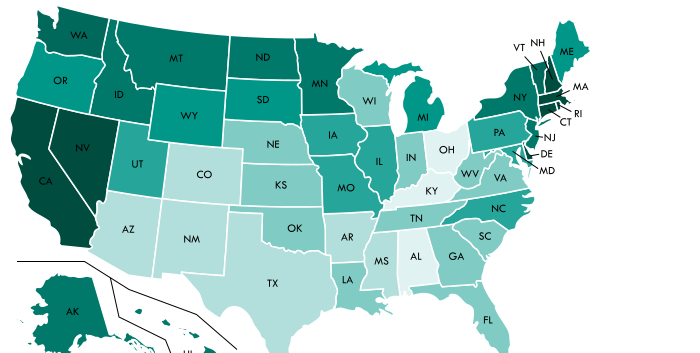
Most common states for video specialists
| Rank | State | Population | # of jobs | Employment/ 1000ppl |
|---|---|---|---|---|
| 1 | District of Columbia | 693,972 | 157 | 23% |
| 2 | Iowa | 3,145,711 | 269 | 9% |
| 3 | Delaware | 961,939 | 74 | 8% |
| 4 | Alaska | 739,795 | 56 | 8% |
| 5 | Massachusetts | 6,859,819 | 456 | 7% |
| 6 | Nebraska | 1,920,076 | 140 | 7% |
| 7 | North Dakota | 755,393 | 56 | 7% |
| 8 | Wyoming | 579,315 | 41 | 7% |
| 9 | North Carolina | 10,273,419 | 570 | 6% |
| 10 | Virginia | 8,470,020 | 505 | 6% |
| 11 | Maryland | 6,052,177 | 362 | 6% |
| 12 | Vermont | 623,657 | 40 | 6% |
| 13 | New York | 19,849,399 | 942 | 5% |
| 14 | Minnesota | 5,576,606 | 273 | 5% |
| 15 | Oregon | 4,142,776 | 199 | 5% |
| 16 | Utah | 3,101,833 | 169 | 5% |
| 17 | Idaho | 1,716,943 | 81 | 5% |
| 18 | Hawaii | 1,427,538 | 77 | 5% |
| 19 | New Hampshire | 1,342,795 | 73 | 5% |
| 20 | Montana | 1,050,493 | 55 | 5% |
Most common cities for video specialists
| Rank | City | # of jobs | Employment/ 1000ppl | Avg. salary |
|---|---|---|---|---|
| 1 | Oak Ridge | 1 | 3% | $46,858 |
| 2 | Carlsbad | 1 | 1% | $64,905 |
| 3 | Miami Beach | 1 | 1% | $46,432 |
| 4 | Atlanta | 1 | 0% | $46,124 |
| 5 | Boston | 1 | 0% | $69,248 |
| 6 | Jacksonville | 1 | 0% | $46,380 |
| 7 | Los Angeles | 1 | 0% | $67,119 |
| 8 | New Orleans | 1 | 0% | $46,980 |
| 9 | Orlando | 1 | 0% | $46,103 |
| 10 | San Diego | 1 | 0% | $64,380 |
| 11 | Washington | 1 | 0% | $70,112 |
| 12 | Wichita | 1 | 0% | $45,185 |
Video Specialist job outlook: Expert opinions
Our panel of video specialist experts
Olympic College

Duquesne University

California Baptist University
Cedar Crest College

California Lutheran University

Andrews University
West Virginia State University

Iowa State University
Heidelberg University
WorldatWork
What Video Specialist skills would you recommend for someone trying to advance their career?
Paul Runyon Sr.: The field of photography has seen massive changes in the past decade and there will be many more changes that dictate that anyone entering the field continue to hone their skills in as many different areas as possible. The role of photographers has expanded far beyond the capture of still images and having a good working knowledge of the ever-expanding technology will help starting photographers to capture as much work as possible.
Digital Editing and Post-Processing:
Video and Motion Production:
Animation
Drone Photography
Virtual Reality (VR) and Augmented Reality (AR):
Data Analytics and SEO
Remote Collaboration and Communication
Business and Marketing Skills:
Amy Hesketh
Full Time FacultyOlympic College
Social Sciences & Humanities (SSH) Division
What skills stand out on Video Specialist resumes?
Amy Hesketh: Ability to work with a variety of editing software (Avid, Adobe Premiere Pro/Audition, Resolve). Screenwriting and story development.
What skills will help Video Specialists earn the most?
Amy Hesketh: -Certification in DaVinci Resolve.
-Motion graphics.
-Ability to create a finished, professional video from script to screen.
What skills stand out on Video Specialist resumes?
Dr. Mike Dillon: Evidence (courses, internships, other experience) that demonstrates competence in communicating with a wide array of audiences across multiple platforms. Our journalism program, for instance, is multiplatform: students learn to write, edit, shoot video, create podcasts, adapt stories to fit the requirements of multiple platforms, etc. Basically, we want to send students out of here like Swiss Army Knives -- able to work in their area of proficiency, be that writing or videography, but also adept with a wide variety of other competencies.
What hard/technical skills are most important for Video Specialists?
Dr. Mike Dillon: Media is about storytelling -- whether it's an ad, a social media campaign, a magazine story, etc. Being able to use the tools of your trade, whatever they may be -- algorithms, editing suites, etc. The most important skill, though, is understanding the essence of those tools -- what is they are intended to accomplish. If you understand that, you can easily adapt when tools change -- which they frequently do.
What experience really stands out on Video Specialist resumes?
MaryAnn Pearson: Resumes that include work with student publications (newspapers, magazines, and yearbooks) and links to published articles stand out. Students who have participated in internships also stand out as they show experience.
What experience really stands out on Video Specialist resumes?
Dr. Jill Purdy: "This is partially answered previously. I think students found time to be more self-reliant and independent. Hopefully, not to a fault as they move into their careers.
On resumes, we may see more of the soft skills described. It may sound counterintuitive, but I think a different kind of interpersonal skill was developed. On a Zoom call, what do we have but people and we have to figure out how to get our message across, collaborate, debate, and communicate effectively without extraneous factors. "
What type of skills will young Video Specialists need?
Dr. Gerhard Apfelthaler Ph.D.: The pandemic's one good thing is that recent graduates will have learned to be flexible, agile, and resilient. These are skill sets that will remain invaluable for companies in the future. Companies will need graduates who are creative problem-solvers and excellent communicators. But it's undoubtedly also crucial that everyone develops strong skillsets around data, which is the most important currency of the economy these days.
What experience really stands out on Video Specialist resumes?
Dr. Gerhard Apfelthaler Ph.D.: I would say this is dependent on the type of company or industry. If graduates from big, national, or international employers, it is essential to make it past the artificial intelligence filters. These companies get thousands of resumes weekly, so everything that makes an applicant unique - internships with other large, recognizable companies, projects that show deep subject matter expertise - helps. For smaller, regional companies, it is probably more important to show that one is part of a community and has good networking skills.
What general advice would you give to a Video Specialist?
Kimberly Pichot: If connections were meaningful before, now they are more than crucial. Find ways to connect with marketing professionals, join the American Marketing Association, and join a local chapter. Take the time to build a strong portfolio, develop your brand, and stay out there, no matter how hard it is. And consider starting a side hustle that utilizes your most treasured part of marketing - starting and running a small business while you job hunt will give you some extra skills and push you to new levels.
Dr. Ali Ziyati Ph.D
ProfessorWest Virginia State University
Department of Communications & Media Studies
Will there be an enduring impact of the coronavirus pandemic on Video Specialists?
Dr. Ali Ziyati Ph.D: Graduates are also citizens of the world. This is a global pandemic, and we are all in it. Given the political economy of the coronavirus, many organizations are going through tough times. There will be fewer job opportunities for all graduates. The field of communication, on the other hand, maybe an exception. We learned it the hard way. We had to stay home, work, teach, and learn remotely. We filled our long days with entertainment, games, etc. We shared moments with family and loved ones virtually. The opportunities for internet-based media are endless. The essential item I retain from this experience is that media and communication technologies are central and our graduates.
What type of skills will young Video Specialists need?
Dr. Ali Ziyati Ph.D: Media and technology literacy is of utmost importance. In communication and media studies at West Virginia State University, we do everything we can to provide our graduates with media literacy skills: video, audio, film, public relations, graphic design, etc. In general, graduates have to be excellent in computer and internet-based communication in terms of production and media content distribution. Specific skills include, but are not limited to, graphic design, editing, writing, research, and data analysis.
What experience really stands out on Video Specialist resumes?
Dr. Ali Ziyati Ph.D: The nature of practical experiences and where they took place always stand out in any resume. I would pay close attention to the academic aspect and align with those practical experiences to see the level of the candidate's planning, performance, and dedication to his/her dream job.
Geoffrey Sauer Ph.D.
Associate Professor; Director, ISU English Undergraduate Studies; Director, ISU Studio for New MediaIowa State University
Department of English
What are the biggest trends we'll see in the Video Specialist job market given the pandemic?
Geoffrey Sauer Ph.D.: Today, my students are quite experienced with precarity, a word that's become popular this year (which refers to environments dominated by precarious conditions). This means that many are well-suited to changing circumstances and varying methods of working on teams. Though the high unemployment rate in the US-led to reduced job listings last summer, employers have told me that they've been very impressed with the students they do hire. Many established workers have little experience with different ways to manage distance collaboration. Still, full-time students graduating this December will have had at least 10-12 courses, and those graduating next May will have had at least 15-18 courses taught online (or mostly online). This means new graduates will have had more diverse experiences with collaboration in remote teams under different professors/supervisors, which will allow them to see an extensive range of leadership styles and techniques to manage people working together at a distance. Distance collaboration is here to stay, and today's students will have superior skills and diverse experience working in such environments.
Nathan Cutietta
Director of the Gaming, Esports & Media, Assistant Professor of Communication and MediaHeidelberg University
Communication & Media Department
Are there any particularly good places in the United States for Video Specialists to find work opportunities?
Nathan Cutietta: The job market in Texas seems to be booming in the United States. To be successful, a graduate should be willing to go where the opportunity is. Sometimes the places with the worst economic problems have the most effective options for someone with a specialized skill, since no one wants to live there.
What general advice would you give to a Video Specialist?
Steve Boddy: Graduates should expect fewer full-time employment opportunities. In some cases these opportunities will be accompanied by enhanced well-being benefits but lower salaries. There may be more contract and seasonal opportunities in the short term, which typically will not offer highly valued benefits like health insurance, retirement, and paid time off.
Full-time employment opportunities and competitive hiring wages are expected in high growth industries like technology, health care, logistics and distribution, and other essential jobs. These are most often accompanied with full benefits, which most recently has included increased offerings in well-being, remote work opportunities, and flexible schedules. However, most other organizations will offer fewer full time employment opportunities and potentially lower wages in job offers (due to supply of jobs and abundance of grads). Other reasons for downward pressure on salaries may include the graduates willingness to accept lower rates in favor of the option to work from home or desired geography. Lastly, more college grads are taking seasonal/contract roles, and may miss out on critical benefit offerings that are reserved for employees only (which often account for ~25 - 35% of their total rewards package).
So why does it matter? In all likelihood, new graduates may not start on the career path they envisioned for themselves, and will likely see slower wage growth over time. According to the WorldatWork 2020-2021 Salary Budget Survey released in August of this year, "The national total salary budget increase average fell this year - dropping to 2.9% - notably sudden, and somewhat expected, due to economic uncertainty. This decline represents a pronounced departure from the anticipated increase to 3.3% projected for 2020 a year ago." This is a tough time to be entering the workforce. The key is to be flexible in their job search. Graduates may have to sacrifice some benefits like healthcare and retirement in order to get "their foot in the door." The current reality is new college graduates are facing the worst job market in over a decade with more competition and lower salaries.